Navigating the Spring-to-Summer HVAC Transition: A Safe Homeowner's Maintenance Guide
Why do HVAC systems fail on the first 80-degree day? See what belongs on your seasonal home maintenance checklist and when to call a pro before summer hits.



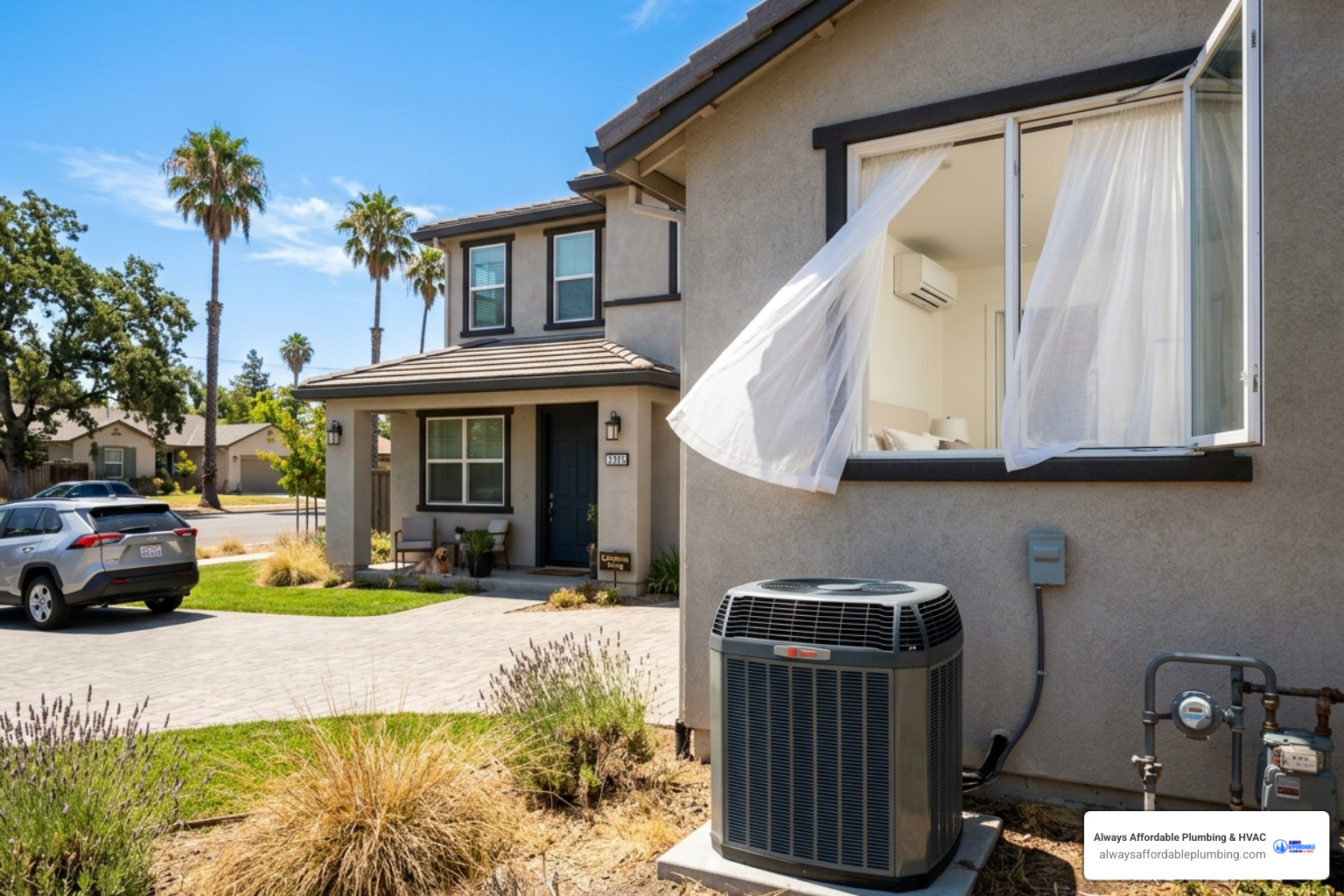
Central air vs mini split for the Sacramento area homes is one of the most common HVAC decisions local homeowners face — and the right answer depends on your home's size, age, ductwork, and how you use your space.
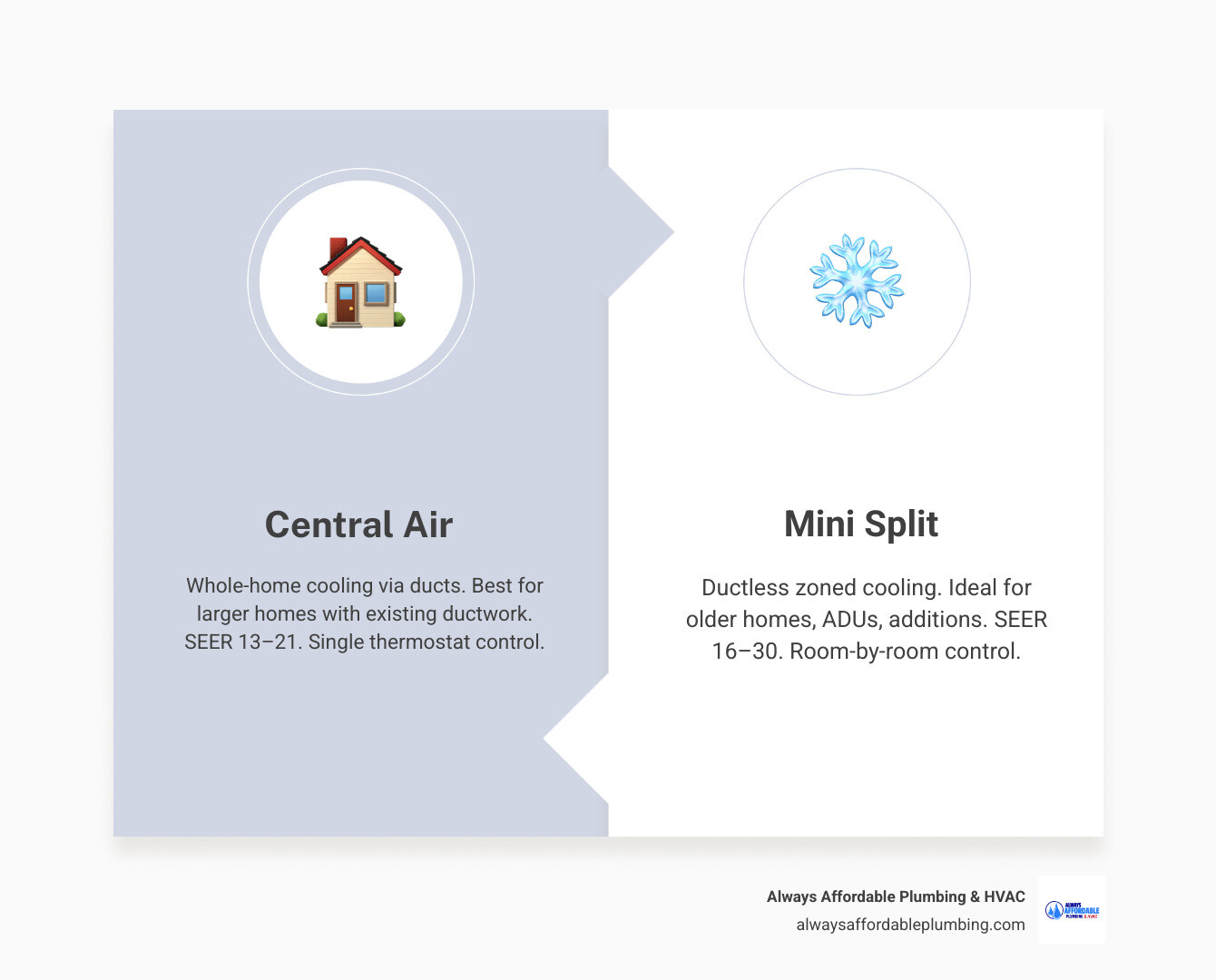
Here's a quick breakdown to help you decide:
• Best for — Central Air: Larger homes with existing ductwork — Mini Split: Homes without ducts, ADUs, additions
• Energy efficiency — Central Air: SEER 13–21 — Mini Split: SEER 16–30
• Zoning — Central Air: Single thermostat — Mini Split: Room-by-room control
• Installation — Central Air: Complex if no ducts exist — Mini Split: Faster, less invasive
• Wildfire smoke — Central Air: Depends on filter quality — Mini Split: Better sealed filtration
• Sacramento heat waves — Central Air: Reliable whole-home cooling — Mini Split: Inverter tech handles extreme heat well
Sacramento summers are no joke. Temperatures regularly climb past 100°F, and the region has recorded a staggering 116°F. When your cooling system becomes a daily necessity from June through September — not a convenience — choosing the wrong setup costs you real money and real comfort. On top of that, wildfire smoke seasons add another layer of concern around indoor air quality that your AC system needs to address.
Whether you're cooling a 1950s bungalow in East Sacramento, adding climate control to a backyard ADU, or simply replacing an aging system, understanding how these two technologies perform in the Central Valley's specific climate is the smartest place to start.
When we talk about central air vs mini split for the Sacramento area homes, we are essentially comparing two different philosophies of comfort. One is a "whole-house" approach, while the other is a "targeted" approach.
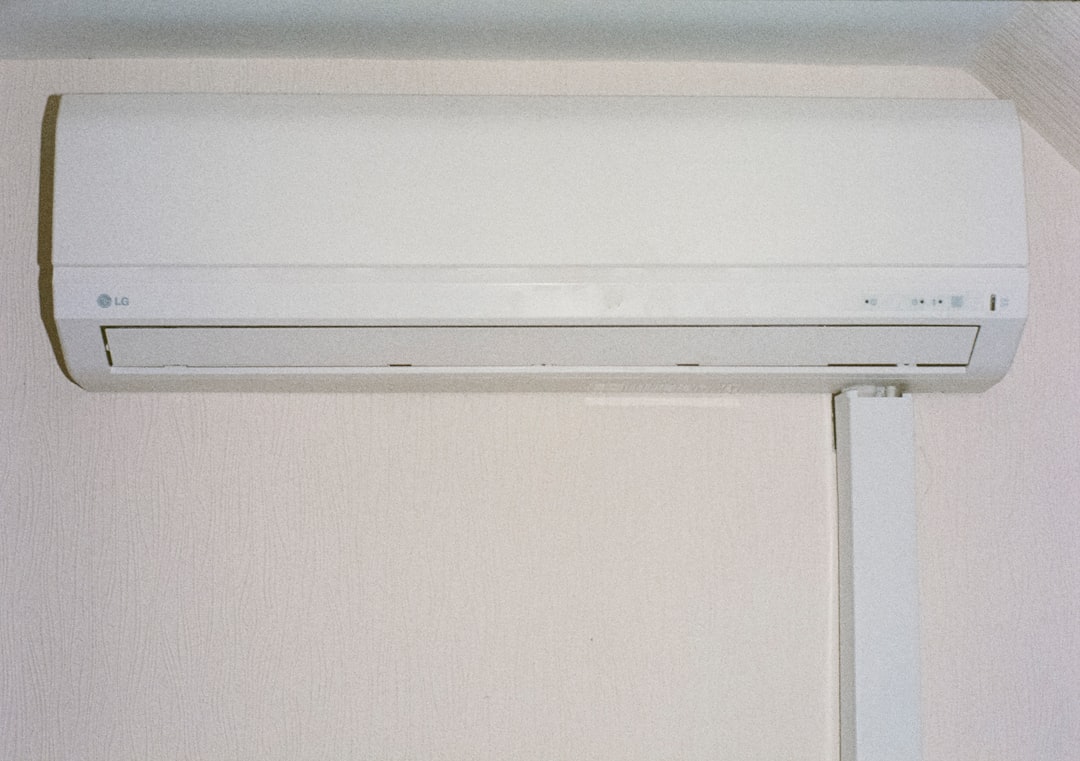
A traditional HVAC system relies on a large outdoor condenser and an indoor air handler usually tucked away in a closet or attic. This system uses a network of ducts to push air into every room. On the other hand, a Mini Split system is often referred to as Ductless. It consists of an outdoor compressor connected to one or more indoor air handlers via small refrigerant lines. These indoor units are mounted directly on the walls or ceilings of the rooms they cool.
For many of us in the Sacramento Valley, central Air Conditioning has been the standard for decades. It works by pulling warm air from your home, cooling it over a set of coils, and then blowing it through a central blower into your ductwork.
The primary advantage of this system is uniformity. When you set your single thermostat to 74°F, the system works to bring the entire house to that temperature. This is ideal for larger, open-concept homes where you want a consistent feel from the kitchen to the master bedroom. However, it requires a robust network of ducts. If your home is older and doesn't have these, installing them can feel like "open-heart surgery" on your house. Our HVAC Services team often sees central units paired with gas furnaces, providing a complete year-round solution for our chilly, damp winters and scorching summers.
Mini splits are the rising stars of the Sacramento cooling scene. Instead of one giant blower, you have individual units in specific rooms. The "secret sauce" of the mini split is inverter technology. Unlike traditional systems that are either 100% "on" or "off," a mini split’s compressor can vary its speed.
Imagine driving a car: a central AC is like flooring the gas until you hit 60 mph, then slamming on the brakes until you drop to 55 mph. A mini split is like using cruise control to maintain a steady speed. This results in incredibly precise temperature control and massive energy savings. Because they don't use ducts, they avoid the common energy losses associated with leaky or poorly insulated ductwork in hot attics.
• Distribution — Central Air: Ducts & Vents — Mini Split: Individual Air Handlers
• Control — Central Air: Single Thermostat — Mini Split: Multi-Zone Thermostats
• SEER Rating — Central Air: 13–21 — Mini Split: 16–30+
• Installation — Central Air: Invasive (if adding ducts) — Mini Split: Minimal (3-inch wall hole)
Sacramento’s climate is unique. We deal with "microclimates" where the temperature in Roseville might be five degrees higher than in Davis. During a heat wave, your AC isn't just a luxury; it’s a safety requirement.
Mini splits are particularly adept at handling extreme heat because of their variable-speed compressors. While a central AC might struggle to keep up when it hits 110°F outside, a mini split can adjust its output to maintain comfort without "short-cycling." Furthermore, because mini splits function as a Heat Pump, they are incredibly efficient at keeping you warm during our occasionally frosty winters by simply reversing the refrigerant cycle.
One of the biggest concerns for Sacramento residents in recent years has been indoor air quality (IAQ) during wildfire season. When the Valley fills with smoke, your HVAC system is your first line of defense.
Central air systems rely on the filter in your return air vent. If your ducts are leaky (which many are), smoke and pollutants can actually be sucked into the system from your attic or crawlspace and blown into your living areas. Mini splits offer a "sealed" advantage. Since there are no ducts running through unconditioned spaces, there is less opportunity for outside air to infiltrate the system. Many modern mini split units also feature advanced multi-stage filtration that can capture smaller particles, providing a literal breath of fresh air when the sky turns orange.
With California’s high electricity rates, efficiency is everything. Mini Split AC Sacramento CA systems are legendary for their SEER (Seasonal Energy Efficiency Ratio) ratings. While a standard central unit might top out at a SEER of 21, mini splits can soar past 30.
This efficiency translates to lower monthly bills. Many homeowners in our area report 20% to 40% reductions in cooling costs after switching to a ductless setup. Additionally, there are significant financial incentives available. Between SMUD rebates, federal tax credits via the Inflation Reduction Act, and various California energy incentives, the "net" cost of an upgrade is often much lower than people expect.
For those of us with solar panels — a common sight from Elk Grove to Rocklin — mini splits are a perfect match. Their low power draw and ability to integrate with smart home systems make them ideal for maximizing your solar investment and navigating "time-of-use" utility plans.
The debate of central air vs mini split for the Sacramento area homes often comes down to the specific structure of the house.
If you live in a beautiful 1920s bungalow in Land Park or a mid-century home in Carmichael, you might not have the space for bulky ductwork. Cutting into lath-and-plaster walls or original hardwood ceilings is a nightmare. A Mini Split Installation Sacramento CA is the perfect solution here. We only need a small three-inch hole to connect the indoor and outdoor components, preserving the architectural integrity of your home.
Sacramento has seen a boom in Accessory Dwelling Units (ADUs). For a standard 749 sq ft 2-bedroom, 2-bathroom ADU, we almost always recommend a multi-zone mini split. Why? Because a central AC for a space that small is often "overkill." It requires taking up precious square footage for a mechanical closet and duct runs. With two or three mini split heads, the occupants can keep the living room cool during the day and only cool the bedrooms at night, which is much more efficient for a compact footprint.
With more people working from home in places like Folsom and Rancho Cordova, we see many garage-to-office conversions. Extending central ductwork to a garage is often expensive and inefficient. A single-zone mini split provides independent climate control, so you aren't paying to cool the whole house just to stay comfortable in your office.
We’ve all been there: the upstairs bedroom that feels like a sauna while the downstairs living room is a walk-in freezer. This is the classic "thermostat battle."
Central air systems usually have one thermostat. If it’s downstairs, the upstairs stays hot. If you move it upstairs, the downstairs gets too cold. Mini splits solve this through true zoning. Each indoor unit has its own thermostat. You can set the nursery to a perfect 72°F, the home office to 68°F, and turn off the unit in the guest room entirely. This level of Services allows for customized comfort while ensuring you aren't wasting energy on unoccupied rooms.
Maintenance requirements differ slightly between the two systems, but both are essential for longevity in our dusty Valley environment.
• Central Air Maintenance: Requires annual Mini Split Service Sacramento CA (yes, we service both!) to check refrigerant levels, clean the outdoor coils, and—most importantly—inspect the ductwork. Over time, ducts can leak, losing 20-30% of your conditioned air into the attic.
• Mini Split Maintenance: These units have filters that need to be rinsed every few weeks during heavy use. Because the units are inside the room, it's a simple DIY task: pop the panel, rinse the filter, and snap it back in. Annual professional deep cleaning of the indoor blowers is also recommended to prevent dust buildup.
In the Sacramento real estate market, central air is often seen as a "must-have" for traditional buyers. It offers familiarity and "curb appeal" because the components are hidden. However, as energy costs rise, mini splits are becoming a major selling point. Savvy buyers in areas like Davis or Granite Bay specifically look for high-efficiency ductless systems because they know the long-term utility savings are substantial. A well-installed mini split system is a permanent home improvement that adds tangible value to your property.
When it comes to noise, the mini split wins by a landslide. Traditional central systems often have a loud "clunk" when the compressor kicks on, and you can hear the rush of air through the vents. Mini splits are designed to be "whisper-quiet," operating in the 19-30 decibel range. For context, 20 decibels is about the sound of rustling leaves. This makes them ideal for nurseries, home offices, or for light sleepers who don't want to be jolted awake by their AC.
Yes! Modern mini splits are "heat pumps," meaning they can move heat in both directions. In the summer, they move heat from inside your home to the outside. In the winter, they pull heat from the outside air (even when it's cold!) and move it inside. They are significantly more efficient than traditional electric baseboard heaters or even some older gas furnaces, providing year-round comfort for Sacramento’s varied seasons.
Leaky ducts are the silent "thieves" of your home's efficiency. According to industry data, the average ducted home loses 20% to 30% of its conditioned air through leaks, holes, and poor connections. In Sacramento, where attics can reach 140°F in July, that cool air is being wasted before it ever reaches your living room. By choosing a ductless mini split, you eliminate this problem entirely, ensuring that 100% of the air you pay to cool actually stays in your home.
Choosing between central air vs mini split for the Sacramento area homes isn't about finding the "best" system; it's about finding the best system for your lifestyle and your home.
If you have a large, newer home with high-quality ductwork, a high-efficiency central AC upgrade might be your best bet. But if you’re looking to solve a "hot room" problem, cooling an ADU, or living in a classic Sacramento home without ducts, the flexibility and efficiency of a mini split are hard to beat.
At Always Affordable Plumbing & HVAC, we pride ourselves on helping our neighbors in Elk Grove, Roseville, Folsom, and throughout the Sacramento area find the perfect balance of comfort and affordability. We live here, we work here, and we know exactly what it takes to keep a home cool when the Valley heat turns up.
Experience the benefits of a ductless system in your Sacramento home today by reaching out to our team for a personalized consultation. Whether it's a quick repair or a full system overhaul, we're here to ensure your home remains your sanctuary, no matter how high the mercury climbs.
See what our satisfied customers have to say about their experience with Always Affordable
Plumbing & HVAC.

"Chappy was very skilled in his knowledge of my HVAC unit. I greatly appreciate the quick response and experienced tech. The whole endeavor was made less stressful by his humor and honest conversation. I find comfort in knowing I now have a shop i trust for the next time."
"Tony, James, Ronnie did an amazing job setting up our new AC! They were quick, efficient, considerate, and polite! We appreciate them scheduling us in on such short notice. Definitely recommend this company!"
"Prompt, professional service with kindness and care. They came out to address both plumbing and AC issues. I received a courtesy call before they arrived. All issues were resolved the same day with integrity and respect. Thankful for businesses like this. Absolutely recommend to those that I love."
"Excellent service! Jason came out promptly and in addition to doing my outside faucet he also put in new irrigation equipment! All done perfectly! Jason was lovely"
"Honest with the assessment; friendly and good manners. No high pressure sales. Just good to honest "tell it like you see it" Thought my kitchen disposer needed an overhaul. But Jason, there Plumber gave me an honest lesson on what was really happening. Saved me hundreds, if I went the route of replacing. Thank you!"
"Absolutely 5 stars. If you are looking for affordable ,professional and kind. Chappy was excellent and very knowledgeable . I called in the morning because my air conditioner stopped working he was here within hours and fixed my air with a smile. I highly recommend Chappy and Always Affordable plumbing and Hvac."
"Scott and James were great. They got there quickly and diagnosed the problem with my A/C.They did a very thorough job testing everything. Sent me pictures and called to keep me informed. Got it done the next day and everything is working fine. Be glad when I get home so I can enjoy my new system. Thanks guys for a great job."
"Chappy was very helpful. He knew our issue right away, cleaned our coils. He also came on the same day we called and got our AC blowing cold air again."
"After some timing ’curfuffles’ the Tech Jason arrived and not only completed a speedy install on my toilet, he was personable & professional. Because of the timing issues Jason was attentive and showed up with everything needed! No extra store runs 😊 I was very comfortable with having this Tech in my Daughter’s home. We will definitely use this Service again."