Options Comparisons for Homeowners: Evaluating Heat Pump vs. Gas Furnace Infrastructure
Evaluating a heat pump vs gas furnace? Use our options comparisons for homeowners to check your electrical and ductwork readiness. Decide with confidence.


That sinking feeling usually hits right in the middle of a brutal heat wave. Your air conditioning is running nonstop, you can hear the blower motor working hard, but the house still feels uncomfortably warm. When you hold your hand up to the register, you realize the system is blowing tepid air. Figuring out what to do next requires effective home maintenance tips and troubleshooting, so you can quickly determine whether you are dealing with a minor airflow hiccup or a major mechanical failure.
The most important concept for a homeowner to understand in this high-stress moment is system triage. Triage means identifying what you can safely check yourself versus what requires immediate expert intervention. If a pipe suddenly bursts behind your drywall, you would not start tearing down the framing; you would immediately seek out professional plumbing services to stop the damage. The same logic applies to your heating and cooling equipment. There is a definitive line between basic, safe upkeep and hazardous repair work.
To navigate this boundary safely, our technicians at Always Affordable Plumbing & HVAC rely on a specific diagnostic measurement: the thermostat temperature differential. This simple reading tells you exactly how well your equipment is extracting heat from your indoor air. By understanding how this metric works, you can avoid panicking over a simple clogged filter while simultaneously protecting yourself from attempting dangerous electrical or refrigerant repairs. The goal is to gather objective data about your system's performance before you pick up the phone, ensuring you make the smartest possible decision for your home.
When evaluating why a system is struggling, you have to factor in the environment where it operates. In our years of serving the Sacramento area and throughout the Central Valley, we have seen firsthand how the local climate places an immense, sustained load on mechanical cooling systems. With extreme summer heat frequently pushing temperatures well past the triple-digit mark, your equipment is forced to operate at maximum capacity for weeks on end. During these peak heat waves, the system has absolutely zero margin for error.
Furthermore, this region's notoriously dry, dusty climate and surrounding agricultural operations create a unique hazard for HVAC equipment. Dust, pollen, and airborne agricultural debris from harvest seasons circulate heavily in the air. As a result, indoor air filters and outdoor condenser coils tend to clog much faster here than the national average. A filter that might last three months in a milder, wetter climate can become completely impacted in just a few weeks during a Central Valley summer.
When this debris restricts airflow, it immediately compromises the system's ability to transfer heat. This restriction causes a direct, measurable drop in your thermostat temperature differential. The system is still consuming electricity and running the blower, but the lack of adequate air volume prevents the cooling cycle from completing. In extreme climates, our team always stresses that frequent, proactive maintenance checks are simply non-negotiable. Ignoring minor airflow restrictions in this environment rapidly escalates into complete system failures, leaving you stranded without cooling when you need it most.
Before you assume the worst about your equipment, you need to verify that it is actually receiving enough air to function. The very first diagnostic step in any cooling failure is to locate and inspect your indoor air filter. This is a safe, foundational check that every homeowner should master.
1. Turn off the system: Always switch your thermostat to the "off" position before pulling the filter to prevent loose dust from being sucked directly into the sensitive blower motor.
2. Locate the filter housing: This is typically found behind a return air grille in a hallway, in the ceiling, or directly on the side of the indoor air handler in your garage or attic.
3. Inspect the media: Pull the filter out and hold it up to a light source. If you cannot see light passing through the pleats, the filter is completely clogged and must be replaced immediately.
4. Check return grilles: Ensure that no heavy furniture, thick rugs, or curtains are blocking the return air vents inside your home, which can artificially choke the system.
5. Install a fresh filter: Ensure the arrows on the new filter's frame point toward the equipment, aligning with the natural direction of airflow.
According to data from the U.S. Department of Energy, replacing a dirty, clogged filter with a clean one can lower your air conditioner's energy consumption by 5% to 15%. But beyond energy savings, the mechanical relationship is critical. A blocked filter literally starves the system of air. Without enough warm indoor air blowing across the indoor evaporator coil, the coil gets too cold. The condensation on the coil then freezes into a solid block of ice, blocking airflow entirely and causing the system to blow warm air. Often, simply restoring proper airflow by changing the filter is enough to correct an abnormal thermostat temperature differential and get the system cooling again.
Airflow matters just as much outside as it does inside. The outdoor unit (the condenser) is responsible for releasing the heat that was removed from your home. If it cannot breathe, your house will not cool down.
• Clear the perimeter: Ensure the outdoor unit is completely free of debris, fallen leaves, and overgrown vegetation. There should be at least two feet of clear space around the entire unit to allow for proper air circulation.
• Inspect the fins: Look at the delicate metal fins on the outside of the unit. If they are blanketed in dust, cottonwood seeds, or pet hair, the system cannot effectively exhaust heat.
• Understand the impact: Blocked condenser coils trap heat inside the refrigerant loop. If the heat cannot escape outside, the system cannot absorb more heat from inside your house, leading directly to warm air blowing from your vents.
Once you have confirmed that the air filter is clean and the outdoor unit is clear of debris, the next step is to gather objective data about your system's performance.
The Problem: Your system is running, but you cannot tell if it is actually cooling the air or just moving warm air around the house. Relying on how the air "feels" on your hand is subjective and often misleading, leading to unnecessary panic or delayed action.
The Cause: To know definitively if the mechanical cooling cycle is working, you need to measure the thermostat temperature differential. This is the exact temperature difference between the warm return air going into the system and the conditioned supply air coming out of the vents.
The Solution: You can safely take this reading using a standard digital probe thermometer, such as a clean cooking thermometer.
1. Turn the system on and let it run for at least 15 minutes to stabilize the cooling cycle.
2. Insert the thermometer into the return air grille (where the filter is located) and record the temperature.
3. Insert the same thermometer into the closest supply register (vent) to the indoor unit and record that temperature.
4. Subtract the supply temperature from the return temperature to find your differential.
A healthy standard differential should typically read between 14 and 20 degrees Fahrenheit. For example, if the air going in is 78 degrees, the air coming out should be between 58 and 64 degrees.
• 14 to 20 Degrees Fahrenheit — System Status: Healthy Cooling Cycle — Recommended Action: Monitor system; ensure filters remain clean.
• 10 to 13 Degrees Fahrenheit — System Status: Underperforming — Recommended Action: Check for dirty filters, blocked vents, or dusty outdoor coils.
• Below 10 Degrees Fahrenheit — System Status: Mechanical Failure — Recommended Action: Stop DIY troubleshooting and contact a professional immediately.
If your differential is significantly lower than 14 degrees after you have changed the filter and cleared the outdoor unit, the issue is beyond basic airflow and requires expert attention.
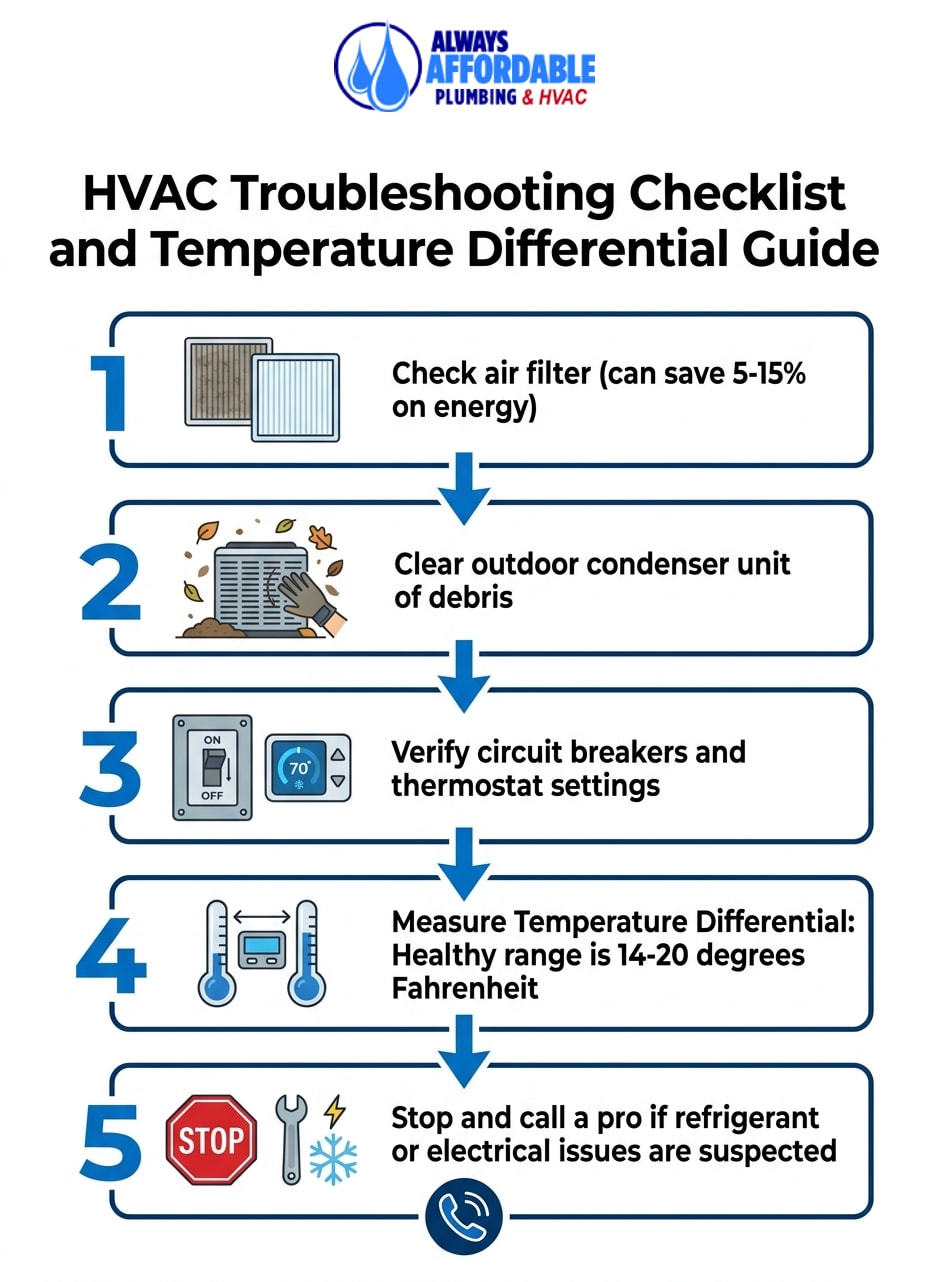
There is a hard boundary in home maintenance where safe DIY troubleshooting ends and legally required professional intervention begins. If you have confirmed that your air filter is clean, the circuit breakers are properly set, and your thermostat temperature differential remains critically low, it is time to stop and call an expert.
Never attempt dangerous repairs yourself. Handling high-voltage electrical components or tapping into pressurized refrigerant lines requires specialized licensing, training, and equipment. Attempting to recharge refrigerant yourself is not only illegal under environmental regulations, but it is also highly dangerous. Furthermore, modern HVAC systems contain complex electrical capacitors and contactors that hold lethal electrical charges even when the main power is switched off at the breaker.
When a system fails despite good airflow, you are typically looking at professional-level failures. These include slow refrigerant leaks, a failing compressor, frozen evaporator coils, or complex electrical faults in the control board. Continuing to run a system with a severe mechanical issue can destroy the compressor, turning a manageable repair into a complete, premature system replacement.
Transitioning to a professional diagnostic is the safest and most cost-effective decision at this stage. You might worry about the expense of a sudden service call, but working with our established team at Always Affordable Plumbing & HVAC means you benefit from transparent pricing and a 100% satisfaction guarantee. This removes the guesswork and anxiety from the process. Just as you would schedule an emergency plumber when a pipe bursts, bringing in our licensed HVAC technicians ensures the root cause of your warm air issue is resolved safely and permanently.
Understanding how to establish diagnostic thresholds applies to all critical home systems, not just your heating and cooling equipment. Whether you are dealing with a failing AC compressor in the dead of summer or a severe plumbing backup in the middle of winter, both situations require immediate, professional triage to prevent escalating damage.
Consider the parallels between these major systems. A frozen evaporator coil requires the exact same urgency and professional expertise as main sewer line clearing. In both cases, the underlying infrastructure of your home has failed, and delaying professional help only makes the damage worse. For instance, ignoring a low thermostat temperature differential can permanently burn out a blower motor, just as ignoring a slow drain can lead to catastrophic water damage. If you are curious about the cascading effects of neglected plumbing, understanding what happens when you leave a waste-clogged toilet overnight provides a stark warning about the severe risks of procrastination.
Real-world emergencies rarely happen at convenient times. We see this all the time at Always Affordable Plumbing & HVAC. One local homeowner experienced this firsthand when they woke up on a cold winter morning to a severely backed-up sewer line. Realizing the situation was far beyond a standard plunger, they made an emergency morning call to our team. Our technicians arrived within a few hours, provided a clear and upfront quote, and persistently worked to clear the complex clog without giving up. They successfully restored flow to the home and provided useful future maintenance options to prevent a recurrence.
This scenario perfectly illustrates the value of knowing your limits as a homeowner. When you hit the hard boundary of DIY maintenance—whether it is a backed-up sewer line or an air conditioner blowing warm air—calling in licensed professionals ensures your home is protected, comfortable, and safe.
Your AC may blow warm air if there is a severe restriction in airflow or a mechanical failure in the cooling cycle. The most common culprits are completely clogged air filters, frozen indoor evaporator coils, or a lack of heat transfer at the outdoor condenser unit. If the system is starved of air, it cannot properly condition the space, resulting in tepid air coming from your vents.
The safest first step is to turn the system off and replace any dirty indoor air filters. Next, ensure the outdoor condenser unit is clear of leaves, debris, and overgrown vegetation so it can release heat properly. If restoring proper airflow does not fix the issue, you must call a licensed professional to check for complex electrical faults or refrigerant leaks.
Yes, a severely dirty filter can entirely stop your air conditioning from cooling your home. A clogged filter blocks warm indoor air from reaching the evaporator coil, causing the condensation on the coil to freeze into solid ice. Once the coil freezes, airflow is completely blocked, and the system will only blow warm air until the ice melts.
You should call a professional if you have already changed your air filter, checked your circuit breakers, and your system is still blowing warm air. Additionally, if you notice ice forming on the indoor coil or the outdoor refrigerant lines, turn the system off immediately and call an expert. Never attempt to handle high-voltage electrical components or pressurized refrigerant lines yourself.
A healthy thermostat temperature differential should typically fall between 14 and 20 degrees Fahrenheit. This measurement represents the exact temperature difference between the warm return air entering your system and the cooled supply air blowing out of your vents. Consistently reading below 14 degrees indicates that your system is underperforming and requires mechanical maintenance.
You can safely measure this difference by using a standard digital probe thermometer while the system is running. Insert the thermometer into the return air grille to get your baseline temperature, then take a second reading at the closest supply register. Subtract the supply temperature from the return temperature to calculate your system's current cooling differential.
Dealing with an HVAC system that suddenly stops cooling can be stressful, but having a clear checklist of safe, basic troubleshooting steps puts you in control. By checking your filters and measuring your thermostat temperature differential, you can confidently determine the definitive threshold for when to call a licensed professional. At Always Affordable Plumbing & HVAC, our goal is to ensure your home stays safe and comfortable all season long.
See what our satisfied customers have to say about their experience with Always Affordable
Plumbing & HVAC.

"Chappy was very skilled in his knowledge of my HVAC unit. I greatly appreciate the quick response and experienced tech. The whole endeavor was made less stressful by his humor and honest conversation. I find comfort in knowing I now have a shop i trust for the next time."
"Tony, James, Ronnie did an amazing job setting up our new AC! They were quick, efficient, considerate, and polite! We appreciate them scheduling us in on such short notice. Definitely recommend this company!"
"Prompt, professional service with kindness and care. They came out to address both plumbing and AC issues. I received a courtesy call before they arrived. All issues were resolved the same day with integrity and respect. Thankful for businesses like this. Absolutely recommend to those that I love."
"Excellent service! Jason came out promptly and in addition to doing my outside faucet he also put in new irrigation equipment! All done perfectly! Jason was lovely"
"Honest with the assessment; friendly and good manners. No high pressure sales. Just good to honest "tell it like you see it" Thought my kitchen disposer needed an overhaul. But Jason, there Plumber gave me an honest lesson on what was really happening. Saved me hundreds, if I went the route of replacing. Thank you!"
"Absolutely 5 stars. If you are looking for affordable ,professional and kind. Chappy was excellent and very knowledgeable . I called in the morning because my air conditioner stopped working he was here within hours and fixed my air with a smile. I highly recommend Chappy and Always Affordable plumbing and Hvac."
"Scott and James were great. They got there quickly and diagnosed the problem with my A/C.They did a very thorough job testing everything. Sent me pictures and called to keep me informed. Got it done the next day and everything is working fine. Be glad when I get home so I can enjoy my new system. Thanks guys for a great job."
"Chappy was very helpful. He knew our issue right away, cleaned our coils. He also came on the same day we called and got our AC blowing cold air again."
"After some timing ’curfuffles’ the Tech Jason arrived and not only completed a speedy install on my toilet, he was personable & professional. Because of the timing issues Jason was attentive and showed up with everything needed! No extra store runs 😊 I was very comfortable with having this Tech in my Daughter’s home. We will definitely use this Service again."