Heat Pump Auxiliary Heat Explained: Why It Engages During Mild Valley Winters
Why did your thermostat just flash "Aux Heat"? Having heat pump auxiliary heat explained helps you tell a normal defrost cycle from a sudden system failure.



Why does liquid drain perfectly fine, but the moment you introduce solid waste, everything backs up again? If you find yourself constantly reaching for the plunger, diagnosing recurring toilet clogs requires looking past the bathroom and into the hidden drain lines. A toilet that passes liquid but consistently chokes on heavy flushes is sending a clear warning signal. In our experience at Always Affordable Plumbing & HVAC, this usually means you are not dealing with a simple, isolated blockage in the bowl, but rather a structural restriction further down the line.
When heavy solid waste repeatedly fails to clear the drain, continuing to aggressively plunge the fixture will not solve the underlying issue. To stop the cycle of constant backups, our team always recommends transitioning away from guesswork and relying on professional plumbing services. By utilizing advanced diagnostics like sewer line camera inspection, you can pinpoint exactly what is stopping your plumbing system from functioning as intended.
To understand why a heavy flush fails, it helps to look at how a modern toilet is engineered to handle waste. Toilets are not simply bowls with holes in the bottom; they are carefully calibrated hydro-mechanical devices designed to move solids using gravity and vacuum pressure.
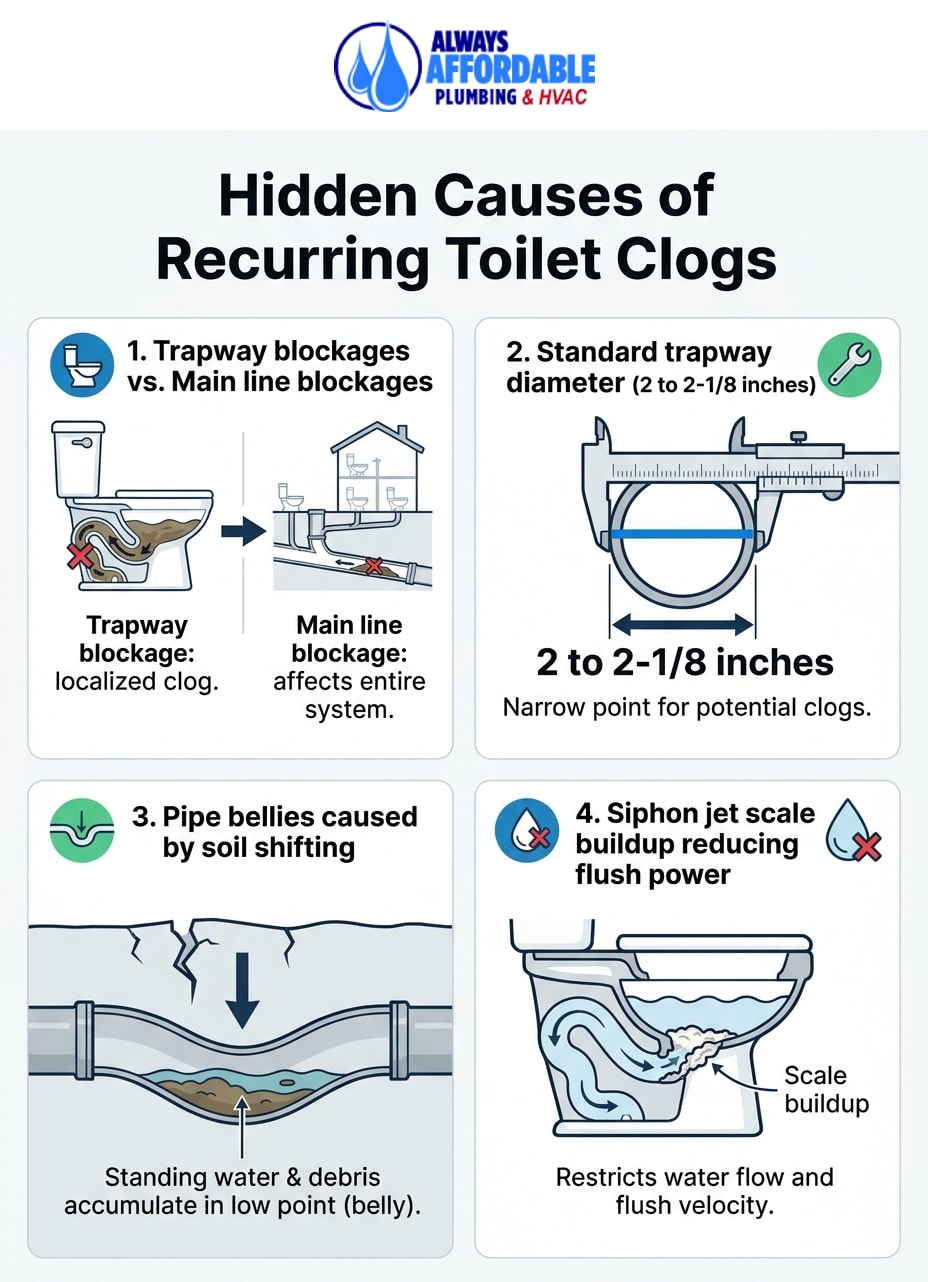
According to standard plumbing code specifications, the internal trapway of a residential toilet is designed to easily pass solids that are 2 to 2-1/8 inches in diameter. Because of this clearance, human waste alone rarely clogs a healthy, properly functioning toilet. When the bowl mechanics are working correctly, a recurring failure to pass solid waste almost always points to a downstream restriction.
The power behind a successful heavy flush does not just come from gravity—it comes from the siphon jet. When you press the handle, water dumps from the tank into the bowl. While some water washes down the sides from the rim jets, the majority of the water is forced through a primary siphon jet located at the bottom of the bowl.
• Creating a vacuum: This sudden, high-pressure injection of water pushes into the trapway, forcing the air out and creating a powerful vacuum. This siphon action is what literally pulls heavy solid waste up and over the trapway curve.
• The impact of mineral buildup: Over time, hard water deposits (calcium and magnesium scale) can build up inside the siphon jet and the rim holes.
• Loss of flush power: When these jets become obstructed by scale, the volume and speed of the water entering the bowl are drastically reduced. The toilet loses its ability to create a strong vacuum, resulting in a weak, lazy flush that leaves heavy solids behind.
When diagnosing recurring toilet clogs, the first major distinction our plumbers make is whether the obstruction is localized inside the toilet itself (the trapway) or located deeper underground in the main sewer line. The mechanical differences between these two issues dictate entirely different repair approaches.
A trapway blockage usually involves an object physically wedged inside the curved porcelain channel of the toilet. Common culprits include accidental foreign objects (like a child's toy), excessive amounts of thick toilet paper, or flushable wipes. It is important to understand why wipes and paper towels cause repeat toilet clogs: unlike standard toilet tissue, these products are woven to resist breaking down in water. Even if they seem to flush initially, they easily snag on minor imperfections inside the pipe, creating a net that catches subsequent solid waste.
Conversely, a main sewer line issue affects the entire drainage system of the home. Here is a breakdown of how the symptoms differ:
• Scope of the Problem — Trapway Blockage (Localized): Only one specific toilet is backing up. — Main Sewer Line Issue (Systemic): Multiple fixtures on the lowest floor are affected.
• Associated Noises — Trapway Blockage (Localized): Usually silent, simply fails to drain. — Main Sewer Line Issue (Systemic): Gurgling or bubbling sounds in the tub or sink when flushing.
• Water Backflow — Trapway Blockage (Localized): Water rises only inside the toilet bowl. — Main Sewer Line Issue (Systemic): Flushing the toilet causes water to back up into the shower drain.
• Response to Plunging — Trapway Blockage (Localized): Often clears temporarily with a standard plunger. — Main Sewer Line Issue (Systemic): Plunging pushes water into other fixtures instead of clearing the line.
If the toilet mechanics are sound and there is no object wedged in the trapway, recurring heavy-flush failures are frequently caused by structural pipe issues underground. One of the most common hidden culprits we encounter in the local area is a condition known as a pipe belly.
A pipe belly occurs when a section of the underground lateral sewer line loses its proper slope and sags downward, creating a permanent dip or low spot in the pipe. A pattern we see often throughout the Sacramento Valley involves expansive clay soils contracting during hot, dry summer and fall months. This soil movement pulls support away from older sewer lines, causing them to sag.
Here is how a pipe belly specifically disrupts heavy flushes:
1. The pooling effect: Because the pipe sags, standing water constantly pools in the lowest section of the belly, essentially creating a secondary, unintended trap under your yard.
2. Separation of waste: When you flush, liquid wastewater is light enough to flow over the top of this pooled water. However, heavy solid waste drops into the dip and gets left behind.
3. The compounding blockage: Over weeks and months, the trapped solid waste acts like a dam. It catches toilet paper, organic material, and grease.
4. Total failure: Eventually, the accumulated debris reduces the diameter of the pipe so severely that any new heavy flush immediately causes a total backup into the home.
Because these underground shifts happen gradually, they often go completely unnoticed until the toilet consistently fails to clear solid waste.
When faced with a stubborn toilet, a homeowner's first instinct is usually to grab a plunger or rent a drain snake. While these tools have their place, treating the symptom does not cure the underlying disease.
Plungers rely entirely on hydrostatic pressure. By forcing a volume of water back and forth, they can dislodge soft blockages caught in the trapway. However, plunging cannot fix structural issues like scale buildup, root intrusions, or pipe bellies. In fact, repeated, aggressive plunging can cause secondary damage. The intense pressure can blow out the wax ring seal located at the base of the toilet, leading to hidden wastewater leaks under your bathroom floor.
If plunging fails, many people turn to blind cable augering (snaking). While a drain snake can reach deeper into the pipe, our technicians frequently warn homeowners that doing so blindly is often just a temporary fix for structural pipe issues.
The difference between clearing and cleaning: When a cable is fed blindly into a clogged main line, it eventually hits the obstruction. The spinning cutting head might poke a hole through the sludge, roots, or trapped solids. This allows the backed-up liquid to drain, giving the illusion that the problem is solved.
The risk of assuming the problem is fixed: Because the technician cannot see what they are doing, they are only opening a temporary channel. The surrounding scale, the sagging pipe belly, or the dense root mass remains completely intact. Within a few weeks or months, the heavy solid waste will simply snag on the remaining debris, and the exact same toilet clog will return.
To break the cycle of constant backups and temporary fixes, you must identify the root cause of the restriction. The definitive diagnostic tool our team uses to avoid guesswork is a high-definition sewer camera inspection.
This process involves feeding a specialized, waterproof fiber-optic camera directly into the drain line. As the camera travels through the pipes, it sends a live, high-definition video feed back to a monitor. This provides undeniable camera scope visual confirmation of line obstruction, showing exactly what is happening deep underground.
Camera inspections eliminate the mystery of recurring clogs by identifying:
• The exact nature of the blockage: Whether it is a mass of flushable wipes, severe hard water scale, or invasive tree roots.
• The presence of structural defects: The camera easily reveals pipe bellies, collapsed sections, or offset joints.
• The precise location and depth: The camera head contains a built-in sonde transmitter. A technician above ground can use a locating wand to track the camera's exact position and depth, mapping precisely where the repair needs to happen.
Working with our team at Always Affordable Plumbing & HVAC means benefiting from a commitment to transparent, honest diagnostics. By using camera scoping, we show the homeowner exactly what the problem is on the screen, rather than relying on guesswork or charging repeatedly for temporary snaking that never addresses the real issue.
Once a camera inspection identifies the true cause of your recurring toilet clogs, you can move forward with a targeted, permanent solution. Identifying the root cause prevents future property damage, eliminates the anxiety of flushing, and stops the endless frustration of dealing with a plunger every week.
Depending on what the camera reveals, the potential repair paths may include:
• Hydro Jetting: If the pipe is structurally sound but choked with hard water scale, grease, or heavy sludge, high-pressure hydro jetting can scour the interior walls of the pipe back to their original diameter.
• Targeted Excavation: If the camera identifies a severe pipe belly or a collapsed joint, the exact location is marked. This allows for a localized, targeted repair rather than digging up the entire sewer line.
• Trenchless Repair: In cases of minor root intrusion or cracking, trenchless pipe lining can often rehabilitate the pipe from the inside without requiring major digging.
Because every plumbing system is unique, we highly recommend consulting with local plumbing experts to review your camera footage and discuss the most effective, permanent solutions for your home.
If your toilet only clogs when solid waste is introduced, you likely have a partial blockage or a weak siphon jet. The toilet can easily pass liquid water, but heavy solids snag on downstream obstructions or fail to be pulled through the trapway due to a lack of vacuum pressure. Inspecting the siphon jet for hard water scale is a good first step.
Fixing a constantly clogging toilet requires identifying the root cause rather than just plunging the symptom. First, ensure the siphon jet and rim holes are clear of mineral buildup to restore full flush power. If the mechanics are fine, a professional camera inspection is required to locate hidden pipe bellies, root intrusions, or foreign objects trapped deep in the line.
Yes, a toilet can easily be affected by a clog located dozens of feet away in the main sewer line. When the main underground lateral line develops a sag, accumulates scale, or is infiltrated by tree roots, it restricts the flow of solid waste. Because the toilet is often the lowest drain in the home, it is usually the first fixture to show signs of a deep pipe blockage.
A toilet that repeatedly fails on heavy flushes is typically struggling against a downstream restriction or suffering from compromised flush volume. Standard trapways are designed to pass 2-inch solids easily. When heavy flushes fail, it usually means the water is flowing over a structural dip (a pipe belly) while leaving the heavy solids behind to accumulate.
The most accurate way to diagnose a recurring toilet clog is by performing a sewer line camera inspection. This involves sending a high-definition fiber-optic camera down the drain to visually inspect the interior of the pipes. It provides visual confirmation of structural issues, scale, or blockages, completely eliminating guesswork from the diagnostic process.
Deep pipe clogs are most commonly caused by structural pipe bellies, invasive tree roots, or the accumulation of non-degradable items like flushable wipes. Over time, shifting soil can cause underground pipes to sag, creating a trap where heavy waste settles. Tree roots seeking moisture can also penetrate pipe joints, acting as a net that catches solid waste as it flows out of the home.
If you are tired of dealing with constant backups and want to definitively solve the problem, diagnosing recurring toilet clogs starts with seeing exactly what is happening underground. Reach out to our professional team to schedule a diagnostic camera inspection and restore the reliability of your home's plumbing system today.
See what our satisfied customers have to say about their experience with Always Affordable
Plumbing & HVAC.

"Chappy was very skilled in his knowledge of my HVAC unit. I greatly appreciate the quick response and experienced tech. The whole endeavor was made less stressful by his humor and honest conversation. I find comfort in knowing I now have a shop i trust for the next time."
"Tony, James, Ronnie did an amazing job setting up our new AC! They were quick, efficient, considerate, and polite! We appreciate them scheduling us in on such short notice. Definitely recommend this company!"
"Prompt, professional service with kindness and care. They came out to address both plumbing and AC issues. I received a courtesy call before they arrived. All issues were resolved the same day with integrity and respect. Thankful for businesses like this. Absolutely recommend to those that I love."
"Excellent service! Jason came out promptly and in addition to doing my outside faucet he also put in new irrigation equipment! All done perfectly! Jason was lovely"
"Honest with the assessment; friendly and good manners. No high pressure sales. Just good to honest "tell it like you see it" Thought my kitchen disposer needed an overhaul. But Jason, there Plumber gave me an honest lesson on what was really happening. Saved me hundreds, if I went the route of replacing. Thank you!"
"Absolutely 5 stars. If you are looking for affordable ,professional and kind. Chappy was excellent and very knowledgeable . I called in the morning because my air conditioner stopped working he was here within hours and fixed my air with a smile. I highly recommend Chappy and Always Affordable plumbing and Hvac."
"Scott and James were great. They got there quickly and diagnosed the problem with my A/C.They did a very thorough job testing everything. Sent me pictures and called to keep me informed. Got it done the next day and everything is working fine. Be glad when I get home so I can enjoy my new system. Thanks guys for a great job."
"Chappy was very helpful. He knew our issue right away, cleaned our coils. He also came on the same day we called and got our AC blowing cold air again."
"After some timing ’curfuffles’ the Tech Jason arrived and not only completed a speedy install on my toilet, he was personable & professional. Because of the timing issues Jason was attentive and showed up with everything needed! No extra store runs 😊 I was very comfortable with having this Tech in my Daughter’s home. We will definitely use this Service again."