Seasonal Home Maintenance Checklist: Preventing HVAC and Plumbing Emergencies
Prevent HVAC emergencies with a seasonal home maintenance checklist. Why proactive scheduling beats waiting for sudden failures. See what needs attention now.



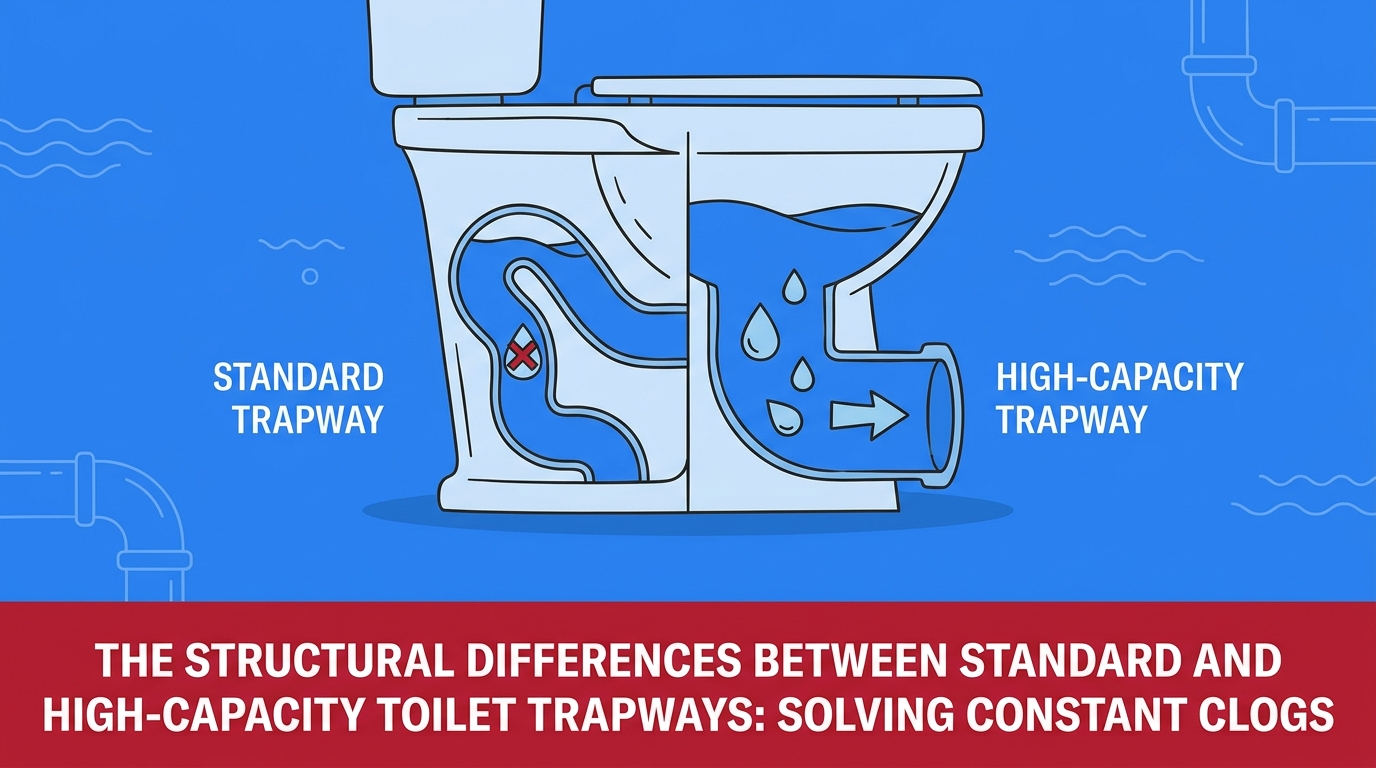
If your toilet is constantly backing up, understanding the structural differences between standard and high-capacity toilet trapways is the first step toward a permanent solution. You flush the handle, and instead of a powerful, clearing swirl, the water level rises dangerously close to the rim. It is a frustrating, anxiety-inducing moment that leaves you reaching for the plunger—again. For many homeowners, this is a weekly or even daily routine, despite completely normal usage.
To help you stop the cycle of constant plunging, we recommend exploring our home plumbing and HVAC services to evaluate your home's unique needs.
Most homeowners assume that frequent clogs mean there is a severe blockage deep in their main sewer lines. While tree roots and collapsed pipes are certainly real threats, the actual root cause of a toilet that struggles to clear solid waste is often much closer to the surface. The problem usually lies within the internal structural anatomy of the toilet itself. Simply put, not all plumbing fixtures are manufactured to the same specifications.
Over the last few decades, toilet design has evolved significantly. The biggest shift has been the transition from narrow, restrictive internal passages to modern, high-performance designs. When you compare standard 2-inch vs. high-capacity 2 3/8-inch trapways, the difference in flushing power becomes incredibly clear. Understanding how your toilet's internal plumbing anatomy dictates its ability to handle heavy waste is the key to identifying why your current fixture fails—and how to choose one that actually works.
Before you can diagnose why a fixture is failing, you need to understand how it is supposed to work. The trapway is the curved, snake-like channel hidden inside the base of your toilet. Its job is to carry water and solid waste from the bottom of the bowl, up over a curve, and down into the floor drain that connects to your home's main sewer system.
This internal channel is typically shaped like an "S" or a "P." This specific curve is not just for directing waste; it is a critical safety feature. The upward curve of the trapway holds a small amount of standing water in the bowl at all times. This water acts as a physical seal, blocking hazardous and foul-smelling sewer gases—like methane and hydrogen sulfide—from rising out of the pipes and entering your bathroom.
When you press the flush lever, you are relying on a combination of gravity and fluid dynamics. Water rushes from the tank into the bowl, rapidly raising the water level. This sudden influx of water pushes over the top curve of the trapway (called the weir), creating a powerful siphon effect. This siphon acts like a vacuum, aggressively pulling the water and solid waste out of the bowl and down the drain. If the internal passage is too narrow, that siphon breaks, and the waste has nowhere to go. This is why upgrading to high-performance fixtures through professional plumbing upgrades is often the most effective solution for chronic issues.
The quick fix: You might notice that some modern toilets have a smooth, flat exterior (skirted toilets), while older models show the winding outline of the pipe on the outside (exposed trapways). While skirted models are easier to clean on the outside, the internal function remains exactly the same. Whether hidden or exposed, the performance still comes down to the battle of standard 2-inch vs. high-capacity 2 3/8-inch trapways.
If you live in a home with builder-grade fixtures or toilets installed more than a decade ago, you almost certainly have a standard trapway. For generations, the plumbing industry standard for this internal passage has been exactly 2 inches in diameter. While a 2-inch pipe is generally sufficient for moving liquids and light toilet paper, it quickly becomes a severe bottleneck when handling heavy solid waste.
When a large volume of waste hits a 2-inch curve, it compresses. If the mass is larger than the diameter of the pipe, it wedges itself against the porcelain walls, stopping the siphon effect instantly. The water continues to pour in from the tank, but with the exit blocked, the bowl simply fills up. This is the exact moment you have to grab the plunger. High-capacity trapways were engineered specifically to eliminate this bottleneck. These upgraded internal channels typically measure between 2 1/8 and 2 3/8 inches in diameter.
• Diameter — Standard Trapway: 2.0 inches — High-Capacity Trapway: 2.125 to 2.375 inches
• Cross-Sectional Area — Standard Trapway: ~3.14 square inches — High-Capacity Trapway: ~4.43 square inches (at 2 3/8")
• Waste Handling — Standard Trapway: Prone to bottlenecking with heavy solids — High-Capacity Trapway: Allows large solids to pass freely
• Common Application — Standard Trapway: Older homes, builder-grade fixtures — High-Capacity Trapway: Premium, high-performance upgrades
You might be wondering why a fraction of an inch even matters. The secret lies in the mathematics of circles. When you increase the diameter of a pipe from 2 inches to 2 3/8 inches, you are not just adding a tiny sliver of space. You are significantly expanding the total cross-sectional area—and therefore the total volume—of the passage.
A standard 2-inch pipe has an area of roughly 3.14 square inches. A high-capacity 2 3/8-inch pipe has an area of roughly 4.43 square inches. That seemingly small increase in diameter results in a massive 41% increase in the space available for waste to pass through. This wider throat prevents solid waste from compacting at the very first curve of the trapway, allowing the siphon to pull everything down the drain without hesitation. When comparing standard 2-inch vs. high-capacity 2 3/8-inch trapways, the math clearly shows why the larger option rarely clogs.
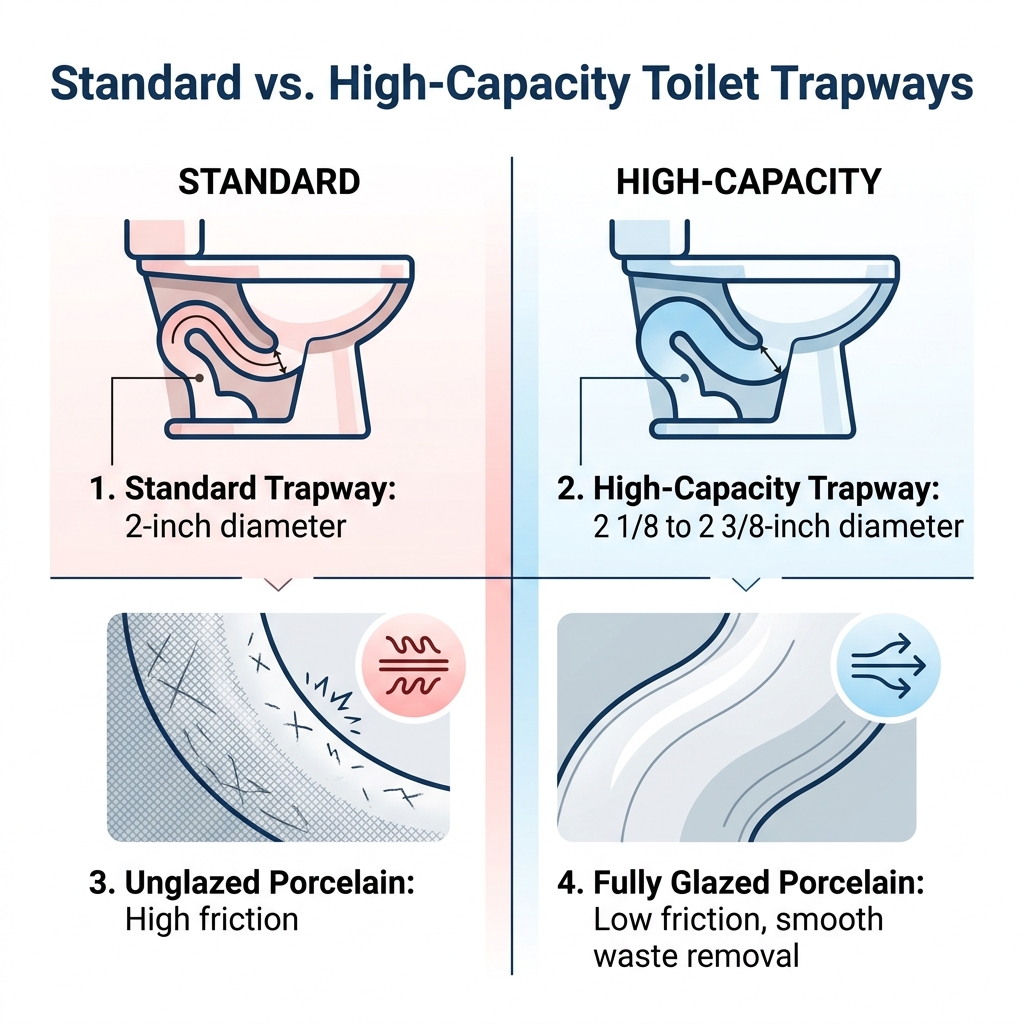

While the physical width of the pipe is crucial, it is only half of the equation. The other critical factor in preventing clogs is the texture of the pipe's interior walls. This brings us to the concept of internal friction. To understand this, you have to look at how toilets are manufactured.
Toilets are made by pouring liquid clay into a mold, letting it dry, and then firing it in a massive kiln at incredibly high temperatures. In its raw state, fired porcelain is highly porous and rough to the touch—almost like fine sandpaper. If the inside of your toilet's trapway is left as raw porcelain, it creates a tremendous amount of drag. As solid waste and toilet paper travel through the curves, this rough surface grips the material, slowing it down and eventually snagging it until a clog forms. This is one reason why plunging a heavily clogged toilet sometimes makes the blockage worse, as the force just compacts the waste harder against the rough walls.
To solve this, premium manufacturers apply a liquid glass coating—called glaze—to the porcelain before it goes into the kiln. When fired, this glaze melts and hardens into a perfectly smooth, waterproof, glass-like finish. However, glazing the hidden internal trapway is difficult and expensive. Many budget manufacturers only glaze the bowl where you can see it, leaving the internal trapway raw to save money.
A high-performance toilet features a fully glazed trapway. This means the smooth, glass-like finish extends completely through the internal channel, from the bottom of the bowl all the way to the floor drain. When you compare fully glazed vs. unglazed or partially glazed internal pathways, the difference in friction is night and day. In a fully glazed trapway, waste glides through the curves effortlessly, drastically reducing the chances of a blockage.
Understanding anatomy is important, but context is everything. The structural design of your toilet matters more today than it did thirty years ago because of the way modern plumbing uses water. Decades ago, a standard toilet used 3.5 to 5 gallons of water per flush. With that massive volume of water, the toilet could essentially brute-force waste through a narrow, unglazed trapway simply by washing it away with a flood.
Today, water conservation is a legal requirement. With strict environmental laws in place, modern toilets are required to use significantly less water. In fact, California's strict Title 20 Appliance Efficiency Regulations mandate a maximum of 1.28 gallons per flush (GPF). This makes a highly efficient, friction-reducing trapway absolutely essential for residents to prevent clogs during drought conditions. You can no longer rely on water volume to do the heavy lifting.
Here is how a low-flow flush relies on structural design rather than water volume:
1. Precision Water Delivery: Because there is only 1.28 gallons available, the tank must release the water with perfect timing to wash the bowl and trigger the siphon simultaneously.
2. Friction Reduction: With less water to lubricate the waste, the porcelain itself must provide the slip. This makes fully glazed vs. unglazed or partially glazed internal pathways the deciding factor in whether the flush succeeds.
3. Volume Maximization: The trapway must be wide enough to allow the waste to pass without needing extra water pressure to force it through a bottleneck.
When you combine low water volume with a narrow, rough trapway, constant clogs are inevitable. A high-capacity, fully glazed trapway is the only reliable way to achieve a clean, powerful flush under modern water restrictions. Keeping these advanced systems running smoothly is easy when you maintain them through a plumbing maintenance membership.
When you are staring at a row of toilets in a home improvement store, it is impossible to see inside the porcelain to measure the trapway or check the glazing. Fortunately, the plumbing industry has an objective standard to help homeowners make informed diagnostic decisions: Maximum Performance (MaP) testing.
MaP testing was developed by water efficiency advocates to provide a real-world metric for how well a toilet actually clears solid waste. Instead of just testing with water or plastic balls, the MaP test uses highly realistic soybean paste extrusions and toilet paper to simulate heavy human waste. The toilet is loaded with increasing amounts of this paste to see exactly how many grams it can successfully clear in a single flush without clogging.
The results of these tests correlate directly with internal anatomy. Toilets with standard 2-inch, unglazed trapways routinely score on the lower end of the spectrum, often struggling to clear 350 to 400 grams of waste. In contrast, top-performing models featuring standard 2-inch vs. high-capacity 2 3/8-inch trapways—specifically the wider, fully glazed models—can clear up to 1,000 grams of waste per flush. This is the highest possible score on the MaP scale.
If you are tired of plunging and are ready to replace a failing fixture, looking for a toilet with a MaP score of 800 to 1,000 grams is the smartest move you can make. It proves that the internal geometry is optimized for heavy duty use. If you are considering upgrading multiple fixtures in your home to high-performance models, there are flexible financing options for plumbing upgrades that make the process stress-free.
A fully glazed trapway is an internal plumbing channel that has been coated with a smooth, glass-like finish throughout its entire length. This manufacturing process drastically reduces internal friction. When comparing fully glazed vs. unglazed or partially glazed internal pathways, the fully glazed option allows solid waste and toilet paper to glide smoothly into the sewer line without snagging on rough porcelain.
The industry standard for a toilet trapway is exactly 2 inches in diameter. While this size is common in builder-grade and older toilets, it frequently creates a bottleneck for heavy solid waste. High-capacity models expand this diameter to anywhere between 2 1/8 and 2 3/8 inches, providing up to 41% more volume for waste to pass through.
Your low-flow toilet likely keeps clogging because it lacks the water volume necessary to force waste through a standard, rough internal pipe. Modern toilets are restricted to 1.28 gallons per flush. If that limited amount of water is paired with an unglazed or narrow 2-inch trapway, it simply fails to create enough siphon force to push solid waste through the curves.
No, a toilet trapway cannot be widened, modified, or smoothed out after it has been manufactured. The trapway is permanently cast into the porcelain and fired in a kiln at thousands of degrees. If your current toilet has a narrow or unglazed trapway that causes constant clogs, the only way to upgrade is to replace the entire toilet fixture.
A good MaP (Maximum Performance) score for preventing clogs is anything above 800 grams, with 1,000 grams being the highest possible rating. A score in this range indicates that the toilet has the optimal trapway diameter and internal glazing required to consistently clear heavy solid waste without backing up.
Dealing with a toilet that backs up every week is more than just a nuisance; it is a disruption to your daily life. However, once you understand the structural differences between standard and high-capacity toilet trapways, the mystery of the constant clogs disappears. You no longer have to guess whether the issue is tree roots in your yard or just a poorly designed fixture. You have the technical confidence to know that a standard 2-inch vs. high-capacity 2 3/8-inch trapway makes all the difference in the world.
Moving away from the constant anxiety of an overflowing bowl almost always requires upgrading to a high-capacity model with a fully glazed internal pathway. Upgrading to an effective high-capacity fixture is highly accessible with budget-conscious pricing and a 100% satisfaction guarantee. By consulting with a professional, you can ensure that your new, high-performance toilet integrates perfectly with your home's existing drain lines, giving you peace of mind and a plunger-free bathroom for years to come.
See what our satisfied customers have to say about their experience with Always Affordable
Plumbing & HVAC.

"Chappy was very skilled in his knowledge of my HVAC unit. I greatly appreciate the quick response and experienced tech. The whole endeavor was made less stressful by his humor and honest conversation. I find comfort in knowing I now have a shop i trust for the next time."
"Tony, James, Ronnie did an amazing job setting up our new AC! They were quick, efficient, considerate, and polite! We appreciate them scheduling us in on such short notice. Definitely recommend this company!"
"Prompt, professional service with kindness and care. They came out to address both plumbing and AC issues. I received a courtesy call before they arrived. All issues were resolved the same day with integrity and respect. Thankful for businesses like this. Absolutely recommend to those that I love."
"Excellent service! Jason came out promptly and in addition to doing my outside faucet he also put in new irrigation equipment! All done perfectly! Jason was lovely"
"Honest with the assessment; friendly and good manners. No high pressure sales. Just good to honest "tell it like you see it" Thought my kitchen disposer needed an overhaul. But Jason, there Plumber gave me an honest lesson on what was really happening. Saved me hundreds, if I went the route of replacing. Thank you!"
"Absolutely 5 stars. If you are looking for affordable ,professional and kind. Chappy was excellent and very knowledgeable . I called in the morning because my air conditioner stopped working he was here within hours and fixed my air with a smile. I highly recommend Chappy and Always Affordable plumbing and Hvac."
"Scott and James were great. They got there quickly and diagnosed the problem with my A/C.They did a very thorough job testing everything. Sent me pictures and called to keep me informed. Got it done the next day and everything is working fine. Be glad when I get home so I can enjoy my new system. Thanks guys for a great job."
"Chappy was very helpful. He knew our issue right away, cleaned our coils. He also came on the same day we called and got our AC blowing cold air again."
"After some timing ’curfuffles’ the Tech Jason arrived and not only completed a speedy install on my toilet, he was personable & professional. Because of the timing issues Jason was attentive and showed up with everything needed! No extra store runs 😊 I was very comfortable with having this Tech in my Daughter’s home. We will definitely use this Service again."