
Why Your AC Runs Constantly: Understanding Heat Transfer Degradation and Cooling Cycles
Why is your AC running constantly? We explain heat transfer degradation. Use our local service expertise and area tips to decide when to call a pro on this.


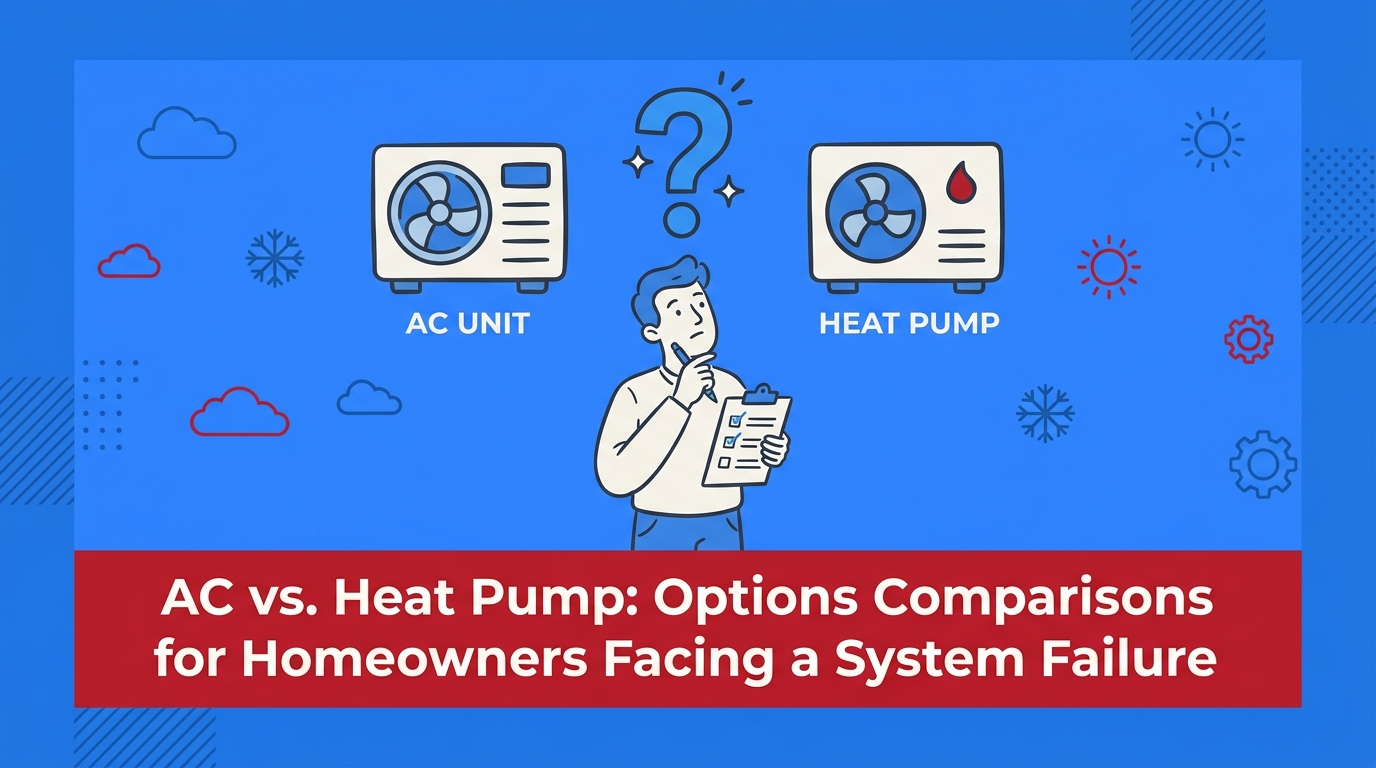
Replacing a failed air conditioner means you simply have to buy another standard air conditioner. That is one of the most widespread misconceptions our technicians at Always Affordable Plumbing & HVAC see when responding to calls across the local area. When an aging cooling system grinds to a halt on a sweltering afternoon, the immediate stress often pushes people into rushing a replacement without looking at the bigger picture. In reality, navigating reliable options comparisons for homeowners is the smartest way to turn a sudden breakdown into a long-term upgrade for your property.
A catastrophic failure forces a major decision point: do you stick with the familiar technology of a traditional central AC, or do you upgrade to a high-efficiency heat pump? Both paths have distinct advantages depending on your home's infrastructure. Just as our community relies on us for comprehensive professional plumbing services and highly expert plumbing repair when pipes burst, you can trust our objective HVAC guidance when your cooling system fails. The very first step in making this choice is understanding the modern metrics used to evaluate long-term value, specifically looking closely at SEER2 efficiency ratings.
In our years of servicing local homes, we've seen countless families panic when the house gets hot and uncomfortable. The instinct is to sign off on the first available box that produces cold air. However, a replacement cooling system is an infrastructure investment that will live with your home for over a decade. Taking a breath to evaluate your options ensures you do not lock yourself into outdated technology or higher-than-necessary utility bills.
Key factors our team recommends considering immediately:
• The age of your indoor equipment: Your outdoor unit does not operate alone; it pairs with an indoor air handler or furnace.
• Your long-term energy goals: Reducing monthly consumption requires specific hardware choices upfront.
• Current ductwork condition: High-efficiency systems require proper airflow to meet their rated performance levels.
To make an informed choice, you must first understand how these two systems operate at a mechanical level. A pattern we see often during local service calls is that many homeowners assume a heat pump is an entirely different class of machinery. The truth is much simpler: during the high-demand summer cooling months, both systems operate using the exact same refrigeration principles.
A standard central air conditioner is a one-way street. It is designed solely to remove heat from the inside of your home and release it outside. It does this by circulating chemical refrigerant between an indoor evaporator coil and an outdoor compressor. Warm indoor air blows across the cold indoor coil, the refrigerant absorbs the heat, and it travels outside where the compressor pressurizes it and the condenser coil releases the heat into the outdoor air. Because it only cools, a traditional AC must be paired with a separate heating system, usually a gas or electric furnace, to keep your home warm in the winter.
A heat pump contains the exact same core components as an air conditioner: an outdoor compressor unit and an indoor air handler. The critical difference is a single component called a reversing valve. This valve allows the system to reverse the flow of the refrigerant.
Instead of just pumping heat out of your house in the summer, a heat pump can absorb ambient thermal energy from the outdoor air in the winter and pump it inside. Even when it feels cold outside, there is still thermal energy present in the air that a modern heat pump can capture and compress into usable indoor heat. This dual functionality means a heat pump serves as both your air conditioner and your primary heater, all from one piece of equipment.
One common myth our installation teams hear constantly in residential neighborhoods is that heat pumps sacrifice cooling power in order to provide winter heating. Homeowners often worry that if they install a heat pump, their house will not stay cool enough when the temperature outside peaks. This is entirely false.
Detailing how a heat pump performs identically to a traditional AC during high-demand summer cooling months is critical for peace of mind. When your thermostat is set to "cool," the heat pump's reversing valve locks into the cooling position. At that moment, the heat pump is functionally indistinguishable from a standard central air conditioner. It utilizes the same compressor technology, the same refrigerant lines, and the same indoor blower motor to extract heat from your living spaces. Comfort is never compromised with either choice during peak summer heat.
Keeping a house comfortable in the summer is about more than just lowering the air temperature; it is also about removing moisture. Both modern central ACs and high-efficiency heat pumps excel at dehumidification when they are properly sized for the home.
How moisture is managed:
• Coil condensation: As warm, humid indoor air passes over the cold evaporator coil, moisture condenses on the metal fins, much like a cold glass of water sweating on a hot day.
• Drainage: This condensation drips into a drain pan and is safely channeled outside or into your home's wastewater plumbing.
• Variable-speed advantages: Many high-efficiency heat pumps feature variable-speed compressors. These units run longer cycles at lower speeds, which pulls significantly more humidity out of the air than older, single-stage units that blast on and off quickly.
Whether you choose a standard air conditioner or a dual-purpose heat pump, you need a reliable way to measure how efficiently the system will cool your home. As local HVAC professionals, we rely on standardized metrics to help consumers compare different units side-by-side.
The primary metric for cooling efficiency is the Seasonal Energy Efficiency Ratio, now updated to SEER2. SEER2 efficiency ratings represent the total cooling output of the system over a typical cooling season divided by the total electrical energy input during that same timeframe. The "2" indicates the updated, more rigorous testing protocols that better reflect real-world conditions, including increased static pressure in ductwork.
Evaluating these ratings helps homeowners predict future operating costs. The math is straightforward: higher ratings directly translate to lower long-term energy consumption.
1. Establish the baseline: The Department of Energy mandates minimum SEER2 efficiency ratings for all new installations. These minimums vary slightly by geographic region, but they ensure that any new system you buy today is significantly more efficient than a unit manufactured ten or fifteen years ago.
2. Compare standard vs. high-efficiency: Standard replacement AC units typically hover around the baseline legal minimums. High-efficiency heat pumps, however, often boast SEER2 ratings well above the minimum threshold, heavily reducing the amount of electricity required to cool the home.
3. Calculate the long-term impact: While the exact reduction in your utility bill depends on your specific usage habits and home insulation, upgrading from an old, failing unit to a high-SEER2 system predictably lowers the monthly electrical burden.
Addressing the financial aspects of a replacement decision requires looking beyond the initial day of installation. High-efficiency heat pumps often have a different initial equipment profile than standard AC units, primarily because you are purchasing a system that handles both heating and cooling.
A standard air conditioner might present a lower barrier to entry on the day it is installed, especially if your home already has a functioning, relatively new gas furnace in place. However, the operational costs over the next fifteen years tell a different story. Improved SEER2 efficiency ratings contribute to lower monthly energy bills over the system's lifespan. By utilizing less electricity to achieve the same level of indoor comfort, a high-efficiency system steadily recoups its initial equipment profile over time.
Because heat pumps significantly reduce fossil fuel dependency by providing highly efficient electric heating, they are heavily favored by modern energy policies. Generic federal tax credits and local utility incentives may apply to qualifying high-efficiency heat pump installations. These programs are designed to encourage homeowners to adopt greener technology by offsetting the initial equipment profile.
We advise readers to consult a tax professional or their utility provider to verify current generic programs, as availability and qualification requirements shift regularly. Leveraging the Always Affordable Plumbing & HVAC brand promise here means you can rely on our team for objective advice; we ensure your chosen system meets your comfort goals without breaking the bank, and we back our installations with a 100% satisfaction guarantee.
Synthesizing all this technical information into a practical decision-making framework is how you move from a stressful breakdown to a confident installation. Our team typically sees that the right choice for your neighbor might not be the right choice for you.
The biggest factor in choosing between an AC-only replacement or a dual-function heat pump is the condition of your existing heating system. If your furnace is only a few years old and in excellent condition, replacing just the failed outdoor AC unit with a standard air conditioner might be the most logical path. However, if your furnace is aging, showing signs of wear, or approaching the end of its typical lifespan, replacing the entire setup with a high-efficiency heat pump eliminates the need for a separate furnace altogether.
In our daily work across the community, we see firsthand how regional climate factors dictate home maintenance across the board. Just as Sacramento's notorious hard water impacts plumbing and requires specific care, local seasonal extremes dictate the best HVAC choice. Thorough research is key for all home systems. Whether you are comparing HVAC units or looking into using enzyme cleaners for clogged toilets, making informed decisions protects your property. Rest assured, our local service areas are fully covered for all these comprehensive home maintenance needs.
• Primary Function — Traditional Central AC: Cooling only (removes heat from home) — High-Efficiency Heat Pump: Heating and cooling (reversible heat transfer)
• Winter Operation — Traditional Central AC: Requires a separate furnace to generate heat — High-Efficiency Heat Pump: Extracts ambient heat from outdoor air
• Summer Operation — Traditional Central AC: Excellent cooling and dehumidification — High-Efficiency Heat Pump: Identical cooling and dehumidification
• Efficiency Metric — Traditional Central AC: Measured by SEER2 efficiency ratings — High-Efficiency Heat Pump: Measured by SEER2 efficiency ratings
• Energy Incentives — Traditional Central AC: Standard local rebates may apply — High-Efficiency Heat Pump: Qualifies for broader generic tax credits
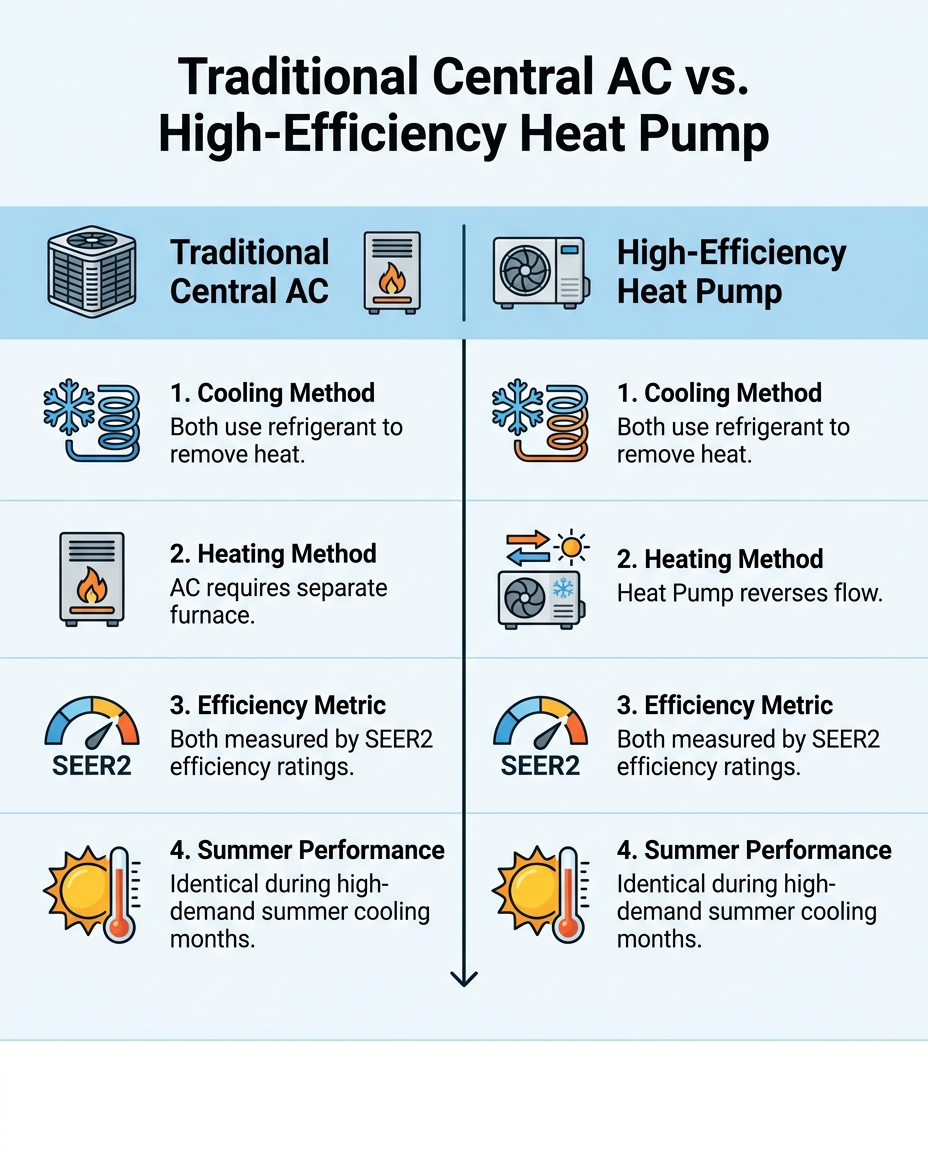

Neither is universally better; the choice depends heavily on your existing heating system and efficiency goals. Heat pumps offer dual functionality and often feature higher baseline SEER2 efficiency ratings. If your furnace is old, our team usually recommends a heat pump as an excellent all-in-one upgrade, whereas a standard AC might make sense if your furnace is brand new.
Yes. During high-demand summer cooling months, a heat pump operates exactly like a standard air conditioner. It effectively removes heat and dehumidifies the indoor air using the exact same refrigeration cycle, ensuring your home stays perfectly comfortable even on the hottest days.
The primary consideration for a heat pump is that the initial equipment profile can be different than a standalone air conditioner. Because it replaces both your heating and cooling systems, the upfront installation scope is often larger. Additionally, homes in extremely frigid, sub-zero climates may occasionally require supplemental backup heating, though modern cold-climate heat pumps have largely mitigated this issue.
SEER2 efficiency ratings dictate how much electricity the system will consume to cool your home over its lifespan. Choosing a unit with a higher SEER2 rating means lower monthly utility bills. When comparing options, factoring in the long-term energy savings of a higher-rated system can help justify a different initial equipment choice.
During the summer, a heat pump uses a reversing valve to direct the flow of chemical refrigerant in the cooling direction. It absorbs thermal energy from the warm air inside your home via the indoor evaporator coil and pumps that heat outside to the compressor, releasing it into the outdoor air.
Understanding the mechanical and financial differences between these systems ensures you make an informed, confident choice after a catastrophic failure. You do not have to settle for a rushed decision when your old unit breaks down. Remember that performance during high-demand summer cooling months is consistently excellent with either modern option, so your decision should ultimately hinge on your existing furnace's condition and your long-term energy goals.
By prioritizing your specific comfort needs and evaluating how SEER2 efficiency ratings impact your monthly budget, you can turn a stressful breakdown into a lasting home improvement. Take the time to explore your replacement options with our experienced team at Always Affordable Plumbing & HVAC to secure your home's comfort for the next decade.
See what our satisfied customers have to say about their experience with Always Affordable
Plumbing & HVAC.

"Chappy was very skilled in his knowledge of my HVAC unit. I greatly appreciate the quick response and experienced tech. The whole endeavor was made less stressful by his humor and honest conversation. I find comfort in knowing I now have a shop i trust for the next time."
"Tony, James, Ronnie did an amazing job setting up our new AC! They were quick, efficient, considerate, and polite! We appreciate them scheduling us in on such short notice. Definitely recommend this company!"
"Prompt, professional service with kindness and care. They came out to address both plumbing and AC issues. I received a courtesy call before they arrived. All issues were resolved the same day with integrity and respect. Thankful for businesses like this. Absolutely recommend to those that I love."
"Excellent service! Jason came out promptly and in addition to doing my outside faucet he also put in new irrigation equipment! All done perfectly! Jason was lovely"
"Honest with the assessment; friendly and good manners. No high pressure sales. Just good to honest "tell it like you see it" Thought my kitchen disposer needed an overhaul. But Jason, there Plumber gave me an honest lesson on what was really happening. Saved me hundreds, if I went the route of replacing. Thank you!"
"Absolutely 5 stars. If you are looking for affordable ,professional and kind. Chappy was excellent and very knowledgeable . I called in the morning because my air conditioner stopped working he was here within hours and fixed my air with a smile. I highly recommend Chappy and Always Affordable plumbing and Hvac."
"Scott and James were great. They got there quickly and diagnosed the problem with my A/C.They did a very thorough job testing everything. Sent me pictures and called to keep me informed. Got it done the next day and everything is working fine. Be glad when I get home so I can enjoy my new system. Thanks guys for a great job."
"Chappy was very helpful. He knew our issue right away, cleaned our coils. He also came on the same day we called and got our AC blowing cold air again."
"After some timing ’curfuffles’ the Tech Jason arrived and not only completed a speedy install on my toilet, he was personable & professional. Because of the timing issues Jason was attentive and showed up with everything needed! No extra store runs 😊 I was very comfortable with having this Tech in my Daughter’s home. We will definitely use this Service again."


