Seasonal Home Maintenance Checklist: Preventing HVAC and Plumbing Emergencies
Prevent HVAC emergencies with a seasonal home maintenance checklist. Why proactive scheduling beats waiting for sudden failures. See what needs attention now.



Are you staring at a bowl full of standing water, wondering exactly how long does it take for enzyme cleaners to clear a severely clogged toilet? It is a stressful situation for any homeowner. You have already applied a biological drain cleaner, but the water level has not budged, and you are left wondering if the product is actually working or if you are simply wasting time. The immediate anxiety of a severely clogged toilet often tempts people to grab a plunger or try flushing again, but doing so prematurely can lead to a disastrous overflow that damages your bathroom floors.
When you are dealing with a heavy blockage, understanding the timeline of biological breakdown is critical. Unlike harsh chemical drain cleaners that rely on immediate, caustic reactions to burn through blockages, enzyme cleaners use live bacteria to naturally digest waste. This means the process requires patience. A biological breakdown is not an instant fix; it is a steady, natural process. Knowing exactly how long this process takes will help you make an informed decision about whether to keep waiting for the enzymes to do their job or to escalate the situation and seek professional plumbing services.
The critical decision point: The standard wait time is 12 to 24 hours for severe organic clogs to fully dissolve. If you understand this timeline, you can safely manage the situation without risking a messy overflow. However, if that window passes without any change in the water level, you will know definitively that it is time to abandon the waiting game and explore mechanical removal options.
For a severely clogged toilet, enzyme cleaners typically take 12 to 24 hours to fully break down organic waste. If you are searching for what breaks down poop in a toilet fast, it is important to understand that "fast" is a relative term when dealing with biological cleaners. While caustic chemicals might promise to dissolve clogs in thirty minutes, they do so by generating intense heat that can severely damage your porcelain bowl and the plumbing pipes hidden behind your walls. Enzymes are significantly safer for your plumbing system, but they trade speed for safety.
At Always Affordable Plumbing & HVAC, our team typically sees homeowners frustrated by unrealistic product claims. We believe in providing honest, transparent advice to our local area customers. The truth is that DIY biological cleaners are never an instant solution. Overselling the speed of these products only leads to frustration and false expectations. An overnight dwell time minimum is the absolute requirement for heavy organic buildup. If you pour an enzyme cleaner into your toilet bowl at noon, you should not expect the water to magically recede by dinnertime. Setting realistic expectations prevents you from assuming the product has failed when it simply hasn't had enough time to work.
The 12 to 24-hour timeline is not an arbitrary number; it is based on the biological mechanism of bacterial digestion. When you introduce an enzyme cleaner to a clogged toilet, you are actually introducing dormant bacteria. Here is why the process takes time:
• Bacterial Activation: The dormant bacteria must first come into contact with water and organic food sources to wake up and become active. This initial activation phase can take an hour or more.
• Enzyme Production: Once active, the bacteria begin to secrete specific enzymes—like proteases for proteins and lipases for fats—that act as chemical scissors, cutting complex waste molecules into smaller, digestible pieces.
• Multiplication and Digestion: The bacteria consume these smaller pieces and begin to multiply. The larger the clog, the more bacteria are needed to consume it. This exponential growth and continuous digestion process takes many hours to complete.
• Water Volume and Density: A severe clog is dense and compacted. The enzymes can only work on the surface area of the blockage they can physically touch. They must slowly eat their way through the dense material layer by layer.
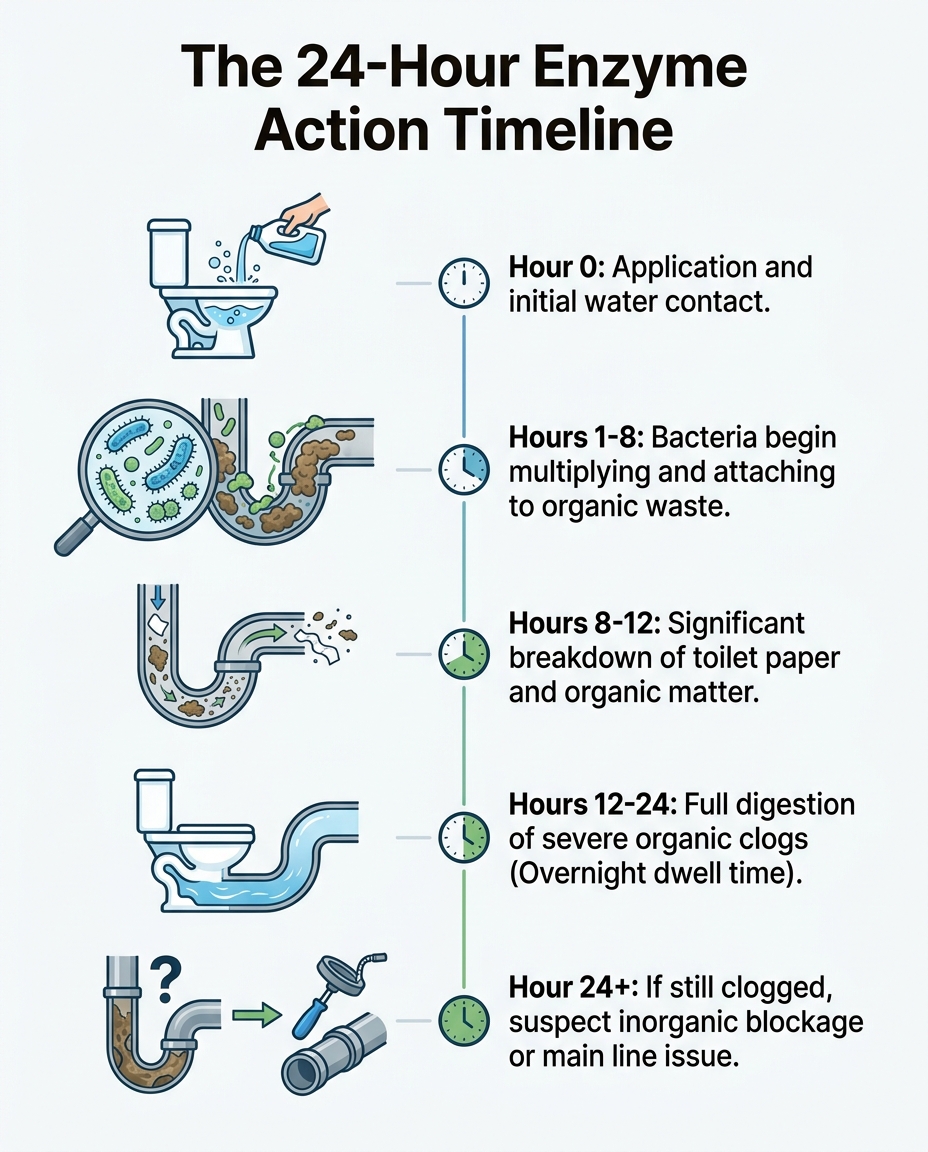

To fully understand why you must wait, it helps to look at the exact science of what breaks down poop in the toilet. Biological drain cleaners are formulated with specific strains of naturally occurring bacteria and enzymes. These microscopic organisms are specifically chosen for their ability to digest organic matter, turning solid human waste and toilet paper into harmless liquids and gases that can easily flow down your drain.
This biological process is entirely different from how traditional chemical drain cleaners operate. Caustic chemicals rely on sodium hydroxide or sulfuric acid to create a violent chemical reaction. This reaction generates significant heat to burn through blockages. While local dry heat can impact outdoor pipes and cause soil shifting, indoor toilet clogs and enzyme effectiveness remain primarily temperature-controlled by the climate inside the home. The controlled, room-temperature environment of your bathroom is perfect for bacteria to thrive, whereas the extreme heat generated by chemical cleaners can crack porcelain bowls, melt PVC piping, and ruin the wax ring sealing your toilet to the floor.
Here is the step-by-step biological process happening inside your toilet bowl:
1. Targeted Application: The liquid or powder enzyme cleaner is poured directly into the standing water, where it sinks and makes contact with the dense organic blockage.
2. Molecular Breakdown: The enzymes break the complex bonds holding the solid waste and toilet paper together, softening the mass.
3. Continuous Consumption: The bacteria feed on the softened waste. As long as there is organic material to consume, the bacteria will continue to multiply and feed until the blockage is entirely gone.
If you absolutely cannot wait the required 12 to 24 hours for this biological process to finish, you will need to explore mechanical alternatives. For readers in a rush, learning tips for a clogged toilet with no plunger or using a toilet auger are the safest ways to restore flow without resorting to dangerous chemicals.
One of the most unpleasant realities of a severely clogged toilet is managing the situation while you wait for the enzymes to work. Our plumbers frequently hear homeowners ask if you can unclog a toilet with poop still in it. The answer is yes—enzyme cleaners are specifically designed to target the waste directly through the standing water. You do not need to empty the bowl before applying a biological cleaner. In fact, the standing water acts as the delivery mechanism, carrying the bacteria down to the site of the blockage.
While you wait out the overnight dwell time minimum, there are specific steps you should follow to ensure the enzymes have the best possible environment to work, without creating a bigger mess in your bathroom.
• Adding warm water safely: Enzymes work best in warm environments. If there is room in the bowl, you can carefully pour in a few cups of warm (never boiling) water to help activate the bacteria. Boiling water can crack the porcelain, so stick to lukewarm tap water.
• Avoiding the plunger: Do not plunge the toilet while the enzymes are actively dwelling. Plunging aggressively can splash bacteria-laden water out of the bowl and all over your bathroom surfaces. It can also push the enzymes past the clog, reducing their effectiveness.
• Restricting access: Close the bathroom door or place a sign on the toilet lid to ensure family members do not accidentally try to use or flush the toilet while the enzymes are working.
• Testing the drain: After the 12 to 24-hour period has passed, test the drain by pouring a small bucket of water into the bowl rather than pulling the flush handle. If the water level drops normally, the clog is cleared. If the water simply rises, the clog is still present, and a flush would cause an overflow.
Biological cleaners are highly effective, but they have one major limitation: they exclusively target organic waste and toilet paper. If your toilet is clogged with inorganic materials, you could pour gallons of enzyme cleaner into the bowl and wait a month, and the clog would never dissolve. Establishing the definitive criteria for when the enzyme approach has officially failed is crucial for protecting your plumbing.
If 12 to 24 hours for severe organic clogs have passed with zero change in the water level, the blockage is almost certainly inorganic or mechanical. Common inorganic culprits include "flushable" wipes (which do not actually break down in water), feminine hygiene products, dental floss, paper towels, and children's toys. When patience isn't enough, mechanical removal using a closet auger or professional intervention becomes necessary.
Consider a real-world scenario our team recently handled where waiting was not an option: One spring afternoon, an urgent call came in regarding a severely clogged toilet affecting an elderly family member. The homeowner knew that waiting 24 hours for an enzyme cleaner to work was impossible given the urgent need. Our Always Affordable Plumbing & HVAC technicians responded within hours, bypassed chemical treatments entirely, mechanically cleared the inorganic blockage, and cleaned up the spilled water to restore the bathroom immediately.
• Organic Clogs — Common Culprits: Human waste, standard toilet paper — Enzyme Effectiveness: Highly Effective (Takes 12-24 hours) — Required Action: Apply biological cleaner, wait overnight, test with water.
• Fibrous Clogs — Common Culprits: "Flushable" wipes, paper towels — Enzyme Effectiveness: Ineffective (Will not break down synthetic fibers) — Required Action: Mechanical removal via toilet auger or professional plumbing service.
• Foreign Objects — Common Culprits: Toys, dental floss, hygiene products — Enzyme Effectiveness: Zero Effectiveness — Required Action: Immediate mechanical extraction to prevent the object from moving deeper.
Sometimes, a severely clogged toilet that refuses to drain despite your best efforts with enzyme cleaners is not actually a toilet issue at all. It may be the first warning sign of a much larger, whole-home plumbing issue. If a blockage is located deep within your plumbing system, enzyme cleaners poured into a toilet bowl will not clear it, especially if the issue involves severe tree root intrusion or a collapsed pipe.
It is important to identify if the issue is isolated to one single toilet or if it is part of a larger system backup. Warning signs of a main line issue include hearing a gurgling sound in your bathroom sink when you flush the toilet, or seeing water back up into your shower drain when the washing machine runs. If multiple fixtures are affected simultaneously, the blockage is deep in the main line.
For example, a pattern we see often in the local area is exactly what happened to a recent customer who woke up on a winter weekday morning to a completely backed-up plumbing system. What initially looked like a stubborn toilet clog was actually a main line blockage affecting the entire house. Our technicians were dispatched immediately, worked until the main line was fully unclogged using heavy-duty mechanical equipment, and provided options for future prevention. If you notice signs that extend beyond a single bowl, it is time to stop pouring enzymes and request an inspection of your main sewer line.
Enzyme drain cleaners typically take between 12 and 24 hours to fully clear a severe organic clog. Because they rely on live bacteria to naturally digest waste rather than harsh chemical reactions, the process requires patience. An overnight dwell time is the minimum recommendation for heavy toilet blockages.
While "fast" is relative, biological enzyme cleaners are the safest way to break down solid waste, though they require up to 24 hours. Harsh chemical drain cleaners may act faster, but they generate intense heat that can crack your toilet bowl and destroy your pipes. For immediate results, mechanical removal with a toilet auger is the fastest and safest method.
Yes, leaving an enzyme cleaner in a toilet overnight is actually what we recommend as best practice. The bacteria need an extended period of uninterrupted time to multiply, attach to the organic waste, and digest the blockage. Leaving it overnight ensures the enzymes have enough time to work without someone accidentally flushing the toilet.
A badly clogged toilet will only clear itself if the blockage is entirely composed of light organic waste and toilet paper that slowly dissolves in water over several days. However, if the clog contains "flushable" wipes, feminine hygiene products, or foreign objects, it will never clear itself and will require mechanical removal.
If your toilet remains severely clogged after a full 24-hour enzyme treatment, you should stop adding cleaners and avoid flushing the toilet to prevent an overflow. A lack of progress indicates the clog is likely inorganic or mechanical. At this point, you should use a closet auger or contact a professional plumber to physically extract the blockage.
Yes, enzyme cleaners are completely safe for older plumbing systems, including cast iron and older PVC pipes. Unlike acidic or caustic chemical cleaners that can corrode aging pipes and ruin seals, biological cleaners only target organic waste, leaving the actual plumbing infrastructure completely unharmed.
Dealing with a severely clogged toilet is frustrating, but understanding how biological cleaners work can save you from making the situation worse. While enzyme cleaners are a remarkably safe and effective solution for breaking down organic clogs without damaging your pipes, they demand patience. Remember that 12 to 24 hours is the standard wait time, and an overnight dwell time is the absolute minimum required for the bacteria to digest heavy waste.
However, if you have waited out the full 24-hour period and the standing water simply refuses to recede, it is time to abandon the DIY approach. A stubborn clog that resists biological treatment is a clear indicator of an inorganic blockage or a deeper issue within your plumbing system. Instead of risking a catastrophic overflow or damaging your porcelain with further chemical attempts, contact a professional plumber to mechanically clear the blockage safely and restore your home's plumbing to perfect working order.
See what our satisfied customers have to say about their experience with Always Affordable
Plumbing & HVAC.

"Chappy was very skilled in his knowledge of my HVAC unit. I greatly appreciate the quick response and experienced tech. The whole endeavor was made less stressful by his humor and honest conversation. I find comfort in knowing I now have a shop i trust for the next time."
"Tony, James, Ronnie did an amazing job setting up our new AC! They were quick, efficient, considerate, and polite! We appreciate them scheduling us in on such short notice. Definitely recommend this company!"
"Prompt, professional service with kindness and care. They came out to address both plumbing and AC issues. I received a courtesy call before they arrived. All issues were resolved the same day with integrity and respect. Thankful for businesses like this. Absolutely recommend to those that I love."
"Excellent service! Jason came out promptly and in addition to doing my outside faucet he also put in new irrigation equipment! All done perfectly! Jason was lovely"
"Honest with the assessment; friendly and good manners. No high pressure sales. Just good to honest "tell it like you see it" Thought my kitchen disposer needed an overhaul. But Jason, there Plumber gave me an honest lesson on what was really happening. Saved me hundreds, if I went the route of replacing. Thank you!"
"Absolutely 5 stars. If you are looking for affordable ,professional and kind. Chappy was excellent and very knowledgeable . I called in the morning because my air conditioner stopped working he was here within hours and fixed my air with a smile. I highly recommend Chappy and Always Affordable plumbing and Hvac."
"Scott and James were great. They got there quickly and diagnosed the problem with my A/C.They did a very thorough job testing everything. Sent me pictures and called to keep me informed. Got it done the next day and everything is working fine. Be glad when I get home so I can enjoy my new system. Thanks guys for a great job."
"Chappy was very helpful. He knew our issue right away, cleaned our coils. He also came on the same day we called and got our AC blowing cold air again."
"After some timing ’curfuffles’ the Tech Jason arrived and not only completed a speedy install on my toilet, he was personable & professional. Because of the timing issues Jason was attentive and showed up with everything needed! No extra store runs 😊 I was very comfortable with having this Tech in my Daughter’s home. We will definitely use this Service again."