What Breaks Down Poop in a Toilet? Why Chemical Degreasers Fail on Organic Blockages
Why do drain cleaners fail on heavy organic clogs? See exactly what breaks down poop in toilet fixtures and when to choose safe, mechanical removal instead.


If you are staring at a bowl filled to the very rim late at night, you are likely asking yourself a common question: will a severely clogged toilet unclog itself over time? When a toilet backs up, our team at Always Affordable Plumbing & HVAC knows the immediate reaction is often a mix of frustration and hope—specifically, the hope that if you just close the bathroom door and wait until morning, the standing water pressure and time will naturally dissolve the blockage. It is a stressful scenario, presenting a critical decision point for any homeowner: is it safe to leave this standing water overnight, or does waiting risk an unexpected overflow and unseen structural damage to your flooring?
The reality is that while minor amounts of excess toilet paper might soften slightly, a complete, severe blockage is a different story entirely. Waiting for a severe clog to clear naturally is a gamble with your home's hygiene and structural safety. Relying on time to fix a mechanical plumbing issue almost never yields the results homeowners want. For a definitive, safe resolution, reaching out for residential plumbing services to perform professional sewer and drain clearing is often the only permanent solution to restore full function to your bathroom.
The short answer is no; in our experience serving the local area, a severe blockage will rarely, if ever, clear itself over time. While the internet is full of myths suggesting that gravity and standing water will eventually push a clog through, the mechanical reality of your plumbing system dictates otherwise. Relying on time is an ineffective and potentially risky strategy that can lead to far more expensive repairs if left unaddressed.
To understand why time is not a reliable solution, it is important to differentiate between the types of blockages that occur in residential plumbing. Not all clogs are created equal, and the material causing the backup directly determines whether standing water will have any effect at all.
There is a distinct difference between a minor snag and a severe, solid blockage. Understanding this difference is key to knowing why waiting is usually a futile effort.
• Minor Snag — Common Causes: Slight excess of standard toilet paper, temporary low-flow flush issue. — Effect of Waiting Overnight: May partially soften, allowing a slow drain, but often still requires plunging.
• Severe Blockage — Common Causes: Flushable wipes, heavy organic matter, paper towels, foreign objects. — Effect of Waiting Overnight: No effect. The material will not disintegrate fast enough to restore flow.
• Systemic Backup — Common Causes: Tree roots in the main line, collapsed sewer lateral. — Effect of Waiting Overnight: Zero effect. The blockage is deep underground and requires mechanical clearing.
While standard toilet paper is engineered to dissolve, flushable wipes, heavy organic matter, and foreign objects retain their structural integrity. They do not completely disintegrate quickly enough to restore full flow without mechanical intervention. Once a dense mass is lodged in the tight curves of your plumbing, time simply cannot do the work of a professional drain clearing tool.
To scientifically understand why a severe clog will not clear itself, you have to look at the mechanical design of the toilet itself. A toilet is not just a straight pipe leading to the sewer; it is a carefully engineered fixture designed to manage water flow and protect your home from hazardous sewer gases. The most critical component of this design is the trapway.
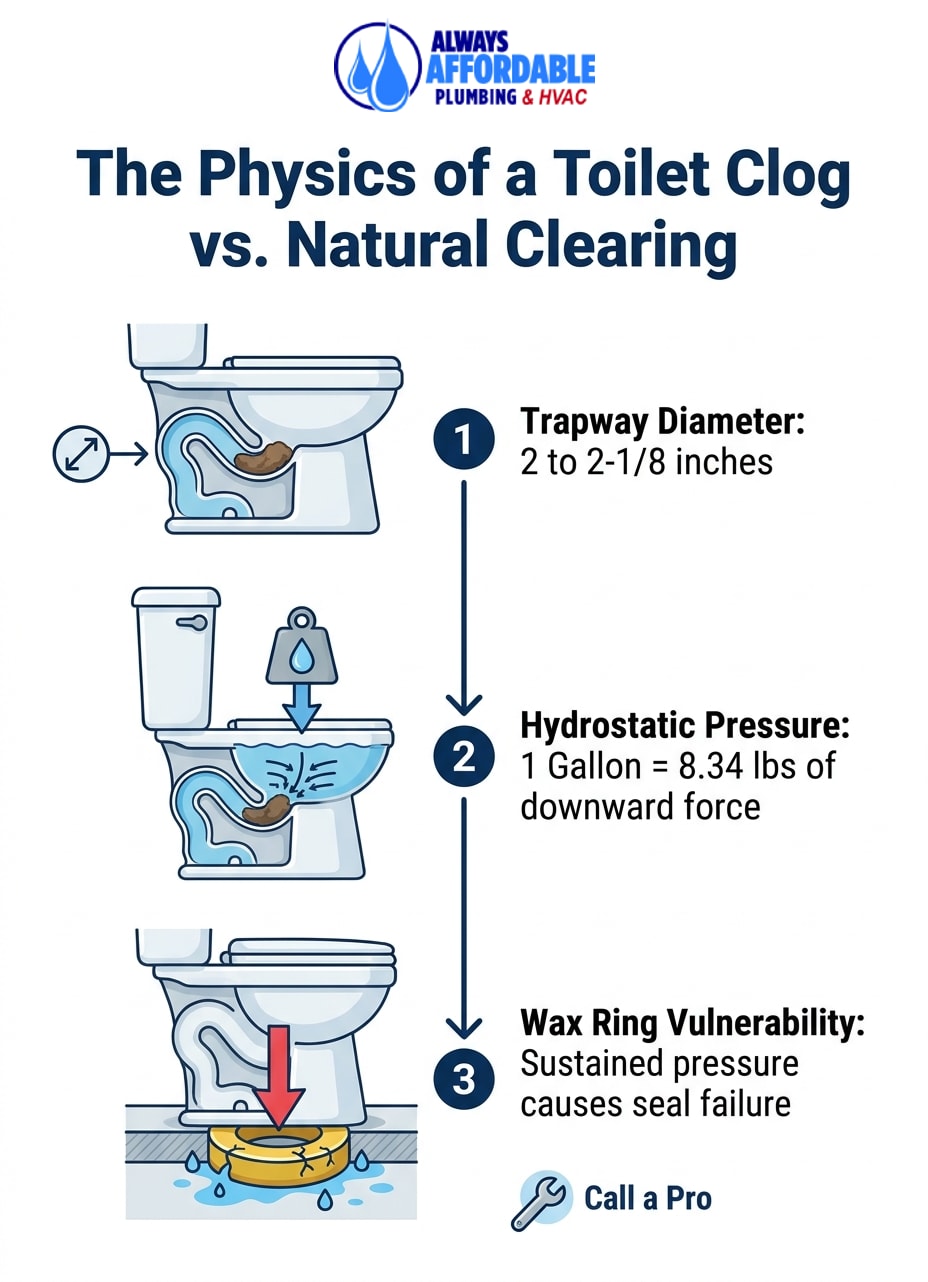
The standard toilet trapway—the internal channel that carries waste from the bowl to the floor drain—is typically only 2 to 2-1/8 inches in diameter. Furthermore, this trapway is not a straight drop. It is molded into a curved "S" or "P" shape. This upward and downward curve is an essential design feature. It is meant to hold a specific amount of water at all times, creating an airtight seal that prevents toxic, foul-smelling sewer gases from rising out of the municipal sewer line and into your bathroom.
However, this highly effective design also creates a natural bottleneck for solid mass. When heavy organic waste, dense wads of toilet paper, or non-degradable wipes enter this tight, 2-inch curved channel, they must navigate a sharp upward incline (the weir) before dropping down into the drainpipe. Physical blockages easily become wedged in these tight curves, creating a watertight seal against the smooth porcelain walls.
Our plumbers frequently see that once a dense mass is lodged tightly in the upward curve of the trapway, the static water pressure from the bowl above is mechanically unable to push it through. Gravity is simply pushing the standing water down against a solid wall of material that is braced against the curve of the pipe. Without the mechanical force of a professional auger or hydro-jetting equipment to break the mass apart, the trapway will stubbornly resist natural clearing, no matter how many hours you wait.
A pattern we see often at Always Affordable Plumbing & HVAC is homeowners assuming that leaving a clogged toilet overnight is harmless. The thought process is usually, "As long as nobody flushes it again, it won't overflow, so it is safe to leave." This perspective overlooks a specific, hidden danger that shifts the reality from "waiting is harmless" to "waiting causes active damage." That danger is hydrostatic pressure.
The weight of standing water: Water is remarkably heavy. One gallon of water weighs approximately 8.34 pounds. When a toilet is backed up to the brim, the bowl can hold two to three gallons of water, meaning there is between 16 and 25 pounds of continuous, heavy hydrostatic pressure pushing downward toward the base of the fixture.
The vulnerability of the wax ring: Your toilet is connected to the floor drain (the closet flange) by a wax ring. This ring is designed to create a watertight and airtight seal during the brief, momentary rush of water during a normal flush. It is not designed to act as a permanent waterproof barrier against hours of sustained, heavy static water pressure.
When a toilet remains full to the brim for hours or overnight, that sustained weight continuously presses against the wax ring. Over time, this heavy pressure can compromise and degrade the wax seal. Once the seal is breached, water begins to slowly seep out. Because the toilet base covers the flange, these leaks are often completely silent and unseen, spreading under your bathroom flooring.
Over weeks and months, a compromised wax ring leads to severe subfloor water damage, wood rot, and mold growth, turning a simple clog into a major structural repair. If you are unsure of what to do with standing water in a clogged toilet, the most critical step is to realize that leaving it to sit is actively putting your bathroom floor at risk.
When searching for answers about toilet clogs, many people want to know what actually breaks down waste and why the water in the bowl isn't doing the job. The effectiveness of natural degradation in standing water is severely limited by the environment inside the bowl and the materials involved.
Standard toilet paper is specifically manufactured for residential plumbing. It is designed to rapidly lose its structural integrity and disperse into tiny paper fibers as soon as it becomes saturated with water. However, this process relies on the agitation of the flush to help break the paper apart. In a stagnant, completely clogged bowl, even toilet paper dissolves much slower.
Heavy organic matter softens in water, but it does not rapidly dissolve in stagnant, room-temperature water. The enclosed, undisturbed environment of a blocked trapway prevents the rapid degradation needed to clear a severe blockage overnight.
The danger of flushable wipes: The biggest culprit in modern plumbing blockages is the "flushable" wipe. Despite the marketing on the package, these wipes are engineered with synthetic fibers designed to retain their structural integrity when wet—after all, that is how they function for personal hygiene. Because they do not break down in water, they will never dissolve in a trapway. They catch on minor imperfections in the pipe, accumulate, and form impenetrable blockages that require professional extraction.
Another common mistake homeowners make when facing a stagnant bowl is pouring harsh chemical drain cleaners into the water. This is highly dangerous and largely ineffective.
• Ineffective on solid mass: Chemicals rely on generating heat (an exothermic reaction) to burn through hair and grease in sink drains. They are entirely ineffective at dissolving dense organic matter or synthetic wipes lodged in a toilet trap.
• Damage to porcelain and pipes: The intense heat generated by chemical cleaners can crack the porcelain bowl of your toilet. Furthermore, if the chemicals fail to clear the clog, you are now left with a bowl full of highly toxic, caustic water that poses a severe burn hazard to you or the plumber who eventually has to mechanically clear the line.
Sometimes, a toilet that refuses to drain is not actually suffering from a localized clog in the trapway at all. It is crucial to broaden the scope to systemic plumbing issues, as a backed-up toilet is frequently the first visible symptom of a much larger problem deep underground: a main sewer line backup.
Environmental factors heavily influence plumbing infrastructure, especially in older homes. In our years of servicing the local area, we frequently see older homes that utilize aging cast iron or clay sewer laterals. While these materials were standard decades ago, they degrade over time, becoming brittle and developing hairline cracks.
The threat of tree roots: Regional dry spells drive thirsty tree roots deep underground in search of moisture and nutrients. When these roots sense the moisture vapor escaping from the tiny cracks in aging clay or cast iron pipes, they infiltrate the sewer line. Once inside, they rapidly expand into a dense, net-like root ball that catches all passing waste and paper.
If your main sewer line is compromised by root intrusion, no amount of waiting, plunging, or natural degradation will allow your toilet to drain. The blockage is not in the bathroom; it is buried under your front lawn.
Signs of a main line issue: You can usually distinguish a main line backup from a local toilet clog by observing the rest of the house. If you flush the toilet and water backs up into the bathtub or shower, or if running the washing machine causes the toilet to gurgle and bubble, the main line is obstructed. When these systemic issues arise across local service areas, professional camera inspections and specialized drain clearing equipment are the only way to locate and remove the deep-rooted blockage.
Shifting from emergency problem identification to long-term prevention is the best way to protect your home from the stress of a severely clogged toilet. Proactive maintenance ensures your pipes remain clear and functional year-round.
Our team at Always Affordable Plumbing & HVAC highly recommends implementing best practices in your household to prevent the vast majority of severe blockages:
• Monitor what is flushed: Enforce a strict "toilet paper and human waste only" rule. Never flush paper towels, feminine hygiene products, cotton swabs, or dental floss.
• Ban all wipes: Even if a product claims to be "flushable" or "septic safe," throw it in the trash can. Wipes are the leading cause of severe residential and municipal sewer blockages.
• Address slow drains early: If your toilet seems to lack flushing power or drains slowly, do not wait for a complete backup. A slow drain is a warning sign of a developing blockage.
Beyond daily habits, routine professional maintenance is invaluable. Annual plumbing inspections can catch slow drains and minor root intrusions before they escalate into complete, messy blockages. Routine drain clearing removes the buildup of minerals, scale, and organic sludge that slowly narrows the diameter of your pipes over time.
For homeowners looking for peace of mind, joining a preventative plumbing maintenance club is a smart, proactive measure. Regular professional oversight ensures your entire plumbing system, from the toilet trapway to the main sewer lateral, remains in optimal condition, drastically reducing the likelihood of late-night emergencies.
In the end, waiting for a severely clogged toilet to fix itself is a persistent myth that risks wax ring failure, hidden water damage, and unnecessary stress. While a minor snag of toilet paper might occasionally soften enough to pass, a severe blockage caused by dense organics, wipes, or main line root intrusions will never clear on its own.
The criteria for calling a professional are straightforward: if you have attempted basic plunging, if the water level has not dropped after a few hours, or if you notice gurgling in other fixtures that suggests a systemic main line issue, it is time to act. Do not leave a bowl full of standing water overnight to exert hydrostatic pressure on your vulnerable floor seals.
At Always Affordable Plumbing & HVAC, we believe professional intervention is a safe, definitive solution to restore your home's hygiene. With transparent pricing and a 100% satisfaction guarantee, you can have complete confidence that your plumbing issues will be resolved correctly the first time. Instead of risking overnight damage and crossing your fingers, reach out for professional sewer and drain clearing to protect your home and restore your peace of mind immediately.
In most cases, a severe organic clog will not unclog itself. While human waste can soften slightly over many hours, it does not rapidly dissolve in cold, stagnant water. Because the toilet trapway is only about two inches wide and features sharp curves, a solid mass will remain wedged in place until it is mechanically broken apart and pushed through by professional equipment.
Nothing breaks down heavy organic waste instantly in a stagnant toilet bowl. While standard toilet paper is designed to disperse quickly in water, solid waste requires time, agitation, and bacterial action to break down—processes that do not occur rapidly in a backed-up fixture. Avoid using harsh chemical drain cleaners, as they are ineffective on solid masses and can severely damage the porcelain bowl.
You should not leave a severely clogged, full toilet sitting for more than a few hours. A bowl filled to the brim holds several gallons of water, exerting continuous hydrostatic pressure on the wax ring seal at the base of the toilet. Leaving this standing water overnight can cause the wax ring to fail, leading to silent leaks and severe water damage to the subfloor beneath the fixture.
A severely clogged toilet will almost never fix itself, regardless of how long you wait. While a very minor snag of excess toilet paper might soften enough to drain slowly after an hour or two, severe blockages involving wipes, heavy organics, or foreign objects will remain permanently lodged in the trapway until they are mechanically removed.
If the clog is partial, the water may slowly seep past the blockage over several hours, lowering the bowl level. However, this does not mean the clog is gone; the solid mass is still obstructing the pipe, and the toilet will likely back up again upon the next flush. A complete blockage will not drain at all and requires immediate professional clearing.
Yes, standing water in a backed-up toilet can absolutely cause a leak to appear in the ceiling downstairs. The continuous heavy pressure of the standing water can break the watertight seal of the wax ring beneath the toilet base. Once that seal fails, water slowly seeps into the flooring, eventually soaking through the subfloor and dripping through the ceiling below.
You can identify a main sewer line backup by looking for systemic symptoms across multiple plumbing fixtures. If flushing the toilet causes water to back up into the shower drain, or if running the washing machine causes the toilet to bubble and gurgle, the blockage is deep in the main line. Localized toilet clogs only affect the toilet itself, while main line issues affect the entire home's drainage.
See what our satisfied customers have to say about their experience with Always Affordable
Plumbing & HVAC.

"Chappy was very skilled in his knowledge of my HVAC unit. I greatly appreciate the quick response and experienced tech. The whole endeavor was made less stressful by his humor and honest conversation. I find comfort in knowing I now have a shop i trust for the next time."
"Tony, James, Ronnie did an amazing job setting up our new AC! They were quick, efficient, considerate, and polite! We appreciate them scheduling us in on such short notice. Definitely recommend this company!"
"Prompt, professional service with kindness and care. They came out to address both plumbing and AC issues. I received a courtesy call before they arrived. All issues were resolved the same day with integrity and respect. Thankful for businesses like this. Absolutely recommend to those that I love."
"Excellent service! Jason came out promptly and in addition to doing my outside faucet he also put in new irrigation equipment! All done perfectly! Jason was lovely"
"Honest with the assessment; friendly and good manners. No high pressure sales. Just good to honest "tell it like you see it" Thought my kitchen disposer needed an overhaul. But Jason, there Plumber gave me an honest lesson on what was really happening. Saved me hundreds, if I went the route of replacing. Thank you!"
"Absolutely 5 stars. If you are looking for affordable ,professional and kind. Chappy was excellent and very knowledgeable . I called in the morning because my air conditioner stopped working he was here within hours and fixed my air with a smile. I highly recommend Chappy and Always Affordable plumbing and Hvac."
"Scott and James were great. They got there quickly and diagnosed the problem with my A/C.They did a very thorough job testing everything. Sent me pictures and called to keep me informed. Got it done the next day and everything is working fine. Be glad when I get home so I can enjoy my new system. Thanks guys for a great job."
"Chappy was very helpful. He knew our issue right away, cleaned our coils. He also came on the same day we called and got our AC blowing cold air again."
"After some timing ’curfuffles’ the Tech Jason arrived and not only completed a speedy install on my toilet, he was personable & professional. Because of the timing issues Jason was attentive and showed up with everything needed! No extra store runs 😊 I was very comfortable with having this Tech in my Daughter’s home. We will definitely use this Service again."