Seasonal Home Maintenance Checklist: Preventing HVAC and Plumbing Emergencies
Prevent HVAC emergencies with a seasonal home maintenance checklist. Why proactive scheduling beats waiting for sudden failures. See what needs attention now.




You are staring at a rising bowl of water at 11:30 p.m., wondering what actually happens when you leave a waste-clogged toilet overnight. The exhaustion of a long day is setting in, and the last thing anyone wants to deal with right before bed is a severe, messy plumbing issue. This creates a highly common decision point for homeowners: do you leave the heavily soiled fixture to hopefully "fix itself" while you sleep, or do you roll up your sleeves and take immediate intervention steps?
Many people turn to search engines in this exact moment, typing in queries like will a clogged toilet fix itself overnight in hopes of finding a magical morning resolution. The temptation to simply close the bathroom door and walk away is strong. However, hoping for a passive fix often leads to an even more difficult extraction process the next day. Understanding the mechanics of your plumbing system can help you decide whether you need to call for professional plumbing services immediately, if you are dealing with a broader sewer line backup, or if a quick 20-minute mitigation strategy is all you need to safely go to sleep.
The short answer is no. A heavy waste clog will rarely, if ever, resolve itself simply by sitting in a bowl of still water. While minor blockages consisting entirely of lightweight tissue might soften enough to flush the next day, a severe obstruction involving solid human waste requires physical agitation or a chemical reaction to break the bond holding it inside the plumbing trap.
Leaving a blockage submerged in 8-12 hours of standing water does not change the biological density of solid waste. In fact, relying on time alone without any active intervention is one of the most common reasons minor bathroom clogs escalate into stubborn, compacted blockages that require professional augering.
To understand why waiting fails, you have to look at how different materials react to prolonged submersion in water. There is a vast difference between engineered paper products and biological waste.
• Toilet Paper — Design & Composition: Engineered with short cellulose fibers designed specifically for rapid water absorption. — Reaction to Standing Water: Breaks down and loses structural integrity almost immediately upon contact with water. — Overnight Outcome: Often dissolves enough to pass through the trapway passively.
• Solid Human Waste — Design & Composition: Biologically dense, containing lipids (fats), proteins, and fibrous materials. — Reaction to Standing Water: Resists breaking down in still water; absorbs moisture slowly without losing its core mass. — Overnight Outcome: Swells in size, becoming more firmly lodged in the porcelain trap.
• Flushable Wipes — Design & Composition: Woven with synthetic fibers to remain strong while wet. — Reaction to Standing Water: Does not dissolve or break apart in standing water at all. — Overnight Outcome: Remains completely intact, often acting as a net that catches other waste.
Because toilet paper is manufactured to disintegrate, people mistakenly assume everything else in the bowl will follow suit. But solid waste retains its density, meaning the clog you leave at midnight will likely be the exact same clog waiting for you at 7:00 a.m.
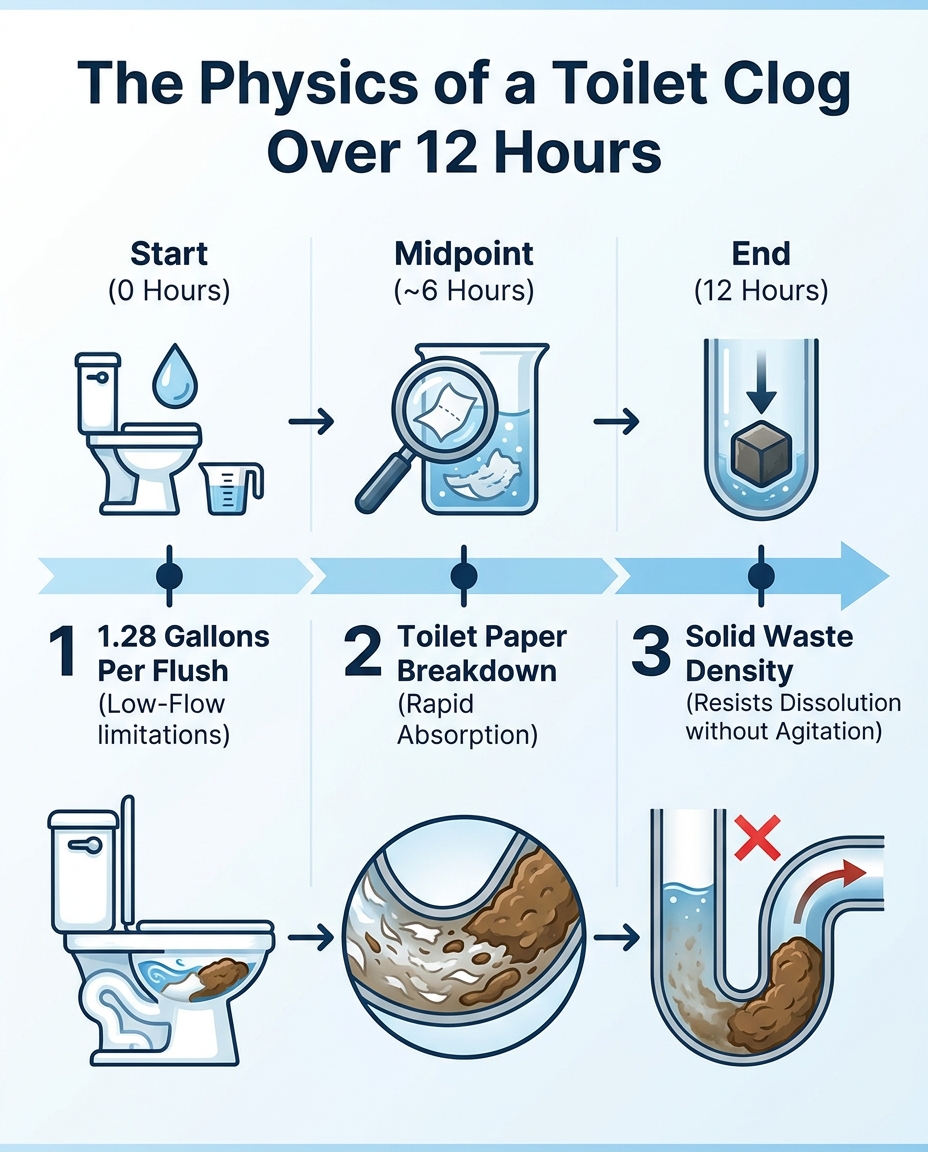
To truly grasp why the overnight waiting game is a losing strategy, it helps to understand the basic physics of your bathroom plumbing. Every toilet features a built-in "S-trap" or "P-trap"—a curved section of porcelain designed to hold a small amount of water to block sewer gases from entering your home. When a heavy obstruction hits the tightest curve of this trap, it creates a watertight seal.
The role of hydrostatic pressure: When a bowl fills with water during a backup, that water exerts downward force, known as hydrostatic pressure. Homeowners often hope that this downward weight will eventually push the blockage through. However, the volume of water in a standard toilet bowl simply does not generate enough head pressure to force a compacted, dense mass of solid waste up and over the curve of the trapway.
The swelling effect: Instead of dissolving, exposing organic material to 8-12 hours of standing water often causes the exact opposite of what you want. The outer layer of the waste absorbs the surrounding moisture, causing the entire mass to swell and expand against the unyielding porcelain walls. By the time morning arrives, the blockage has effectively cemented itself into the curve, making it significantly harder to plunge out than it would have been the night before.

The Physics of a Toilet Clog Over 12 Hours
The age and design of your fixture play a massive role in whether a clog can clear itself. Older toilets from the 1980s and early 1990s used upwards of 3.5 to 5 gallons per flush. That massive volume of water created significant downward pressure, which occasionally allowed minor clogs to push through after a long soak.
Today's plumbing landscape is entirely different. A modern low-flow toilet relies on the velocity of a siphon jet rather than sheer water volume to clear the bowl. Under California Title 20 appliance efficiency regulations, fixtures are mandated to use a maximum of 1.28 gallons per flush. For Sacramento area homes built or updated recently, this reduced water volume makes natural clog resolution even less likely.
When you are wondering will a clogged toilet fix itself overnight, you have to account for the fact that 1.28 gallons simply does not generate the heavy hydrostatic weight needed to overcome the friction of a swollen blockage. Once the flush cycle finishes and the water settles into a standing pool, the kinetic energy drops to zero. Without that high-velocity jet action, the low volume of water just sits passively on top of the obstruction.
If time and standing water aren't the answer, what actually breaks down poop in a toilet fast? Clearing a severe organic blockage requires one of three specific catalysts to break the structural bond of the waste.
• Kinetic Agitation: This is the most effective and immediate method. Plunging forces water rapidly back and forth against the obstruction. This kinetic energy physically breaks the clog apart and disrupts the suction holding it in the trapway. Relying purely on 8-12 hours of standing water removes agitation entirely from the equation.
• Surfactants and Lubrication: A surfactant (like liquid dish soap) lowers the surface tension of the water. Instead of just sitting on top of the clog, the soapy water penetrates the edges, lubricating the dry porcelain walls of the trapway and allowing the mass to slide through more easily.
• Biological Enzymes: Enzyme-based drain cleaners use natural bacteria to digest organic proteins and lipids. While highly effective for long-term pipe maintenance and breaking down waste, enzymes take days—not hours—to eat through a solid mass. They are not a viable solution for an immediate, late-night emergency.
Notice that "time alone" is not on this list. To clear a heavily soiled bowl, you must introduce an active agent to change the environment inside the pipe.
We know you are exhausted and just want to go to sleep. Fortunately, you do not need to spend an hour wrestling with a plunger at midnight. By applying the science of surfactants and thermal energy, you can perform a low-effort mitigation routine that takes about 20 minutes and sets you up for success.
Here is the exact step-by-step process for how to unclog a toilet with poop in it before bed:
1. Stop the water flow: If the bowl is dangerously full, locate the shut-off valve on the wall behind the fixture and turn it clockwise. This prevents any accidental overflows if someone tries to flush it again.
2. The Surfactant Addition: Squeeze a generous amount (about half a cup) of liquid dish soap directly into the standing water. Dish soap is formulated to break down heavy biological lipids and grease.
3. The Thermal Catalyst: Heat a gallon of water on the stove or in the microwave until it is very hot, but not boiling. Pouring actively boiling water into a cold porcelain bowl can cause the fixture to crack instantly. Carefully pour the hot water into the bowl from waist height to generate some initial downward force.
4. The Short Dwell Time: Instead of waiting all night, let this hot, soapy mixture sit for exactly 20 to 30 minutes. The heat accelerates the breakdown of the fats, while the soap lubricates the porcelain trap.
5. Gentle Agitation: After 30 minutes, take a flange plunger (the type with a pull-out sleeve at the bottom, not a flat cup plunger) and gently plunge the drain hole. Because the soap and heat have done the heavy lifting, it should only take a few gentle thrusts to break the seal and send the water down the drain without causing massive splashback.
If you are struggling with clearing a stubborn toilet clog, this hot water and soap method provides the best chance of success. This proactive 30-minute routine is far more effective than asking will a clogged toilet fix itself overnight and waking up to a worse problem.
Sometimes, despite your best efforts with dish soap and a plunger, the water absolutely refuses to recede. When a blockage resists basic mitigation, it usually means the problem has moved beyond the fixture's internal trap and into the deeper drainage system.
Signs you have a deeper system issue:
• Cross-fixture backups: If plunging the toilet causes water to bubble up in your shower drain or bathtub, the clog is located in the shared branch line, not the toilet itself.
• Gurgling sounds: Hearing a rhythmic gurgling noise from the sink when you attempt to flush indicates a venting issue or a partial main line obstruction blocking airflow.
• Zero water movement: If you have already tried the soap mitigation and left the bowl filled with 8-12 hours of standing water to no avail, and the water level hasn't dropped a single millimeter, the obstruction is completely watertight and likely lodged deep in the main sewer line.
At Always Affordable Plumbing, our commitment to honest advice and transparent pricing means helping you understand what you can safely wait out versus when you actually need emergency intervention. We never want homeowners pouring harsh, caustic chemicals into a standing bowl, as these acids sit idle, generate dangerous fumes, and can permanently damage the porcelain and internal seals. When the simple tricks fail, having access to comprehensive plumbing solutions ensures the blockage is extracted safely using professional-grade augers or hydro-jetting equipment.
When you are standing in your bathroom late at night, the answer to will a clogged toilet fix itself overnight is almost always no. Leaving a heavily soiled, waste-clogged toilet to sit in still water merely allows the organic material to swell and compact further into the plumbing trap.
Instead of relying on false hope and waking up to a stressful morning, take 20 minutes to apply hot water and dish soap. This low-effort, science-backed mitigation strategy breaks down surface tension and lubricates the porcelain, allowing a gentle plunge to clear the way. If the water still won't budge, you can safely go to sleep knowing you tried the right steps, and that a professional team is ready to clear the deeper line obstruction for you the next day. Understanding what actually happens when you leave a waste-clogged toilet overnight empowers you to make the smart, safe choice for your home's plumbing.
Minor clogs consisting only of toilet paper may eventually soften and unclog themselves, but severe blockages will not. Toilet paper is engineered to dissolve rapidly in water, losing its structural integrity over a few hours. However, solid human waste, flushable wipes, and foreign objects retain their density and will remain lodged in the trapway regardless of how long they sit in standing water.
If a clog is going to naturally clear due to toilet paper dissolving, it typically takes between one to three hours. If the water level in the bowl has not dropped at all after this window, the obstruction is too dense to break down passively. Waiting any longer than a few hours usually causes organic waste to swell, making the eventual removal much more difficult.
The fastest way to break down solid waste in a toilet bowl is by introducing a combination of thermal energy and a surfactant, followed by kinetic agitation. Pouring a half-cup of liquid dish soap and a gallon of hot (not boiling) water into the bowl lubricates the trapway and begins breaking down the biological lipids. After a 20-minute dwell time, using a flange plunger provides the necessary agitation to push the softened mass through.
Yes, you can leave a plunger resting in the toilet bowl overnight, but it will not actively help clear the clog. The rubber flange will simply sit in the standing water without creating the necessary kinetic force. If you are too exhausted to plunge the toilet at night, it is perfectly safe to leave the tool in the bowl so it is ready for use in the morning.
Yes, the hot water and dish soap method is highly effective for localized organic clogs trapped in the fixture's porcelain curve. The dish soap acts as a heavy lubricant and surfactant, reducing the surface tension of the water, while the heat accelerates the breakdown of fats in the waste. However, this method will not work if the obstruction is located deeper down in the home's main sewer line.
See what our satisfied customers have to say about their experience with Always Affordable
Plumbing & HVAC.

"Chappy was very skilled in his knowledge of my HVAC unit. I greatly appreciate the quick response and experienced tech. The whole endeavor was made less stressful by his humor and honest conversation. I find comfort in knowing I now have a shop i trust for the next time."
"Tony, James, Ronnie did an amazing job setting up our new AC! They were quick, efficient, considerate, and polite! We appreciate them scheduling us in on such short notice. Definitely recommend this company!"
"Prompt, professional service with kindness and care. They came out to address both plumbing and AC issues. I received a courtesy call before they arrived. All issues were resolved the same day with integrity and respect. Thankful for businesses like this. Absolutely recommend to those that I love."
"Excellent service! Jason came out promptly and in addition to doing my outside faucet he also put in new irrigation equipment! All done perfectly! Jason was lovely"
"Honest with the assessment; friendly and good manners. No high pressure sales. Just good to honest "tell it like you see it" Thought my kitchen disposer needed an overhaul. But Jason, there Plumber gave me an honest lesson on what was really happening. Saved me hundreds, if I went the route of replacing. Thank you!"
"Absolutely 5 stars. If you are looking for affordable ,professional and kind. Chappy was excellent and very knowledgeable . I called in the morning because my air conditioner stopped working he was here within hours and fixed my air with a smile. I highly recommend Chappy and Always Affordable plumbing and Hvac."
"Scott and James were great. They got there quickly and diagnosed the problem with my A/C.They did a very thorough job testing everything. Sent me pictures and called to keep me informed. Got it done the next day and everything is working fine. Be glad when I get home so I can enjoy my new system. Thanks guys for a great job."
"Chappy was very helpful. He knew our issue right away, cleaned our coils. He also came on the same day we called and got our AC blowing cold air again."
"After some timing ’curfuffles’ the Tech Jason arrived and not only completed a speedy install on my toilet, he was personable & professional. Because of the timing issues Jason was attentive and showed up with everything needed! No extra store runs 😊 I was very comfortable with having this Tech in my Daughter’s home. We will definitely use this Service again."