The Physics of Flushing: How the Siphon Jet Clears Solid Waste
Why is your plunger failing? Understand how the siphon jet clears solid waste to see when a clog needs professional augering. Get clear answers today.


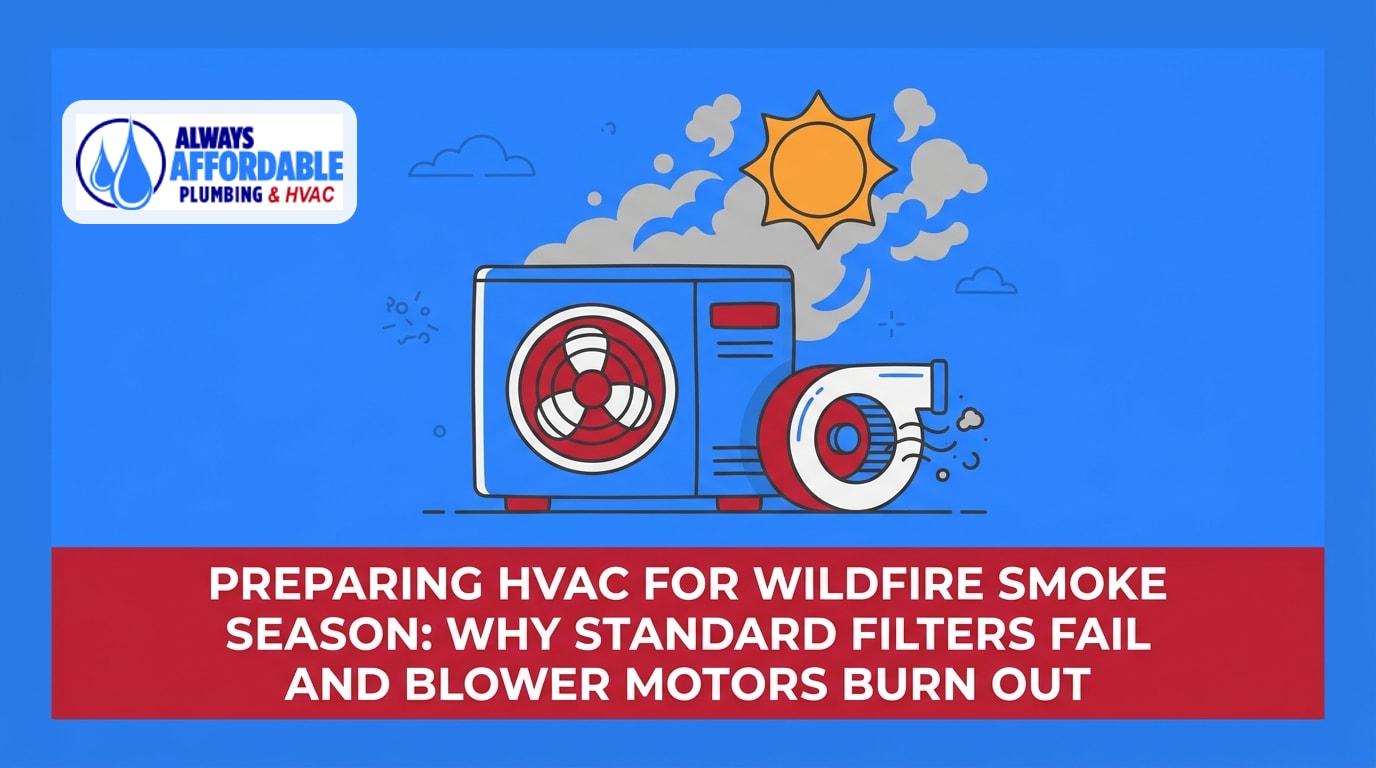
Summer in the valley brings more than just heat—it brings the inevitable haze that creeps over the hills and settles into our neighborhoods. As the sky turns orange and the air quality drops during the peak August-October smoke season, your first instinct is to seal the house and crank the AC. But properly preparing hvac for wildfire smoke season requires much more than just closing windows and hoping for the best.
At Always Affordable Plumbing & HVAC, our team typically sees homeowners caught in a frustrating dilemma. You want better indoor air quality to protect your family's lungs, but upgrading your filtration without professional guidance can unknowingly risk the health of your equipment. True air conditioning preparation means finding the exact balance between high-efficiency filtration and proper airflow. If you rely on standard HVAC services without addressing the specific mechanical demands of heavy smoke, you might be setting your system up for failure just when you need it most.
To understand why typical air conditioning setups struggle during a fire event, you have to look at the physical nature of the smoke itself. The primary danger in wildfire smoke is PM2.5 fine particulate matter. These microscopic particles are 2.5 micrometers in diameter or smaller. To put that into perspective, a single human hair is roughly 30 times larger than a PM2.5 particle.
Because they are so incredibly small, these fine particles easily bypass basic physical barriers. They slip through tiny gaps in window frames, slide under weather-stripping, and infiltrate residential ductwork that isn't perfectly sealed. Once inside, they remain suspended in the air for long periods.
This problem is severely compounded by local geography. In our experience servicing local neighborhoods, valley topographies often create inversion layers during hot, dry summers. A layer of warm air acts like a lid, trapping cooler air and heavy PM2.5 fine particulate matter close to the ground. Instead of the smoke blowing away in a day or two, these inversion layers can trap hazardous air for weeks. During these prolonged events, your HVAC system is forced to run continuously under heavy strain, constantly pulling in and attempting to process heavily polluted air. Short-term fixes simply are not enough for sustained events where the Air Quality Index (AQI) exceeds 150 (Unhealthy) for days on end.
There is a widespread misconception that any air filter will improve indoor air quality for the people living in the house. We constantly remind our customers that standard filters were never built for human lungs.
The Problem: You run your air conditioner during a heavy smoke day, but the house still smells like a campfire, and a fine layer of dust settles on your furniture.
The Cause: Standard 1-inch MERV 4 fiberglass filters were engineered with one specific purpose: to protect the internal HVAC equipment from large debris. They are designed to catch particles that are 10 microns or larger, such as pet hair, carpet fibers, and large dust bunnies. Because PM2.5 fine particulate matter is significantly smaller than 10 microns, it sails right through the wide, porous weave of a basic fiberglass filter without slowing down.
The Compounding Issue: As this microscopic ash circulates through your system, it doesn't just stay in the air. It builds up on the indoor evaporator coils. Because the coils are cold and often damp with condensation, the ash turns into a muddy sludge. This sludge insulates the coils, drastically reducing the system's cooling capacity and forcing it to run longer to reach your target temperature.
The Solution: Relying on a standard 1-inch filter during a heavy smoke event offers a false sense of security. Recognizing that these filters fail against PM2.5 is the first step toward implementing a real air quality strategy.
When homeowners realize their standard filter isn't working, a pattern we see often during fire season is the rush to the hardware store to buy the thickest, highest-rated filter on the shelf. The EPA generally recommends MERV 13 filters for wildfire smoke, which is accurate for capturing fine particles. However, there is a critical caveat that is often ignored: your specific HVAC system must be able to handle the increased airflow resistance.
This introduces the concept of "static pressure," measured in inches of water column (in. w.c.). Most residential systems are designed to operate at around 0.5 in. w.c. of total external static pressure. Think of it like breathing through a thin cotton sheet versus breathing through a heavy wool blanket. A dense MERV 13 filter acts like that wool blanket, spiking the pressure.
If you slide a highly restrictive filter into a system that was only designed for a basic 1-inch fiberglass filter, the blower motor is suddenly suffocated. It has to work twice as hard to pull the same amount of air through the dense material. Never attempt DIY static pressure modifications or blower motor adjustments to compensate for this; altering blower speeds or ducting requires a licensed professional to prevent severe electrical hazards and equipment damage.
• Restricted air volume: Dense filter media physically blocks the volume of air the blower motor can pull, creating a vacuum effect in the return duct.
• Excess electrical draw: To compensate for the restriction, the motor draws more electricity, working constantly at its maximum capacity.
• Dangerous overheating: Blower motors rely on the air passing over them to stay cool. With reduced airflow, the motor generates excess heat that cannot dissipate.
• Catastrophic failure: Over time, this continuous strain leads to burned-out wiring, failed capacitors, or a completely seized mechanical motor—especially in older PSC (Permanent Split Capacitor) motors that lack the adaptive capabilities of modern ECM blowers.

If you have recently upgraded your filter to combat the wildfire smoke season, we urge you to monitor your system for signs of mechanical distress. A suffocating system will usually give you warning signs before it completely breaks down.
• Unusual sounds: A struggling blower motor often whines, hums loudly, or sounds like it is physically straining to push air through the vents.
• Weak airflow: Hold a hand near your supply vents. If the air pressure feels noticeably lower or weaker than usual, the filter is likely restricting the blower.
• Erratic system cycling: Watch for short-cycling (turning on and off rapidly) or running continuously for 18+ hours a day without ever reaching the temperature set on the thermostat. Both indicate extreme mechanical strain.
• Unexpected odors: A faint burning smell or an electrical ozone odor coming from the vents can indicate a blower motor that is actively overheating.
You do not have to choose between breathing clean air and protecting your air conditioner. There are safe, expertly assessed alternatives to the DIY MERV 13 upgrade that will effectively manage indoor air quality without destroying your equipment.
The most important step is a professional static pressure test. A licensed technician uses specialized digital manometers to measure exactly how much resistance your ductwork and blower motor currently face. This data determines exactly what MERV rating your specific system can handle safely. Our technicians at Always Affordable Plumbing & HVAC believe in a transparent approach to system tune-ups and indoor air quality upgrades, prioritizing these honest static pressure assessments over pushy upselling.
If your system cannot handle a dense 1-inch filter, a common professional solution we install is a wider filter cabinet. Upgrading to a 4-inch or 5-inch media filter provides a massive increase in surface area. Because the pleated material is spread out over a larger space, it can offer a high MERV rating (capturing PM2.5) while maintaining incredibly low airflow resistance.
Additionally, supplementary indoor air quality (IAQ) upgrades, such as active air scrubbers or UV purification systems, can work in tandem with your existing HVAC setup. Having a qualified technician evaluate your system for proper HVAC care during smoke season ensures you get the right combination of filtration and airflow.
• Standard 1-Inch Fiberglass — PM2.5 Capture Ability: Very Poor — Airflow Resistance: Low — System Safety: Safe for equipment, poor for lungs
• 1-Inch MERV 13 (Unassessed) — PM2.5 Capture Ability: High — Airflow Resistance: Dangerously High — System Safety: High risk of blower motor failure
• 4 to 5-Inch Deep Media Cabinet — PM2.5 Capture Ability: High — Airflow Resistance: Low to Moderate — System Safety: Safe, balanced, and highly effective
Taking proactive steps before the sky turns gray can save you from uncomfortable days and expensive mechanical repairs. Use this seasonal checklist to prepare your home safely.
1. Seal the home envelope: Check for leaky ductwork, especially in unconditioned spaces like attics or crawlspaces. In our local area, we frequently find duct leakage rates of 20-30% in older homes, allowing fine smoke particles to bypass filtration entirely. Ensure all windows and doors are properly weather-stripped.
2. Schedule a pre-season inspection: Have a professional clean the evaporator coils and verify the electrical health of the blower motor before the heavy lifting begins. Clean coils transfer heat more effectively, reducing the total runtime of the system.
3. Verify thermostat settings: Consult with a professional about setting your thermostat fan to the correct position. Depending on your specific filtration setup, leaving the fan set to "on" might help filter the air continuously, but it can also pull in outdoor air if your ductwork is leaky.
4. Secure preventative maintenance: Enroll in a routine maintenance membership to ensure your system is regularly monitored, cleaned, and calibrated throughout periods of heavy mechanical strain.
MERV 13 is generally recommended for capturing the fine particles associated with wildfire smoke. However, this rating must be balanced against your specific system's static pressure limits. Installing a MERV 13 filter in a 10-15 year old system that hasn't been adjusted can severely restrict airflow, leading to equipment failure. Always have a professional verify your system's capacity before upgrading.
Yes, fine ash and particulate matter can cause significant wear on your air conditioner. The ash can coat the indoor evaporator coils, acting as an insulator that reduces cooling efficiency and can cause the system to freeze. Furthermore, the restricted airflow from rapidly clogging filters can overheat and burn out the blower motor.
Not necessarily; if you have proper filtration in place, running the AC can actually help clean and circulate the indoor air. The key is ensuring that any fresh air intake vents (if your system has them) are temporarily closed so you are only recirculating and filtering the indoor air, rather than pulling active smoke inside.
Running the AC only filters out smoke if the system is equipped with a filter capable of trapping PM2.5 fine particulate matter. If you are using standard 1-inch fiberglass filters, the system will simply recirculate the microscopic smoke particles throughout your home without removing them from the air.
Smoke odors can easily infiltrate your home through poorly sealed ductwork, unsealed windows, or natural gaps in the home's envelope. It is also important to note that standard physical air filters do not remove odors or volatile organic compounds (VOCs); they only trap physical particles, allowing the smell of smoke to pass right through the vents.
True protection during the wildfire smoke season requires the right balance of high-quality filtration and healthy mechanical airflow. As we've seen time and again at Always Affordable Plumbing & HVAC, standard 1-inch filters completely fail against microscopic smoke particles, but dropping a highly restrictive filter into an unassessed system can easily fail your equipment. You need a solution that clears the air without suffocating your blower motor. Before the peak of the season hits, reach out for a professional static pressure assessment to upgrade your home's air filtration safely and effectively.
See what our satisfied customers have to say about their experience with Always Affordable
Plumbing & HVAC.

"Chappy was very skilled in his knowledge of my HVAC unit. I greatly appreciate the quick response and experienced tech. The whole endeavor was made less stressful by his humor and honest conversation. I find comfort in knowing I now have a shop i trust for the next time."
"Tony, James, Ronnie did an amazing job setting up our new AC! They were quick, efficient, considerate, and polite! We appreciate them scheduling us in on such short notice. Definitely recommend this company!"
"Prompt, professional service with kindness and care. They came out to address both plumbing and AC issues. I received a courtesy call before they arrived. All issues were resolved the same day with integrity and respect. Thankful for businesses like this. Absolutely recommend to those that I love."
"Excellent service! Jason came out promptly and in addition to doing my outside faucet he also put in new irrigation equipment! All done perfectly! Jason was lovely"
"Honest with the assessment; friendly and good manners. No high pressure sales. Just good to honest "tell it like you see it" Thought my kitchen disposer needed an overhaul. But Jason, there Plumber gave me an honest lesson on what was really happening. Saved me hundreds, if I went the route of replacing. Thank you!"
"Absolutely 5 stars. If you are looking for affordable ,professional and kind. Chappy was excellent and very knowledgeable . I called in the morning because my air conditioner stopped working he was here within hours and fixed my air with a smile. I highly recommend Chappy and Always Affordable plumbing and Hvac."
"Scott and James were great. They got there quickly and diagnosed the problem with my A/C.They did a very thorough job testing everything. Sent me pictures and called to keep me informed. Got it done the next day and everything is working fine. Be glad when I get home so I can enjoy my new system. Thanks guys for a great job."
"Chappy was very helpful. He knew our issue right away, cleaned our coils. He also came on the same day we called and got our AC blowing cold air again."
"After some timing ’curfuffles’ the Tech Jason arrived and not only completed a speedy install on my toilet, he was personable & professional. Because of the timing issues Jason was attentive and showed up with everything needed! No extra store runs 😊 I was very comfortable with having this Tech in my Daughter’s home. We will definitely use this Service again."