Myth vs Reality: Will a Severely Backed-Up Toilet Clear Itself Overnight?
Wondering will a severely clogged toilet unclog itself over time? See why waiting overnight risks water damage and when to call a pro on this bathroom backup.


Your toilet is clogged, and no matter how aggressively you plunge, the water in the bowl simply refuses to go down. It is an incredibly frustrating scenario that leaves many homeowners feeling defeated. If you find yourself battling a stubborn blockage, understanding exactly how the siphon jet clears solid waste is the first step toward a permanent fix. In our years of providing plumbing solutions to the local area, our team at Always Affordable Plumbing & HVAC frequently reminds homeowners that toilets are not just porcelain bowls; they are carefully engineered hydraulic machines. When brute force fails to clear a blockage, the problem usually lies within the invisible fluid dynamics operating beneath the surface.
If you are dealing with a severe blockage that resists standard plunging, it is time to look into comprehensive plumbing services to secure professional plumbing assistance before the situation worsens.
The Anatomy of a Stubborn Blockage: Not all clogs are created equal. Soft blockages, like excess toilet paper, can often be dislodged with the simple hydraulic pressure created by a standard household plunger. However, dense solid waste blockages often resist plunging due to the specific, curved geometry of the toilet trapway. When you plunge repeatedly with no success, the issue is rarely a lack of effort on your part. Instead, it is highly likely that the toilet's internal mechanisms—specifically the siphon jet—have failed to create the necessary vacuum to pull the waste through the system.
Recognizing Siphon Jet Failure: The siphon jet relies on precise water pressure and vacuum dynamics to function. When this jet is functioning poorly, you lose the mechanical advantage required to move dense mass through the curved pipes. Recognizing this mechanical failure is the key decision point for homeowners. Continuing to plunge a toilet with a compromised siphon jet is a mathematically ineffective exercise that can damage the wax ring seal at the base of the fixture. Understanding these mechanics helps you know exactly when to put the plunger away and seek professional diagnostic tools.
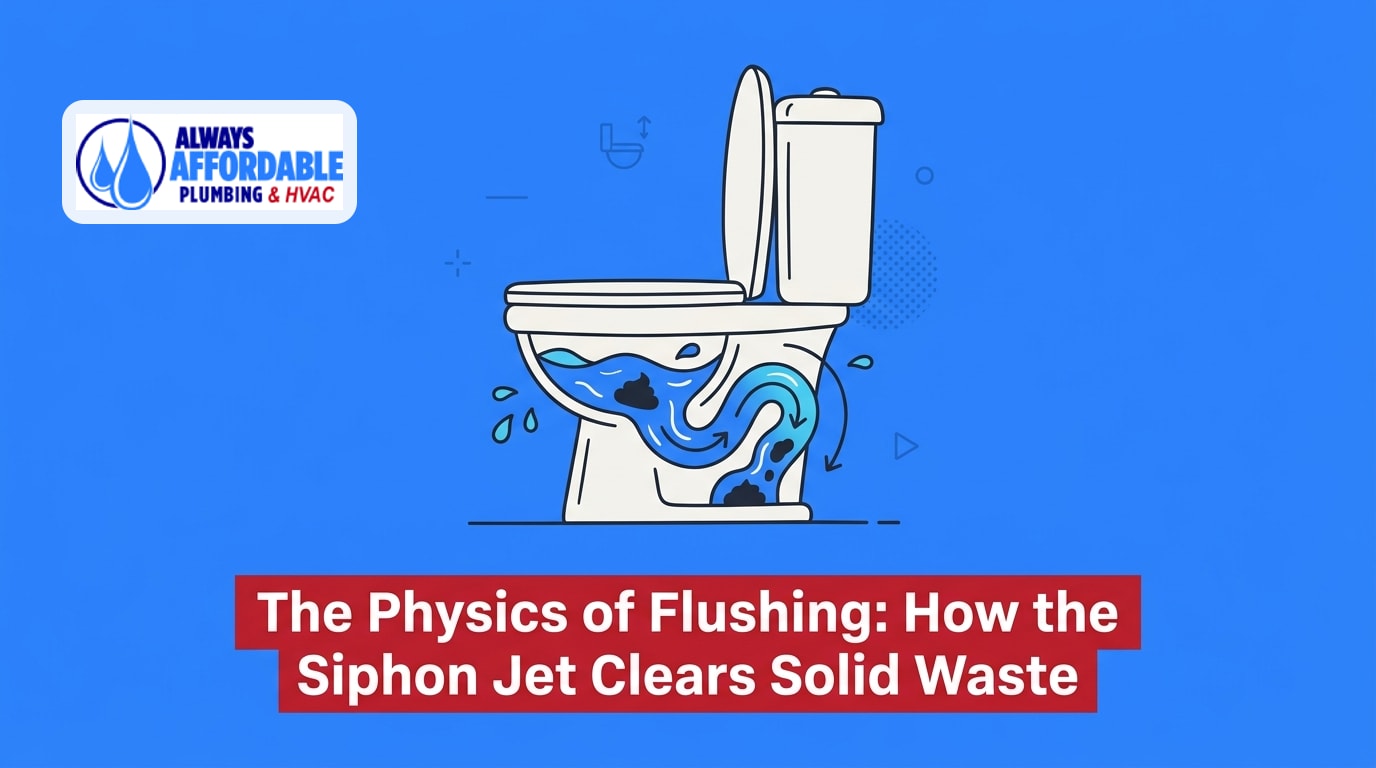
To understand why a toilet fails to clear, you must first understand how it is designed to work. The magic of a modern gravity-fed toilet does not happen in the tank; it happens in the bowl, driven by a small, often overlooked feature called the siphon jet. Located at the bottom of the bowl and pointing directly into the trapway opening, the siphon jet is the engine of the flushing mechanism. It is responsible for providing the concentrated water velocity necessary to push water over the internal weir (the highest point of the trapway) and initiate the flushing action.
The process of moving dense waste requires a specific combination of water volume and targeted pressure. Here is the step-by-step mechanical sequence of a successful flush:
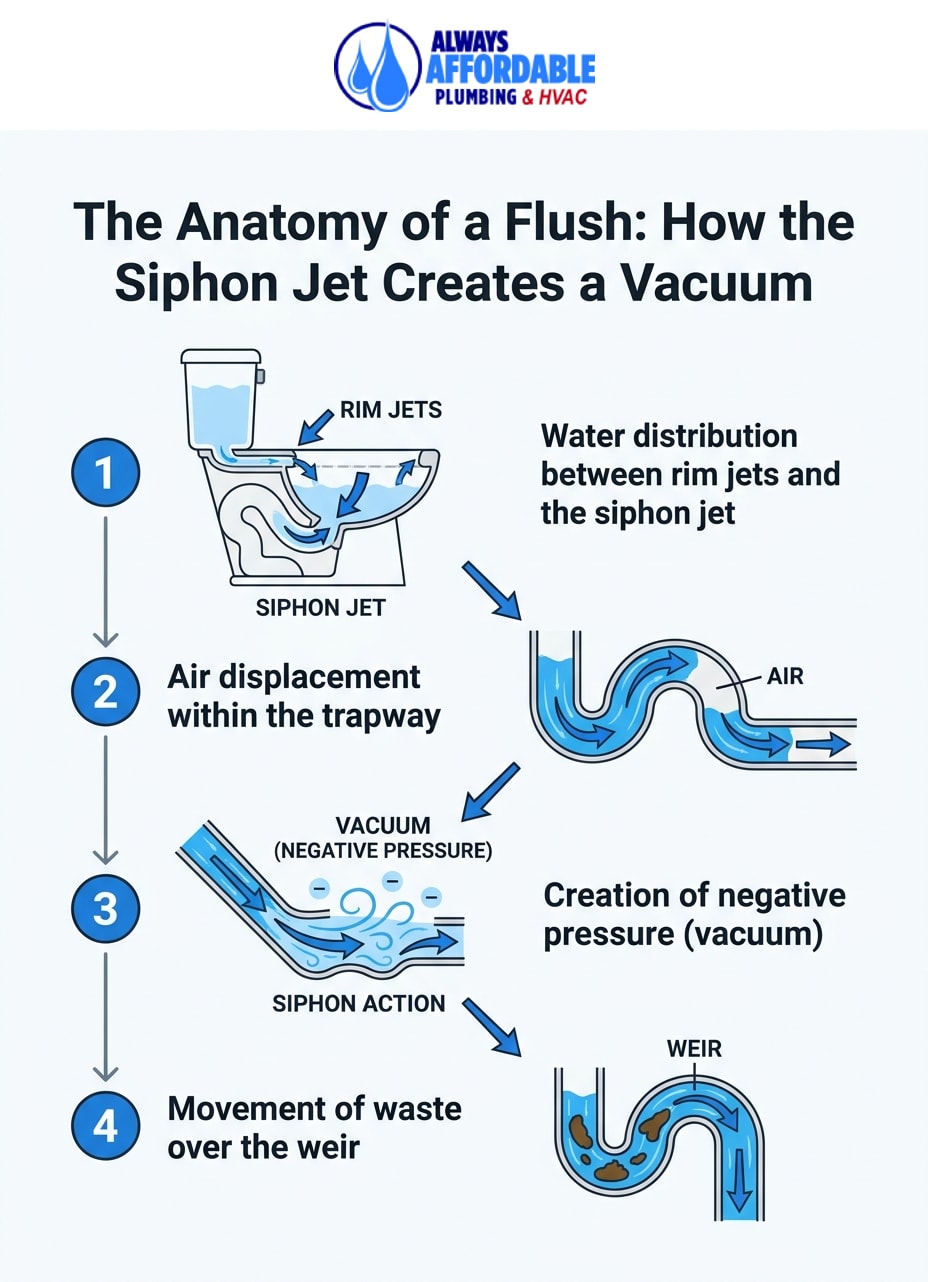
1. The Release: The flush valve opens in the tank, dropping roughly 1.28 to 1.6 gallons of water down into the bowl in a matter of seconds.
2. The Split: This water is divided into two paths. A smaller portion travels through the rim jets to rinse the sides of the bowl, while the vast majority is funneled directly into the siphon jet at the base.
3. The Push: The siphon jet forcefully ejects this water directly into the trapway, creating a concentrated stream of high-velocity fluid.
4. The Clear: This targeted pressure forces the standing water and waste up and over the trapway weir, triggering the siphon effect that pulls the remaining contents out of the bowl and into the drain line.
The true power of the siphon jet lies in its ability to manipulate air and water pressure. As the rapid influx of water shoots through the siphon jet, it forcefully displaces the air resting inside the trapway. By pushing the air out and filling the curved pipe entirely with fast-moving water, the system creates a state of negative pressure, or a vacuum.
This vacuum is what actively pulls the waste down into the sewer system. It does not merely rely on gravity to let the water fall; the siphon jet water pressure and vacuum dynamics physically drag the dense solid mass through the friction points of the porcelain bends. Without the initial, high-velocity push from the siphon jet, this vacuum never forms, and the water simply rises in the bowl without ever triggering a true flush.
To fully grasp why some waste gets stuck and resists plunging, we have to examine the internal anatomy of the toilet itself. Every toilet features a built-in trapway—a curving channel of porcelain that connects the bottom of the bowl to the drainpipe in the floor or wall. This curved design is not accidental; it is a vital safety feature required by modern plumbing codes.
The primary purpose of standard S-trap and P-trap toilet configurations is to hold a small amount of standing water in the bowl at all times. This water acts as a physical, airtight seal that prevents hazardous, foul-smelling sewer gases (like hydrogen sulfide and methane) from rising out of the municipal sewer lines and entering your living space. While these bends are necessary for health and safety, they inherently create natural friction points where dense solid waste can easily become lodged.
• Shape Design — S-Trap Configuration: Curves in an "S" shape, directing waste downward. — P-Trap Configuration: Curves in a "P" shape, directing waste horizontally.
• Drain Connection — S-Trap Configuration: Connects to a drain pipe located in the floor. — P-Trap Configuration: Connects to a drain pipe located in the wall.
• Common Usage — S-Trap Configuration: Standard in most residential floor-mounted toilets. — P-Trap Configuration: Common in commercial settings or wall-mounted residential toilets.
• Friction Profile — S-Trap Configuration: Sharp downward curve creates a high-friction point at the weir. — P-Trap Configuration: Horizontal exit requires strong sustained vacuum to clear.
Because these trapways force water and waste to travel upward against gravity before falling into the drain, the siphon jet's power is specifically calibrated to overcome this exact structural resistance. If the jet loses even a fraction of its velocity, the fluid dynamics fail, and dense waste will inevitably stall at the tightest curve of the trapway, resulting in a clog that simple plunging cannot easily dislodge.
One of the most common and frustrating scenarios homeowners face is a partial flush. You press the handle, the water swirls, the liquid clears the bowl, but the solid waste remains stubbornly at the bottom. Dealing with a clogged toilet with poop can be highly unpleasant, but it is important to address this topic from a strictly mechanical perspective. Based on the countless service calls our team handles, a pattern we see often is that this phenomenon is a classic indicator of a specific fluid dynamics failure rather than a total pipe blockage.
The Mechanical Problem: When a toilet flushes liquid but leaves solids behind, it means the system has enough basic gravity flow to move water, but it lacks the concentrated velocity required to move mass. Dense solid waste requires a powerful, sustained vacuum to be pulled up and over the trapway weir. Liquid, on the other hand, can simply spill over the weir as the water level in the bowl rises.
The Underlying Cause: This specific mechanical failure almost always points to a partially obstructed siphon jet. If the jet hole at the bottom of the bowl is restricted, the water exiting it lacks the speed and force necessary to displace the air in the trapway. Without that rapid air displacement, the vacuum never forms. The water from the tank simply fills the bowl and drains out slowly over the weir, leaving heavier objects behind. This is a very different issue from a complete trapway clog, where neither liquid nor solid can pass through.
The Analytical Solution: Fixing this issue requires diagnosing the exact mechanical reason your toilet flushes water but leaves solid waste behind. Plunging will not solve this problem because there is no actual obstruction in the pipe to push away; the issue is a lack of suction power originating from the jet itself. Restoring the toilet's function means restoring the siphon jet's full diameter and water velocity.
If the siphon jet is responsible for the toilet's flushing power, what causes it to fail over time? The answer usually lies in the local water supply. Water quality directly impacts the longevity and performance of internal toilet mechanics. In regions with highly mineralized water, environmental factors naturally degrade siphon jet performance year after year.
The Impact of Regional Hard Water: The Sacramento Valley is known for having hard water, meaning the municipal water supply carries high concentrations of dissolved minerals, primarily calcium and magnesium. While safe for consumption, our technicians at Always Affordable Plumbing & HVAC consistently see this hard water wreak havoc on local plumbing fixtures. As water sits in the toilet bowl and slowly evaporates, it leaves behind microscopic deposits of calcium carbonate. Over months and years, this calcium carbonate scale slowly builds up inside small orifices like the rim holes and the siphon jet.
The Mathematics of Restriction: The buildup of mineral scale is insidious. Because the siphon jet is already a small opening, even a single millimeter of hard water scale can significantly reduce its overall diameter. In fluid dynamics, reducing the diameter of an opening exponentially decreases the volume of water that can pass through it in a given amount of time.
• Velocity Loss: The water exiting a scaled jet is sluggish rather than forceful.
• Vacuum Failure: The sluggish water cannot push the air out of the trapway fast enough to create a siphon.
• Mimicking a Clog: When the jet is scaled over, the toilet loses its mechanical ability to clear dense solid waste. To the homeowner, this mimics the exact symptoms of a deep, stubborn clog, leading to endless, fruitless plunging.
Because this scaling happens gradually, homeowners often do not notice the slow decline in flush power until the day the toilet completely fails to clear a solid mass.
When faced with a toilet that won't flush, the instinct is to grab a plunger and apply as much force as possible. However, understanding the mechanics of the siphon jet and the geometry of the trapway reveals exactly why DIY plunging is often mathematically ineffective.
The Limits of Hydraulic Pressure: A standard plunger relies on creating hydraulic pressure. When you compress the rubber cup, you force water down into the trapway, attempting to push the blockage through the bends. This works reasonably well for soft, loose obstructions situated near the bowl opening. However, if the blockage is dense and lodged deep within the sharp curves of an S-trap or P-trap, the force generated by a hand-operated plunger is often insufficient to overcome the friction holding the mass in place.
When the Siphon Jet is the Real Issue: Plunging becomes completely useless when the root cause of the problem is a scaled-over siphon jet. If the jet cannot create a vacuum, pushing water back and forth with a plunger will not magically restore the toilet's flushing power. You are treating a symptom (remaining waste) rather than the disease (lack of suction).
Professional Mechanical Solutions: Overcoming these physical limitations requires scientifically sound solutions that address the root mechanical failure without damaging the porcelain fixture.
• Closet Augering: Professionals utilize a closet auger, a specialized tool designed to navigate the specific curves of a toilet trapway to physically break up or retrieve dense blockages that a plunger cannot move.
• Jet Descaling: If mineral scale is the culprit, professionals have methods to safely descale and clear the siphon jet and rim holes, restoring the original factory water velocity.
Furthermore, if you are experiencing severe or recurring blockages across multiple fixtures, the problem might not be isolated to the toilet's trapway at all. These symptoms can indicate serious issues further down the line, requiring professional main sewer line services to clear tree roots or structural pipe blockages.
When a toilet flushes liquid but leaves solid waste behind, it indicates a failure in the siphon jet's ability to create a vacuum. Liquid can simply spill over the internal trapway weir using gravity, but moving dense solid mass requires a powerful suction force. This usually points to a partially blocked or scaled-over siphon jet that cannot push water fast enough to trigger a full flush.
The siphon jet is the small, targeted opening located at the very bottom of the toilet bowl, pointing directly into the drain hole (trapway). During a flush, the majority of the water from the tank is forced through this jet at high velocity. This rapid stream of water displaces the air in the trapway, initiating the vacuum suction that pulls waste out of the bowl.
Clearing a blocked siphon jet requires breaking down the mineral scale that has accumulated inside the orifice without scratching or damaging the porcelain. While mild scale can sometimes be loosened with specialized mineral-dissolving treatments, severe calcification deep within the jet often requires professional descaling tools. Because the jet is delicate and essential to the toilet's function, mechanical clearing is best left to a professional plumber.
A slow-flushing toilet is typically caused by restricted water flow from the tank to the bowl, preventing the rapid air displacement needed for a strong siphon. This restriction is most commonly due to mineral scale buildup in the rim jets or the main siphon jet. It can also be caused by a flapper valve that closes too quickly or a partial obstruction deep within the trapway.
The difference lies in the shape of the internal plumbing channel and where it connects to your home's drain system. An S-trap curves in an "S" shape and directs waste downward into a floor drain, which is standard for most residential bathrooms. A P-trap curves horizontally into a "P" shape and connects to a drain pipe in the wall, commonly seen in commercial buildings or wall-mounted residential toilets.
You can identify hard water scale by looking for crusty, white, yellow, or rust-colored rings around the water line and specifically around the rim holes and the jet opening at the bottom of the bowl. Mechanically, you will notice a gradual decrease in flushing power over time, culminating in partial flushes where the water swirls weakly rather than pulling down with a strong, definitive suction.
Struggling with a stubborn clog is rarely a reflection of a lack of effort; more often than not, it is a strict mechanical limitation dictated by the siphon jet or the physics of the trapway itself. When plunging proves mathematically ineffective against dense solid waste or a scaled-over jet, understanding these internal fluid dynamics is the first step toward a permanent, stress-free solution.
You do not have to fight a losing battle against plumbing physics. Always Affordable Plumbing & HVAC offers transparent, affordable pricing and a 100% satisfaction guarantee, entirely removing the stress of calling a professional for stubborn solid waste clogs. When standard plunging isn't enough, reaching out for a professional assessment ensures your toilet's flush power is fully and safely restored.
See what our satisfied customers have to say about their experience with Always Affordable
Plumbing & HVAC.

"Chappy was very skilled in his knowledge of my HVAC unit. I greatly appreciate the quick response and experienced tech. The whole endeavor was made less stressful by his humor and honest conversation. I find comfort in knowing I now have a shop i trust for the next time."
"Tony, James, Ronnie did an amazing job setting up our new AC! They were quick, efficient, considerate, and polite! We appreciate them scheduling us in on such short notice. Definitely recommend this company!"
"Prompt, professional service with kindness and care. They came out to address both plumbing and AC issues. I received a courtesy call before they arrived. All issues were resolved the same day with integrity and respect. Thankful for businesses like this. Absolutely recommend to those that I love."
"Excellent service! Jason came out promptly and in addition to doing my outside faucet he also put in new irrigation equipment! All done perfectly! Jason was lovely"
"Honest with the assessment; friendly and good manners. No high pressure sales. Just good to honest "tell it like you see it" Thought my kitchen disposer needed an overhaul. But Jason, there Plumber gave me an honest lesson on what was really happening. Saved me hundreds, if I went the route of replacing. Thank you!"
"Absolutely 5 stars. If you are looking for affordable ,professional and kind. Chappy was excellent and very knowledgeable . I called in the morning because my air conditioner stopped working he was here within hours and fixed my air with a smile. I highly recommend Chappy and Always Affordable plumbing and Hvac."
"Scott and James were great. They got there quickly and diagnosed the problem with my A/C.They did a very thorough job testing everything. Sent me pictures and called to keep me informed. Got it done the next day and everything is working fine. Be glad when I get home so I can enjoy my new system. Thanks guys for a great job."
"Chappy was very helpful. He knew our issue right away, cleaned our coils. He also came on the same day we called and got our AC blowing cold air again."
"After some timing ’curfuffles’ the Tech Jason arrived and not only completed a speedy install on my toilet, he was personable & professional. Because of the timing issues Jason was attentive and showed up with everything needed! No extra store runs 😊 I was very comfortable with having this Tech in my Daughter’s home. We will definitely use this Service again."