Seasonal Home Maintenance Checklist: Preventing HVAC and Plumbing Emergencies
Prevent HVAC emergencies with a seasonal home maintenance checklist. Why proactive scheduling beats waiting for sudden failures. See what needs attention now.



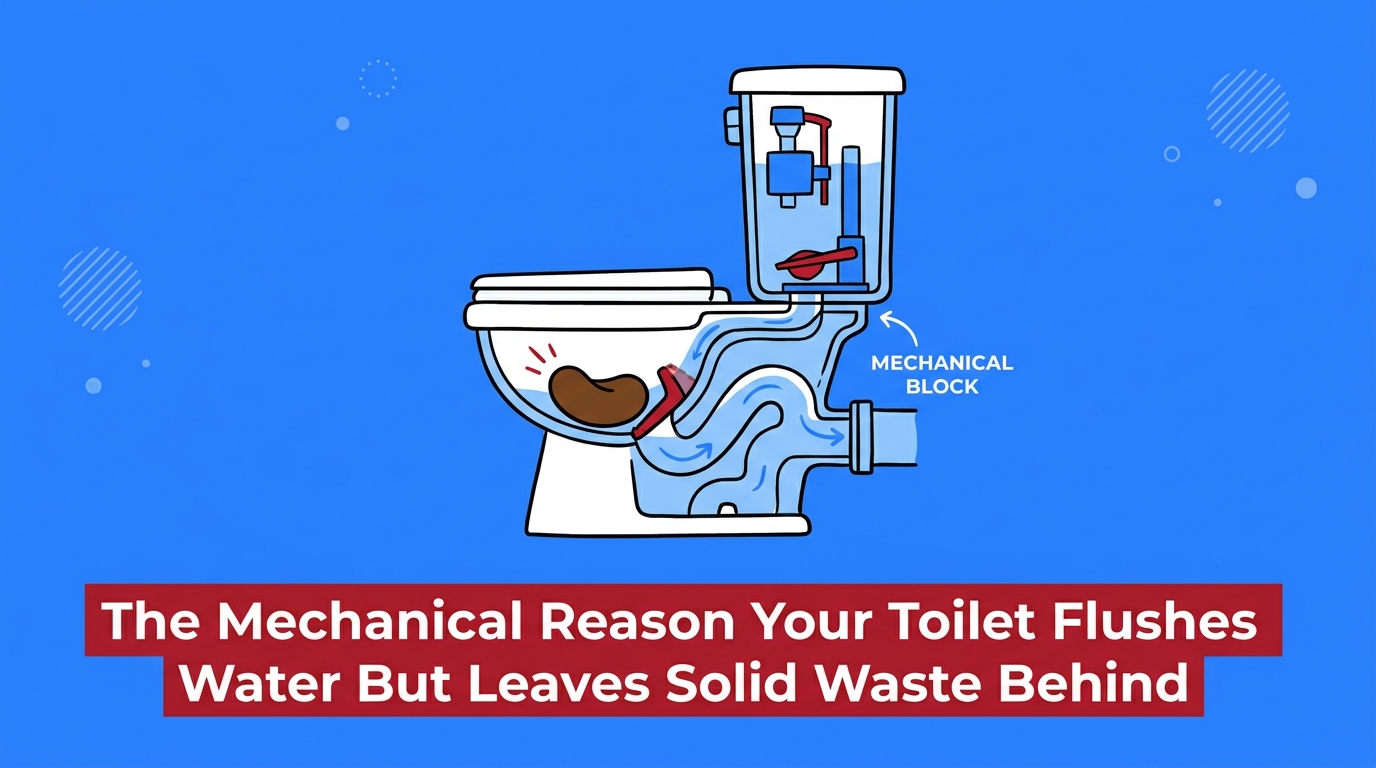
At Always Affordable Plumbing & HVAC, our team frequently responds to calls where homeowners are repeatedly plunging a seemingly clear bowl. If you find yourself in this situation, you are likely dealing with the mechanical reason your toilet flushes water but leaves solid waste behind. You press the handle, the water swirls normally, and the liquid drains over the internal trap. Yet, when the cycle finishes, the heavier organic matter remains sitting at the bottom of the bowl. This specific failure is incredibly frustrating because traditional plunging does absolutely nothing to fix it.
Most homeowners immediately assume they have a standard clog. They reach for the plunger, apply heavy pressure, and try to force the obstruction down the line. However, a toilet requires precise mechanical coordination to pull solid waste through the trapway. When that coordination breaks down, the fixture loses its pulling power entirely. Figuring out if the issue is a simple mineral blockage requiring descaling or a deeper fixture failure is the most important decision you can make before spending money on repairs.
Understanding these hidden mechanics prevents unnecessary, aggressive plunging that can damage your wax ring and cause leaks. If you are tired of double-flushing, it is time to look beyond the plunger. By identifying symptoms like reduced water flow pressure from rim holes, you can determine exactly what is failing. For a complete assessment of your household fixtures, reaching out for professional plumbing services is the safest way to restore full functionality.
A flush is not just a matter of water falling from a tank into a bowl. It is a carefully engineered fluid dynamic process designed to move heavy material up, over, and down a curved pipe. Shifting your focus from "clogs" to "fluid dynamics" is the key to understanding why your fixture is failing.
Gravity-fed toilets rely on a specific volume of water entering the bowl in a matter of seconds. When you press the handle, the flapper lifts, and water rushes downward. This rapid drop is non-negotiable. Any delay in this water delivery weakens the flush immediately. The bowl must fill fast enough to completely cover the trapway opening at the bottom of the fixture.
Key factors in water delivery:
• Flapper timing: The flapper must stay open long enough to drain the majority of the tank.
• Fill valve performance: The tank must have enough starting volume to create the necessary weight.
• Unrestricted pathways: The channels connecting the tank to the bowl must be completely clear of debris.
The trapway is the S-shaped channel built into the porcelain. To move solids, the rapid influx of water must push air out of this channel and fill it entirely with water. Once the channel is full, a vacuum forms. This vacuum is what physically pulls solid waste up and over the internal trap (the weir). Without a proper seal and high velocity, the vacuum fails to form entirely. Liquid will simply drain gently over the weir, but heavier solids will be left behind.
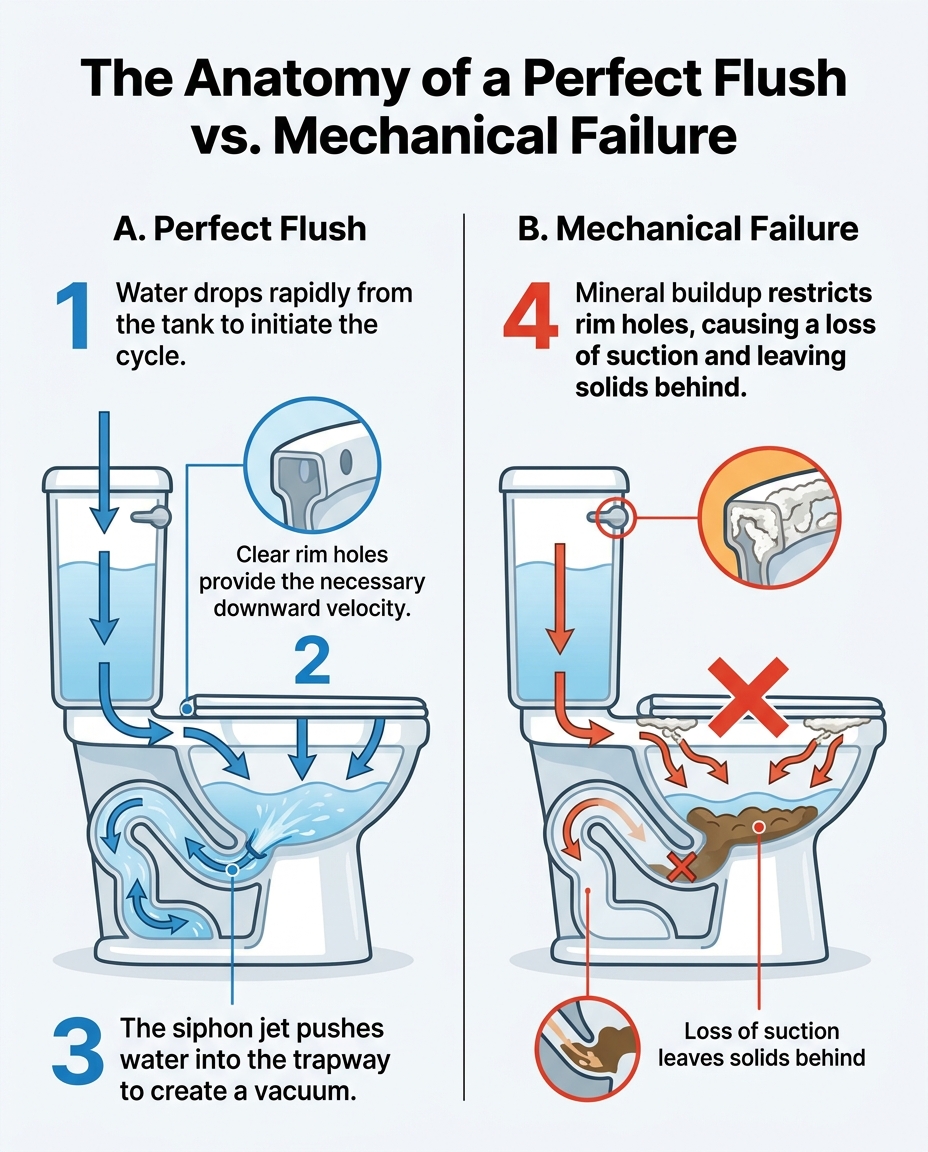

The small holes tucked under the rim of your toilet bowl do much more than just wash the porcelain. They dictate the exact speed and angle of the water entering the bowl. When these pathways are compromised, the entire fluid dynamic process falls apart.
Calcium and magnesium deposits from hard water gradually reduce the diameter of these rim holes over time. Because this happens out of sight, most homeowners miss the early warning signs. As the holes shrink, you will directly observe reduced water flow pressure from rim holes. This reduced pressure destroys the velocity needed to initiate the siphon for solid waste.
Signs of hard water scaling to look for:
• Dark streaks: Mineral deposits often trap bacteria, leaving dark vertical streaks on the bowl.
• Crusty deposits: White or yellow scaling directly underneath the rim.
• Uneven water flow: Water cascading down only one side of the bowl during a flush.
The quick inspection trick: Take a small handheld mirror and hold it under the rim of the bowl. If the holes look jagged, crusted over, or completely sealed shut, hard water is choking your flush.
In our years of experience serving the local area, we've noticed that homes heavily utilize low-flow toilets (1.28 gallons per flush or less). These water-saving models rely entirely on unobstructed rim holes to generate siphon velocity, making them extremely sensitive to hard water scaling. Older 3.5 GPF toilets had enough sheer water volume to power through partial blockages, but a pattern we see often is that modern low-flow engineering operates on very tight margins. If mineral scaling reduces the rim hole capacity by even 20%, a low-flow model will fail to clear solids immediately.
While rim holes provide the swirling action, the siphon jet provides the heavy lifting. Locate the siphon jet by looking at the very bottom of the bowl—it is the large, distinct hole pointing directly into the trapway opening. The siphon jet is responsible for the final, forceful "push" that triggers the vacuum.
If mineral scaling or debris partially blocks this jet, the toilet loses its pulling power entirely. It is critical to contrast a mechanical failure (a lack of suction due to scaling) with a physical obstruction (a foreign object stuck in the pipe). If you suspect a deeper issue beyond the fixture itself, exploring professional sewer and drain solutions is the right next step.
• Water Level Behavior — Mechanical Failure (No Suction): Stays normal or drops slightly low — Physical Blockage (Clog): Rises high into the bowl, threatening to overflow
• Drainage Speed — Mechanical Failure (No Suction): Liquid drains at a normal pace over the weir — Physical Blockage (Clog): Water drains incredibly slowly over several hours
• Plunging Result — Mechanical Failure (No Suction): Zero improvement; next flush fails identically — Physical Blockage (Clog): Often dislodges the obstruction and restores flow
• Secondary Fixtures — Mechanical Failure (No Suction): No impact on nearby sinks or showers — Physical Blockage (Clog): Nearby drains may gurgle when the toilet is flushed
A very common question homeowners ask us is, "Will a waste-clogged toilet unclog itself if I just leave it alone?" The short answer is that while organic matter does break down, waiting is almost always a temporary band-aid for a deeper mechanical deficiency.
Organic waste and toilet paper will naturally begin to break down and dissolve when left in standing water. Over several hours, the structure of the waste softens. If you return later and flush, the softened material might successfully pass through the trapway.
However, this does not solve the underlying lack of siphon velocity. If the root cause of your problem is reduced water flow pressure from rim holes, the very next time you use the restroom, the flush will simply fail again. Waiting out a partial flush only masks the symptom. For a deeper look at the biological and physical processes at play, you can read more about what happens when you leave a waste-clogged toilet overnight.
Before assuming you need a brand-new fixture, you can perform safe, visual diagnostic steps to identify the failure point. Avoid using harsh chemical drain cleaners during this process. Liquid chemicals generate intense heat that can crack porcelain and corrode older plumbing lines, and they do absolutely nothing to clear hard water minerals from rim holes.
Reputable professionals prioritize honest, transparent diagnostics. A reliable technician from our team will help you understand if the issue is just mineral buildup causing reduced water flow pressure from rim holes before automatically recommending a deep trapway auger or a costly full fixture replacement. If you need an expert evaluation, booking comprehensive home services ensures the problem is properly identified.
1. Turn off the water supply: Locate the valve behind the toilet and turn it clockwise until it stops.
2. Empty the bowl: Flush the toilet once to remove the standing water.
3. Inspect the hardware: Use a small mirror and a flashlight to check the rim holes and the siphon jet for crusty white or yellow scaling.
4. The bucket test: Fill a bucket with two gallons of water. Pour it rapidly directly into the center of the bowl.
5. Observe the result: If the bucket pour creates a strong, aggressive siphon that empties the bowl instantly, your trapway is clear. The problem lies entirely in the tank hardware or blocked rim holes failing to deliver water fast enough.
Sometimes, the toilet's mechanics are perfectly fine. The rim holes are clear, the siphon jet is clean, and the flapper opens completely—but the toilet still fails to clear solids. In these scenarios, a deeper plumbing issue is mimicking a weak flush.
A partial main sewer line clog restricts both air and water flow. For a toilet to flush, the massive volume of water entering the drain pipe must push the existing air out of the way. If a deep root intrusion or sludge buildup is blocking the main line, that air has nowhere to go. The trapped air pushes back against the water, completely killing the siphon effect. Just recently, our team at Always Affordable Plumbing & HVAC helped a local homeowner who woke up to a backed-up sewer line and urgently needed help when other plumbers were unavailable. Our technicians arrived within hours, provided a transparent assessment, and unclogged the line while offering options for future prevention. Deep line obstructions require professional diagnostic tools, like high-definition sewer cameras, to locate and clear safely.
If you have a deep line obstruction, you will usually notice secondary symptoms. Listen closely to your bathtub or shower drain when you flush the toilet. If you hear a bubbling or gurgling sound, air is being forced backward through the plumbing vents. Attempting to auger a deep main line yourself with a hand snake is highly ineffective and risks permanently damaging your pipes.
This happens when the toilet fails to create a strong vacuum in the trapway. Liquid easily flows over the internal weir due to gravity, but heavy solid waste requires a high-velocity suction to be pulled up and out of the bowl. This loss of suction is usually caused by blocked rim holes or a clogged siphon jet.
Organic waste and toilet paper will soften and partially dissolve if left in standing water for several hours. While a later flush might push the softened waste through, this does not fix the underlying mechanical issue. If your toilet lacks water velocity, the problem will return on the very next use.
Water and time are the primary natural elements that break down organic waste in a toilet bowl. As the material sits in the water, it absorbs moisture, loses its structural integrity, and begins to disintegrate. However, relying on natural breakdown is not a permanent solution for a fixture suffering from mechanical failure.
You can clean a clogged siphon jet by applying a descaling solution, like white vinegar, directly to the mineral buildup. Allow the vinegar to sit and break down the calcium for several hours. Afterward, use a stiff nylon brush or a specialized wooden tool to safely scrape away the softened minerals without scratching the porcelain.
If hard water scaling is severely neglected for years, the mineral buildup can become rock-hard and nearly impossible to remove without damaging the fixture. Because modern low-flow toilets rely entirely on clear rim holes to function, permanent calcification can render the toilet completely unusable, requiring a full replacement.
A successful flush relies entirely on the precise, rapid coordination of water dropping from the tank, swirling through the rim holes, and pushing through the siphon jet. When you understand this fluid dynamic process, it becomes clear that the mechanical reason your toilet flushes water but leaves solid waste behind is rarely a simple clog. Reduced water flow pressure from rim holes is often the hidden culprit destroying your fixture's vacuum power.
If visual inspections reveal persistent mechanical failures, or if the bucket test points to a deeper trapway issue, it is time to put the plunger away. Seeking professional, transparent diagnostics will help you pinpoint the exact failure without risking damage to your plumbing system. Reach out to our certified technicians today to explore comprehensive plumbing and drain solutions and get your home's fixtures running smoothly again.
See what our satisfied customers have to say about their experience with Always Affordable
Plumbing & HVAC.

"Chappy was very skilled in his knowledge of my HVAC unit. I greatly appreciate the quick response and experienced tech. The whole endeavor was made less stressful by his humor and honest conversation. I find comfort in knowing I now have a shop i trust for the next time."
"Tony, James, Ronnie did an amazing job setting up our new AC! They were quick, efficient, considerate, and polite! We appreciate them scheduling us in on such short notice. Definitely recommend this company!"
"Prompt, professional service with kindness and care. They came out to address both plumbing and AC issues. I received a courtesy call before they arrived. All issues were resolved the same day with integrity and respect. Thankful for businesses like this. Absolutely recommend to those that I love."
"Excellent service! Jason came out promptly and in addition to doing my outside faucet he also put in new irrigation equipment! All done perfectly! Jason was lovely"
"Honest with the assessment; friendly and good manners. No high pressure sales. Just good to honest "tell it like you see it" Thought my kitchen disposer needed an overhaul. But Jason, there Plumber gave me an honest lesson on what was really happening. Saved me hundreds, if I went the route of replacing. Thank you!"
"Absolutely 5 stars. If you are looking for affordable ,professional and kind. Chappy was excellent and very knowledgeable . I called in the morning because my air conditioner stopped working he was here within hours and fixed my air with a smile. I highly recommend Chappy and Always Affordable plumbing and Hvac."
"Scott and James were great. They got there quickly and diagnosed the problem with my A/C.They did a very thorough job testing everything. Sent me pictures and called to keep me informed. Got it done the next day and everything is working fine. Be glad when I get home so I can enjoy my new system. Thanks guys for a great job."
"Chappy was very helpful. He knew our issue right away, cleaned our coils. He also came on the same day we called and got our AC blowing cold air again."
"After some timing ’curfuffles’ the Tech Jason arrived and not only completed a speedy install on my toilet, he was personable & professional. Because of the timing issues Jason was attentive and showed up with everything needed! No extra store runs 😊 I was very comfortable with having this Tech in my Daughter’s home. We will definitely use this Service again."