The Myth of Melting Grease: Safely Removing and Cleaning Sink P-Traps
Boiling water won't melt away a stubborn grease clog. See why safely removing and cleaning sink p traps works better, and when to call a professional.




Before the first freeze hits, having heat pump auxiliary heat explained can save you from an unnecessary morning panic. Winter mornings in the valley usually start with a crisp chill, but stepping out of bed onto a freezing floor quickly changes the mood. You walk over to check the temperature, and there it is: your thermostat auxiliary heat indicator is glowing brightly on the screen. For most homeowners, this sudden alert immediately triggers a wave of worry. You might wonder if your primary heating system has completely failed overnight, or if this secondary mode is going to cause your next energy bill to skyrocket.
Waking up to an unexpected frost and noticing your system running differently than usual is a very common experience. The fan might sound a little louder, the air coming out of the vents might feel intensely hot rather than moderately warm, and the system seems to be working overtime. The crucial decision point you face in this exact moment is knowing whether this is a standard seasonal response or a glaring sign that your equipment needs professional attention.
To make the best decision for your home, you need to understand that modern heat pumps are built with secondary heating methods designed specifically for temporary temperature dips. This backup system sits quietly in the background for most of the year, only stepping in when the outdoor conditions demand extra firepower. By learning what triggers this secondary mode, you can confidently monitor your system's health throughout the colder months.
Need help keeping your home warm? We offer professional heating services to ensure your system runs efficiently all season long.
To truly get your heat pump auxiliary heat explained, we have to look at how these systems operate under normal conditions. Standard heat pump operation does not actually generate heat the way a traditional gas furnace does. Instead, it involves transferring ambient heat from the outside air into your home. Even when it feels cold outside during mild valley winters, there is still thermal energy present in the air. The heat pump uses a specialized refrigerant cycle to absorb this outdoor heat, compress it to raise its temperature, and then release that warmth inside your living space. It is a highly efficient process that works beautifully for the vast majority of the year.
However, physics has its limits. When the outdoor air becomes too cold, there simply is not enough ambient heat available to keep your home at a comfortable temperature. This is where the secondary system comes into play.
Here are the core components that make this dual-heating process possible:
• The primary compressor: The outdoor unit responsible for extracting ambient heat and pumping it indoors.
• The reversing valve: The internal component that allows the system to switch between cooling in the summer and heating in the winter.
• Electric resistance heating strips: These serve as the auxiliary heat source, and they are built directly into your indoor air handler. Think of them like the glowing coils inside a giant toaster.
• The internal sensors: Smart components that monitor the temperature differential and automatically engage the backup strips when the primary compressor falls behind.
These electric strips automatically engage to supplement the primary heat pump cycle when the outdoor temperature cannot provide enough ambient heat. Because they generate heat using electricity rather than transferring it, they consume more power. Understanding this dual-heating capability prevents unnecessary panic when the secondary system kicks on. It is not a malfunction; it is a built-in safety net designed to keep you comfortable. If you want to ensure this transition happens smoothly, scheduling regular heat pump maintenance and repair is the best way to keep both the primary and auxiliary systems in peak condition.
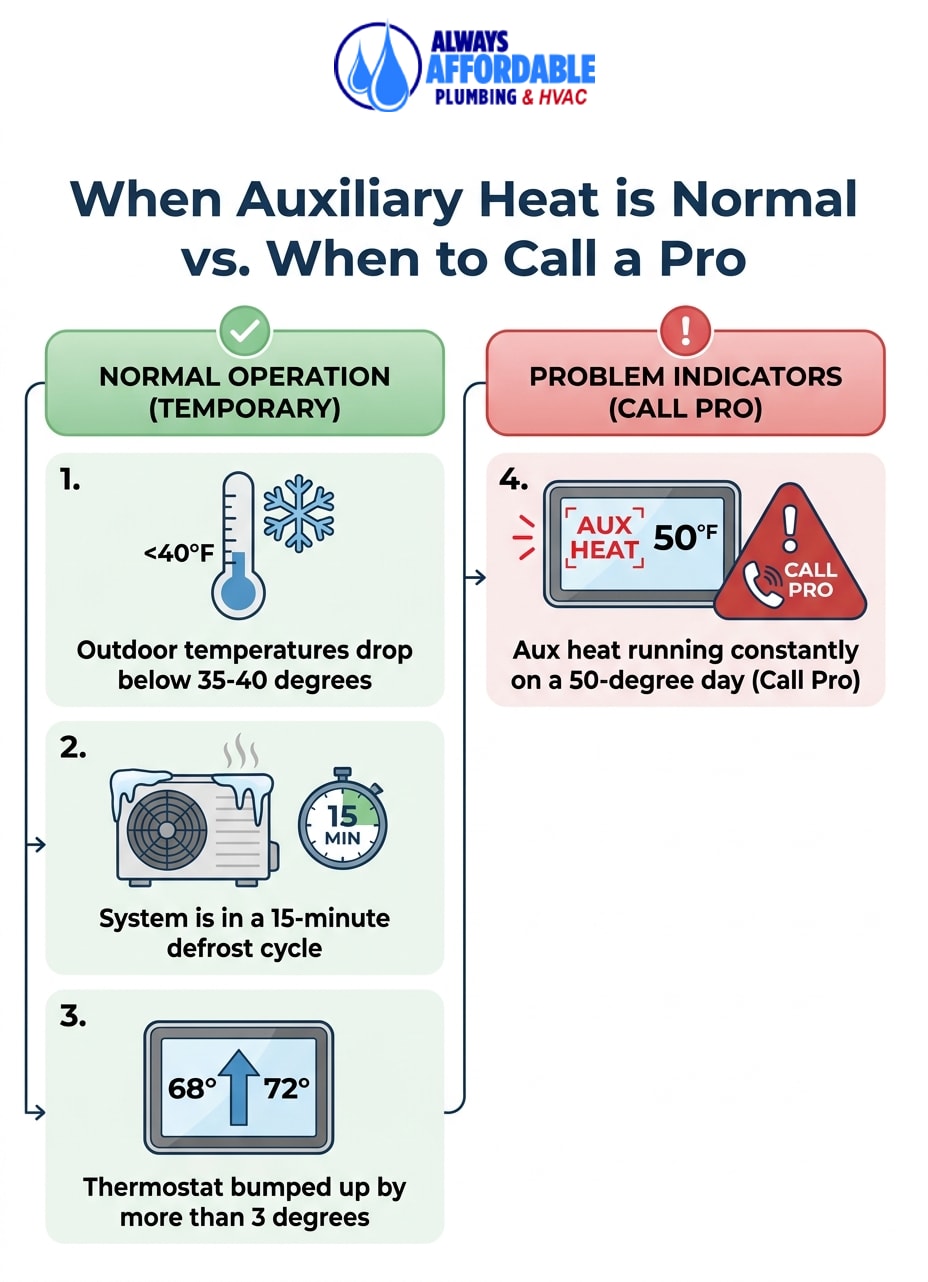
One of the most important concepts to grasp about your heating system is the "balance point." Heat pumps are incredibly efficient, but they have a specific threshold—typically between 35 and 40 degrees Fahrenheit—where they begin to lose that efficiency. Above this temperature, the system can easily pull enough heat from the outside air to keep your home warm without any extra help. Below this temperature, the system struggles to extract enough thermal energy to meet the demands of your thermostat.
In the Sacramento Valley, our winter climate creates the perfect environment for this balance point to be tested. We frequently experience mild daytime highs that allow a heat pump to operate at maximum efficiency all afternoon. However, those pleasant days are often paired with near-freezing early morning lows. When the temperature drops to 34 or 35 degrees just before sunrise, your heat pump suddenly finds itself working in conditions where ambient heat is scarce.
Once the outdoor temperature drops below this balance point, the system automatically calls on the auxiliary strips to maintain indoor comfort. The primary heat pump does not shut off; rather, the electric strips turn on simultaneously to give the system a much-needed boost. This combined effort ensures that your home does not slowly drop in temperature while the outdoor unit struggles to keep up.
It is vital to recognize that this is a temporary, perfectly normal function designed to bridge the gap until the outdoor temperature rises. As the sun comes up and the valley air warms back into the 40s and 50s, the balance point shifts back in your favor. The system will automatically revert to its standard, highly efficient cycle once the ambient air warms up, shutting off the energy-heavy auxiliary strips. During mild valley winters, you might only rely on this secondary heat for an hour or two in the early morning.
Beyond the 35-degree balance point, there is another very specific reason your thermostat auxiliary heat indicator might light up on a chilly morning: the defrost cycle. This is a normal, automated maintenance routine that your system performs to protect itself from ice damage.
During cold, damp mornings, moisture in the air can easily condense and freeze on the outdoor unit's coils. If left unchecked, this frost will build up into a solid block of ice, completely blocking the airflow and preventing the system from extracting any heat at all. To prevent this, the heat pump must periodically melt the ice.
Here is the step-by-step process of how a normal seasonal defrost cycle works:
1. Frost detection: Internal sensors on the outdoor unit detect that the coil temperature has dropped low enough for ice to form, or a built-in timer initiates the cycle based on run-time.
2. Reversing the flow: To protect itself, the heat pump temporarily reverses its refrigerant cycle. It stops pulling heat from the outside and instead pulls heat from inside your home, functioning essentially as an air conditioner for a brief period to send hot refrigerant out to the frozen coils.
3. Melting the ice: The hot refrigerant flows through the outdoor unit, rapidly melting away the accumulated frost. You might even see steam rising from the top of the unit during this phase.
4. Engaging the backup: Because the system is technically running in air conditioning mode to melt the outdoor ice, it would normally blow freezing cold air directly into your living room. To prevent blowing freezing air into the home during this process, the auxiliary heat strips turn on to warm the indoor air before it reaches your vents.
5. Returning to normal: A normal defrost cycle typically lasts about 10 to 15 minutes. Once the outdoor sensors confirm the ice is gone, the reversing valve shifts back to heating mode, the backup strips turn off, and standard operation resumes.
If you see the auxiliary light turn on for a short 15-minute window while there is visible frost outside, your system is simply taking care of itself.
While outdoor temperatures and defrost cycles trigger your backup heat automatically, your own habits can also force the system into this high-energy mode. One of the most common reasons a thermostat auxiliary heat indicator turns on has nothing to do with the weather outside, and everything to do with how the temperature is adjusted inside.
When you wake up feeling chilly and walk over to the thermostat, the natural instinct is to crank the heat up significantly to warm the house faster. However, raising the thermostat setting by more than 2 to 3 degrees at once forces the system to meet a sudden, high demand. Most modern thermostats are programmed to view a large temperature jump as an immediate necessity that the primary heat pump cannot handle quickly enough on its own.
This phenomenon is known as "setback recovery." It causes the thermostat to bypass the efficient heat pump cycle and immediately engage the energy-heavy auxiliary strips to bridge the large temperature gap as fast as possible. While your home will warm up quickly, you are using the most expensive heating method available to do it.
To avoid this, homeowners should increase temperatures gradually. If you want to raise the temperature from 65 to 70 degrees, do it one or two degrees at a time, waiting for the system to reach the new target before bumping it up again. This patient approach keeps the primary heat pump engaged and prevents the backup strips from turning on unnecessarily.
Paying close attention to how your heating system sounds and behaves in winter is just as crucial as monitoring your cooling system in summer. Just as identifying the sound of a failing AC capacitor can save your summer cooling, understanding how your thermostat inputs affect your winter heating cycle can save you from high energy bills.
A frequent point of confusion during mild valley winters is the difference between auxiliary heat and emergency heat. While both utilize the same electric resistance strips inside your air handler, how and why they activate are entirely different.
Auxiliary heat turns on automatically based on outdoor temperatures, defrost needs, or sudden thermostat adjustments. It works alongside your outdoor heat pump, supplementing the primary cycle. You do not have to press any special buttons to make it work; the system manages it for you.
Emergency heat, on the other hand, is a manual setting on the thermostat that completely shuts off the outdoor heat pump and relies 100% on the indoor electric strips. Emergency mode should only be used if the outdoor unit is physically damaged, frozen solid, or completely non-functional.
Here is a breakdown of how the two modes compare:
• Activation Method — Auxiliary Heat: Automatic (controlled by system sensors) — Emergency Heat: Manual (switched on by the homeowner)
• Outdoor Unit Status — Auxiliary Heat: Running normally (extracting ambient heat) — Emergency Heat: Completely shut down and bypassed
• Primary Heat Source — Auxiliary Heat: Heat pump + electric strips working together — Emergency Heat: Electric strips only (working alone)
• Energy Consumption — Auxiliary Heat: Moderate to High (temporary usage) — Emergency Heat: Extremely High (constant usage)
• When to Expect It — Auxiliary Heat: Morning frost, sub-35°F temps, 3+ degree adjustments — Emergency Heat: Only when the outdoor unit is severely damaged
These principles apply to standard central systems as well as alternative setups, though specific configurations may vary. Certain specialized systems handle cold weather differently. For example, many modern mini-split systems are engineered with hyper-heating technology that allows them to extract ambient heat at much lower temperatures without relying on traditional electric resistance strips. Understanding how your specific equipment manages frost and extreme cold helps prevent unnecessary worry when the temperature drops.
Now that you know how the system is supposed to function, you need to know when to draw the line between normal operation and a genuine malfunction. Not every glowing light on your thermostat requires a service call, but ignoring a system that is genuinely struggling can lead to major breakdowns.
Normal operation includes brief engagements during morning frost, 15-minute defrost cycles, and temporary use after a large thermostat adjustment. If your thermostat auxiliary heat indicator turns off once the valley sun warms the afternoon air, your system is doing exactly what it was designed to do.
However, there are clear warning signs of a malfunction that require attention. If you notice any of the following symptoms, it is time to have the system evaluated:
• Constant running on mild days: The auxiliary heat running constantly for hours on a mild 50-degree day is a strong indicator that the primary compressor is failing.
• Blowing cold air: If the system is blowing cold air continuously while the heat is turned on, the reversing valve or refrigerant levels may be compromised.
• Severe ice buildup: If the outdoor unit remains completely encased in ice after a defrost cycle, or if the ice is several inches thick and crushing the coils, a professional assessment is necessary.
• Unusually high energy bills: A sudden, massive spike in your electricity usage during a mild month often means the backup strips are stuck in the "on" position.
When these symptoms appear, relying on affordable, transparent HVAC services with a 100% satisfaction guarantee ensures you aren't overcharged for winter heating check-ups. Seeking a transparent, honest evaluation ensures you understand your system's health without paying for unneeded repairs. Whether you have a traditional central unit or modern ductless heating options, a proper diagnostic will pinpoint the exact cause of the continuous backup heat.
At what temperature should auxiliary heat come on?
Auxiliary heat typically comes on when outdoor temperatures drop below the heat pump's balance point, which is usually between 35 and 40 degrees Fahrenheit. At this temperature, there is not enough ambient heat in the air for the system to operate efficiently on its own. The backup strips engage automatically to help maintain your indoor comfort until the weather warms up.
Why is my aux heat on when it is not that cold?
If it is not freezing outside, your backup heat might be on because you recently raised the thermostat setting by more than two or three degrees at once. This triggers a setback recovery mode, forcing the system to use extra power to heat the house quickly. It could also mean the system is running a brief 15-minute defrost cycle to clear away morning moisture from the outdoor coils.
How do I stop my heat pump from using auxiliary heat?
To minimize the use of backup heat, always adjust your thermostat gradually, raising the temperature only one or two degrees at a time. Keep your outdoor unit clear of debris and snow so it can pull in air efficiently. If the system still relies heavily on the backup strips during mild weather, have a professional check the refrigerant levels and the reversing valve.
Is it bad if my auxiliary heat is on?
It is not inherently bad; it is a normal, built-in function designed to keep your home warm during cold snaps or defrost cycles. However, because it uses electric resistance strips, it consumes significantly more electricity than standard heat pump operation. If it stays on continuously for days at a time, it will lead to much higher energy bills and should be inspected.
How long should a heat pump stay in defrost mode?
A normal defrost cycle should last anywhere from 10 to 15 minutes. During this time, the system reverses its flow to melt ice off the outdoor coils while using the backup strips to keep the indoor air warm. If your system stays in defrost mode for more than 30 minutes, or cycles into defrost constantly throughout the day, the sensors may be malfunctioning.
Does auxiliary heat consume more electricity than normal heating?
Yes, it consumes substantially more electricity. Normal heat pump operation uses a small amount of power to transfer existing heat from the outdoors into your home, which is highly efficient. The backup strips, however, must generate heat from scratch using electric resistance, which requires a massive amount of electrical current to operate.
Getting your heat pump auxiliary heat explained is the first step toward a stress-free winter. By understanding normal defrost cycles and temperature balance points, you can avoid unnecessary worry when the backup indicator lights up. A clear, non-alarmist understanding of your system's normal operation versus a true malfunction empowers you to make smart decisions. Schedule your seasonal tune-up today to ensure your primary and secondary heating systems are working together flawlessly.
See what our satisfied customers have to say about their experience with Always Affordable
Plumbing & HVAC.

"Chappy was very skilled in his knowledge of my HVAC unit. I greatly appreciate the quick response and experienced tech. The whole endeavor was made less stressful by his humor and honest conversation. I find comfort in knowing I now have a shop i trust for the next time."
"Tony, James, Ronnie did an amazing job setting up our new AC! They were quick, efficient, considerate, and polite! We appreciate them scheduling us in on such short notice. Definitely recommend this company!"
"Prompt, professional service with kindness and care. They came out to address both plumbing and AC issues. I received a courtesy call before they arrived. All issues were resolved the same day with integrity and respect. Thankful for businesses like this. Absolutely recommend to those that I love."
"Excellent service! Jason came out promptly and in addition to doing my outside faucet he also put in new irrigation equipment! All done perfectly! Jason was lovely"
"Honest with the assessment; friendly and good manners. No high pressure sales. Just good to honest "tell it like you see it" Thought my kitchen disposer needed an overhaul. But Jason, there Plumber gave me an honest lesson on what was really happening. Saved me hundreds, if I went the route of replacing. Thank you!"
"Absolutely 5 stars. If you are looking for affordable ,professional and kind. Chappy was excellent and very knowledgeable . I called in the morning because my air conditioner stopped working he was here within hours and fixed my air with a smile. I highly recommend Chappy and Always Affordable plumbing and Hvac."
"Scott and James were great. They got there quickly and diagnosed the problem with my A/C.They did a very thorough job testing everything. Sent me pictures and called to keep me informed. Got it done the next day and everything is working fine. Be glad when I get home so I can enjoy my new system. Thanks guys for a great job."
"Chappy was very helpful. He knew our issue right away, cleaned our coils. He also came on the same day we called and got our AC blowing cold air again."
"After some timing ’curfuffles’ the Tech Jason arrived and not only completed a speedy install on my toilet, he was personable & professional. Because of the timing issues Jason was attentive and showed up with everything needed! No extra store runs 😊 I was very comfortable with having this Tech in my Daughter’s home. We will definitely use this Service again."