Seasonal Home Maintenance Checklist: Preventing HVAC and Plumbing Emergencies
Prevent HVAC emergencies with a seasonal home maintenance checklist. Why proactive scheduling beats waiting for sudden failures. See what needs attention now.



Are you wondering, can a failing water pressure regulator cause my toilet to run constantly? The short answer is yes. While a running toilet often seems like a simple nuisance—a worn-out flapper or a sticky float—our team at Always Affordable Plumbing & HVAC knows it is frequently the first audible alarm for a much larger whole-house water pressure problem. When municipal water pressure enters your home unregulated, it can physically overpower your plumbing fixtures. Before you head to the hardware store to buy another replacement part, the home's overall pressure must be evaluated to ensure standard toilet fill valve seals aren't simply being blown open by brute force.
In our years of providing professional home services and expert plumbing repair across the local area, we've found that understanding the root cause of your plumbing symptoms is the critical first step to a permanent fix.
To understand why a toilet runs when pressure is high, you first need to understand how water enters your home. Municipal water systems operate under immense pressure to ensure water can travel long distances, climb hills, and supply fire hydrants. It is not uncommon for city water mains to carry water at 100 to 150 PSI (pounds per square inch). However, normal residential water pressure should always sit between 40 and 60 PSI.
This is where the Pressure Reducing Valve (PRV) comes in. The PRV is a bell-shaped brass valve typically installed on the main water line where it enters your house. Its job is to act as a barrier, stepping down that massive municipal pressure to a safe, usable level for your home's delicate pipes and appliances. In fact, modern plumbing codes generally require a functional PRV on any home where the incoming city water pressure exceeds 80 PSI.
Inside the PRV is a heavy-duty spring and a flexible rubber diaphragm. As water flows through, the spring compresses to restrict the flow, dropping the pressure. In our experience, hard water minerals, sediment, and constant mechanical fatigue over time can cause that diaphragm to tear or the spring to fail. When the internal components of a PRV fail, the valve loses its ability to hold back the city water. The result is that full, unregulated municipal pressure—often water pressure exceeding 80 PSI—floods directly into your home's plumbing system, putting immediate stress on every single fixture.
When unregulated water pressure enters the home, the weakest points in your plumbing system are the first to show symptoms. In many of the homes we service, the weakest point is the toilet fill valve.
Standard toilet fill valve seals are engineered for normal residential conditions. They rely on a small rubber gasket and the buoyancy of a plastic float to shut off the incoming water once the toilet tank is full. These components are highly effective at 50 PSI, but they are generally only designed to hold back a maximum of 80 PSI. They simply lack the mechanical strength to resist anything higher.
When water pressure exceeding 80 PSI hits the toilet, it physically pushes past the rubber seal inside the fill valve, even when the float is in the fully raised, "closed" position. The water forces its way through the microscopic gaps, causing the tank to slowly overfill. Because toilets are designed not to flood your bathroom, this excess water spills down into the overflow tube in the center of the tank.
As the water continuously spills into the overflow tube, it drains into the toilet bowl. This creates a continuous running sound. Alternatively, if the water level rises slowly, it may trigger a periodic "ghost flush," where the toilet suddenly runs for a few seconds to refill the tank even though nobody used it. It is crucial to understand that in this scenario, the toilet valve is actually functioning exactly as designed. The parts are not broken; they are simply being overpowered by external forces that require a broader diagnostic approach.
There is nothing more frustrating than spending an afternoon replacing a toilet flapper and fill valve, only to hear the toilet start running again three days later. This cycle of endless repairs is exactly what happens when homeowners treat the symptom rather than diagnosing the root cause.
When water pressure is excessively high, installing a brand-new fill valve might temporarily stop the running toilet. A fresh, stiff rubber seal might hold back the pressure for a few days or weeks. But because standard toilet fill valve seals are not built for constant high-pressure exposure, the new parts will quickly degrade, warp, or blow out entirely, putting you right back where you started.
• Symptom Treatment — Action Taken: Replacing flappers, floats, and fill valves repeatedly. — Long-Term Result: Parts fail quickly; toilet continues to run; underlying pressure threatens other appliances.
• Root Cause Diagnosis — Action Taken: Testing whole-home water pressure to evaluate the PRV. — Long-Term Result: Identifies the true issue; replacing the PRV protects the entire house and permanently stops the running toilet.
Just last fall, our team worked with a local homeowner who experienced this exact scenario when dealing with a persistent shower head leak that kept returning despite basic fixes. After providing a free estimate before work began, our technician diagnosed the underlying high-pressure issue, provided a lasting whole-home solution, and fixed the leak within an hour while waiving the diagnostic fee. This is why we always recommend you schedule a plumbing inspection to get transparent, affordable diagnostics rather than throwing money at localized parts that are doomed to fail.
A running toilet is rarely the only sign of a failing pressure reducing valve. Because high pressure affects the entire house simultaneously, our plumbers typically see a cluster of symptoms. Recognizing these early can save you from catastrophic water damage.
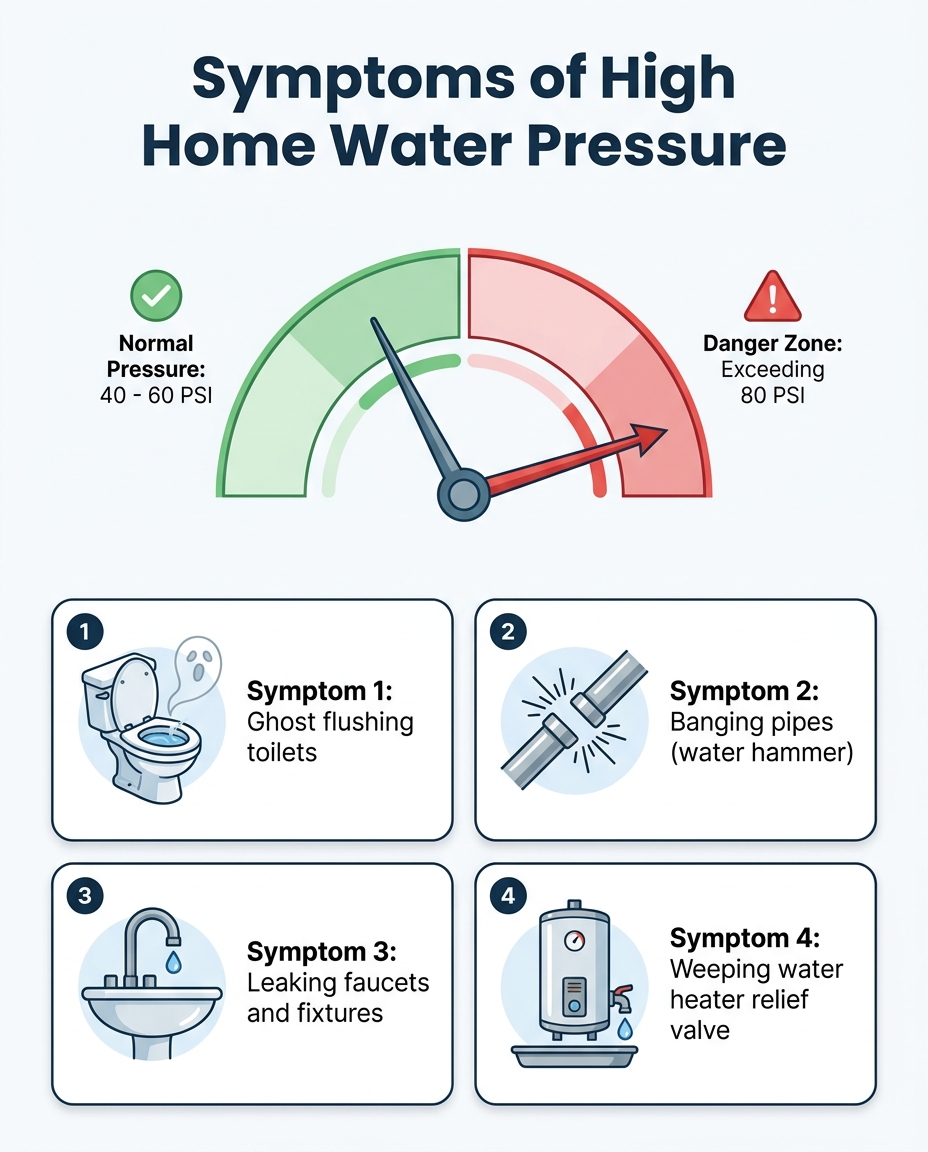
• Banging pipes (Water Hammer): When you turn off a faucet quickly or the washing machine valve snaps shut, high pressure causes the water to slam into the pipes, creating a loud bang. Over time, this shockwave can break pipe joints inside your walls.
• Leaking faucets: Just like standard toilet fill valve seals, the rubber O-rings inside your kitchen and bathroom faucets cannot withstand water pressure exceeding 80 PSI and will begin to drip constantly.
• Weeping water heater relief valves: Your water heater has a Temperature and Pressure (T&P) relief valve designed to open if the tank is going to explode. If this valve is constantly dripping water onto the floor, it means the incoming house pressure is dangerously high.
• Bulging appliance hoses: Washing machine and dishwasher hoses are highly susceptible to bursting under high pressure, which is one of the leading causes of severe indoor flooding.
These risks are especially relevant locally. Municipal water systems in the Sacramento region can experience significant pressure spikes that severely test residential plumbing seals and pressure regulators, a pattern we see often. Understanding how local water pressure spikes expose plumbing weak points is essential for protecting your property from sudden leaks and premature appliance failure.

Confirming a PRV failure requires a specific diagnostic process. You cannot determine water pressure simply by looking at how fast water comes out of the kitchen sink. Instead, water pressure is tested using a specialized gauge that threads onto a regulated hose bib or a utility sink connection.
During our diagnostic tests, a pressure gauge is attached to the system, and the main water supply is turned on. A normal, healthy reading will hold steady between 40 and 60 PSI. If the needle immediately jumps to a water pressure exceeding 80 PSI, the PRV has failed and is allowing municipal pressure directly into the home.
However, diagnosing a failing PRV isn't always that straightforward. Municipal water pressure often fluctuates based on neighborhood demand. Pressure tends to spike in the middle of the night when very few people are using water. To catch these nighttime spikes, our technicians will often use a gauge with a "lazy hand"—a secondary needle that stays at the highest pressure point reached during the testing period. If the gauge reads 55 PSI during the day but the lazy hand shows it hit 110 PSI overnight, the PRV is failing intermittently.
Because the PRV is tied directly to the municipal water main, replacing it is not a DIY project. It requires cutting into the main line, soldering or pressing new heavy-duty brass fittings, and calibrating the new valve to exact code specifications. Relying on professional preventative plumbing maintenance ensures that your pressure is tested accurately and any necessary replacements are handled safely and up to code.
Yes, excessive home water pressure physically overcomes the internal seals of the toilet. When the pressure exceeds what standard toilet fill valve seals are designed to handle, water pushes past the closed valve and continuously fills the tank. This excess water spills into the overflow tube, resulting in a toilet that runs constantly or flushes itself periodically.
Look for pressure gauge readings above normal limits, banging pipes, and multiple leaking fixtures. A bad water pressure regulator will allow municipal pressure into the home, which often results in a cluster of plumbing issues happening all at once. If your toilets are running, your faucets are dripping, and your pipes bang when you turn off the water, your regulator is likely failing.
Running toilets, leaking faucets, water hammer, and weeping pressure relief valves on water heaters are the primary signs. You may also notice that your washing machine fills much faster than usual, or that your shower stream feels aggressively hard. If left unchecked, water pressure exceeding 80 PSI can lead to burst appliance hoses and severe indoor flooding.
Yes, but if a new fill valve doesn't fix the problem, high home water pressure is likely the culprit. A fill valve can certainly fail on its own due to old age or mineral buildup. However, if you replace the fill valve and the toilet begins running again a short time later, it is a strong indicator that high water pressure is destroying the new parts.
While some have rebuild kits, our experience shows that age and mineral buildup usually make full replacement by a professional the most reliable option. The internal brass housing of a PRV often becomes pitted and scored over years of use. Installing a new spring and diaphragm into a damaged housing rarely provides a long-lasting fix, making a complete replacement the safer choice for protecting your home.
Annual testing is recommended as part of routine preventative plumbing maintenance. Because water pressure regulators degrade slowly over time, you may not notice the pressure creeping up until a seal blows out. Having a professional check the static pressure and test for overnight spikes once a year is the best way to catch a failing PRV before it causes damage.
A running toilet is much more than just a minor annoyance that wastes a little bit of water. It is very often a critical warning sign that your home's water pressure regulator is failing. Ignoring this symptom, or simply treating it by constantly swapping out standard toilet fill valve seals, leaves your entire plumbing system vulnerable to water pressure exceeding 80 PSI. Over time, this unregulated pressure will damage your pipes, ruin your faucets, and potentially burst your appliance hoses.
Stop the cycle of ineffective repairs and ghost flushing by calling Always Affordable Plumbing & HVAC. By seeking professional pressure diagnostics, you can identify the true root cause of your plumbing issues. A licensed technician can accurately test your home's water pressure, replace a failing PRV safely, and ensure that your entire plumbing system remains protected for years to come.
See what our satisfied customers have to say about their experience with Always Affordable
Plumbing & HVAC.

"Chappy was very skilled in his knowledge of my HVAC unit. I greatly appreciate the quick response and experienced tech. The whole endeavor was made less stressful by his humor and honest conversation. I find comfort in knowing I now have a shop i trust for the next time."
"Tony, James, Ronnie did an amazing job setting up our new AC! They were quick, efficient, considerate, and polite! We appreciate them scheduling us in on such short notice. Definitely recommend this company!"
"Prompt, professional service with kindness and care. They came out to address both plumbing and AC issues. I received a courtesy call before they arrived. All issues were resolved the same day with integrity and respect. Thankful for businesses like this. Absolutely recommend to those that I love."
"Excellent service! Jason came out promptly and in addition to doing my outside faucet he also put in new irrigation equipment! All done perfectly! Jason was lovely"
"Honest with the assessment; friendly and good manners. No high pressure sales. Just good to honest "tell it like you see it" Thought my kitchen disposer needed an overhaul. But Jason, there Plumber gave me an honest lesson on what was really happening. Saved me hundreds, if I went the route of replacing. Thank you!"
"Absolutely 5 stars. If you are looking for affordable ,professional and kind. Chappy was excellent and very knowledgeable . I called in the morning because my air conditioner stopped working he was here within hours and fixed my air with a smile. I highly recommend Chappy and Always Affordable plumbing and Hvac."
"Scott and James were great. They got there quickly and diagnosed the problem with my A/C.They did a very thorough job testing everything. Sent me pictures and called to keep me informed. Got it done the next day and everything is working fine. Be glad when I get home so I can enjoy my new system. Thanks guys for a great job."
"Chappy was very helpful. He knew our issue right away, cleaned our coils. He also came on the same day we called and got our AC blowing cold air again."
"After some timing ’curfuffles’ the Tech Jason arrived and not only completed a speedy install on my toilet, he was personable & professional. Because of the timing issues Jason was attentive and showed up with everything needed! No extra store runs 😊 I was very comfortable with having this Tech in my Daughter’s home. We will definitely use this Service again."