Seasonal Home Maintenance Checklist: Preventing HVAC and Plumbing Emergencies
Prevent HVAC emergencies with a seasonal home maintenance checklist. Why proactive scheduling beats waiting for sudden failures. See what needs attention now.



When your plumbing starts acting sluggish and water rises instead of draining, you might find yourself asking a very specific question: can you flush too much toilet paper if you have a septic system in Granite Bay? The short answer is yes. In our years of providing plumbing services to the local community, our team at Always Affordable Plumbing & HVAC has seen firsthand how excessive volume can quickly overwhelm the delicate biological balance inside your waste management system. What starts as a minor inconvenience can rapidly escalate into a costly and messy situation.
Many homeowners experience anxiety about what goes down their drains, and for good reason. Flushing large quantities of thick, slow-dissolving paper is a leading cause of sudden backup emergencies. Unlike municipal sewer lines that benefit from continuous, high-volume water flow from hundreds of homes, a private residential tank relies entirely on your household's water usage and bacterial action to process waste. If you are already dealing with a slow drain or a rising water level, reaching out for expert residential plumbing services is the safest next step.
Understanding your system's capacity is the key to preventing catastrophic plumbing failures. This guide covers the mechanics of waste breakdown, the impact of different paper types, and how local weather conditions can turn a simple paper overload into a major household crisis.
To understand why paper volume matters, you first need to understand the foundational mechanics of how a private waste system functions. Our technicians often explain to customers that Granite Bay properties with private septic tanks operate as miniature, self-contained water treatment plants. They do not rely on a city-wide network of sweeping water volume to push waste miles away. Instead, they rely on gravity, time, and biology.
When you flush a toilet, the waste travels down your main sewer line and enters the primary chamber of the tank. From there, a specific separation process takes place:
1. The Scum Layer: Lighter materials, such as fats, oils, and greases, float to the top of the tank. This forms a protective crust that keeps oxygen out, creating the ideal environment for bacteria to thrive.
2. The Effluent Layer: The middle section consists of relatively clear liquid. This water slowly exits the tank through an outlet baffle and flows into the drain field, where it percolates into the soil.
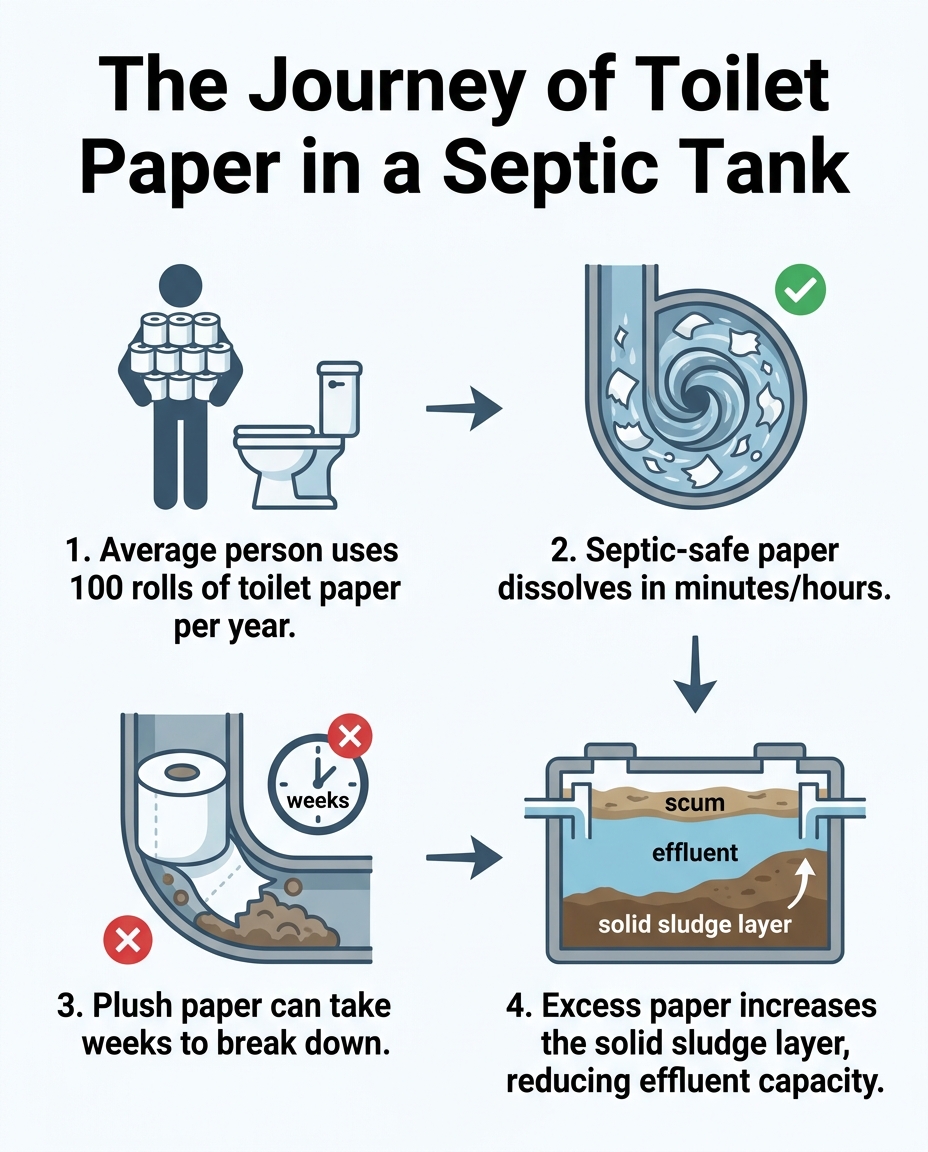
3. The Sludge Layer: Heavy solids, including human waste and toilet paper, sink to the bottom. Here, anaerobic bacteria go to work, slowly digesting the organic matter and reducing its volume.
The system requires a precise water-to-bacteria ratio to function correctly. The bacteria need time to digest the solids in the sludge layer. When an influx of non-dissolving solids—like excessive amounts of heavy toilet paper—enters the tank, it physically displaces this critical ratio. The paper piles up faster than the bacteria can break it down, throwing off the natural digestion cycle and artificially raising the sludge level.
The Problem: Flushing too much toilet paper rapidly increases the solid sludge layer at the bottom of your tank. Unlike organic human waste, which bacteria digest relatively quickly, thick paper fibers take significantly longer to break down. When large wads of paper are introduced daily, they form a dense, pulpy mat that resists bacterial action.
The Cause: As this undissolved paper accumulates, it reduces the functional liquid capacity of the tank. The effluent layer shrinks, meaning wastewater has less time to settle and separate before being pushed out into the drain field. The natural digestion process is effectively choked out by the sheer volume of cellulose fibers.
The Solution: If the sludge layer rises high enough to reach the outlet baffle, solid paper waste will be forced out into the delicate perforated pipes of your drain field. Once paper clogs those lines, wastewater has nowhere to go but backward. This is exactly how paper overload connects directly to sudden backup emergencies inside the home. Managing your household flushing habits is the best prevention, but if the lines are already compromised, professional sewer line and backup clearing is required to remove the blockage and restore normal flow.

Not all toilet paper is created equal, and your choice at the grocery store has a massive impact on the health of your plumbing. Many homeowners living in Granite Bay properties with private septic tanks unknowingly compromise their systems by choosing the wrong type of paper. A pattern we see often during service calls is that thick, multi-ply, and plush toilet papers are marketed for comfort, but they achieve that softness through tightly woven, durable fibers that resist breaking down in water.
To evaluate your current household choices, consider performing a simple "jar test" at home:
• Step 1: Fill a clear glass jar halfway with water.
• Step 2: Drop in two or three squares of your current toilet paper.
• Step 3: Secure the lid and shake the jar vigorously for ten seconds.
• Step 4: Observe the results. If the paper has disintegrated into a cloudy pulp, it is safe for your tank. If it remains largely intact or tears into large, heavy chunks, it is likely contributing to rapid sludge buildup.
Here is a breakdown of how different paper types perform:
• Ultra-Plush / 3-Ply — Dissolution Speed: Very Slow (Weeks) — Impact on System Capacity: High risk. Rapidly increases sludge layer and resists bacterial digestion.
• Standard 2-Ply — Dissolution Speed: Moderate (Days) — Impact on System Capacity: Moderate risk. Generally acceptable in small, controlled amounts.
• Recycled / 1-Ply — Dissolution Speed: Fast (Hours) — Impact on System Capacity: Low risk. Breaks down quickly and maintains bacterial balance.
• Certified Septic-Safe — Dissolution Speed: Very Fast (Minutes) — Impact on System Capacity: Lowest risk. Specifically engineered to disintegrate upon contact with water.
Beyond toilet paper, you must strictly guard against flushing other paper products. Paper towels, facial tissues, and feminine hygiene products are engineered to retain their strength when wet and will never dissolve in your tank. Furthermore, it is crucial to understand why flushable wipes are dangerous for your plumbing. Despite the label, these wipes contain synthetic fibers that do not break down, creating severe hazards for both the tank and the drain field.
Your plumbing system does not operate in a vacuum; it is heavily influenced by the environment outside your home. The drain field is the final, and arguably most important, stage of the waste management process. Its function is to disperse liquid effluent safely into the surrounding soil, where natural microbes provide a final layer of filtration.
In our experience serving the local area, Granite Bay's wet winter months saturate the soil, putting extra hydrostatic stress on septic drain fields and making the system highly vulnerable to backups if overloaded with slow-dissolving toilet paper. When the ground is already waterlogged from heavy seasonal rains, it loses its ability to absorb additional liquid. The water table rises, and the drain field trenches become temporarily submerged.
This creates a dangerous bottleneck. If your tank is already overloaded with undissolved paper, the functional liquid capacity is reduced. The system attempts to push wastewater into a drain field that cannot accept it. The resulting hydrostatic stress forces the water to seek the path of least resistance—which is often back up the main sewer line and into your ground-floor bathtubs and showers. A tank that might function adequately during the dry summer months can easily trigger sudden backup emergencies during heavy winter rains if paper volume is not strictly managed.
Recognizing the indicators of a developing problem before it becomes a catastrophic failure can save your property from extensive water damage. Because the tank is buried underground, the first signs of trouble almost always appear inside the home. Fast response times are critical when multiple fixtures begin acting up simultaneously.
Our team recently responded to a homeowner who called about major sewer line issues that initially looked like a standard blockage but ultimately required a full replacement. Because we provided a transparent, reasonable estimate upfront, our plumbers were able to diagnose the unforeseen problems deep in the line, replace 140 feet of pipe, install new cleanouts, and repair the concrete—resolving the issue and leaving the work area improved. Catching these issues early makes all the difference.
Watch for these early warning signs:
• Slow-draining sinks and showers: If one sink is slow, you likely have a localized clog in that specific pipe. If every drain on the ground floor is slow, the main line or the tank itself is struggling to accept water.
• Gurgling sounds from toilets: When water struggles to flow past a mass of undissolved paper, it creates negative air pressure in the pipes, causing a distinct bubbling or gurgling noise when you flush.
• Localized odors: A healthy system contains sewer gases safely within the pipes and vents them through the roof. If you smell a foul, sulfurous odor near your drains or out in the yard near the drain field, effluent is backing up.
• Water backing up in unexpected places: If flushing the toilet causes water to bubble up in the nearby shower drain, you have a systemic blockage in the main sewer line.
If you notice these symptoms, skip the chemical drain cleaners. Harsh chemicals destroy the beneficial bacteria in your tank, making the waste breakdown problem even worse. Instead, call a professional for proper diagnostics.
Moderate use of septic-safe paper is generally fine for a well-maintained system. As a rule of thumb, our technicians recommend using only what is necessary for hygiene—typically a few squares per flush—to prevent solid waste overload. Household size ultimately dictates the acceptable volume your specific tank can handle.
When multiple people live in a home, the cumulative volume of paper flushed daily increases significantly. Granite Bay properties with private septic tanks are sized based on the number of bedrooms, which estimates daily water and solid waste usage. If your household uses excessive amounts of paper per bathroom visit, you are accelerating the rate at which the sludge layer builds up at the bottom of the tank, reducing the time bacteria have to break it down.
It accumulates as solid sludge and rapidly reduces the functional capacity of your tank. Because thick paper resists natural bacterial breakdown, it piles up faster than it can be digested, pushing the sludge layer dangerously close to the outlet baffle.
When the sludge layer rises too high, solid paper fibers can escape into the drain field, clogging the perforated pipes and ruining the soil's ability to absorb water. This directly leads to sudden backup emergencies inside the home. Furthermore, excessive paper usage means you will face an increased frequency of required professional pumping to remove the undissolved mass before it causes permanent damage to the drain field.
Yes, multi-ply and plush papers resist rapid dissolution and are highly detrimental to private waste systems. While they offer superior comfort, their densely woven fibers take weeks to break down, overloading the tank's bacterial digestion process.
We strongly recommend switching to alternatives that break down quickly. Single-ply paper, recycled paper, or brands specifically labeled as "septic-safe" are engineered to disintegrate almost immediately upon contact with water. By switching away from ultra-plush brands, you significantly reduce the solid mass entering your system, preserving its capacity and extending the lifespan of your drain field.
Septic-safe paper can dissolve in minutes to hours, while thick, multi-ply paper can take weeks or even months to fully break down. The exact timeline depends heavily on the specific brand of paper and the health of the bacterial colony inside the tank.
Anaerobic bacteria are responsible for digesting the cellulose fibers in the paper. If the tank is healthy and the paper is thin, the bacteria can process it efficiently. However, if the tank has been exposed to harsh chemical cleaners or antibacterial soaps, the bacterial colony may be weakened, drastically slowing down the dissolution timeline and allowing paper to accumulate rapidly.
Rarely. Once a solid mass of undissolved paper forms in the main line or at the tank's inlet baffle, it typically requires mechanical clearing by a professional. In our years of clearing lines, we find that water pressure alone is usually not enough to push a heavy, pulpy blockage through the pipe.
Homeowners should never ignore slow drains hoping they will resolve independently. A partial blockage caused by a buildup of paper will only collect more debris with every subsequent flush. Waiting for the clog to clear itself usually results in the blockage solidifying further, eventually leading to a complete stoppage and a messy indoor backup.
Typically, a tank should be pumped every 3 to 5 years, depending on your daily water usage, the size of the tank, and the number of people living in the home. A smaller tank with a large family will require more frequent service.
It is important to understand that high paper usage may accelerate this timeline significantly. If your household flushes large volumes of thick toilet paper, the sludge layer will build up much faster than the standard 3-to-5-year estimate. Regular professional inspections can measure the exact depth of the sludge layer, allowing you to schedule a pump-out before the solid waste reaches a critical level and threatens the drain field.
Maintaining a healthy plumbing system doesn't have to be a source of constant worry. Mindful flushing habits are your first and best line of defense against sudden backup emergencies. By choosing fast-dissolving paper, limiting the volume used per flush, and keeping non-dissolving items out of your drains, you give the natural bacterial process the time and space it needs to function properly.
If you suspect your system is already overloaded, or if you are noticing the early warning signs of a developing clog, professional diagnostics can identify issues before they escalate into costly property damage. Always Affordable Plumbing & HVAC offers transparent, budget-friendly pricing, ensuring homeowners aren't hit with surprise fees if a paper clog turns into an emergency. Don't wait for a slow drain to become a complete stoppage. Reach out to our plumbers serving Granite Bay and surrounding areas to schedule an inspection and keep your home's plumbing flowing smoothly.
See what our satisfied customers have to say about their experience with Always Affordable
Plumbing & HVAC.

"Chappy was very skilled in his knowledge of my HVAC unit. I greatly appreciate the quick response and experienced tech. The whole endeavor was made less stressful by his humor and honest conversation. I find comfort in knowing I now have a shop i trust for the next time."
"Tony, James, Ronnie did an amazing job setting up our new AC! They were quick, efficient, considerate, and polite! We appreciate them scheduling us in on such short notice. Definitely recommend this company!"
"Prompt, professional service with kindness and care. They came out to address both plumbing and AC issues. I received a courtesy call before they arrived. All issues were resolved the same day with integrity and respect. Thankful for businesses like this. Absolutely recommend to those that I love."
"Excellent service! Jason came out promptly and in addition to doing my outside faucet he also put in new irrigation equipment! All done perfectly! Jason was lovely"
"Honest with the assessment; friendly and good manners. No high pressure sales. Just good to honest "tell it like you see it" Thought my kitchen disposer needed an overhaul. But Jason, there Plumber gave me an honest lesson on what was really happening. Saved me hundreds, if I went the route of replacing. Thank you!"
"Absolutely 5 stars. If you are looking for affordable ,professional and kind. Chappy was excellent and very knowledgeable . I called in the morning because my air conditioner stopped working he was here within hours and fixed my air with a smile. I highly recommend Chappy and Always Affordable plumbing and Hvac."
"Scott and James were great. They got there quickly and diagnosed the problem with my A/C.They did a very thorough job testing everything. Sent me pictures and called to keep me informed. Got it done the next day and everything is working fine. Be glad when I get home so I can enjoy my new system. Thanks guys for a great job."
"Chappy was very helpful. He knew our issue right away, cleaned our coils. He also came on the same day we called and got our AC blowing cold air again."
"After some timing ’curfuffles’ the Tech Jason arrived and not only completed a speedy install on my toilet, he was personable & professional. Because of the timing issues Jason was attentive and showed up with everything needed! No extra store runs 😊 I was very comfortable with having this Tech in my Daughter’s home. We will definitely use this Service again."