
Why Your AC Runs Constantly: Understanding Heat Transfer Degradation and Cooling Cycles
Why is your AC running constantly? We explain heat transfer degradation. Use our local service expertise and area tips to decide when to call a pro on this.



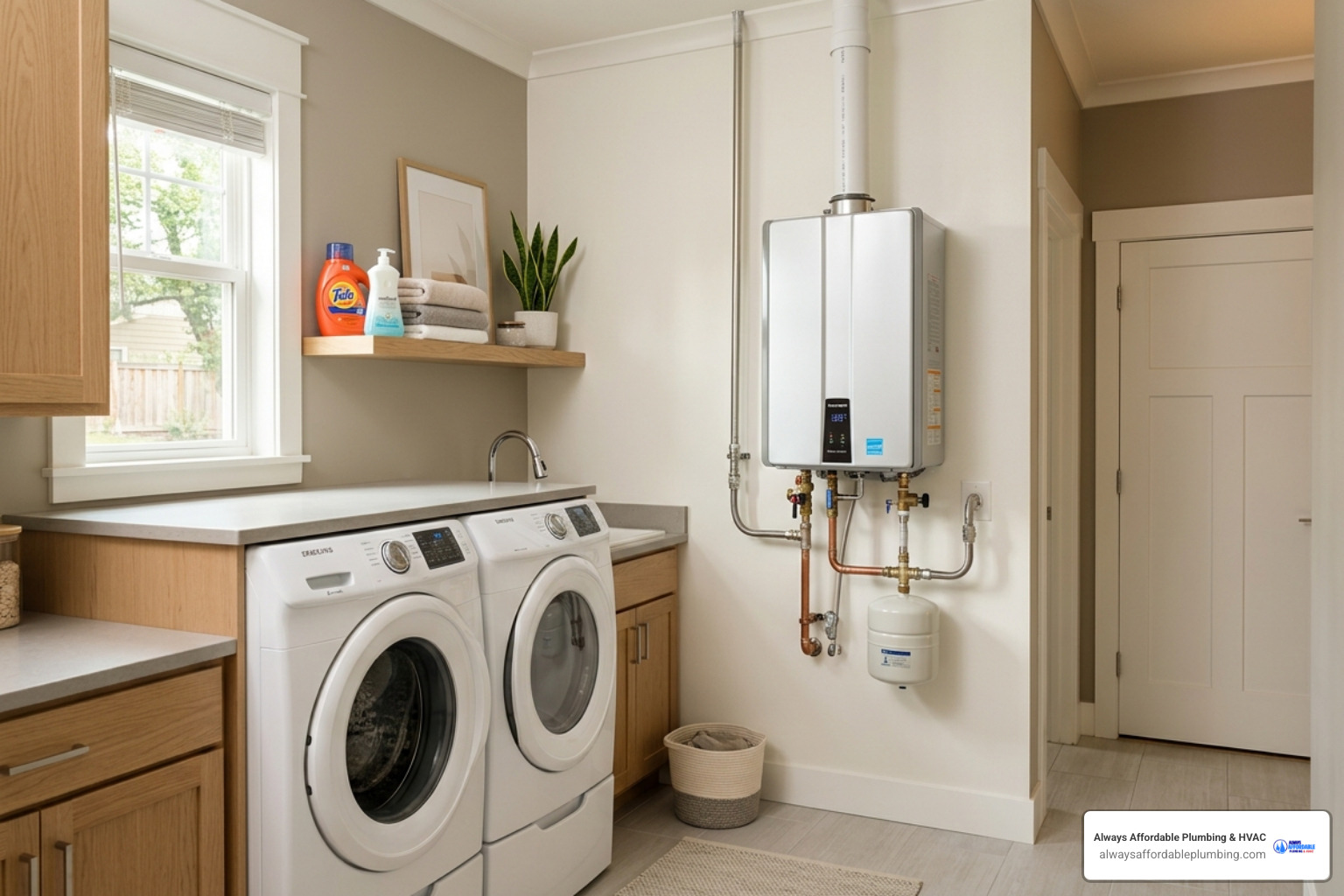
How long does a tankless water heater last is one of the most important questions you can ask before investing in a new hot water system — and the short answer is: a lot longer than you might expect.
Here's what the numbers look like at a glance:
• Tankless water heater (average, with basic care) — Expected Lifespan: 15-20 years
• Tankless water heater (well-maintained, soft water) — Expected Lifespan: 20-30+ years
• Tankless with hard water, no treatment or maintenance — Expected Lifespan: 7-12 years
• Traditional tank water heater (average) — Expected Lifespan: 8-12 years
That's nearly double the lifespan of a conventional tank unit — and in many cases, even more when you stay on top of maintenance. For Sacramento-area homeowners, where water hardness and usage habits vary, knowing what affects that number can make a real difference in how long your system holds up.
This guide walks you through everything that shapes tankless water heater lifespan — from water quality and maintenance habits to unit type and installation quality — so you can protect your investment and plan ahead with confidence.
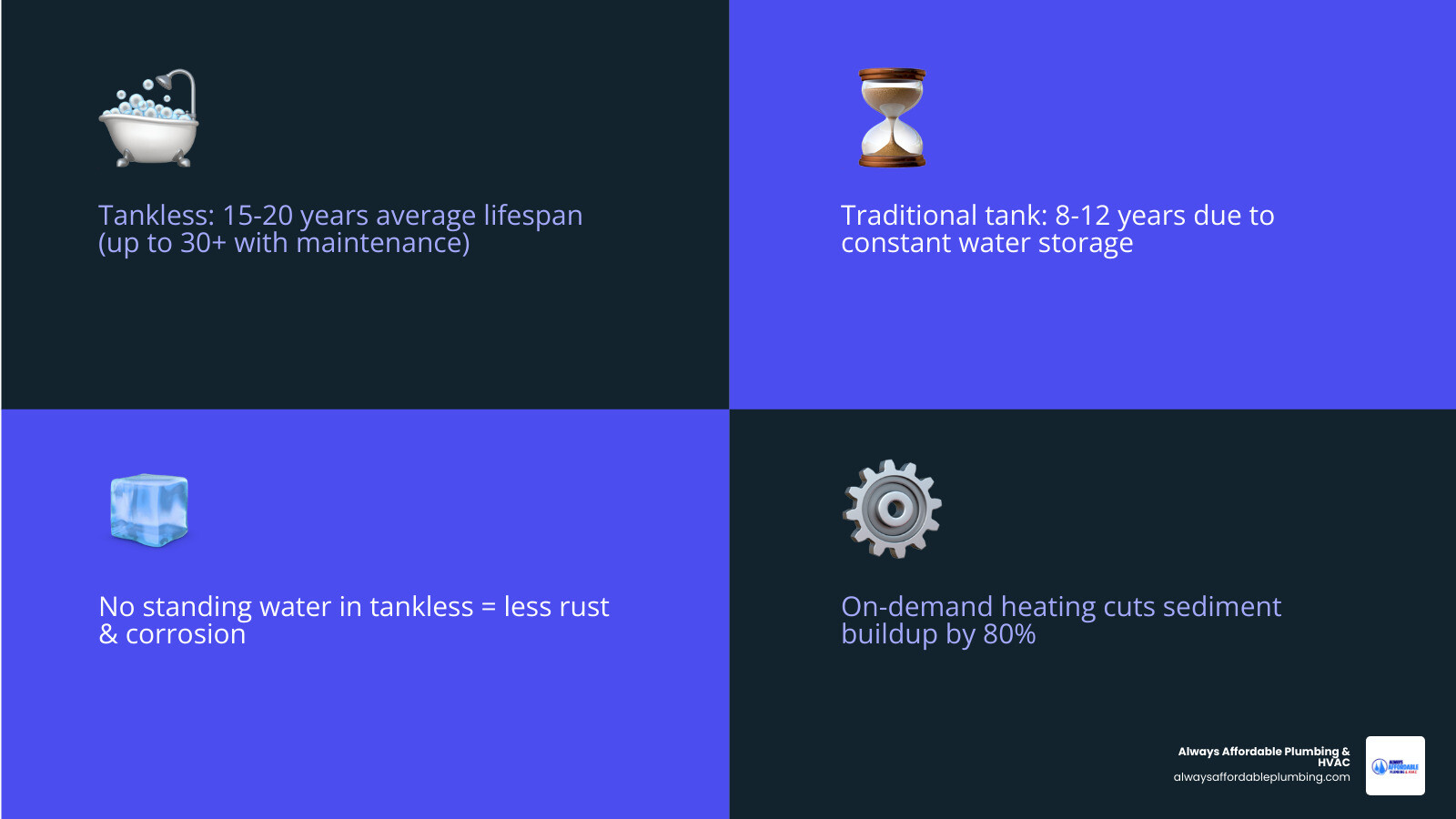
When we talk about the durability of home appliances, the Tankless Water Heater is often the marathon runner of the group. As of April 2026, the industry standard for a well-made tankless unit is a 20-year benchmark. This is a significant leap forward compared to traditional tank-style heaters, which usually start gasping for air around the 8 to 12-year mark.
Why the massive difference? It comes down to how they are built. Traditional heaters are constantly filled with 40 to 50 gallons of water. This water sits there, heating and cooling, which leads to inevitable sediment buildup and tank corrosion. Eventually, the tank rusts from the inside out and leaks. A tankless unit, however, doesn't store water. It only heats it as it passes through the heat exchanger. Because there is no standing water, there is far less opportunity for the "slow death" of rust and corrosion to take hold.
If you are asking yourself, Do I Need to Switch to a Tankless Water Heater, the longevity factor is usually the strongest "yes" in the pro column. While a traditional tank might last 10-15 years in the absolute best-case scenario, many homeowners in areas like Roseville and Elk Grove find that their tankless systems are still going strong after 25 or even 30 years with the right care.
While the 20-year average is a great baseline, your specific mileage may vary. Several "hidden" factors determine whether your unit reaches its golden years or retires early.
First and foremost is installation quality. A tankless unit is a sophisticated piece of machinery. If it isn't vented correctly or if the gas lines aren't sized properly, the unit has to work harder than it was designed to. This creates "thermal stress," which can wear out internal components prematurely. Following a Tankless Water Heater Installation Guide Roseville CA ensures that the unit is set up for success from day one.
Unit sizing is another silent killer of longevity. If you install a unit that is too small for your household’s hot water demand, it will "short-cycle" or run at maximum capacity constantly. Imagine driving your car at 100 mph everywhere you go; it’s going to break down much faster than a car driven at a reasonable pace. Proper sizing, as detailed in our Tankless Water Heater Installation Citrus Heights Guide, ensures the system can handle the load without overexerting itself.
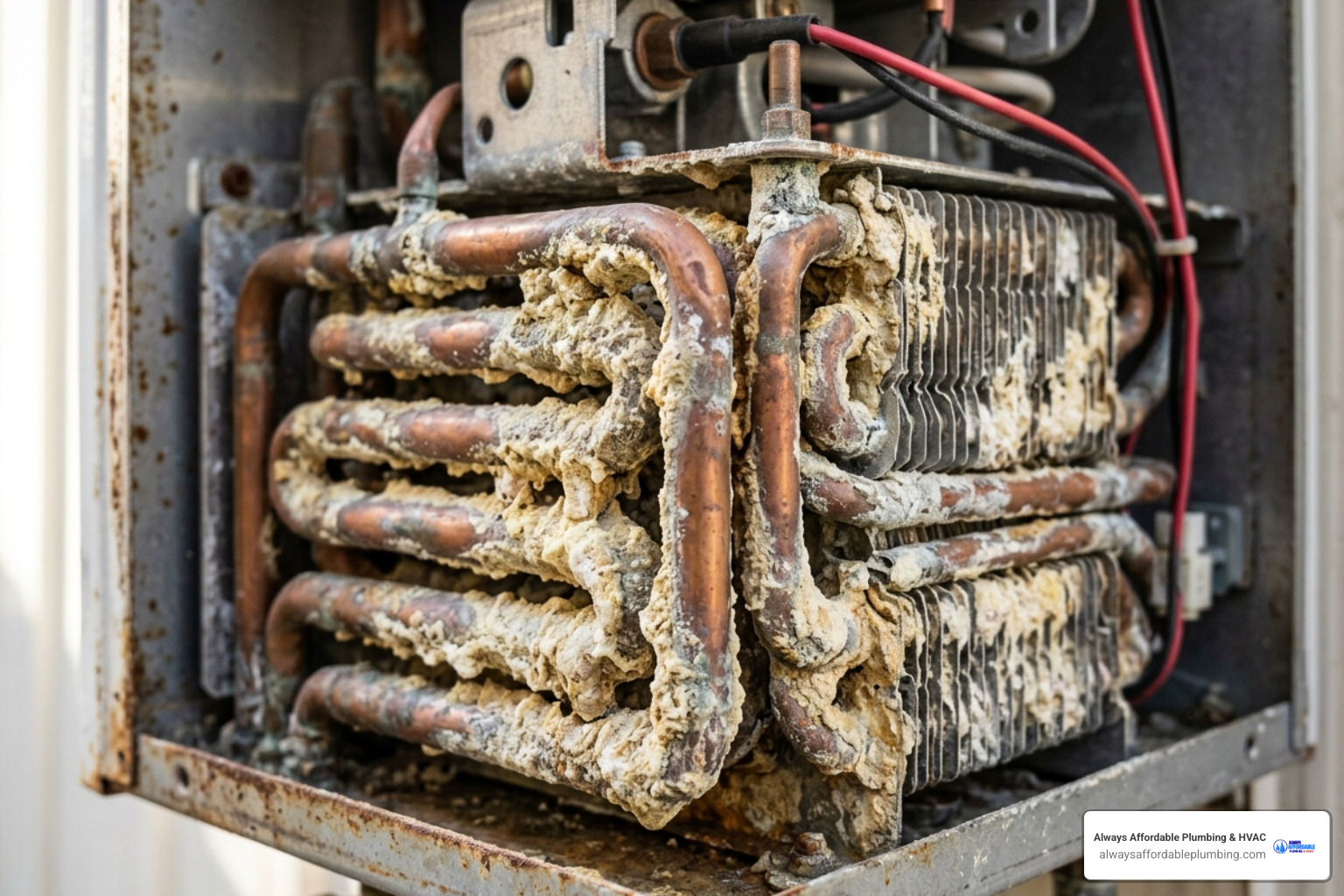
In the Sacramento valley, we often deal with "crunchy" water—otherwise known as hard water. This is perhaps the single biggest threat to Tankless Water Heaters for Homes. Hard water contains high levels of calcium and magnesium. When this water is heated, those minerals solidify and create "scale" inside the heat exchanger.
This scale acts like insulation, but not the good kind. It forces the heat exchanger to get much hotter than necessary to warm the water, leading to metal fatigue. Without a water softener or regular treatment, hard water can slash a tankless heater's lifespan by 5 to 10 years. If you live in a high-mineral area, checking out an Affordable Tankless Roseville Guide 2026 can help you understand the local water challenges and how to mitigate them with pre-filtration or softening systems.
Think of your tankless water heater like a high-performance sports car. You wouldn't dream of driving 100,000 miles without an oil change, right? The same logic applies here. Annual maintenance is the "fountain of youth" for these systems.
A comprehensive Tankless Maintenance Sacramento Guide typically recommends an annual flush. This involves circulating a food-grade descaling solution (like vinegar or citric acid) through the unit to dissolve mineral deposits. Beyond flushing, a professional service visit should include:
• Filter cleaning: Both the water inlet filter and the air intake filter need to be clear for the unit to breathe and flow properly.
• Sensor calibration: Ensuring the flame sensors and temperature probes are accurate prevents the unit from over-firing.
• Burner inspection: For gas units, ensuring the burners are clean and the ignition is crisp prevents "hard starts" that stress the system.
By following a Residential Tankless Heater Sacramento Guide, you can easily push your unit's life expectancy past the two-decade mark.
Not all tankless heaters are created equal. The fuel source and the materials used inside the box play a major role in how many years of hot water you’ll get.
Gas vs. ElectricGenerally, gas-fired tankless units are the "marathon runners." They typically last 20+ years because their components are robust and designed for high-output performance. Electric tankless units are also durable, usually lasting 15 to 20 years, but they are more sensitive to water quality. If the heating elements get coated in scale, they can burn out, much like the elements in an electric kettle. Understanding Why Home Tankless Water Heater choices vary between gas and electric can help you pick the one best suited for your home's infrastructure.
Condensing vs. Non-CondensingCondensing units are the gold standard for efficiency, often reaching over 90% efficiency. They use a secondary heat exchanger to capture heat from exhaust gases. While they are more complex, they are built with high-grade materials to handle the acidic condensate they produce. Non-condensing units are simpler but vent at much higher temperatures, which can put more stress on the venting materials over time.
Copper vs. Stainless SteelIf you are looking at the internal "guts," the heat exchanger material matters.
• Copper: Excellent heat conductor but more susceptible to corrosion and scaling. These typically last 12–15 years in moderate conditions.
• Stainless Steel: Much more resistant to corrosion and hard water damage. Units with stainless steel exchangers often carry longer warranties and can easily last 20–25 years. This is why many Best Commercial Tankless Install Sacramento projects specify stainless steel—they need to last under heavy use.
Even the best systems won't last forever. If your unit is approaching its 15th or 20th birthday, keep an eye out for these "retirement" signals:
1. Inconsistent Temperatures: If your shower goes from ice-cold to scalding and back again, the sensors or the heat exchanger may be failing.
2. Strange Noises: Bangs, clanks, or screeching sounds often indicate a heavy buildup of scale or a failing fan motor.
3. Frequent Error Codes: If you find yourself resetting the unit once a week, the control board or ignition system is likely on its way out.
4. Visible Leaks: Any moisture around the unit is a red flag. Unlike a Water Heater with a tank, a tankless unit shouldn't have any standing water. A leak usually means a breach in the heat exchanger.
5. Reduced Flow Rate: If your "endless" hot water feels more like a "weak trickle," mineral buildup may have narrowed the internal piping beyond the point where a flush can fix it.
If you notice these signs, it’s time to call for Tankless Water Heater Services Folsom CA to see if a repair is possible or if a replacement is the smarter move.
For most homes in the Sacramento area, an annual flush is the standard. However, if you have exceptionally hard water (above 7 grains per gallon) and don't have a water softener, you might need to perform a flush every 6 months. Regular maintenance is the most effective way to ensure you get the full 20 years out of your Tankless Water Heater Install Shingle Springs CA.
Usually, the warranty is a "minimum" expectation. Most top-tier manufacturers offer a 12 to 15-year warranty on the heat exchanger. This doesn't mean the unit will die on day one of year 16! In fact, with proper care, it's common for units to last 5 to 10 years beyond their warranty period. Check out our Affordable Tankless Install Sloughhouse Guide for more on how warranties protect your investment.
Yes, absolutely. An undersized unit will suffer from "thermal fatigue." Because it has to run at 100% capacity to meet the demand of your household, the components wear out much faster. Proper sizing is a critical part of any Roseville Tankless Water Heater Installation Guide to ensure the system "cruises" rather than "races" to provide your hot water.
Investing in a tankless water heater is a smart move for any homeowner looking for efficiency and longevity. When you ask, "how long does a tankless water heater last", you are looking at a 20-year horizon—nearly double what you’d get from a traditional tank.
At Always Affordable Plumbing & HVAC, we’ve seen how a little bit of maintenance goes a long way. Whether you are in Sacramento, Elk Grove, or Folsom, we are here to help you maximize that lifespan with professional installation and expert maintenance. A tankless system is a long-term investment in your home’s comfort, and with the right care, it will provide endless hot water for decades to come.
If you're ready to upgrade or need a check-up for your current Water Heater, give us a call. We’re here to make sure your hot water never runs out!
See what our satisfied customers have to say about their experience with Always Affordable
Plumbing & HVAC.

"Chappy was very skilled in his knowledge of my HVAC unit. I greatly appreciate the quick response and experienced tech. The whole endeavor was made less stressful by his humor and honest conversation. I find comfort in knowing I now have a shop i trust for the next time."
"Tony, James, Ronnie did an amazing job setting up our new AC! They were quick, efficient, considerate, and polite! We appreciate them scheduling us in on such short notice. Definitely recommend this company!"
"Prompt, professional service with kindness and care. They came out to address both plumbing and AC issues. I received a courtesy call before they arrived. All issues were resolved the same day with integrity and respect. Thankful for businesses like this. Absolutely recommend to those that I love."
"Excellent service! Jason came out promptly and in addition to doing my outside faucet he also put in new irrigation equipment! All done perfectly! Jason was lovely"
"Honest with the assessment; friendly and good manners. No high pressure sales. Just good to honest "tell it like you see it" Thought my kitchen disposer needed an overhaul. But Jason, there Plumber gave me an honest lesson on what was really happening. Saved me hundreds, if I went the route of replacing. Thank you!"
"Absolutely 5 stars. If you are looking for affordable ,professional and kind. Chappy was excellent and very knowledgeable . I called in the morning because my air conditioner stopped working he was here within hours and fixed my air with a smile. I highly recommend Chappy and Always Affordable plumbing and Hvac."
"Scott and James were great. They got there quickly and diagnosed the problem with my A/C.They did a very thorough job testing everything. Sent me pictures and called to keep me informed. Got it done the next day and everything is working fine. Be glad when I get home so I can enjoy my new system. Thanks guys for a great job."
"Chappy was very helpful. He knew our issue right away, cleaned our coils. He also came on the same day we called and got our AC blowing cold air again."
"After some timing ’curfuffles’ the Tech Jason arrived and not only completed a speedy install on my toilet, he was personable & professional. Because of the timing issues Jason was attentive and showed up with everything needed! No extra store runs 😊 I was very comfortable with having this Tech in my Daughter’s home. We will definitely use this Service again."


