Seasonal Home Maintenance Checklist: Preventing HVAC and Plumbing Emergencies
Prevent HVAC emergencies with a seasonal home maintenance checklist. Why proactive scheduling beats waiting for sudden failures. See what needs attention now.



Transitioning your heat pump from cooling to heating mode in early autumn is a milestone every homeowner faces as the seasons shift. Before the first freeze hits, the weather often plays tricks on us. Mornings start off chilly, making the house feel like an icebox, but by mid-afternoon, the sun is blazing and the indoor temperature climbs right back up. In our years serving the local area, we've noticed that this specific time of year, known as the early autumn shoulder season, forces your climate control system into a demanding daily routine.
Most homeowners don't realize that constantly toggling the thermostat back and forth between heat and cool puts a unique mechanical strain on the system. You are asking a heavy-duty piece of machinery to completely reverse its internal operation, sometimes twice in a single day. The unsung hero handling this daily transition is a small but mighty component called the reversing valve. If you need professional help navigating these seasonal changes, exploring our heating services is a great place to start.
Understanding how this valve operates, and what it sounds like when it struggles, is the key to recognizing a true mechanical failure before you are left freezing on a cold night. Recognizing the signs of a stuck reversing valve versus normal transition cycles empowers you to make smart decisions about your home comfort.
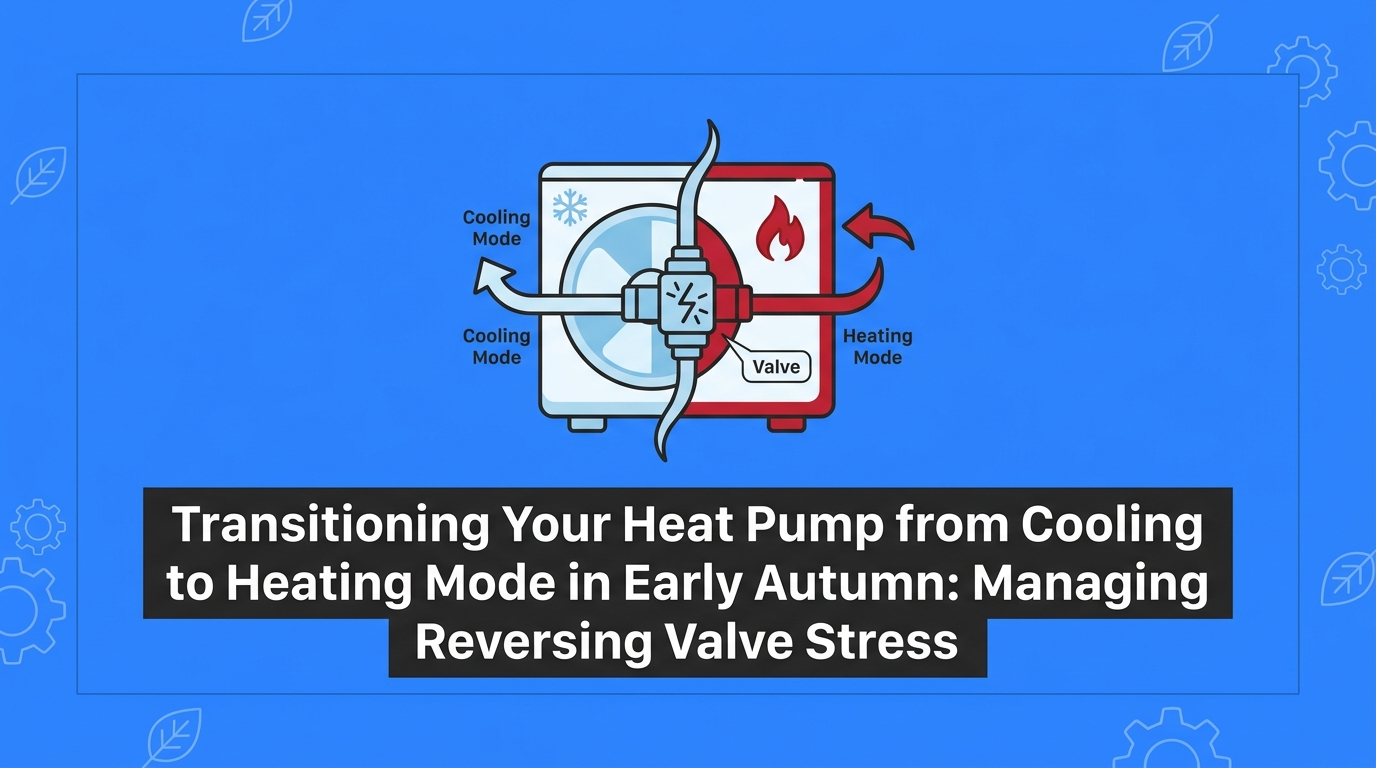
To understand why daily temperature swings requiring both heating and cooling can stress your system, it helps to look inside the machine. A heat pump is essentially an air conditioner that can run backward. The component that makes this magic happen is the reversing valve. Before you schedule professional heat pump maintenance and repair, knowing how this part functions can help you communicate better with your technician.
The reversing valve is a brass body with multiple tubes connected to it, sitting right next to your compressor. It acts as a physical traffic cop for the refrigerant flowing through your system. Here is the step-by-step sequence of events that occurs when you change your thermostat from cool to heat:
1. The Thermostat Signal: You adjust the temperature on your wall, sending a low-voltage electrical signal down the wire to the outdoor unit.
2. The Solenoid Activation: This electrical signal reaches the solenoid coil, which sits on top of the reversing valve. The coil generates a magnetic field.
3. The Pilot Valve Shift: The magnetic field pulls a tiny internal pin inside the pilot valve. This small movement redirects a tiny amount of pressurized refrigerant.
4. The Main Slide Moves: Using the system's own internal pressure, a larger sliding block inside the main brass tube is pushed from one side to the other.
5. Refrigerant Reversal: The flow of hot, high-pressure refrigerant is instantly redirected. Instead of sending the heat outside, the system now pumps that heat into your indoor coil to warm your home.
The solenoid coil is the electrical brain of the operation. Without that magnetic field, the valve cannot shift. Because it relies on electricity, the coil is often the first thing to fail if there is a wiring issue or a power surge. When the coil receives power, you might hear a distinct click. That click is a sign that the electrical command was received and the physical sliding mechanism inside the valve body is trying to do its job.
The reversing valve does not just flip a switch; it physically redirects high-pressure gas. Because of this, the system needs a moment to balance pressures. When the main slide moves, the high pressure from the compressor and the low pressure from the suction line suddenly swap paths. This sudden change in the direction of the refrigerant dictates whether the indoor coil gets hot or cold. It also explains why the transition is not instantaneous—the system needs time to equalize before it starts blowing warm air through your vents.
One pattern our team at Always Affordable Plumbing & HVAC sees often during service calls in the Sacramento area is homeowners panicking over a strange noise coming from their outdoor unit during the first cold morning of the year. Because the heat pump has been running strictly in cooling mode for months, that first shift into heating mode can be noisy. The trick is knowing how to distinguish between a healthy system transition and a stuck valve.
When the reversing valve shifts, it relies on system pressure. This sudden change in pressure creates distinct sounds that are entirely normal. However, mechanical distress sounds very different. If you are ever in doubt, having a professional evaluate the system as part of comprehensive HVAC solutions is the safest route.
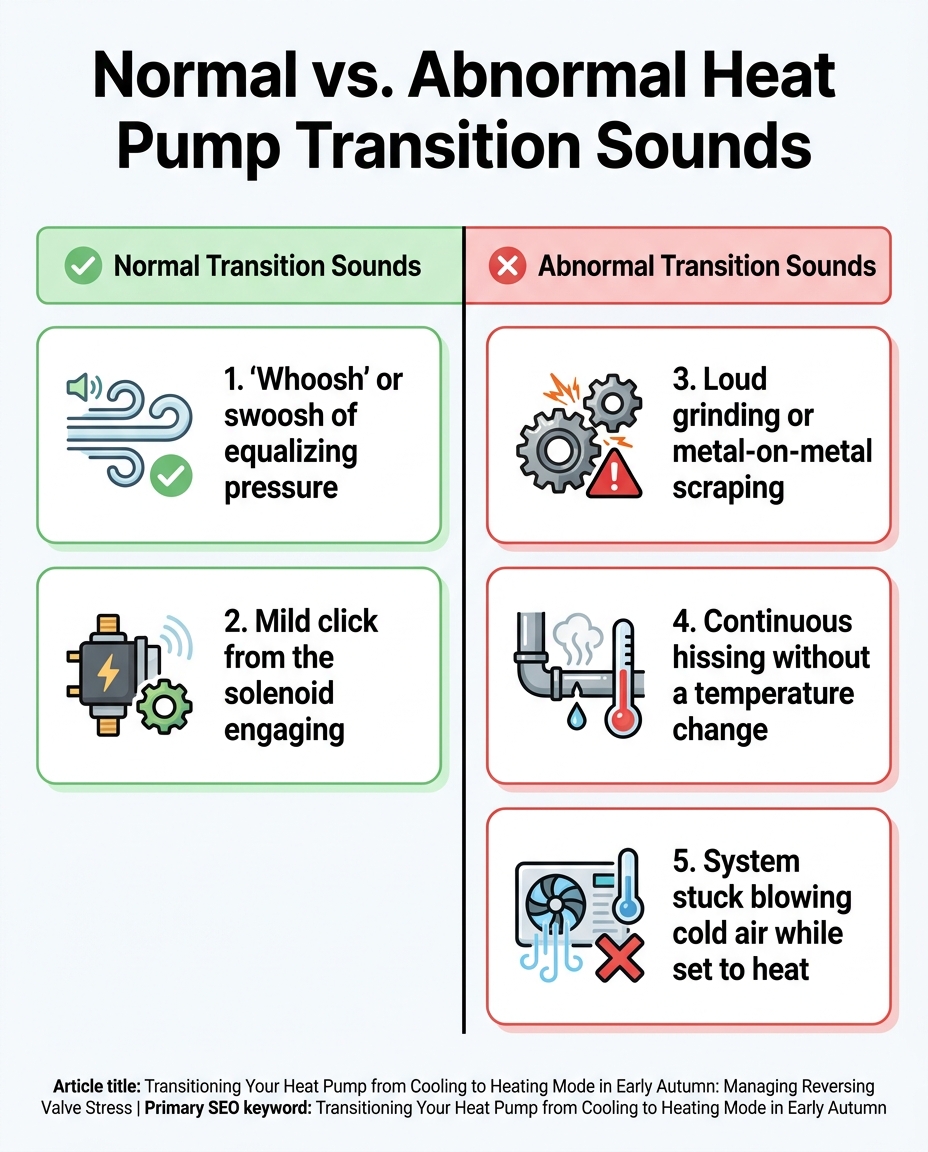
• A loud "whoosh" or swooshing sound — What It Means: Refrigerant pressures are rapidly equalizing as the internal slide moves. — Status: Normal
• A distinct electrical click from the outdoor unit — What It Means: The solenoid coil has energized and is attempting to move the pilot valve. — Status: Normal
• Blowing cool air for the first 2-5 minutes — What It Means: The indoor coil is warming up, and the system is clearing out leftover cool air. — Status: Normal
• Loud metal-on-metal grinding or screeching — What It Means: The internal slide is jammed, or the compressor is struggling against a blocked valve. — Status: Warning Sign
• Continuous hissing without a temperature change — What It Means: The valve is stuck halfway, allowing refrigerant to bypass without actually heating or cooling. — Status: Warning Sign
• System blows cold air continuously on heat setting — What It Means: The reversing valve has failed to shift out of cooling mode. — Status: Warning Sign

In our experience maintaining local heating and cooling systems, we've found that the regional climate plays a massive role in the lifespan of your mechanical equipment. Sacramento's Mediterranean climate shoulder season—typically spanning late September through October—is characterized by extreme diurnal temperature swings. It is not uncommon to wake up to a brisk 45-degree morning and end up sweating in an 85-degree afternoon. These 30-plus degree daily temperature fluctuations force your heat pump to run dual duty.
Every time you switch the thermostat from heat to cool, the reversing valve must physically slide back and forth. Doing this once a week is fine. Doing this twice a day for a month straight introduces cumulative mechanical fatigue. The brass body of the valve expands and contracts with the fluctuating ambient outdoor temperatures, and the internal sliding block experiences friction. Daily temperature swings requiring both heating and cooling mean the valve is working overtime precisely when the weather is most unpredictable.
Furthermore, fluctuating ambient temperatures impact the system's overall efficiency during the shift. A heat pump requires more energy to extract heat from a cold morning than it does to maintain a mild afternoon temperature. If your system spent all summer battling triple-digit heat, the internal components are already fatigued. This is why catching summer wear before heating season begins is so highly recommended. A valve that is slightly sticky in August might completely jam when forced to reverse under the pressure of a cold October morning.
If you notice the primary symptom—your thermostat is set to heat, but the system continuously blows cold air (or vice versa)—you are likely dealing with a stuck reversing valve. Because this component bridges the electrical and mechanical sides of your heat pump, diagnosing it accurately is not a weekend project.
The Problem: Your home in the Sacramento area is getting colder, the thermostat says "Heat," but the vents feel like the air conditioner is running. You hear the outdoor unit running, but the indoor climate is not matching your settings.
The Cause: The reversing valve has either lost electrical power to the solenoid coil, or the internal slide is physically jammed due to sludge, wear, or a pressure imbalance. When the valve is stuck, the refrigerant continues to flow in the cooling direction, ignoring the thermostat's request for warmth.
The Solution: Call a licensed professional for a thorough diagnosis. Diagnosing a stuck valve requires testing electrical continuity with a multimeter and checking real-time refrigerant pressures with specialized gauges—tasks strictly for licensed pros. Our technicians have spent countless hours diagnosing these exact issues, and we believe in providing budget-conscious, transparent service. A proper professional diagnosis ensures you won't overpay for unnecessary repairs. Sometimes, the fix is as simple as replacing a faulty low-voltage wire or a bad solenoid coil, rather than replacing the entire brass valve. If the issue is larger, having access to reliable air conditioning services ensures your home stays comfortable year-round.
A professional will differentiate between a bad solenoid coil (an electrical failure) and a physically jammed internal slide (a mechanical failure). If the coil is dead, it can often be replaced on its own without opening the sealed refrigerant lines. If the valve is mechanically jammed, the entire unit must be removed with a torch, the refrigerant recovered, and a new valve welded into place. Accurate testing saves money in the long run by pinpointing the exact failure point. Based on what our crews have encountered in the field, we strongly warn against common DIY mistakes, such as tapping the brass valve with a hammer or wrench. Forcing the valve can easily rupture the pressurized refrigerant lines, turning a simple repair into a major environmental hazard and a massive expense.
You cannot control the weather, but you can control how your system reacts to it. Managing your thermostat correctly during the early autumn shoulder season minimizes stress on the reversing valve and keeps your energy bills in check. Here are a few best practices to implement this fall:
• Avoid rapid mode switching: Never switch the thermostat back and forth between heat and cool in a matter of minutes. If you switch from cool to heat, give the system at least five to ten minutes to equalize pressures before demanding another change.
• Use the 'Auto' setting wisely: If your thermostat has an 'Auto' mode that automatically toggles between heating and cooling, set a reasonable deadband. A deadband is the temperature gap between the heating setpoint and the cooling setpoint. A deadband of at least 4 to 5 degrees prevents the system from short-cycling back and forth all afternoon.
• Leverage programmable schedules: Utilize programmable thermostat schedules to anticipate the natural temperature curve of the day. Set the heat to run early in the morning and turn off by 9 AM, allowing the house to naturally coast until the afternoon warmth kicks in.
• Keep the fan on 'Auto': Leaving the fan switch in the 'On' position can blow unheated air through the vents while the heat pump is between cycles, making the house feel drafty.
• Schedule a seasonal tune-up: A seasonal tune-up ensures the reversing valve is operating smoothly, electrical connections are tight, and the system is fully prepared for the heavy lifting of winter.
How long does a heat pump take to switch from cooling to heating?
It typically takes a heat pump between two and five minutes to fully transition from cooling to heating. During this brief window, the reversing valve shifts, refrigerant pressures equalize, and the indoor coil begins to warm up. You may feel cool air blowing from the vents initially, but it should turn warm within a few minutes. If it blows cold for more than ten minutes, there may be an issue with the valve.
Why is my heat pump blowing cold air on heat mode?
If your heat pump is blowing cold air while set to heat, the reversing valve is likely stuck in the cooling position. This happens when the solenoid coil fails electrically or the internal slide jams mechanically. It can also occur if the outdoor unit is going through a normal defrost cycle, which temporarily uses air conditioning to melt frost off the outdoor coils. If the cold air persists for hours, a professional diagnosis is required.
What does a bad reversing valve sound like?
In our experience on local service calls, a bad reversing valve often produces a loud, continuous hissing sound, indicating that high-pressure refrigerant is bleeding past the internal seals without fully shifting. You might also hear a repetitive, loud clicking if the solenoid is struggling, or a harsh metal-on-metal grinding noise. These sounds are distinctly different from the normal, brief "whoosh" you hear during a healthy transition.
Is it bad to switch back and forth between AC and heat?
Switching back and forth once or twice a day during the shoulder season is what the system is designed to do, but rapid switching is harmful. Flipping the thermostat from cool to heat and back again within a few minutes does not give the daily temperature swings requiring both heating and cooling enough time to equalize system pressures. This rapid toggling can lock up the compressor or jam the reversing valve.
Is it normal for a heat pump to make a whooshing sound when switching modes?
Yes, a distinct whooshing or swooshing sound is completely normal when a heat pump switches modes. This sound is simply the high-pressure refrigerant rapidly changing direction inside the copper lines as the reversing valve slides into its new position. The noise should only last a few seconds before the system settles into a steady hum.
Can a stuck reversing valve be repaired, or does it need replacement?
It depends on which part of the valve has failed. If the electrical solenoid coil on top of the valve is dead, the coil can be easily unbolted and replaced without opening the refrigerant lines. However, if the internal brass slide is physically jammed or the internal seals are leaking, the entire valve must be cut out and replaced by a licensed professional.
A healthy, responsive reversing valve is the cornerstone of year-round comfort in your home. The early autumn shoulder season puts this component to the test, demanding flawless transitions between heating and cooling to keep up with unpredictable weather. Early intervention is the best way to prevent mid-winter breakdowns when you rely on your heat pump the most. If you hear strange noises or feel cold air when you shouldn't, don't wait for the system to fail completely. Schedule a seasonal inspection today before the weather turns permanently cold, and ensure your home stays cozy all winter long.
See what our satisfied customers have to say about their experience with Always Affordable
Plumbing & HVAC.

"Chappy was very skilled in his knowledge of my HVAC unit. I greatly appreciate the quick response and experienced tech. The whole endeavor was made less stressful by his humor and honest conversation. I find comfort in knowing I now have a shop i trust for the next time."
"Tony, James, Ronnie did an amazing job setting up our new AC! They were quick, efficient, considerate, and polite! We appreciate them scheduling us in on such short notice. Definitely recommend this company!"
"Prompt, professional service with kindness and care. They came out to address both plumbing and AC issues. I received a courtesy call before they arrived. All issues were resolved the same day with integrity and respect. Thankful for businesses like this. Absolutely recommend to those that I love."
"Excellent service! Jason came out promptly and in addition to doing my outside faucet he also put in new irrigation equipment! All done perfectly! Jason was lovely"
"Honest with the assessment; friendly and good manners. No high pressure sales. Just good to honest "tell it like you see it" Thought my kitchen disposer needed an overhaul. But Jason, there Plumber gave me an honest lesson on what was really happening. Saved me hundreds, if I went the route of replacing. Thank you!"
"Absolutely 5 stars. If you are looking for affordable ,professional and kind. Chappy was excellent and very knowledgeable . I called in the morning because my air conditioner stopped working he was here within hours and fixed my air with a smile. I highly recommend Chappy and Always Affordable plumbing and Hvac."
"Scott and James were great. They got there quickly and diagnosed the problem with my A/C.They did a very thorough job testing everything. Sent me pictures and called to keep me informed. Got it done the next day and everything is working fine. Be glad when I get home so I can enjoy my new system. Thanks guys for a great job."
"Chappy was very helpful. He knew our issue right away, cleaned our coils. He also came on the same day we called and got our AC blowing cold air again."
"After some timing ’curfuffles’ the Tech Jason arrived and not only completed a speedy install on my toilet, he was personable & professional. Because of the timing issues Jason was attentive and showed up with everything needed! No extra store runs 😊 I was very comfortable with having this Tech in my Daughter’s home. We will definitely use this Service again."