Seasonal Home Maintenance Checklist: Preventing HVAC and Plumbing Emergencies
Prevent HVAC emergencies with a seasonal home maintenance checklist. Why proactive scheduling beats waiting for sudden failures. See what needs attention now.



When it comes to adapting older Carmichael homes for modern heat pump electrical requirements, our team at Always Affordable Plumbing & HVAC frequently encounters properties built during the mid-century housing boom that were originally wired with electrical panels rated for a maximum capacity of just 60 to 100 amps. Back in the 1960s, a typical household ran a few lights, a refrigerator, and perhaps a television. Fast forward to today, and our reliance on electricity has fundamentally shifted. This historical electrical limitation is often the first major hurdle we help homeowners overcome. Transitioning away from an aging gas furnace to a high-efficiency electric system is an excellent upgrade, but it requires a careful evaluation of your home's existing infrastructure.
The core challenge lies in the sheer power demand of modern HVAC equipment. When you begin planning a heat pump installation, the most critical decision point is determining whether your current electrical panel can safely handle the new load, or if a professional upgrade is mandatory to meet modern safety standards. This is not simply a matter of plugging in a new appliance; it is a complex infrastructural shift that requires licensed expertise. Bypassing a proper electrical assessment can lead to tripped breakers, overloaded circuits, and significant safety hazards.
Understanding the relationship between your 1960s home's electrical capacity and the demands of modern electrification is the foundation of a successful HVAC upgrade. By approaching this transition with a clear understanding of the technical and regulatory requirements, you can ensure that your new system operates safely, efficiently, and reliably for years to come.
The transition from combustion-based heating to advanced electric heating represents a major shift in how a house consumes energy. Legacy gas furnaces rely on natural gas to generate heat, meaning their electrical footprint is remarkably small. In contrast, modern heat pumps rely entirely on electricity to move heat energy from one place to another, requiring a substantially more robust electrical backbone.
Older gas furnaces typically operate on a standard 120-volt circuit. Because the natural gas handles the heavy lifting of producing heat, the electricity is only needed to power the blower motor that pushes air through the ductwork and the low-voltage thermostat controls. This minimal draw rarely strains even an outdated 1960s electrical panel.
Modern heat pumps, however, require dedicated 240-volt circuits. These systems consist of an outdoor compressor unit and an indoor air handler, both of which draw significant amperage. The National Electrical Code (NEC) mandates that heavy-draw HVAC equipment must be placed on dedicated circuits to prevent overloading the home's electrical system. Unlike standard air conditioning systems that only operate during the summer months, a heat pump provides year-round climate control, meaning this high-amperage dedicated circuit will be heavily utilized throughout every season.
Another factor that impacts electrical demand is the operational style of high-efficiency systems. Older HVAC units operate on a single-stage basis: they turn on at 100% capacity, blast air until the thermostat is satisfied, and then shut off completely. This intermittent cycling creates short spikes in electrical demand.
Modern variable-speed heat pumps operate differently. They are designed to run continuously at lower speeds, making micro-adjustments to maintain a consistent indoor temperature. While this continuous operation is incredibly energy-efficient and provides superior comfort, it means the electrical panel must be capable of supporting a sustained, steady electrical draw without overheating or tripping breakers.
• Legacy Gas Furnace — Voltage Requirement: 120V (Standard) — Primary Energy Source: Natural Gas — Impact on Electrical Panel: Minimal (Blower motor only)
• Standard AC (Cooling Only) — Voltage Requirement: 240V (Dedicated) — Primary Energy Source: Electricity — Impact on Electrical Panel: High (Summer months only)
• Modern Heat Pump — Voltage Requirement: 240V (Dedicated) — Primary Energy Source: Electricity — Impact on Electrical Panel: High (Year-round continuous draw)
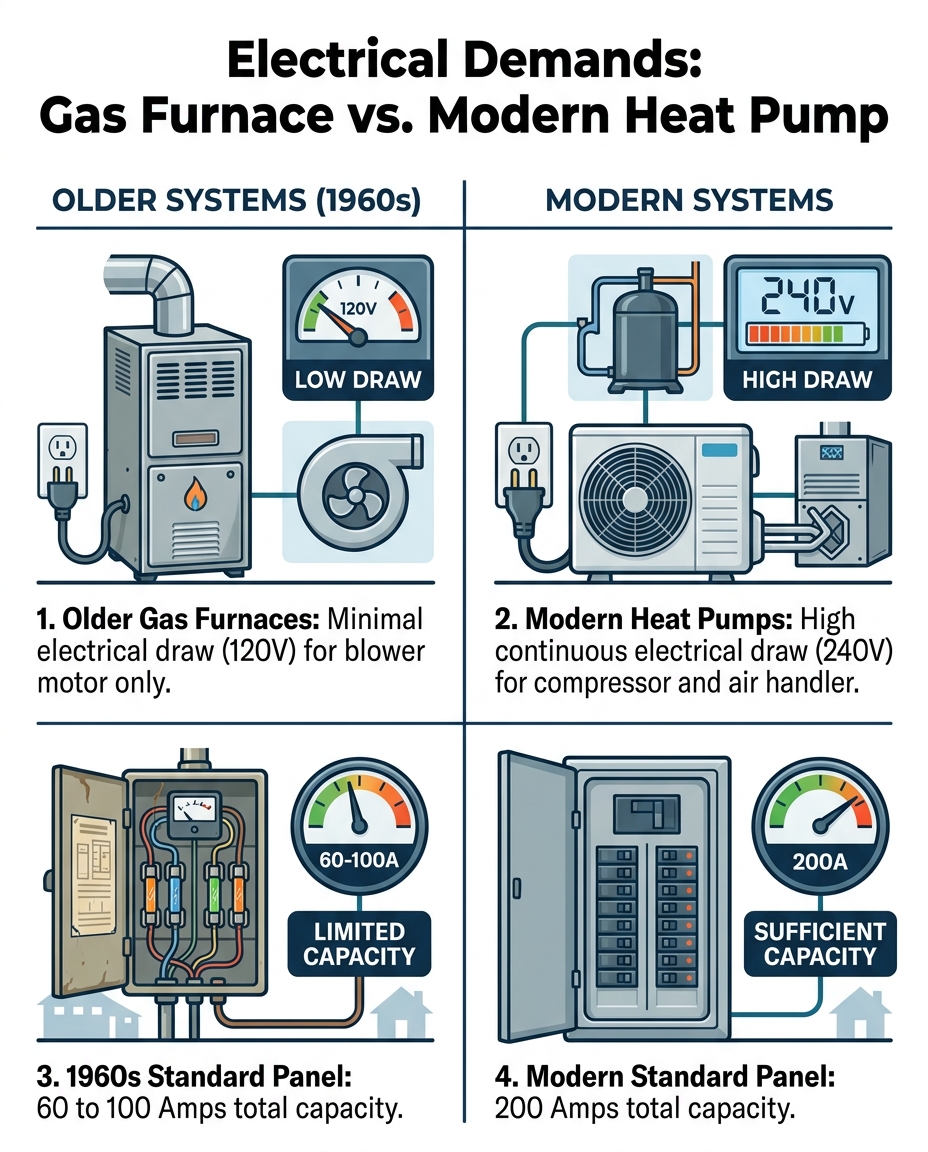

When a home was built in the 1960s, the electrical panel was sized for the appliances of that era. Today, our homes are filled with high-draw electronics, electric ovens, electric dryers, and EV chargers. Adding a high-efficiency heat pump to this mix often pushes an older electrical system past its breaking point.
The most common bottleneck our technicians see in mid-century homes is the 100-amp main electrical panel. While 100 amps was considered generous fifty years ago, it is often vastly insufficient for modern full-home electrification. A new heat pump alone can require a dedicated 30-amp to 50-amp circuit. If your home's panel is already operating near its maximum capacity with daily household use, attempting to add a heat pump without an upgrade will inevitably lead to overloaded circuits, frequently tripped breakers, and severe fire hazards.
Professional assessment is non-negotiable at this stage. A licensed electrician or qualified HVAC technician will perform a formal residential load calculation (often referred to as a Manual J and electrical load calculation based on NEC Article 220). This mathematical process evaluates the square footage of the home, the number of existing dedicated circuits, lighting loads, and major appliances to determine exactly how much capacity remains. If the calculation shows that the new heat pump will exceed the panel's safe operating limits, a heavy-up to a 200-amp main panel becomes a mandatory prerequisite for the installation.
While only a licensed professional should ever open or test an electrical panel, there are several visual indicators that homeowners can observe from the outside that suggest an upgrade may be necessary before a heat pump can be installed:
• Lack of physical breaker space: If every slot in the panel is full, there is no physical room to add the double-pole breaker required for a 240V heat pump.
• Use of tandem breakers: If you see "double" or tandem breakers (two switches squeezed into a single slot), it often indicates that a previous installer ran out of space and attempted to bypass the panel's physical limitations.
• Age and brand of the panel: Certain brands installed heavily in the 1960s and 1970s are known safety hazards and can no longer be legally added onto or serviced.
• Main breaker rating: The large main switch at the top or center of the panel will usually have a number stamped on it (e.g., 60, 100, or 200). If it reads 100 or less, an upgrade is highly likely.
The safety rule: Never attempt to remove the dead-front cover of your electrical panel to inspect the wiring yourself. The bus bars behind that cover carry lethal amounts of electricity, even if the main breaker is turned off.
The operational demands placed on your home's electrical system are directly tied to the weather outside. In the local region, our team knows firsthand that the climate dictates a heavy reliance on robust, year-round climate control, making electrical reliability absolutely critical.
With summer temperatures in Carmichael frequently exceeding 90 degrees, a heat pump operating in cooling mode must work continuously to extract heat from the home and reject it outdoors. During these peak summer heatwaves, the system will draw sustained, high amperage for hours at a time. This continuous draw is exactly what heavily strains outdated 100-amp panels.
Electrical resistance increases with heat. When an undersized, 1960s electrical panel is subjected to the sustained high draw of a heat pump during a 95-degree afternoon, the internal components can overheat. This is why undersized panels most often fail, trip, or degrade during the hottest parts of the summer. Upgrading to a 200-amp service ensures that your electrical backbone has the sheer capacity and physical mass to handle peak cooling loads safely, without generating dangerous excess heat at the breaker connections.
While summer demands are intense, chilly winters also require reliable electrical delivery for the heating cycle. Because heat pumps are the sole source of heat in an electrified home, a panel failure during a cold snap means a complete loss of indoor heating. Unlike a gas furnace that might still function on a small generator, a heat pump requires significant electrical capacity to run the compressor and any auxiliary heat strips during freezing nights. A properly sized electrical service provides the dual-season reliability necessary to keep the home comfortable regardless of extreme weather swings.
Modernizing the infrastructure of a 1960s home is not just a technical challenge; it is heavily regulated by local building codes. Ensuring that both the electrical upgrade and the HVAC installation meet strict regulatory standards is paramount for safety, insurance compliance, and future property valuation.
Replacing an older gas furnace with an electric heat pump often triggers the need for dual permits. Because the scope of work crosses two different licensed trades, local jurisdictions typically require both an HVAC mechanical permit for the equipment installation and a separate electrical permit for the main panel upgrade and the new dedicated 240V circuitry.
The timeline for this process involves multiple steps. First, the electrical panel upgrade must be permitted, installed, and subjected to a rough-in inspection by the county or city building department. The local utility provider must also be involved to disconnect and reconnect the main service lines from the street to the house. Only after the electrical infrastructure is approved can the heat pump be safely wired in and the final mechanical inspection completed.
Partnering with a team that has deep expertise in navigating local building codes and permit requirements for combined HVAC and electrical upgrades provides a transparent and seamless process for the homeowner. Attempting unpermitted electrical work is incredibly dangerous and can lead to severe legal and financial consequences. If an unpermitted, overloaded electrical panel causes a fire, homeowners insurance policies will typically deny the claim. Furthermore, unpermitted mechanical and electrical work will be flagged during a home inspection if you ever decide to sell the property, forcing you to pay for retroactive permits, fines, and potentially tearing out the work to have it redone to code. Relying on licensed professionals ensures the installation meets all modern safety standards from day one.
Upgrading the electrical infrastructure of a 1960s home requires careful planning, but there are strategic ways to sequence the work and alternative options to consider if a full panel upgrade needs to be phased over time.
The most effective strategy is to sequence the electrical panel upgrade immediately before the HVAC installation. By coordinating these projects closely, you can minimize downtime and ensure that the new heat pump has a safe, dedicated power source ready the moment it is installed. If a heavy-up to 200 amps is temporarily out of reach, homeowners might explore alternative solutions. For example, certain ductless mini split options have slightly different electrical profiles and smaller amperage requirements per zone, which may offer a stopgap solution for specific rooms without requiring an immediate whole-home panel replacement.
Transitioning from fossil fuels to high-efficiency electric systems is a major infrastructural investment, but it is one that is heavily encouraged by current energy policies. Homeowners transitioning to high-efficiency electric systems should thoroughly explore available incentives to help offset the initial costs of both the equipment and the necessary electrical upgrades.
There are generally applicable federal tax credits designed to encourage home electrification, which may apply to qualifying heat pump installations and, in some cases, the electrical panel upgrades required to support them. Because these programs frequently change and have specific qualification criteria based on income, equipment efficiency ratings, and tax liability, it is highly recommended to consult with a qualified tax professional and check with your local utility providers for current program details before beginning the project. Investing in both robust electrical infrastructure and high-efficiency equipment yields long-term value through improved safety, better home comfort, and reduced energy consumption.
Navigating the transition from mid-century infrastructure to modern electrification naturally brings up many questions. Whether you are curious about panel sizes or looking into claiming federal tax credits for heat pump upgrades, having clear answers is essential for making informed decisions about your home. Below are some of the most common questions Carmichael homeowners ask regarding electrical requirements for new HVAC systems.
In most residential scenarios, yes, a 200-amp panel is highly recommended and often required when installing a modern heat pump. While the heat pump itself may only require a 30 to 50-amp dedicated circuit, adding that load to a home that already uses electricity for lighting, cooking, and daily living usually pushes an older 100-amp panel past its safe operational capacity. A professional load calculation is the only way to determine this definitively.
A heat pump requires a dedicated 240V circuit because it draws a significant amount of continuous electrical current to operate both the outdoor compressor and the indoor air handler. Placing it on a dedicated circuit ensures that the high amperage does not overload shared household wiring, which prevents tripped breakers and electrical fires. This is a strict requirement mandated by the National Electrical Code for heavy-draw appliances.
Running a modern heat pump on a 100-amp service is generally not feasible for a standard-sized home. Once you account for the baseline electrical usage of a refrigerator, electric oven, water heater, and general lighting, there is rarely enough safe capacity left on a 100-amp main breaker to support the continuous draw of a central heat pump. Attempting to do so without a professional load calculation risks severe electrical hazards.
If your current panel cannot safely support the additional amperage required by the new system, you must upgrade the panel before the heat pump can be installed. The electrical infrastructure serves as the foundation for the HVAC system; installing high-draw equipment on an inadequate panel is a major code violation and safety risk. The panel upgrade is always the first step in the sequencing of the project.
An electrical panel upgrade in Sacramento County requires a specific electrical permit issued by the local building department, followed by formal rough-in and final inspections. Additionally, coordinating with the local utility provider is required to safely disconnect and reconnect the main power drop to the home. This work must be performed by a licensed professional to ensure compliance with all local and national safety codes.
The only accurate way to know if your 1960s home can support a new electric HVAC system is to have a licensed professional perform an electrical load calculation. They will assess the total square footage, the existing amperage of your main breaker, the physical space available in the panel, and the total current draw of all existing appliances. Visual signs like a full panel or tandem breakers often indicate that an upgrade will be necessary.
Understanding your home's electrical requirements is the essential first step to a successful heat pump installation. For homes built in the 1960s, a clear, expert explanation helps bridge the gap between mid-century infrastructure limitations and the demands of modern electrification. By addressing the electrical panel before the HVAC equipment is installed, you ensure a safe, compliant, and highly efficient system that will keep your home comfortable in every season.
Don't let an outdated electrical panel stand in the way of better indoor comfort and energy efficiency. Schedule a professional assessment of your current electrical capacity to determine the best path forward for your home's heating services needs. With the right technical guidance, upgrading your infrastructure can be a smooth, transparent process that adds lasting value and safety to your property.
See what our satisfied customers have to say about their experience with Always Affordable
Plumbing & HVAC.

"Chappy was very skilled in his knowledge of my HVAC unit. I greatly appreciate the quick response and experienced tech. The whole endeavor was made less stressful by his humor and honest conversation. I find comfort in knowing I now have a shop i trust for the next time."
"Tony, James, Ronnie did an amazing job setting up our new AC! They were quick, efficient, considerate, and polite! We appreciate them scheduling us in on such short notice. Definitely recommend this company!"
"Prompt, professional service with kindness and care. They came out to address both plumbing and AC issues. I received a courtesy call before they arrived. All issues were resolved the same day with integrity and respect. Thankful for businesses like this. Absolutely recommend to those that I love."
"Excellent service! Jason came out promptly and in addition to doing my outside faucet he also put in new irrigation equipment! All done perfectly! Jason was lovely"
"Honest with the assessment; friendly and good manners. No high pressure sales. Just good to honest "tell it like you see it" Thought my kitchen disposer needed an overhaul. But Jason, there Plumber gave me an honest lesson on what was really happening. Saved me hundreds, if I went the route of replacing. Thank you!"
"Absolutely 5 stars. If you are looking for affordable ,professional and kind. Chappy was excellent and very knowledgeable . I called in the morning because my air conditioner stopped working he was here within hours and fixed my air with a smile. I highly recommend Chappy and Always Affordable plumbing and Hvac."
"Scott and James were great. They got there quickly and diagnosed the problem with my A/C.They did a very thorough job testing everything. Sent me pictures and called to keep me informed. Got it done the next day and everything is working fine. Be glad when I get home so I can enjoy my new system. Thanks guys for a great job."
"Chappy was very helpful. He knew our issue right away, cleaned our coils. He also came on the same day we called and got our AC blowing cold air again."
"After some timing ’curfuffles’ the Tech Jason arrived and not only completed a speedy install on my toilet, he was personable & professional. Because of the timing issues Jason was attentive and showed up with everything needed! No extra store runs 😊 I was very comfortable with having this Tech in my Daughter’s home. We will definitely use this Service again."