Common Homeowner Questions Answered: Troubleshooting AC Cooling Failures and Stubborn Clogs
Is your AC running nonstop but your house is still hot? We get these common homeowner questions answered. See when to check a filter vs when to call a pro.




Federal tax credits for heat pump and water heater upgrades are available to eligible homeowners through the Energy Efficient Home Improvement Credit (Section 25C), enacted under the Inflation Reduction Act. If you installed a qualifying system between January 1, 2023, and December 31, 2025, here is what you need to know at a glance:
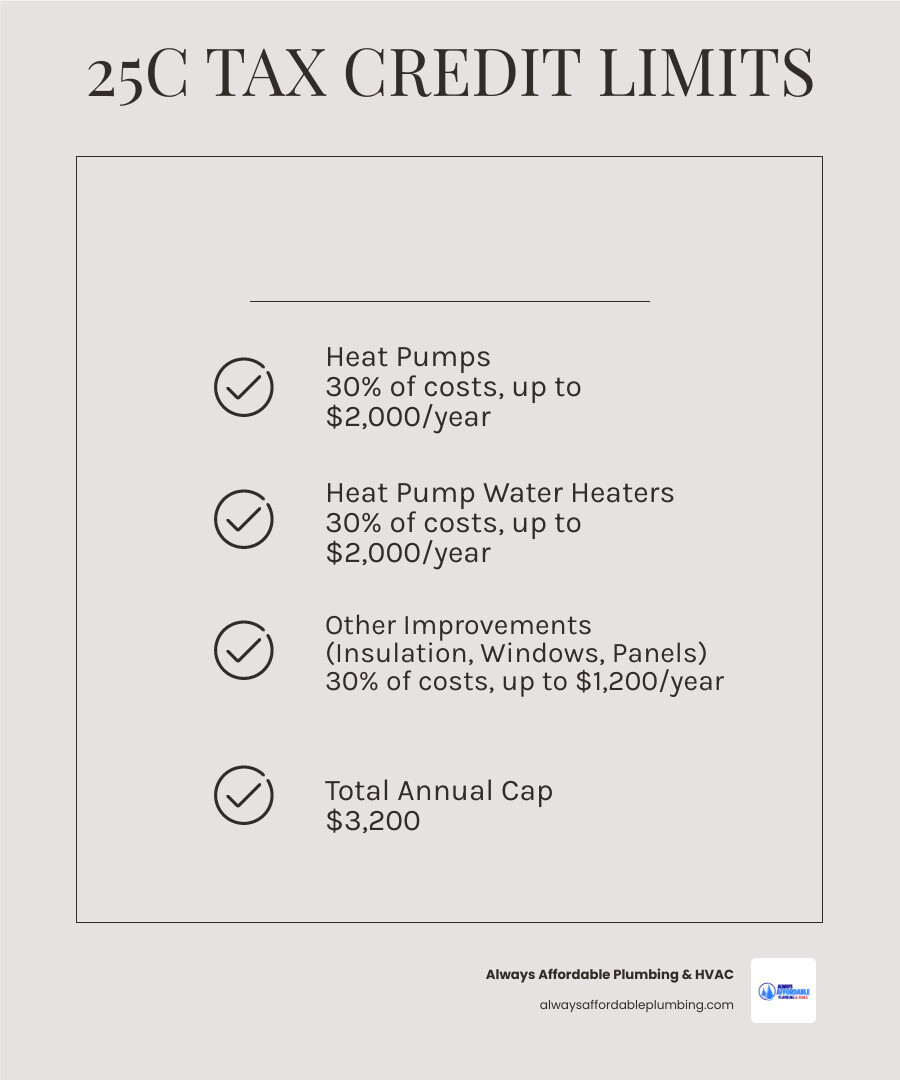
• Heat pump (air source) — Credit Amount: 30% of project cost — Annual Limit: Up to $2,000
• Heat pump water heater — Credit Amount: 30% of project cost — Annual Limit: Up to $2,000
• Other improvements (insulation, windows, panels) — Credit Amount: 30% of project cost — Annual Limit: Up to $1,200
• Total annual cap — Annual Limit: $3,200
• The credit is non-refundable — it reduces the federal taxes you owe, but does not generate a refund beyond your tax liability
• You claim it by filing IRS Form 5695 with your federal tax return for the year the equipment was installed
• No income limits apply — any federal taxpayer who meets the other requirements can claim it
• Starting with 2025 installations, you must report a Qualified Manufacturer ID (QMID) on your tax return
For Sacramento-area homeowners, this is one of the most straightforward ways to reduce the out-of-pocket cost of switching to a more energy-efficient home heating and cooling system. Heat pump water heaters alone can be up to three times more efficient than a conventional water heater — and the federal credit helps offset the upfront investment significantly.
Whether you completed an upgrade in 2025 and are now preparing to file, or you want to understand what you missed and plan ahead, this guide walks you through everything clearly and step by step.
The Inflation Reduction Act completely transformed the landscape for home energy efficiency. Gone are the days of small, lifetime-capped credits. Under the current 25C rules, the limits reset every year. This means if you installed a heat pump in 2024 and a heat pump water heater in 2025, you could potentially claim the full $2,000 credit for each year.
The total annual cap of $3,200 is structured into two main buckets. The first bucket is for "general" improvements like insulation, windows, and traditional HVAC systems, capped at $1,200. The second bucket is specifically for heat pumps and heat pump water heaters, which carries a higher $2,000 cap. When you combine these, you reach that $3,200 maximum.
Not every unit you see at a big-box store will qualify for the tax credit. To protect the integrity of the program, the IRS requires that equipment meet strict efficiency standards. For air source heat pumps and heat pump water heaters, the benchmark is usually the ENERGY STAR certification and the highest efficiency tier established by the Consortium for Energy Efficiency (CEE).
For heat pump water heaters, the unit must generally be ENERGY STAR certified and meet the CEE's highest non-advanced tier. Air source heat pumps have regional requirements; in our part of California, they typically need to meet specific SEER2, EER2, and HSPF2 ratings to qualify. If you are unsure if your current or planned system meets these marks, checking our Heat Pump Installation Elk Grove CA Guide can help you understand the technical requirements for local installations.

As of April 2026, many homeowners are looking back at their 2025 installations to prepare their tax filings. To claim the federal tax credits for heat pump and water heater upgrades, the equipment must have been "placed in service"—meaning fully installed and operational—between January 1, 2023, and December 31, 2025.
Who can claim the credit?
• Homeowners: The credit applies to your "principal residence." This is the home where you live most of the time.
• Renters: Interestingly, if you are a renter and you pay for a qualifying upgrade to your primary residence (with the landlord's permission, of course), you may be eligible to claim the credit.
• Second Homes: You can claim the credit for certain energy property like heat pumps installed in a second home that you use as a residence. However, you cannot claim it for a home you never visit or use.
• Existing Homes only: The 25C credit is for retrofitting existing homes. New constructions typically fall under different developer-focused tax credits.
It is important to note that landlords cannot claim this credit for properties they do not reside in. If you are a property owner in Sacramento looking to upgrade a rental unit, you might want to look into our Water Heater Replacement Sacramento Guide to see how efficiency saves you money on maintenance, even if the tax credit isn't available for that specific property.
Starting with the 2025 tax year, the IRS added a new layer of verification: the Qualified Manufacturer ID (QMID). This is a unique code provided by the manufacturer to prove the product meets federal standards. When we perform a Heat Pump Replacement Sacramento CA Guide service, we always recommend that homeowners secure the Manufacturer Certification Statement immediately.
This statement is a signed document from the manufacturer certifying that the specific model number qualifies for the 25C credit. For 2025 and 2026 filings, you will likely need to enter the QMID or a similar product PIN on your tax forms. For example, some major brands like Rheem have specific four-digit codes (like K3A8) that must be reported. Without this code, the IRS may reject the credit claim.
Claiming your credit isn't automatic; you have to ask for it when you file your annual return. The primary document you’ll need is IRS Form 5695, Residential Energy Credits.
You will specifically look at Part II of this form, which deals with the Energy Efficient Home Improvement Credit. Here, you will input the total cost of your project. One of the best parts about the credit for heat pumps and water heaters is that it covers labor and installation costs. This is different from "building envelope" improvements like windows or insulation, where only the material cost counts.
Because this is a non-refundable credit, it can only reduce your tax liability to zero. For example, if you qualify for a $2,000 credit but only owe $1,500 in federal taxes, your credit will be limited to $1,500. You cannot "carry over" the remaining $500 to the next year. This makes it vital to work with a tax professional if you have a low tax liability year. If your system is acting up and you're worried about the cost of a new one, our Water Heater Repair Sacramento CA services can often keep you running until a year when you can better utilize the tax benefits.
The IRS doesn't require you to mail in your receipts with your tax return, but you must keep them in your files in case of an audit. We recommend creating a "Green Folder" (digital or physical) that contains:
1. The Invoice: This should clearly show the date of installation, the model number, and a breakdown of labor vs. materials.
2. Product Labels: A photo of the ENERGY STAR label from the unit itself.
3. Manufacturer Certification Statement: The document mentioned earlier that includes the QMID.
4. Energy Audit Report: If you had a home energy audit to qualify for the $150 credit, keep the auditor's written report and their EIN (Employer Identification Number).
Keeping these documents organized is just as important as the maintenance of the unit itself. For tips on keeping your system in peak shape so it lasts long enough to pay for itself, check out our Heat Pump Service Sacramento Guide.
The smartest way to use federal tax credits for heat pump and water heater upgrades is to view them as part of a multi-year home improvement strategy. Since the $3,200 cap resets every year, you can "stack" your upgrades to get the maximum money back from the government.
For example, a common strategy we see in Sacramento and Roseville involves upgrading the home's "envelope" first. You might spend one year adding insulation and sealing air leaks. These qualify for 30% of the cost up to $1,200. In that same year, you could install an air source heat pump, which qualifies for another $2,000. That’s $3,200 back in a single year!
Then, in the following year, you could replace your old gas water heater with a heat pump water heater. Since it’s a new tax year, you are eligible for another $2,000 credit.
• Year 1 — Improvement: Insulation & Windows — Credit Category: Envelope — Max Credit: $1,200
• Year 1 — Improvement: Air Source Heat Pump — Credit Category: Heat Pump — Max Credit: $2,000
• Year 2 — Improvement: Heat Pump Water Heater — Credit Category: Heat Pump — Max Credit: $2,000
• Year 2 — Improvement: Electrical Panel Upgrade — Credit Category: Property — Max Credit: $600
Many older homes in Sacramento or Citrus Heights have 100-amp electrical panels that simply can't handle the load of a new electric heat pump and water heater. The good news? The federal government thought of that. You can claim a credit of up to $600 per year for electrical panel upgrades, provided they are installed in conjunction with another qualifying energy-efficient improvement.
In California, we also have access to various state-level rebates and utility incentives from companies like SMUD or PG&E. It is important to remember that if you receive a rebate that is deducted from your purchase price at the time of sale, you must subtract that amount from the total cost before calculating your 30% tax credit. However, if you receive a "post-purchase" rebate, it generally doesn't affect your tax credit basis.
If you are planning an upgrade in the Roseville area, our Heat Pump Replacement Guide Roseville CA provides excellent local context on how to time these improvements for the best ROI.
The maximum annual credit for a heat pump (either for space heating/cooling or for water heating) is $2,000. This is calculated as 30% of the total cost, including labor. If you install both an air source heat pump and a heat pump water heater in the same year, your total credit for that category is still capped at $2,000. To get the full $4,000 for both, you would need to install them in separate tax years.
Generally, no. The 25C credit is intended for "principal residences." If you are a landlord and do not live in the property, you cannot claim the credit for upgrades made to your rental units. However, if you are a tenant and you pay for the upgrade yourself for your primary residence, you may be eligible. Second homes that you use as a residence can qualify for the $2,000 heat pump credit, but not for the $1,200 envelope improvement credit (windows/doors).
Yes, in most cases. If you receive a subsidy or rebate from a public utility that reduces the price you paid for the unit, you must subtract that amount from the "qualified expenses" before you take your 30% calculation. For example, if a heat pump costs $10,000 and you get a $2,000 instant utility rebate, you can only claim 30% of the remaining $8,000.
Navigating federal tax credits for heat pump and water heater upgrades can feel like learning a second language, but the savings are well worth the effort. By switching to high-efficiency electric appliances, you aren't just helping the environment—you're putting thousands of dollars back into your pocket through tax savings and lower monthly utility bills.
At Always Affordable Plumbing & HVAC, we take pride in being the Sacramento area’s energy experts. From Davis to Folsom and Elk Grove to Rocklin, we help our neighbors choose equipment that doesn't just work great, but also meets the strict IRS standards for these valuable credits.
If you want to ensure your next upgrade is "tax-credit ready," or if you're interested in priority service and discounts through our Member's Club, we are here to help. Our team provides quality, transparent, and affordable solutions for all your plumbing and HVAC needs.
Ready to make your home more efficient and claim your piece of the federal pie? More info about HVAC services is just a click away!
See what our satisfied customers have to say about their experience with Always Affordable
Plumbing & HVAC.

"Chappy was very skilled in his knowledge of my HVAC unit. I greatly appreciate the quick response and experienced tech. The whole endeavor was made less stressful by his humor and honest conversation. I find comfort in knowing I now have a shop i trust for the next time."
"Tony, James, Ronnie did an amazing job setting up our new AC! They were quick, efficient, considerate, and polite! We appreciate them scheduling us in on such short notice. Definitely recommend this company!"
"Prompt, professional service with kindness and care. They came out to address both plumbing and AC issues. I received a courtesy call before they arrived. All issues were resolved the same day with integrity and respect. Thankful for businesses like this. Absolutely recommend to those that I love."
"Excellent service! Jason came out promptly and in addition to doing my outside faucet he also put in new irrigation equipment! All done perfectly! Jason was lovely"
"Honest with the assessment; friendly and good manners. No high pressure sales. Just good to honest "tell it like you see it" Thought my kitchen disposer needed an overhaul. But Jason, there Plumber gave me an honest lesson on what was really happening. Saved me hundreds, if I went the route of replacing. Thank you!"
"Absolutely 5 stars. If you are looking for affordable ,professional and kind. Chappy was excellent and very knowledgeable . I called in the morning because my air conditioner stopped working he was here within hours and fixed my air with a smile. I highly recommend Chappy and Always Affordable plumbing and Hvac."
"Scott and James were great. They got there quickly and diagnosed the problem with my A/C.They did a very thorough job testing everything. Sent me pictures and called to keep me informed. Got it done the next day and everything is working fine. Be glad when I get home so I can enjoy my new system. Thanks guys for a great job."
"Chappy was very helpful. He knew our issue right away, cleaned our coils. He also came on the same day we called and got our AC blowing cold air again."
"After some timing ’curfuffles’ the Tech Jason arrived and not only completed a speedy install on my toilet, he was personable & professional. Because of the timing issues Jason was attentive and showed up with everything needed! No extra store runs 😊 I was very comfortable with having this Tech in my Daughter’s home. We will definitely use this Service again."