HVAC Troubleshooting: Why Your System is Blowing Warm Air
Vents blowing hot? Use these home maintenance tips and troubleshooting steps to safely diagnose the failure point. See exactly when to call a professional.



Knowing when to replace your furnace or AC filter is one of the simplest — and most overlooked — things you can do to protect your home's comfort system. Most filters should be replaced every 1 to 3 months, but the right timing depends on your filter type, household, and local air conditions.
Quick Answer: When to Replace Your Filter
• Standard home, no pets — Recommended Replacement Frequency: Every 90 days
• Home with one pet — Recommended Replacement Frequency: Every 60 days
• Multiple pets — Recommended Replacement Frequency: Every 20-30 days
• Allergy or asthma sufferers — Recommended Replacement Frequency: Every 20-30 days
• Vacation or rarely occupied home — Recommended Replacement Frequency: Every 6-12 months
• 1-inch fiberglass filter — Recommended Replacement Frequency: Every 30 days
• Thick 4-5 inch media filter — Recommended Replacement Frequency: Every 6-12 months
Think of your HVAC filter as the lungs of your home. Every time your system runs — whether heating in winter or cooling through a Sacramento summer — air gets pulled through that filter. Over time, it collects dust, pet dander, pollen, mold spores, and other particles until it simply can't do its job anymore.
When that happens, your system works harder, your energy bills climb, and the air your family breathes gets worse. In the Sacramento area, factors like wildfire smoke, agricultural dust, and high pollen counts can shorten a filter's life even faster than the national average.
The good news? Staying on top of filter replacements is easy once you know what to look for — and the payoff for your system's health (and your own) is well worth it.
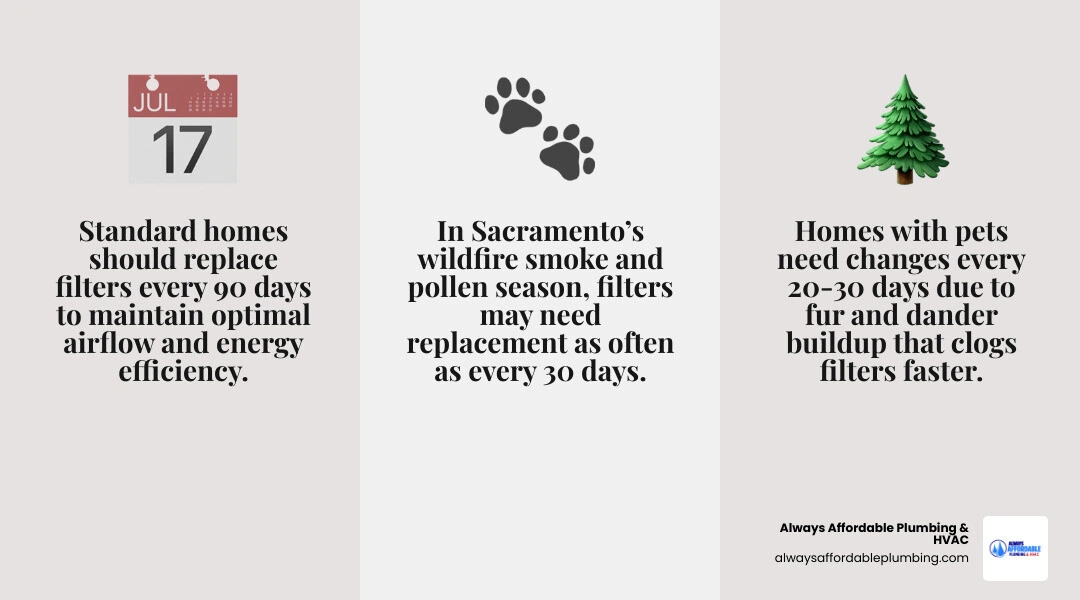

While it is tempting to wait until your system starts acting up, we always recommend a proactive approach. In May 2026, as we transition into the warmer months in Northern California, establishing a routine is critical. The "gold standard" for most residential systems is a 90-day baseline. However, this is not a "set it and forget it" rule.
We suggest a 30-day inspection cycle. Once a month, take a moment to pull the filter out and look at it. If you can no longer see the filter material through the layer of dust, or if it has turned a uniform shade of gray, it is time for a change. Seasonal usage plays a massive role here; during peak summer in Roseville or peak winter in Folsom, your system runs almost constantly, meaning air is being filtered more frequently and the filter will clog faster.
To keep your system in top shape beyond just the filter, it is also important to understand How Often Should You Service Your HVAC to ensure the internal components are as clean as the air flowing through them.
The wide range of "one to three months" exists because not all filters are created equal. Basic fiberglass filters are designed to stop large debris from damaging the furnace blower, but they don't do much for air quality and clog very quickly—often needing replacement every 30 days.
On the other hand, pleated filters have more surface area to trap smaller particles. While they are more efficient, they also create more resistance as they fill up. Always check the manufacturer recommendations on the side of the filter packaging, but these are often "best-case scenario" estimates. If your system runtime is high because you work from home or have the thermostat fan set to "On" rather than "Auto," you will likely fall on the shorter end of that window.
If you look at your filter slot and see a narrow 1-inch gap, you are likely using standard filters that require frequent attention. However, many modern systems in areas like Elk Grove or Davis are equipped with 4-inch or 5-inch media cabinets.
These thicker filters aren't necessarily "stronger" in terms of what they catch, but they have a vastly larger surface area thanks to deep pleats. Because there is more material to catch dust, it takes much longer for the air to become restricted. A 4-inch media filter can often last 6 to 9 months, and a 5-inch filter might even last a full year in a clean, pet-free home. Using a thin filter when your system is under heavy load can lead to rapid airflow restriction, which is a primary reason why many homeowners eventually need professional assistance.
No two homes in Sacramento are identical, and your lifestyle dictates when to replace your furnace or AC filter more than any calendar ever could. Larger homes generally have more air volume circulating, which can actually distribute dust more widely, while smaller homes might see a higher concentration of particles in a single filter. Occupancy levels also matter—more people means more skin cells, hair, and movement that kicks up dust.
If you notice your system struggling despite a relatively new filter, it might be time to look for the Top Signs You Need HVAC Repair.
We love our furry friends, but they are the number one enemy of a clean air filter. Pet dander—tiny flakes of skin—and fur accumulation can bridge the gaps in your filter material in record time. If you have one cat or dog, we recommend a 60-day replacement cycle.
However, for those with multiple animals or high-shedding breeds (like Huskies or Labs), you should adopt a 20-day cycle. In these cases, the filter acts as a giant lint trap. If you wait 90 days, the fur can actually mat over the filter, suffocating your HVAC system.
If anyone in your household suffers from asthma or seasonal allergies, the air filter is your first line of defense. To effectively trap pollen and mold spores, you’ll need a filter with a higher MERV rating (typically MERV 11 to 13).
Because these filters catch much smaller particles, they "fill up" faster than cheap filters. For maximum relief, we suggest monthly changes during the spring and fall when pollen counts in the Central Valley are at their highest. A fresh filter ensures that the air being recirculated is as clean as possible, reducing respiratory triggers.
Living in the Sacramento region, from Citrus Heights to Woodland, means dealing with unique environmental factors. Wildfire smoke is a significant concern; during active fire seasons, the fine particulate matter (PM2.5) can clog a brand-new filter in just a few days.
Similarly, agricultural dust in Yolo County or construction dust in rapidly growing areas like Rocklin can saturate filters prematurely. If you notice a "smoky" or "dusty" smell indoors, or if the outdoor air quality index (AQI) has been poor for more than a week, it is wise to replace your filter immediately, regardless of how long it has been installed.
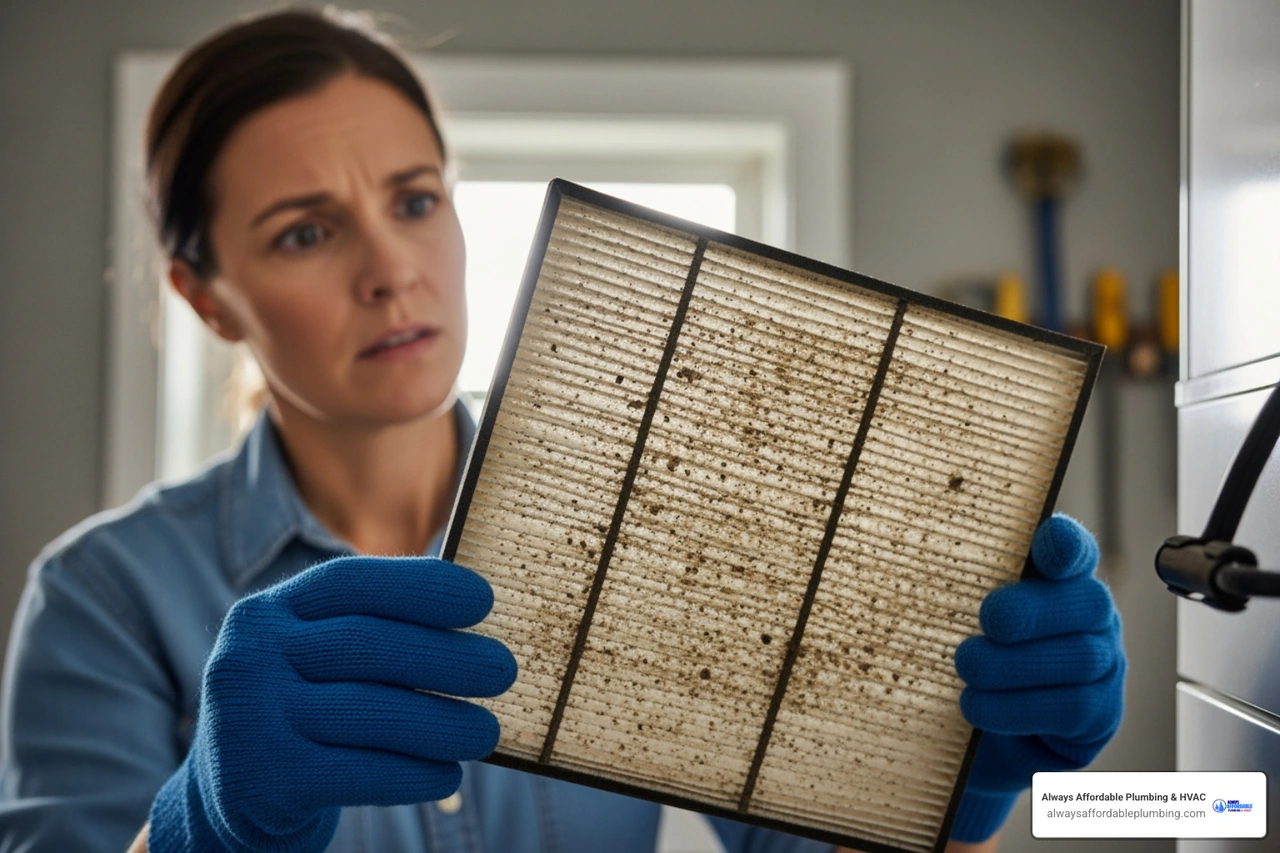
A visual inspection is the most reliable way to tell if you’re overdue. We recommend the "light test": hold your filter up to a bright light source or a window. If the light cannot pass through the material because it is caked with dirt, it is "blinded" and needs to be swapped out. You should also look for gray or brown discoloration, which indicates that the fibers are saturated with pollutants.
Ignoring these signs can lead to serious trouble. Understanding How Clogged Air Filters Damage AC is crucial, as a few dollars spent on a filter can prevent thousands in repairs.
Sometimes your home tells you the filter is dirty before you even look at it. Watch for these red flags:
• Weak Airflow: If the air coming out of your vents feels "lazy" or weaker than usual, the filter is likely acting like a wall.
• Dusty Surfaces: If you find yourself dusting your furniture every two days, your filter is likely so full that it can no longer trap new particles, allowing them to settle back into your living space.
• Unusual Noises: A whistling or humming sound near the intake can indicate that the blower motor is struggling to suck air through a clogged filter.
• Rising Utility Bills: When the system has to run longer to reach the desired temperature because of restricted airflow, your energy consumption spikes.
What happens if you ignore when to replace your furnace or ac filter? The results aren't just inconvenient; they can be catastrophic for your equipment.
• Short-Cycling: The system may turn on and off rapidly because it is overheating or sensing a lack of airflow.
• Frozen Coils: In the summer, restricted airflow causes the temperature of the evaporator coil to drop below freezing, leading to a block of ice that stops all cooling.
• Blower Motor Strain: The motor has to work twice as hard to pull air through a clog, which can cause it to burn out prematurely.
• Heat Exchanger Damage: In the winter, a lack of airflow can cause the heat exchanger to overheat and crack, which is a major safety hazard involving carbon monoxide.
Choosing the right filter is a balance between air purity and system health. The MERV (Minimum Efficiency Reporting Value) scale ranges from 1 to 20, but most residential systems should stay between 8 and 13.
• Fiberglass — MERV Rating: 1–4 — What It Captures: Large dust, lint, carpet fibers — Best For: Basic protection for the machine only
• Pleated — MERV Rating: 5–8 — What It Captures: Dust mites, mold spores, pollen — Best For: Standard homes, budget-friendly
• High-Efficiency Pleated — MERV Rating: 9–12 — What It Captures: Lead dust, auto emissions, pet dander — Best For: Pets, mild allergies, better air quality
• HEPA — MERV Rating: 13–16 — What It Captures: Bacteria, smoke, microscopic allergens — Best For: Severe allergies, high-risk health needs
For most homes in Carmichael or Rancho Cordova, a MERV 8 filter is a great baseline. It protects the equipment and catches common household dust. However, given our local air quality challenges, a MERV 11 or 13 is often a better choice for families.
Be careful, though—higher MERV ratings mean tighter mesh. If your HVAC system is older, a MERV 13 might be too restrictive, causing the same problems as a dirty filter. If you're unsure what your system can handle, it's best to consult a professional during an inspection.
Washable (electrostatic) filters are marketed as eco-friendly because you can hose them off. While they save money over time, they generally have lower MERV ratings and require significant maintenance. They must be completely dry before being reinstalled; otherwise, you risk growing mold inside your ductwork. For most of our customers in North Highlands and Orangevale, high-quality disposable pleated filters offer the best combination of convenience and filtration efficiency.
Before you can change the filter, you have to find it! In most Sacramento homes, the filter is located in one of three places:
1. The Blower Compartment: A slot built into the side or bottom of the furnace/air handler itself.
2. A Media Cabinet: A separate metal box installed between the return duct and the system.
3. Return Air Grilles: Behind the large slatted vents located in your walls or ceilings.
If you are struggling to find it or haven't had your system checked in a while, scheduling an Annual HVAC Service Roseville CA is a great way to have a pro show you the ropes while ensuring everything is running safely.
Changing a filter is a great DIY task, but safety comes first.
1. System Shutdown: Turn off your HVAC system at the thermostat. For extra safety, turn off the power switch near the unit.
2. Remove the Old Filter: Slide it out gently to avoid knocking dust back into the air. Note which way the "Airflow Arrow" is pointing.
3. Check for Snug Fit: Your new filter should match the dimensions (e.g., 16x25x1) exactly. If there are gaps, air (and dust) will just bypass the filter.
4. Align Airflow Arrows: Ensure the arrow on the new filter points toward the furnace or blower motor.
5. Secure the Panel: Make sure the door or grille is latched tightly.
Regularly performing these steps is part of a solid HVAC Maintenance Roseville CA plan that keeps your home comfortable year-round.
We strongly advise against this. While it might seem harmless, running the system without a filter for even 24 hours allows dust and hair to settle directly onto the evaporator coils and blower motor. This can lead to reduced efficiency or even a system breakdown very quickly. If you don't have a replacement, it's better to leave the system off until you can get one.
Yes. When a filter is clogged, it can trap moisture and organic debris, leading to a "musty" or "dirty sock" smell. Additionally, if the filter is so clogged that the furnace is overheating, you might notice a "burning dust" odor as the system struggles to move air.
If your filter turns black (rather than gray/dusty), it could be a sign of "black soot deposition." This often happens if you burn a lot of candles, have a gas fireplace with a flickering flame, or if there is a serious issue with your furnace's combustion. If you see black soot, turn off the system and call us for an inspection immediately.
Staying on top of when to replace your furnace or ac filter is the easiest way to ensure your home remains a sanctuary of comfort and clean air. Whether you are in Sacramento, Elk Grove, or Granite Bay, the unique climate of Northern California demands a bit more attention to our HVAC systems.
At Always Affordable Plumbing & HVAC, we are dedicated to helping our neighbors maintain efficient, long-lasting systems. From simple filter advice to comprehensive system overhauls, our team provides transparent and quality service across the entire region. Don't wait for a breakdown to realize your filter was full—take control of your indoor air quality today.
If you want to ensure your system is ready for the upcoming season, Schedule your professional HVAC maintenance today and let us handle the heavy lifting!
See what our satisfied customers have to say about their experience with Always Affordable
Plumbing & HVAC.

"Chappy was very skilled in his knowledge of my HVAC unit. I greatly appreciate the quick response and experienced tech. The whole endeavor was made less stressful by his humor and honest conversation. I find comfort in knowing I now have a shop i trust for the next time."
"Tony, James, Ronnie did an amazing job setting up our new AC! They were quick, efficient, considerate, and polite! We appreciate them scheduling us in on such short notice. Definitely recommend this company!"
"Prompt, professional service with kindness and care. They came out to address both plumbing and AC issues. I received a courtesy call before they arrived. All issues were resolved the same day with integrity and respect. Thankful for businesses like this. Absolutely recommend to those that I love."
"Excellent service! Jason came out promptly and in addition to doing my outside faucet he also put in new irrigation equipment! All done perfectly! Jason was lovely"
"Honest with the assessment; friendly and good manners. No high pressure sales. Just good to honest "tell it like you see it" Thought my kitchen disposer needed an overhaul. But Jason, there Plumber gave me an honest lesson on what was really happening. Saved me hundreds, if I went the route of replacing. Thank you!"
"Absolutely 5 stars. If you are looking for affordable ,professional and kind. Chappy was excellent and very knowledgeable . I called in the morning because my air conditioner stopped working he was here within hours and fixed my air with a smile. I highly recommend Chappy and Always Affordable plumbing and Hvac."
"Scott and James were great. They got there quickly and diagnosed the problem with my A/C.They did a very thorough job testing everything. Sent me pictures and called to keep me informed. Got it done the next day and everything is working fine. Be glad when I get home so I can enjoy my new system. Thanks guys for a great job."
"Chappy was very helpful. He knew our issue right away, cleaned our coils. He also came on the same day we called and got our AC blowing cold air again."
"After some timing ’curfuffles’ the Tech Jason arrived and not only completed a speedy install on my toilet, he was personable & professional. Because of the timing issues Jason was attentive and showed up with everything needed! No extra store runs 😊 I was very comfortable with having this Tech in my Daughter’s home. We will definitely use this Service again."