
AC vs. Heat Pump: Options Comparisons for Homeowners Facing a System Failure
When your AC fails, choosing a replacement is a major choice. Review these options comparisons for homeowners to weigh SEER2 ratings and decide with confidence.



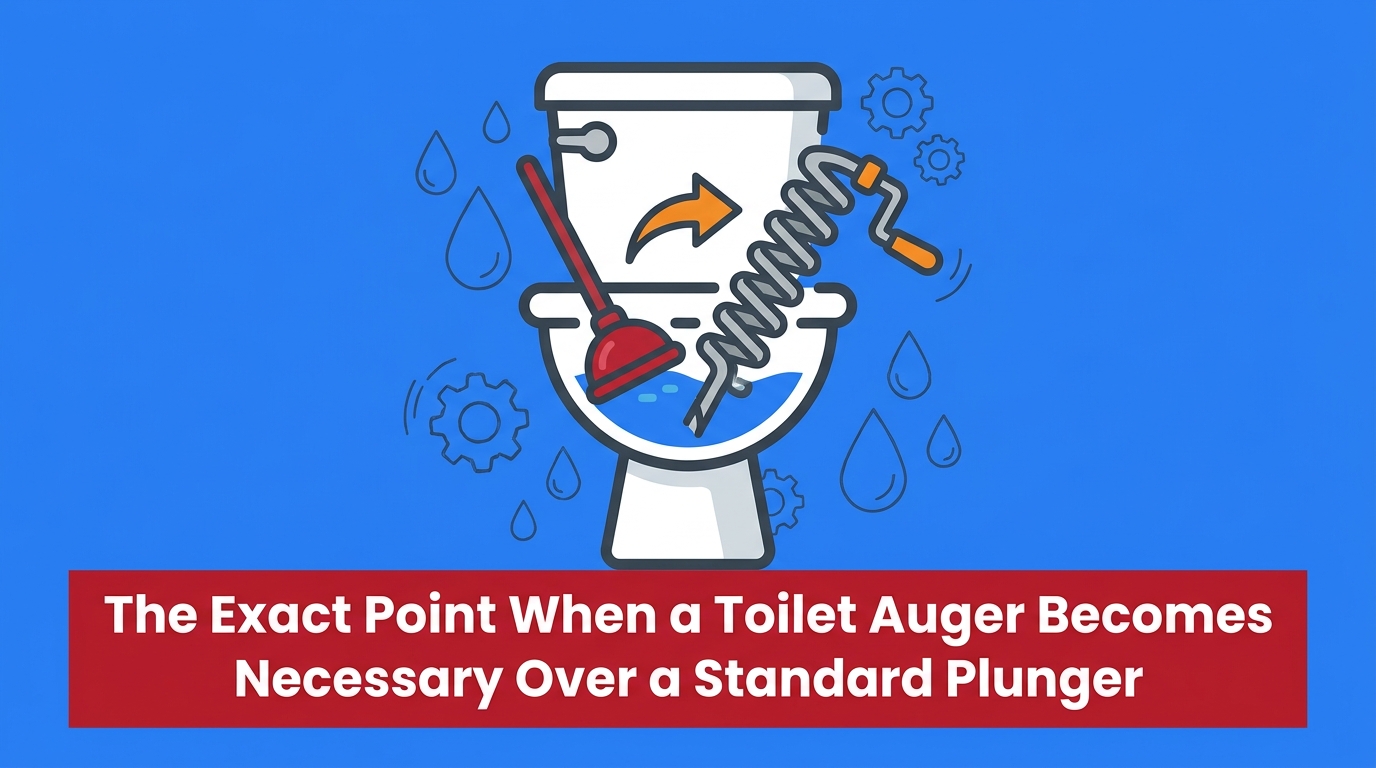
You are staring at a bowl full of standing water, plunging aggressively with no success, trying to determine the exact point when a toilet auger becomes necessary over a standard plunger. Especially in homes featuring early-generation 1.6 Gallon Per Flush (GPF) toilets from the late 1990s, a stubborn toilet clog caused by highly compacted waste can completely resist initial clearing efforts, leaving you frustrated and concerned about an impending overflow. The natural instinct is to keep applying force, hoping the blockage will eventually give way. However, knowing exactly when to stop using hydrostatic pressure is the critical first step to resolving the issue without damaging your bathroom fixture.
If DIY methods have reached their physical limits, it might be time to bring in professional plumbing services for targeted sewer line clearing before the situation worsens.
Understanding the mechanical limits of a standard 6-inch flange plunger is essential for any homeowner. A plunger is a highly effective tool for minor, loose blockages, but it is not a universal solution for every plumbing emergency. When waste becomes densely compacted, or when a hard foreign object becomes lodged in the porcelain curves of the fixture, standard plunging methods quickly lose their effectiveness. Recognizing this exact decision point separates a quick mechanical fix from an expensive, messy disaster.
Not all clogs are created equal. While loose organic material and standard toilet paper typically dissolve or break apart under moderate pressure, compacted waste behaves entirely differently. When a large volume of waste and paper is forced into the narrowest part of the fixture, it forms a dense, semi-solid plug. This plug adheres to the porcelain walls, creating a watertight seal that entirely blocks the flow of water.
The troubleshooting phase: When you encounter a clog that refuses to drain even slightly after several minutes, you are likely dealing with a compacted mass. Continuing to attack this mass with the wrong tool will not yield better results. Instead, it requires a shift in strategy from indirect pressure to direct mechanical force.
To understand why a standard flange plunger eventually fails, it is necessary to examine the science of how plungers actually work. A plunger does not touch the clog directly. Instead, it relies entirely on hydrostatic pressure—forcing water against the blockage to push it through the system.
Every toilet features an internal trapway, commonly known as an S-trap or P-trap, molded directly into the porcelain. This curved channel serves a vital purpose: it holds a small amount of standing water to block hazardous sewer gases from entering your home. However, the tight curves of the S-trap also create a natural bottleneck where waste and paper are most likely to become lodged.
The problem with pressure: When you use a standard flange plunger, you are attempting to force a column of water through this curved trapway. Water is non-compressible. When you push down on the plunger handle, the water must go somewhere. If the trapway is clear, the water flows down the drain. If the trapway is blocked by a loose clog, the force of the water pushes the clog through the curves.
Highly compacted waste absorbs or entirely blocks this hydrostatic pressure, rendering the tool ineffective. Because the compacted mass has formed a watertight seal against the porcelain, the water column generated by the standard flange plunger hits a solid wall. Repeated, forceful plunging on a solid mass does not increase your clearing power. Instead, it forces the trapped water to seek the path of least resistance.
This dynamic is especially prevalent in specific environmental conditions. Older homes in the local area built before 1980 with aging 3-inch cast-iron pipes or retrofitted 1.28 GPF low-flow toilets often lack the necessary flush velocity to clear minor blockages efficiently. During dry spells, these minor blockages can quickly become severely compacted, creating a dense mass that easily defeats the hydrostatic pressure of a standard plunger.
Aggressively plunging a fully compacted clog is not just ineffective; it is structurally dangerous to your plumbing system. When the hydrostatic pressure generated by a standard flange plunger cannot push the clog down the drain, that intense pressure is redirected backward and downward, targeting the weakest point in the fixture's assembly.
The weakest link in any standard toilet installation is the wax ring seal. This thick ring of malleable wax sits between the bottom of the porcelain toilet (the horn) and standard 3-inch or 4-inch closet flanges anchored to your bathroom floor. Its sole purpose is to provide a watertight and airtight seal, ensuring that wastewater and sewer gases go down the pipe rather than leaking onto your floor.
The structural failure: Excessive hydrostatic pressure from a standard flange plunger on an immovable clog can easily exceed the holding capacity of the wax ring. If you plunge violently against a blocked S-trap, the trapped water will eventually blow out the wax seal to escape the pressure chamber.
A compromised wax ring rarely announces itself immediately. Instead, it creates a hidden, slow-moving disaster beneath your bathroom floor. The consequences of a blown seal include:
• Hidden leaks: Wastewater begins seeping under the base of the toilet with every subsequent flush, pooling beneath the flooring materials.
• Subfloor rot: Prolonged exposure to moisture rots the wooden subfloor and joists, compromising the structural integrity of the bathroom.
• Foul odors: A broken seal allows hazardous sewer gases to drift freely into your home.
• Ceiling damage: For second-story bathrooms, the leaking water will eventually destroy the drywall ceiling of the room below.
Protecting the wax ring is the primary reason a mechanical tool must take over. Knowing when to stop plunging is an act of damage prevention.
Homeowners need a clear, actionable rule of thumb to separate safe DIY troubleshooting from accidental property damage. The decision to switch tools should not be based on frustration, but on a specific mechanical threshold.
The exact threshold is simple: if a standard 6-inch flange plunger fails to move the water level after 5 to 10 firm, controlled thrusts, the clog is completely compacted. Continuing past this point drastically increases the risk of fixture damage without improving the chances of clearing the trapway.
Evaluating the response: After executing 5 to 10 plunges, stop and observe the water level in the bowl. If the water slowly drains, you have broken the seal of the clog and can safely flush to clear the remaining debris. If the water remains entirely stagnant, the hydrostatic pressure has failed. The clog is immovable by water force alone.
Once you reach this decision point, the 3-foot closet auger becomes the mandatory next step. This specialized tool allows you to abandon indirect water pressure and apply direct mechanical force to the obstruction. Recognizing this exact decision point empowers you to safely clear stubborn blockages while protecting the integrity of your wax ring and subfloor.
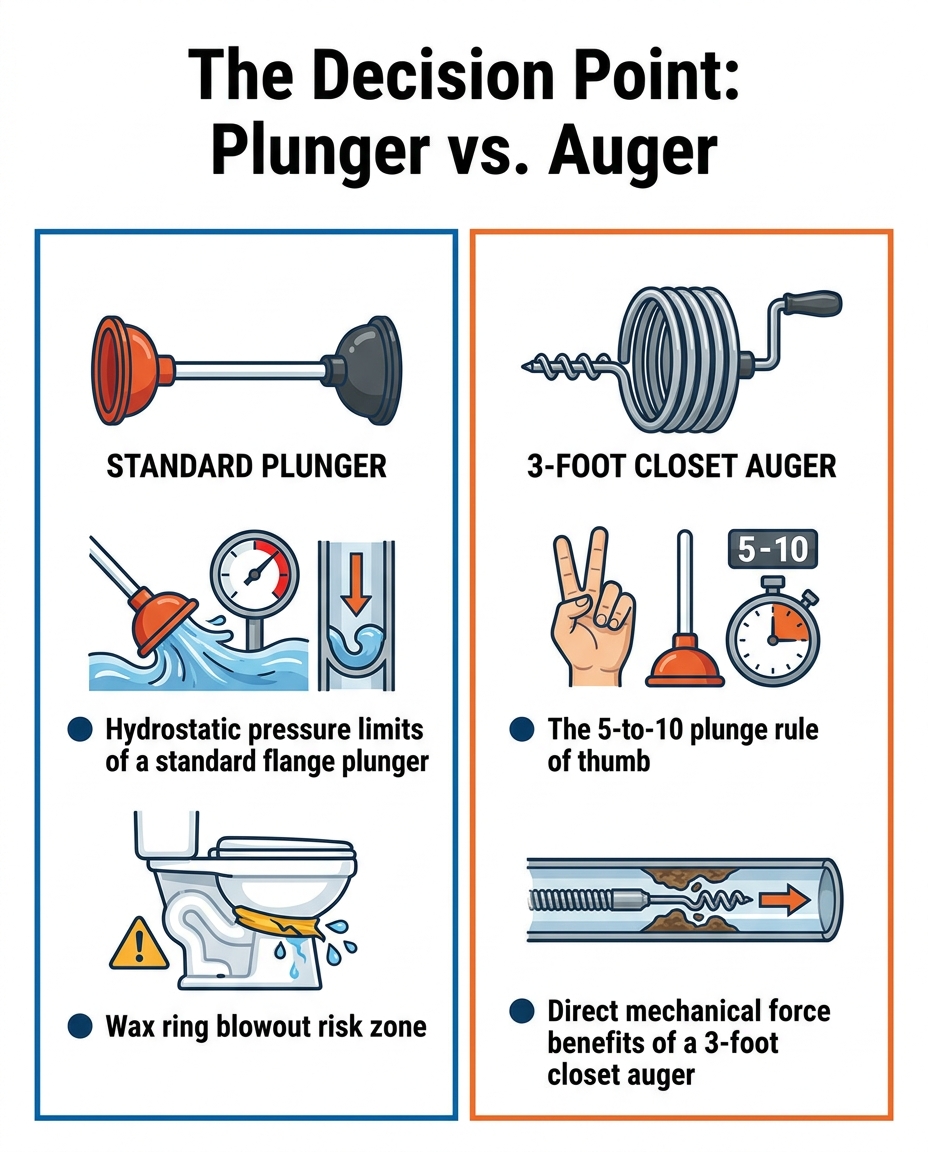

When hydrostatic pressure fails, you must physically touch the clog to break it apart. This is exactly what a 3-foot closet auger is designed to do. Unlike a standard drain snake, which can easily scratch the delicate porcelain of a toilet bowl, a closet auger is engineered specifically for the unique anatomy of an S-trap.
A standard 3-foot closet auger consists of several specialized components that work together to safely navigate the fixture:
• Protective rubber sleeve: The rigid metal tube of the auger features a curved, rubberized tip. This sleeve rests directly in the bowl, guiding the cable into the trapway while protecting the visible porcelain from metal scratches.
• Flexible inner cable: Housed inside the metal tube is a heavy-duty, flexible 1/2-inch thick steel cable capable of bending through the tight curves of the S-trap without kinking.
• Corkscrew head: The working end of the cable features an open-wound corkscrew designed to either bore through compacted waste or snag foreign objects (like flushable wipes or small toys) for retrieval.
• Hand crank: The handle at the top allows the user to rotate the cable, applying direct rotational force to the blockage.
By extending the cable through the rubber sleeve and turning the crank, the auger's tip applies direct mechanical force to the obstruction. This rotational action effectively breaks apart densely compacted waste, allowing it to flow down the drain. If the blockage is caused by a hard object or fibrous material, the corkscrew head hooks onto the mass, allowing you to pull it back out of the bowl.
The intentional design: The 3-foot length is intentionally designed to clear the toilet's internal trapway without reaching into the main drain line. This specific length ensures that you are only addressing clogs located within the fixture itself, preventing the cable from getting tangled in the broader plumbing system.
Successfully clearing a stubborn clog with a 3-foot closet auger is a satisfying victory. However, if you find yourself frequently relying on this tool week after week, the compacted clogs are likely a symptom of a larger underlying issue rather than simple user error.
Chronic compacted clogs often indicate that the toilet itself is struggling to perform its basic function. Over years of use, several factors can degrade a fixture's flushing power:
• Mineral buildup: Hard water deposits (calcium and lime) can accumulate in the siphon jet and the small rim holes under the bowl. This buildup restricts water flow, resulting in a weak, sluggish flush that fails to push waste completely through the trapway.
• Failing flush mechanisms: Worn flappers, stretched chains, or faulty fill valves can prevent the tank from releasing a sufficient volume of water during a flush, leaving debris stranded in the S-trap.
• Worn porcelain glazing: The smooth glazing inside the trapway can wear down over decades of use. When the porcelain becomes rough and porous, waste easily adheres to the walls, quickly forming compacted blockages. This is especially common in first-generation low-flow toilets manufactured between 1994 and 1999.
Evaluating the age and performance of the toilet can save considerable time and effort in the long run. If your fixture requires constant mechanical clearing, it is crucial to recognize the signs it's time for a toilet replacement. Upgrading to a modern, high-efficiency fixture with a fully glazed trapway and powerful flushing action is often far more cost-effective and hygienic than battling chronic clogs with an auger every month.
While a 3-foot closet auger is the ultimate tool for clearing a toilet's internal S-trap, it has a strict physical limit. Understanding this limit is crucial for determining when a DIY approach must end and professional diagnostics must begin.
The problem: You have fully inserted the 3-foot closet auger into the toilet, rotating the handle until the cable is completely extended, but you feel no resistance and the water still refuses to drain.
The cause: If the 3-foot cable does not hit the blockage, the clog is not located in the toilet itself. Instead, the obstruction is located deeper in the 3-inch or 4-inch branch line connecting the bathroom to the main sewer, or in the main sewer line itself. Common causes for deep-line blockages include invasive tree roots, collapsed pipes, or severe grease and sludge buildup.
The solution: Removing a toilet from the floor to run a heavy-duty motorized snake into the main line is strictly beyond safe DIY scope and requires a licensed professional. Attempting to pull a toilet without proper training often results in cracked porcelain, shattered floor flanges, and improper resealing.
When a blockage is located deep in the main line, professional intervention is the only safe route. A typical pattern we see involves major mainline backups occurring unexpectedly. For example, one local homeowner recently woke up to a severely backed-up sewer line that rendered their plumbing unusable. While other companies were unavailable until the next day, technicians were dispatched within hours to unclog the line and discuss future prevention options.
This approach highlights the importance of transparent, honest service. A reputable provider empowers the homeowner to safely use an auger first for trapway clogs, and only recommends a professional call when the clog is verified to be beyond the toilet's reach. This ensures no hidden fees or unnecessary service calls for minor issues.
To catch these deep-line issues before they cause raw sewage backups, enrolling in a preventative plumbing maintenance plan provides routine inspections and cleanings, keeping your entire system flowing freely.
Your plunger is likely failing because the waste has become densely compacted in the toilet's trapway, forming a watertight seal. Plungers rely entirely on hydrostatic pressure to move obstructions. When a clog is highly compacted, it absorbs or blocks that water pressure, requiring direct mechanical force to break it apart.
You should switch to a toilet auger after 5 to 10 firm, controlled thrusts with a standard 6-inch flange plunger yield no results. If the water level in the bowl remains completely stagnant after this attempt, the clog is fully compacted. Continuing to plunge past this point risks damaging the fixture's wax ring seal.
Yes, aggressive over-plunging can cause significant hidden damage to your bathroom. The intense downward hydrostatic pressure can exceed the holding capacity of the wax ring seal at the base of the toilet. A blown wax ring will cause wastewater to leak silently beneath your floorboards, leading to rot and foul odors.
When organic waste is severely compacted and resists plunging, you must use a 3-foot closet auger. Insert the rubber-tipped end into the bowl, feed the flexible cable into the trapway, and turn the crank. The corkscrew tip will apply direct mechanical force to break apart the dense waste so it can flush safely.
A standard closet auger is specifically designed not to scratch the porcelain if used correctly. It features a protective rubber or plastic sleeve at the bend of the metal tube. By keeping this rubber sleeve firmly seated at the bottom of the bowl while you crank the handle, the abrasive metal cable never touches the visible porcelain.
If you fully extend a 3-foot closet auger and do not hit the obstruction, it means the clog is located deeper in your plumbing system, beyond the toilet's internal S-trap. The blockage is likely in the branch line or the main sewer line. This requires a licensed professional to safely remove the toilet and clear the deep line with specialized equipment.
Knowing exactly when to transition from a standard flange plunger to a 3-foot closet auger empowers you to handle household plumbing issues safely and effectively. By understanding the mechanical limits of hydrostatic pressure, you can quickly clear stubborn trapway clogs while protecting your wax ring seal from damage, ensuring you only call for professional help when a blockage truly requires it.
See what our satisfied customers have to say about their experience with Always Affordable
Plumbing & HVAC.

"Chappy was very skilled in his knowledge of my HVAC unit. I greatly appreciate the quick response and experienced tech. The whole endeavor was made less stressful by his humor and honest conversation. I find comfort in knowing I now have a shop i trust for the next time."
"Tony, James, Ronnie did an amazing job setting up our new AC! They were quick, efficient, considerate, and polite! We appreciate them scheduling us in on such short notice. Definitely recommend this company!"
"Prompt, professional service with kindness and care. They came out to address both plumbing and AC issues. I received a courtesy call before they arrived. All issues were resolved the same day with integrity and respect. Thankful for businesses like this. Absolutely recommend to those that I love."
"Excellent service! Jason came out promptly and in addition to doing my outside faucet he also put in new irrigation equipment! All done perfectly! Jason was lovely"
"Honest with the assessment; friendly and good manners. No high pressure sales. Just good to honest "tell it like you see it" Thought my kitchen disposer needed an overhaul. But Jason, there Plumber gave me an honest lesson on what was really happening. Saved me hundreds, if I went the route of replacing. Thank you!"
"Absolutely 5 stars. If you are looking for affordable ,professional and kind. Chappy was excellent and very knowledgeable . I called in the morning because my air conditioner stopped working he was here within hours and fixed my air with a smile. I highly recommend Chappy and Always Affordable plumbing and Hvac."
"Scott and James were great. They got there quickly and diagnosed the problem with my A/C.They did a very thorough job testing everything. Sent me pictures and called to keep me informed. Got it done the next day and everything is working fine. Be glad when I get home so I can enjoy my new system. Thanks guys for a great job."
"Chappy was very helpful. He knew our issue right away, cleaned our coils. He also came on the same day we called and got our AC blowing cold air again."
"After some timing ’curfuffles’ the Tech Jason arrived and not only completed a speedy install on my toilet, he was personable & professional. Because of the timing issues Jason was attentive and showed up with everything needed! No extra store runs 😊 I was very comfortable with having this Tech in my Daughter’s home. We will definitely use this Service again."


