
AC vs. Heat Pump: Options Comparisons for Homeowners Facing a System Failure
When your AC fails, choosing a replacement is a major choice. Review these options comparisons for homeowners to weigh SEER2 ratings and decide with confidence.



Are you constantly adjusting your downstairs thermostat, trying to force cool air up to the second floor? When evaluating Single-Stage vs. Variable-Speed AC Units for Two-Story Homes in Roseville, the primary goal is usually solving this persistent temperature imbalance. You are not alone in this struggle. Many homeowners find themselves freezing in their living rooms just to make the upstairs bedrooms tolerable for sleeping. This frustrating dynamic is a common concrete problem caused by the way traditional cooling systems interact with multi-level architecture.
If you are tired of battling uneven temperatures, exploring comprehensive Sacramento area HVAC services and professional air conditioning system upgrades is the best way to restore whole-house comfort. The decision point often comes down to choosing whether to replace an aging system with a standard single-stage unit or invest in a variable-speed compressor. With the intense Sacramento Valley summer heat exacerbating the issue, having a reliable, continuous cooling strategy is critical for keeping every room in your house comfortable.
Closing vents on the first floor or running portable fans upstairs rarely provides a permanent fix. To truly resolve the hot upstairs phenomenon, we have to look closely at how air moves through your home and how different compressor technologies manage that airflow. The right equipment does more than just lower the temperature; it actively manages air circulation to eliminate hot spots entirely.
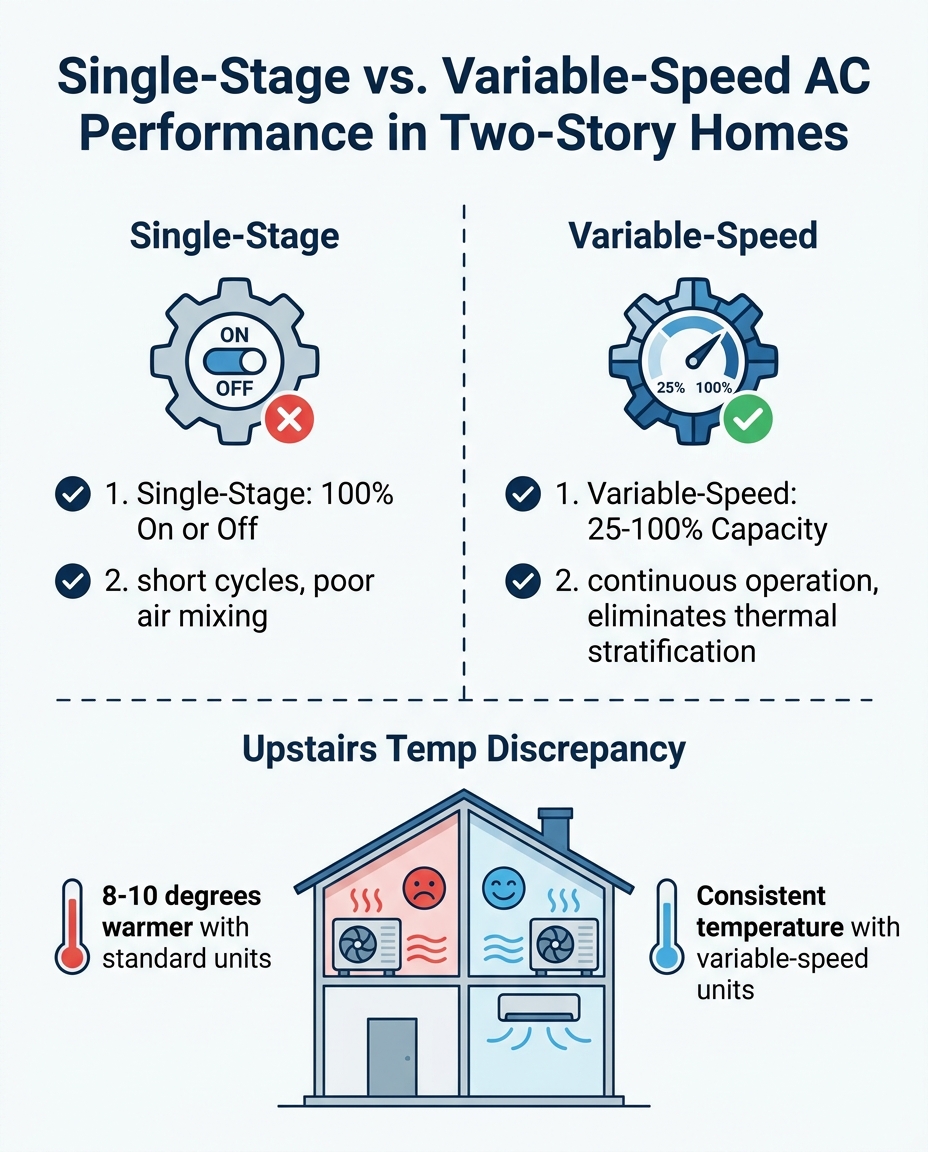
To understand why the second floor is so difficult to cool, we have to look at the basic physics of heat transfer. In Roseville two-story homes, the architectural layout fights against your air conditioner. The disparity in temperature between floors is not a sign that your AC is broken; it is the result of natural scientific principles working exactly as expected. Without continuous air mixing, upper levels will naturally remain 8 to 10 degrees warmer than the ground floor.
Here is exactly how this thermal stratification happens in multi-level layouts:
1. Roof Heat Gain: The second floor absorbs the brunt of the sun's solar radiation. As the sun beats down on your roof, the attic space heats up significantly. Even with good insulation, a large amount of radiant heat transfers through the ceiling and into the upper bedrooms.
2. Natural Thermal Stratification: Heat naturally rises to the highest point in any structure. As the air inside your home warms up, it becomes less dense and floats upward toward the second floor, while the denser, cooler air sinks down the staircase to the first floor.
3. Stagnant Airflow: When your air conditioning system is not actively blowing air, there is nothing to disrupt this natural separation. The hot air stays trapped upstairs, and the cold air pools downstairs, creating a distinct temperature boundary between the two levels.
Because the second floor is fighting both the rising heat from inside the house and the radiant heat from the roof, it requires significantly more cooling power than the first floor. Unfortunately, traditional cooling systems are rarely designed to handle this specific imbalance effectively.
Most older homes are equipped with standard single-stage air conditioners. While these systems are reliable for basic cooling, their mechanical limitations become obvious when applied to two-story homes. A single-stage compressor operates like a simple light switch: it is either running at 100% maximum capacity, or it is completely turned off. There is no middle ground.
During triple-digit days, the Sacramento Valley summer heat causes rapid heat accumulation on the second floor. Here is how standard single-stage technology fails to keep up:
The Problem: The thermostat that controls the entire house is almost always located on the first floor. Because cold air naturally sinks, the first floor cools down very quickly when the AC turns on.
The Cause: Once the downstairs hallway reaches the target temperature (for example, 72 degrees), the thermostat tells the system its job is done. The single-stage compressor shuts off completely. This is known as short-cycling. The system runs just long enough to satisfy the downstairs thermostat, but not nearly long enough to push conditioned air all the way up the ductwork to the second floor.
The Solution Limitation: When the compressor shuts down, the indoor blower fan usually stops as well. The moment the fan stops, air circulation ceases. The hot, stagnant air remains trapped upstairs. To make matters worse, oversized single-stage units cool the downstairs even faster, leading to even shorter cycles and even less air reaching the upper bedrooms.
Modern variable-speed technology directly solves the airflow and stratification problem by changing the way the compressor operates. Instead of blasting at 100% capacity and then shutting off, a variable-speed (or modulating) compressor adjusts its cooling output in tiny increments. It acts more like the accelerator pedal in a car, speeding up or slowing down precisely as needed to match the exact cooling demand of the house.
These advanced units can run continuously at capacities as low as 25% to 30%. This continuous operation is the secret to solving the hot upstairs problem in Roseville two-story homes. Because the system runs at a low, steady speed for much longer periods, the indoor blower fan runs continuously as well.
Continuous Air Mixing: The primary benefit of this technology is that the constant fan operation acts as a whole-house air mixer. It continuously pushes freshly conditioned air up to the second floor while pulling the stagnant hot air down through the return vents. This constant circulation breaks up the thermal stratification, ensuring that the temperature in the upstairs bedrooms matches the temperature on the downstairs thermostat.
Superior Humidity Removal: Another major advantage of variable-speed mechanics is moisture control. Air conditioners remove humidity from the air as a byproduct of the cooling cycle. Because standard units turn on and off constantly, they do not run long enough to pull much moisture out of the air. A variable-speed unit running continuously at a low speed pulls significantly more humidity out of the home. Drier air feels cooler, allowing you to set your thermostat a few degrees higher while actually feeling more comfortable.
When deciding which system is right for your home, it helps to look at a side-by-side evaluation of both technologies. Upgrading your HVAC system is a significant decision, and understanding how these units perform under the pressure of the Sacramento Valley summer heat is essential.
Standard single-stage units offer a lower upfront investment and simpler mechanical parts. They are effective for single-story homes with open floor plans where air mixing is less of a challenge. However, their energy efficiency (measured in SEER2 ratings) is generally lower because they require a massive surge of electricity every time they start up from zero.
Variable-speed units require a higher initial investment, but they offer vastly superior temperature consistency. They eliminate the noticeable temperature swings between cycles and provide long-term energy savings. Because they rarely turn off entirely, they avoid the electrical spikes associated with constant starting and stopping, leading to lower monthly utility bills.
• Compressor Operation — Single-Stage AC: 100% On or completely Off — Variable-Speed AC: Modulates anywhere from 25% to 100%
• Temperature Consistency — Single-Stage AC: Noticeable fluctuations; uneven between floors — Variable-Speed AC: Steady, precise evenness across all levels
• Air Mixing & Circulation — Single-Stage AC: Poor; stops moving air between cycles — Variable-Speed AC: Excellent; continuous fan operation mixes air
• Humidity Control — Single-Stage AC: Basic; short cycles limit moisture removal — Variable-Speed AC: Superior; continuous operation extracts more moisture
• Energy Efficiency (SEER2) — Single-Stage AC: Standard efficiency; high startup energy use — Variable-Speed AC: Maximum efficiency; low, steady energy consumption

While upgrading to a variable-speed central unit is highly effective, sometimes the central ductwork itself is fundamentally flawed. In some Roseville two-story homes, the ducts running to the second floor are undersized, crushed, or simply too long to deliver adequate airflow, regardless of how powerful the compressor is. If the existing infrastructure cannot support a central variable-speed upgrade, lateral options are available.
Ductless systems offer a targeted way to cool specific upstairs bedrooms without relying on the home's main ductwork. These systems are highly efficient and can be installed directly in the rooms that need the most help.
Ductless units bypass central ductwork entirely. An outdoor compressor connects directly to an indoor air-handling unit mounted on the wall of the specific room. This allows you to deliver powerful cooling directly to the master bedroom or upstairs office without overcooling the downstairs living room.
One of the biggest advantages of this approach is the ability to set independent temperatures for individual upstairs rooms. If you prefer the bedroom at 68 degrees at night, you can achieve that without forcing the main central AC to work overtime. Exploring ductless mini split solutions is a smart alternative for homes where modifying the existing ductwork is not practical.
A common concern among homeowners is that variable-speed technology might be out of reach for their budget. While premium systems do carry a higher upfront cost than standard builder-grade units, there are multiple paths to upgrading without compromising on comfort. The key is working with a team that prioritizes clear, upfront estimates before any work begins.
Transparent pricing means you know exactly what the installation entails, with no surprise fees halfway through the job. A professional assessment will evaluate your home's load calculation, ductwork condition, and insulation levels to recommend the most cost-effective solution for your specific layout.
Budget-friendly upgrade paths make advanced cooling technology accessible. Furthermore, high-efficiency variable-speed systems often qualify for general energy rebates, utility incentives, and tax credits that can help offset the initial investment. By factoring in these incentives and the long-term reduction in monthly utility bills, upgrading to a system capable of handling the Sacramento Valley summer heat becomes a financially sound decision for long-term comfort.
If you are comparing central AC to ductless mini splits or just trying to understand why your current setup is struggling, you likely have a few specific concerns. Here are answers to common questions about managing temperatures in Roseville two-story homes.
Your upstairs is hot because heat naturally rises, and your roof radiates solar heat down into the second floor. If your AC is a standard single-stage unit, it likely shuts off once the downstairs thermostat reaches the target temperature. This stops the air circulation, leaving stagnant hot air trapped in the upper bedrooms while the first floor remains perfectly cool.
Yes, a variable-speed AC is specifically designed to cool multi-level homes much more effectively. Because it runs continuously at lower speeds, it constantly pushes conditioned air to the second floor and pulls hot air back through the return vents. This continuous air mixing prevents the heat from pooling upstairs, resulting in even temperatures throughout the entire house.
For most two-story homes, the investment is highly worthwhile due to the dramatic improvement in comfort. Beyond eliminating the hot upstairs problem, these systems provide superior humidity control, quieter operation, and lower monthly energy bills. If you are tired of avoiding your second floor during the summer, the upgrade provides a permanent solution to a frustrating daily problem.
The main difference is how the compressor operates. A single-stage AC only has one speed: 100% full blast. It turns on, cools quickly, and turns completely off. A variable-speed AC can adjust its output in tiny increments, running at anywhere from 25% to 100% capacity. This allows it to run longer, smoother cycles that maintain precise temperatures without sudden spikes or drops.
Yes, if your central AC is still in good condition, you can address a hot second floor using targeted solutions. Installing a ductless mini-split system in the hottest upstairs rooms is a highly effective way to provide localized cooling. Additionally, improving attic insulation or having a professional evaluate your ductwork for leaks and airflow restrictions can help maximize the performance of your existing system.
A comfortable second floor is entirely possible with the right technology and proper installation. You do not have to accept an uninhabitable master bedroom as a normal part of living in a two-story home. By understanding how air flows through your house, you can make an informed decision about your next system.
We encourage you to seek a professional assessment of your current system to find out exactly why your upstairs is struggling. Schedule your inspection and get a free estimate for an upgrade before the peak Sacramento Valley summer heat hits, and enjoy consistent, whole-house comfort all season long.
See what our satisfied customers have to say about their experience with Always Affordable
Plumbing & HVAC.

"Chappy was very skilled in his knowledge of my HVAC unit. I greatly appreciate the quick response and experienced tech. The whole endeavor was made less stressful by his humor and honest conversation. I find comfort in knowing I now have a shop i trust for the next time."
"Tony, James, Ronnie did an amazing job setting up our new AC! They were quick, efficient, considerate, and polite! We appreciate them scheduling us in on such short notice. Definitely recommend this company!"
"Prompt, professional service with kindness and care. They came out to address both plumbing and AC issues. I received a courtesy call before they arrived. All issues were resolved the same day with integrity and respect. Thankful for businesses like this. Absolutely recommend to those that I love."
"Excellent service! Jason came out promptly and in addition to doing my outside faucet he also put in new irrigation equipment! All done perfectly! Jason was lovely"
"Honest with the assessment; friendly and good manners. No high pressure sales. Just good to honest "tell it like you see it" Thought my kitchen disposer needed an overhaul. But Jason, there Plumber gave me an honest lesson on what was really happening. Saved me hundreds, if I went the route of replacing. Thank you!"
"Absolutely 5 stars. If you are looking for affordable ,professional and kind. Chappy was excellent and very knowledgeable . I called in the morning because my air conditioner stopped working he was here within hours and fixed my air with a smile. I highly recommend Chappy and Always Affordable plumbing and Hvac."
"Scott and James were great. They got there quickly and diagnosed the problem with my A/C.They did a very thorough job testing everything. Sent me pictures and called to keep me informed. Got it done the next day and everything is working fine. Be glad when I get home so I can enjoy my new system. Thanks guys for a great job."
"Chappy was very helpful. He knew our issue right away, cleaned our coils. He also came on the same day we called and got our AC blowing cold air again."
"After some timing ’curfuffles’ the Tech Jason arrived and not only completed a speedy install on my toilet, he was personable & professional. Because of the timing issues Jason was attentive and showed up with everything needed! No extra store runs 😊 I was very comfortable with having this Tech in my Daughter’s home. We will definitely use this Service again."


