Why Is My AC Running But Blowing Warm Air? Expert Troubleshooting Steps
Why is your AC blowing warm air? Get clear answers on thermostat settings to check and see common homeowner questions answered before calling for a repair.



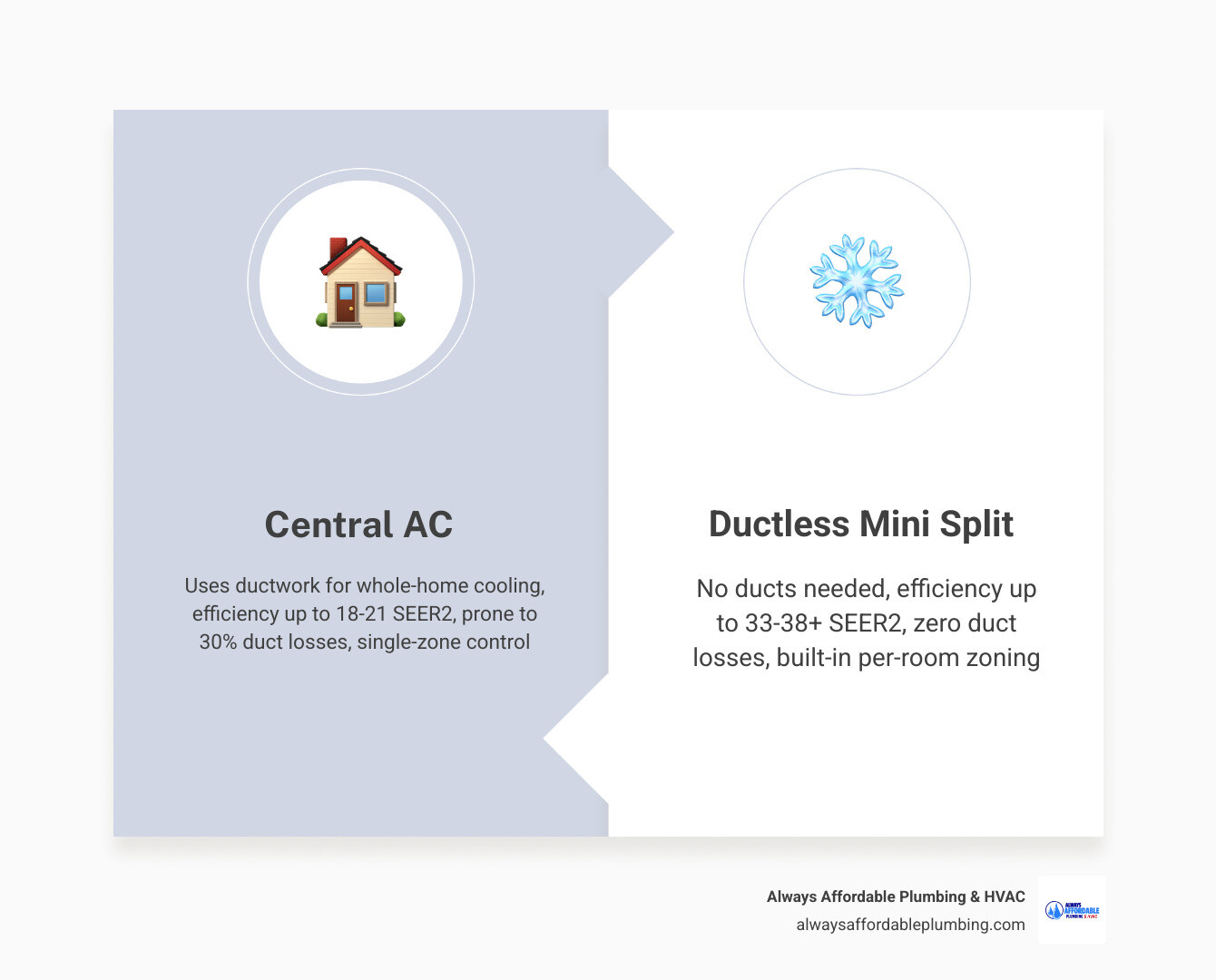
Central ac vs ductless mini split comparison is one of the most common questions Sacramento homeowners ask when upgrading or replacing their home cooling system. The short answer: both systems work well, but the right choice depends on your home's existing setup, how many rooms you need to cool, and whether you want heating capability too.
Here's a quick side-by-side to help you decide at a glance:
• Best for — Central AC: Homes with existing ductwork — Ductless Mini Split: Homes without ducts, additions, or zoning needs
• Efficiency (SEER2) — Central AC: Up to 18–21 — Ductless Mini Split: Up to 33–38+
• Duct losses — Central AC: Up to 30% energy lost — Ductless Mini Split: Zero duct losses
• Zoning — Central AC: Requires costly add-ons — Ductless Mini Split: Built-in, per-room control
• Installation complexity — Central AC: High if no ducts exist — Ductless Mini Split: Minimal — small wall penetration only
• Heating capability — Central AC: Pairs with furnace — Ductless Mini Split: Built-in heat pump option
• Aesthetics — Central AC: Invisible (vents only) — Ductless Mini Split: Visible wall-mounted units
• Whole-home coverage — Central AC: Excellent — Ductless Mini Split: Excellent with multi-zone setup
Most homes with good, existing ductwork do fine with central AC. But if your home lacks ducts, has rooms that never cool evenly, or you're adding a new space — a mini split is often the smarter, more efficient move.
It's a choice that affects your comfort, your energy bills, and your home's value for the next 15 to 20 years. So it's worth understanding the real differences before you commit.
In Sacramento's hot summers, getting this decision right matters even more. The good news: there's no universally wrong answer — just the right answer for your home.
To understand which system fits your lifestyle, we first need to look under the hood. While both systems use the same basic scientific principles to keep you cool, their delivery methods are worlds apart.
At the heart of both systems is a refrigerant cycle. Both use an outdoor condenser unit to release heat and an indoor component to absorb it. Refrigerant travels between these units, changing from liquid to gas and back again to move heat out of your home.
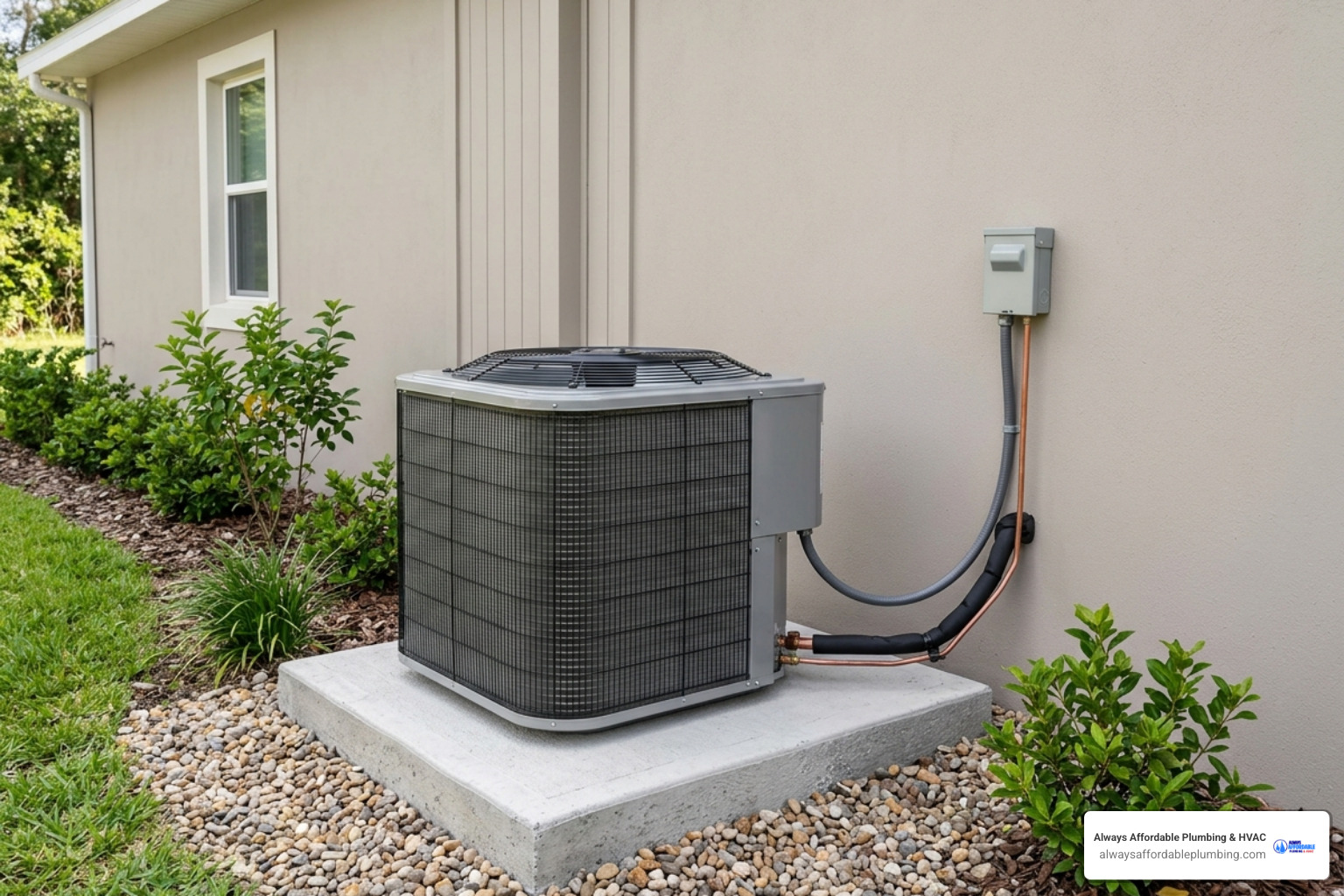
A Mini Split (often called a Ductless system) skips the middleman. Instead of pushing air through a maze of hidden tubes, it sends the refrigerant directly to small, indoor air handlers mounted on your walls or ceilings. This direct-to-room approach is why they are so effective at maintaining precise temperatures.
Central air conditioning is a "forced-air" system. It relies on a single, powerful indoor air handler (usually tucked away in a closet or attic) and a complex network of ductwork. The system pulls warm air from your rooms through return vents, cools it over evaporator coils, and then blasts it back through supply vents located throughout the house.
This infrastructure is great for maintaining a uniform temperature across a large floor plan, but it relies heavily on the integrity of your ducts. If you’ve ever wondered Why is my AC not cooling, the answer often lies in those hidden passages. Over time, ducts can sag, disconnect, or develop leaks, forcing your system to work twice as hard to deliver half the comfort.
The biggest functional difference in a central ac vs ductless mini split comparison is how they handle "zoning."
Traditional central AC is usually an all-or-nothing affair. One thermostat in the hallway dictates the temperature for every room. If your upstairs office is sweltering while your downstairs kitchen is freezing, a central system often struggles to balance the two without expensive motorized dampers.
Ductless systems are built for zoning. Because each indoor head has its own thermostat and remote, you can set the master bedroom to 68°F and the guest room to 74°F—or turn the cooling off entirely in rooms you aren't using. Most modern mini splits also utilize inverter technology. Unlike traditional compressors that are either "on" or "off," variable-speed compressors can ramp up or down like a dimmer switch, using only the exact amount of energy needed to maintain the temperature.
In 2026, energy efficiency isn't just a buzzword; it's a necessity for managing utility bills in the Sacramento Valley. When we look at SEER2 (Seasonal Energy Efficiency Ratio) ratings, mini splits are the clear heavyweights. While a high-end central AC might reach 21 SEER2, premium ductless systems can soar past 35 or even 42 SEER2.
However, the "on-paper" efficiency is only half the story. The U.S. Department of Energy estimates that typical ductwork loses 20% to 30% of conditioned air through leaks, gaps, and poor insulation. That’s money literally disappearing into your attic or crawlspace. Because mini splits deliver air directly into the room, they eliminate this waste entirely.
If you are looking for a deep dive into how these high-efficiency systems work in our local climate, check out our Heat Pumps Roseville CA Complete Guide. Transitioning to these systems often requires Expert Heat Pump Installation to ensure the line sets are properly sealed and the units are sized correctly for our dry, hot summers.
One of the most overlooked parts of the central ac vs ductless mini split comparison is that many mini splits are actually "heat pumps." This means they can reverse the cooling process to provide incredibly efficient heat during our chilly Sacramento winters.
While central AC is usually paired with a gas furnace, a ductless heat pump can handle both jobs. Modern "cold-climate" heat pumps can maintain their heating capacity even when temperatures drop toward freezing. For many homeowners, this provides a "dual-fuel" advantage or the ability to go entirely electric. To keep these units running smoothly year-round, we recommend following a local Heat Pump Service Sacramento Guide to stay ahead of seasonal maintenance.
Your home’s architecture is often the ultimate tie-breaker. If you live in a newer home in Folsom or Elk Grove that was built with high-quality ductwork, replacing your central AC unit is usually the most straightforward path.
However, Sacramento is full of beautiful older homes—think the historic bungalows in Land Park or Midtown—that were built before central air was standard. In these houses, installing new ductwork can be a nightmare. It often involves dropping ceilings, losing closet space, and significant construction mess.
A mini split is the perfect solution for:
• Historic Retrofits: Keeping the original architecture intact while adding modern comfort.
• Home Additions: Cooling a new sunroom or master suite without overtaxing your existing central system.
• Garage Conversions: Turning a dusty garage into a usable home office or gym.
• Problem Areas: That one bedroom over the garage that never stays cool.
If your current HVAC system is more than 15 years old and struggling to keep up, it might be time to evaluate Why HVAC Replacement is Necessary and whether a shift in technology could better serve your home's layout.
We have to be honest: aesthetics are the one area where central AC usually wins. With central air, all you see are small vents on the floor or ceiling. With a mini split, you have a visible indoor unit (the "head") mounted on the wall. While modern units are sleek and low-profile, they are still a design element you have to account for.
On the flip side, mini splits win the noise battle. The indoor units operate at "whisper-quiet" levels—often between 19 and 26 decibels. For context, that is softer than a library or a gentle whisper. You might not even realize it’s on until you feel the cool breeze.
Indoor air quality is another point of comparison. Central systems allow for large, multi-stage HEPA filters and whole-home humidifiers or purifiers. Mini splits have smaller filters that require more frequent cleaning, but because they don't have ducts, they don't circulate the dust, pet dander, or mold that can accumulate in old ductwork. If you do run into issues with your existing setup, our Heat Pump Repair Sacramento Guide can help you troubleshoot common performance dips.
Both systems are long-term investments, and like any investment, they need care. Central AC systems typically last 10 to 15 years, while premium ductless systems can often reach 20 years or more with proper maintenance.
The maintenance "vibe" for each is a bit different. Central AC is about the "big picture"—checking the furnace, the outdoor unit, and the vast network of ducts. Mini splits are about "individual care"—cleaning the filters in each indoor head every few weeks to ensure maximum airflow.
• Filter Changes — Central AC: Every 1–3 months — Ductless Mini Split: Clean every 2–4 weeks
• Professional Tune-up — Central AC: Annual (Spring) — Ductless Mini Split: Annual (Check each zone)
• Duct Cleaning — Central AC: Every 3–5 years — Ductless Mini Split: N/A
• Outdoor Unit — Central AC: Keep 2ft clearance — Ductless Mini Split: Keep 2ft clearance
• Drain Lines — Central AC: Check for clogs annually — Ductless Mini Split: Check for clogs annually
Yes, in almost every scenario. Between the higher SEER2 ratings (up to 38+) and the elimination of the 20-30% energy loss associated with ductwork, mini splits use significantly less electricity to cool the same amount of space. This is especially true when you use the zoning feature to avoid cooling empty rooms.
Absolutely! We call this a "hybrid" solution. Many Sacramento homeowners keep their central AC for the main living areas but install a single-zone mini split in a converted attic, a home office, or a master bedroom. This allows you to stay cool where you spend the most time without running the entire whole-home system at full blast.
As of April 2026, there are still significant federal tax credits available through the Inflation Reduction Act. Qualifying high-efficiency heat pumps (including many mini splits) can earn you a tax credit of up to $2,000, or 30% of the total project cost. Local utility rebates in the Sacramento area can often add several hundred more dollars in savings.
Deciding on a central ac vs ductless mini split comparison doesn't have to be a headache. If your home has healthy ductwork and you want "invisible" cooling for the whole house, central AC is a tried-and-true choice. If you want the ultimate in energy efficiency, have an older home without ducts, or want to finally fix that one "hot room" in the house, a ductless mini split is often the superior technology.
At Always Affordable Plumbing & HVAC, we specialize in helping Sacramento families find the perfect balance between comfort and budget. We don't believe in one-size-fits-all solutions. Our team can perform a professional load calculation and home assessment to show you exactly how each system would perform in your specific space.
Whether you are in Roseville, Elk Grove, or right here in Sacramento, we are here to ensure your home stays a sanctuary all summer long. Discover the best ductless solutions for your home and let us help you make the switch to a cooler, more efficient future.
See what our satisfied customers have to say about their experience with Always Affordable
Plumbing & HVAC.

"Chappy was very skilled in his knowledge of my HVAC unit. I greatly appreciate the quick response and experienced tech. The whole endeavor was made less stressful by his humor and honest conversation. I find comfort in knowing I now have a shop i trust for the next time."
"Tony, James, Ronnie did an amazing job setting up our new AC! They were quick, efficient, considerate, and polite! We appreciate them scheduling us in on such short notice. Definitely recommend this company!"
"Prompt, professional service with kindness and care. They came out to address both plumbing and AC issues. I received a courtesy call before they arrived. All issues were resolved the same day with integrity and respect. Thankful for businesses like this. Absolutely recommend to those that I love."
"Excellent service! Jason came out promptly and in addition to doing my outside faucet he also put in new irrigation equipment! All done perfectly! Jason was lovely"
"Honest with the assessment; friendly and good manners. No high pressure sales. Just good to honest "tell it like you see it" Thought my kitchen disposer needed an overhaul. But Jason, there Plumber gave me an honest lesson on what was really happening. Saved me hundreds, if I went the route of replacing. Thank you!"
"Absolutely 5 stars. If you are looking for affordable ,professional and kind. Chappy was excellent and very knowledgeable . I called in the morning because my air conditioner stopped working he was here within hours and fixed my air with a smile. I highly recommend Chappy and Always Affordable plumbing and Hvac."
"Scott and James were great. They got there quickly and diagnosed the problem with my A/C.They did a very thorough job testing everything. Sent me pictures and called to keep me informed. Got it done the next day and everything is working fine. Be glad when I get home so I can enjoy my new system. Thanks guys for a great job."
"Chappy was very helpful. He knew our issue right away, cleaned our coils. He also came on the same day we called and got our AC blowing cold air again."
"After some timing ’curfuffles’ the Tech Jason arrived and not only completed a speedy install on my toilet, he was personable & professional. Because of the timing issues Jason was attentive and showed up with everything needed! No extra store runs 😊 I was very comfortable with having this Tech in my Daughter’s home. We will definitely use this Service again."