Seasonal Home Maintenance Checklist: Preventing HVAC and Plumbing Emergencies
Prevent HVAC emergencies with a seasonal home maintenance checklist. Why proactive scheduling beats waiting for sudden failures. See what needs attention now.



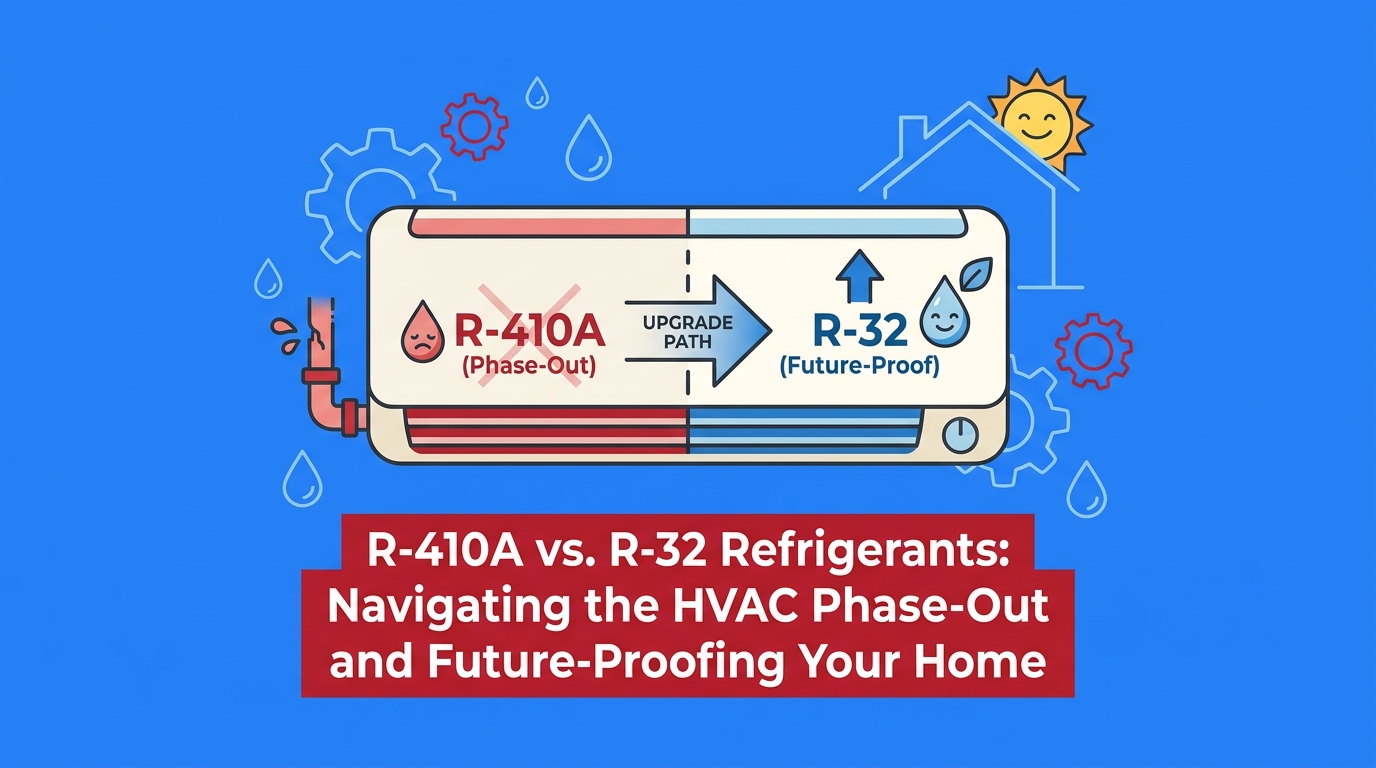
A widespread rumor suggests that existing air conditioners are suddenly obsolete or illegal to run, but that simply is not true. However, understanding R-410A vs. R-32 Refrigerants: What Homeowners Need to Know About the Phase-Out is critical if you are currently holding an installation quote for new equipment. The HVAC industry is actively navigating the current phase-out transition period, which means the decisions you make today will affect your home comfort for the next fifteen years. At Always Affordable Plumbing & HVAC, our team frequently speaks with homeowners who feel pressured by conflicting information, unsure if they should accept an outgoing standard or demand the newest technology. The reality is that regulatory changes are shifting the landscape of residential cooling, and making an informed choice requires looking past the industry jargon.
Whether you are scheduling routine HVAC services or planning a full air conditioning replacement, our experienced technicians know that making the right equipment choice now helps future-proof your investment.
For the past two decades, R-410A has been the undisputed standard in residential heating and cooling. If you have had an air conditioner or heat pump installed since 2010, it almost certainly relies on this specific chemical blend to absorb and release heat. Now, a major regulatory shift is pushing the industry toward lower-impact alternatives, primarily R-32. This transition is not happening overnight, but it is moving quickly enough that anyone purchasing a new system this year must factor it into their decision-making process.
Choosing between an outgoing R-410A system and a new R-32 system is not just about environmental compliance. It directly impacts the long-term energy efficiency of your home, the future availability of maintenance supplies, and the overall lifespan of your investment. By understanding the mechanics of this phase-out, you can evaluate installation quotes with confidence, ensuring you select equipment that delivers reliable performance without unexpected future hurdles.
The transition away from R-410A is driven by federal environmental regulations aimed at reducing the use of hydrofluorocarbons (HFCs). While R-410A was originally introduced to replace ozone-depleting refrigerants like R-22 (Freon), scientists later determined that HFCs trap a significant amount of heat in the atmosphere. To measure this impact, the industry uses lower Global Warming Potential (GWP) metrics to evaluate how much thermal energy a specific gas absorbs compared to carbon dioxide.
Because R-410A has a relatively high GWP rating, regulatory bodies have mandated a gradual shift toward more sustainable alternatives. This is a controlled, phased transition designed to give manufacturers, technicians, and homeowners time to adapt without causing sudden disruptions to existing home comfort systems.
The primary driver behind this industry shift is the American Innovation and Manufacturing (AIM) Act, which empowers the Environmental Protection Agency (EPA) to phase down the production and consumption of high-GWP HFCs. Understanding the timeline of this legislation clarifies why the market is changing right now.
1. The initial phasedown mandate: The AIM Act requires an 85% reduction in HFC production and consumption by the year 2036. This long-term goal forces manufacturers to redesign their equipment to accommodate new, more efficient chemical blends.
2. The 2025 manufacturing restriction: Starting January 1, 2025, the EPA restricts the manufacture of new residential air conditioning and heat pump systems that use refrigerants with a GWP of 700 or higher. Because R-410A exceeds this limit, manufacturers are halting production of these traditional units.
3. The shift to R-32: To meet these strict new requirements, the industry has largely settled on R-32 as the new standard. It meets the lower Global Warming Potential (GWP) metrics required by the EPA while offering excellent thermodynamic properties for residential cooling.
4. The protection of existing supplies: The AIM Act restricts the production of new high-GWP refrigerants and the equipment that uses them, but it does not ban the use of existing R-410A systems. Refrigerant will still be manufactured in smaller quantities specifically for servicing older units.
This timeline highlights why homeowners shopping for a new system today face a unique decision point. The equipment manufactured tomorrow will look very different from the equipment manufactured yesterday, and understanding these regulatory milestones prevents you from investing in outdated technology.
While environmental regulations mandate the switch, the move to R-32 actually brings substantial performance benefits to the homeowner. R-32 is not a completely new, untested chemical; in fact, R-410A is a 50/50 blend of R-32 and another refrigerant (R-125). By isolating R-32 and using it in its pure form, modern HVAC systems can operate more efficiently and effectively.
In our years of installing and maintaining cooling systems across the Sacramento Valley, our technicians have seen firsthand how extreme triple-digit summer heatwaves force your air conditioner to work overtime to extract heat from your home and release it outside. The better a refrigerant is at transferring that heat, the less energy your compressor requires to keep the house cool. R-32 boasts superior thermodynamic properties compared to its predecessor, meaning it absorbs and releases heat more rapidly. This translates directly to more reliable, cost-effective cooling when the outdoor temperatures peak.
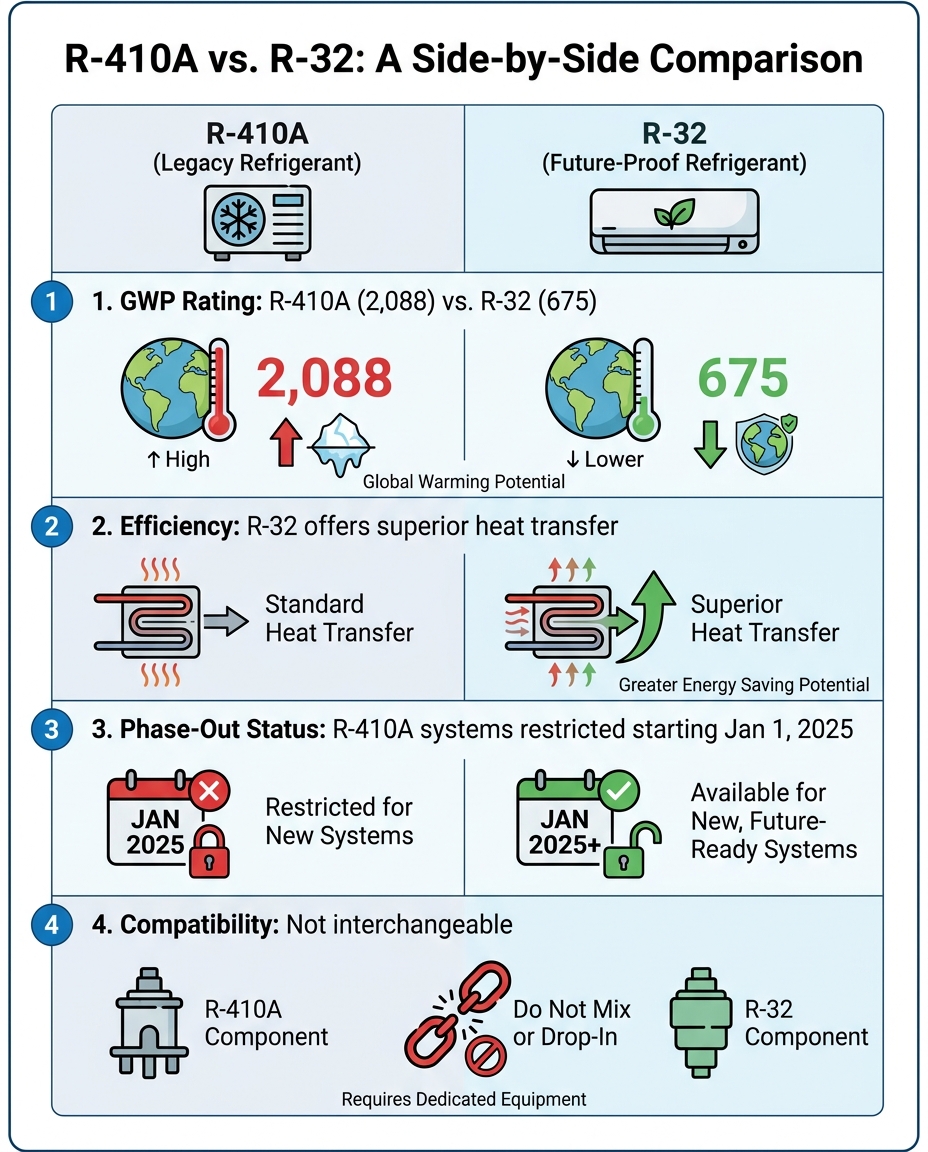
• Global Warming Potential (GWP) — R-410A (The Outgoing Standard): 2,088 — R-32 (The New Standard): 675 (Substantially lower environmental impact)
• Heat Transfer Efficiency — R-410A (The Outgoing Standard): Standard baseline performance — R-32 (The New Standard): Superior heat transfer, requiring less energy
• System Charge Volume — R-410A (The Outgoing Standard): Requires a larger volume of refrigerant — R-32 (The New Standard): Requires up to 20% less refrigerant to operate
• Safety Classification — R-410A (The Outgoing Standard): A1 (Non-flammable) — R-32 (The New Standard): A2L (Mildly flammable, with built-in safety sensors)
• Phase-Out Status — R-410A (The Outgoing Standard): New system manufacturing restricted starting 2025 — R-32 (The New Standard): Approved for all future residential manufacturing
Understanding the A2L Safety Rating: One of the most common questions regarding R-32 involves its A2L safety classification. The "A" stands for non-toxic, while the "2L" designates it as mildly flammable. This sounds alarming to some homeowners, but the reality is highly controlled. An A2L refrigerant is incredibly difficult to ignite; it requires a direct, sustained open flame and a very high concentration of leaked gas to catch fire. Furthermore, modern R-32 systems are engineered with advanced safety mechanisms, including automatic leak detection sensors and shut-off valves that instantly disable the system if a pressure drop occurs. These units are rigorously tested and completely safe for residential installation.

If you currently have a functioning R-410A air conditioner or heat pump sitting in your backyard, you might be wondering how this industry shift impacts you today. The most important thing to know is that your current system is entirely legal to operate, and you are under no obligation to replace it simply because the regulations have changed.
The problem of rising maintenance costs: While your system remains legal, the current phase-out transition period means that the overall supply of R-410A will steadily decrease over the coming years. As manufacturers scale back production to comply with EPA quotas, the basic laws of supply and demand will take effect. If your aging system develops a leak five years from now, the cost to procure the older R-410A refrigerant for a recharge will likely be noticeably higher than it is today.
The cause of compatibility issues: A pattern we see often in the field is the misconception that a technician can simply drain the old R-410A and refill the system with the newer, more efficient R-32. This is mechanically impossible. R-32 operates at different pressures, requires different compressor oils, and mandates specific A2L safety sensors that older units simply do not possess. Attempting to retrofit an older system with a new refrigerant is unsafe and will immediately destroy the compressor.
The solution for homeowners: You must weigh the age and condition of your current unit against the changing market. If your system is only five years old and running perfectly, continue with routine maintenance and enjoy your reliable cooling. However, if your unit is fifteen years old and facing a major compressor failure, pouring money into an outdated refrigerant platform is rarely a wise investment. Understanding when to repair vs replace your HVAC system becomes much clearer when you factor in the long-term availability of these essential supplies.
If you are actively shopping for a new heating and cooling system, the current phase-out transition period adds a layer of complexity to the buying process. You may receive quotes from different contractors proposing entirely different technologies. Knowing how to read these proposals ensures you make a choice that benefits your home for the next decade or more.
Working with a contractor who provides honest, transparent guidance is essential during this shift. You should never feel pressured into a quick sale by fear-mongering tactics regarding regulatory changes. A reputable professional will explain your options clearly, allowing you to choose the best path forward for your specific home.
• Verify the refrigerant type on the proposal: Look closely at the equipment specifications listed on your quote. Does it explicitly state that the new condenser uses R-32, or is it an older R-410A model? Knowing exactly what you are buying is the first step in future-proofing your home.
• Beware of the panic-buying trap: Some contractors may offer deep discounts on remaining R-410A inventory to clear out their warehouses before the new regulations take full effect. While the upfront savings might look appealing, remember that you are buying into a platform that the industry is actively leaving behind.
• Ask about long-term maintenance availability: Discuss the expected lifespan of the proposed equipment with your technician. Ask them directly how the phase-out will affect the availability of replacement parts and refrigerant recharges for that specific model ten years down the road.
• Inquire about generic energy incentives: Because R-32 systems generally offer higher baseline efficiency, they often qualify for various energy rebates or federal tax credits. While specific programs vary by location and utility provider, it is always worth asking your contractor if the high-efficiency system on your quote might be eligible for generic performance incentives.
By treating the refrigerant type as a major deciding factor alongside SEER2 ratings and tonnage, you take control of the purchasing process and protect your long-term investment.
The conversation around the refrigerant phase-out often centers on traditional central air conditioners, but the regulations apply universally to all residential cooling and heating equipment. If you are exploring alternative ways to condition your home, you will find that these newer technologies are also embracing the shift toward lower Global Warming Potential (GWP) metrics.
Heat pumps, which provide both heating in the winter and cooling in the summer, benefit immensely from the transition to R-32. Because a heat pump uses a reversing valve to move thermal energy in both directions, the superior heat transfer properties of R-32 make the system far more effective during extreme temperature swings. In heating mode, R-32 allows the system to extract ambient heat from cold outdoor air more efficiently than R-410A ever could, resulting in better year-round performance and reduced energy consumption.
Ductless mini-split systems are incredibly popular for targeted home comfort, room additions, and homes without existing ductwork. These systems are fully integrated into the transition timeline.
• Enhanced zoned cooling: Ductless systems rely on variable-speed compressors to deliver precise amounts of refrigerant to specific rooms. The lower density and higher efficiency of R-32 allow these mini split units to respond faster to thermostat adjustments, cooling a hot room in a fraction of the time.
• Smaller carbon footprint: Because ductless systems already use less energy by eliminating ductwork leaks, pairing them with R-32 creates one of the most environmentally friendly conditioning solutions available today.
• Unified technology: Whether you install a traditional central system or highly efficient heat pump systems, the underlying chemical mechanics are moving in the same direction, ensuring standardized maintenance and servicing across all platforms.
No, R-410A is not being banned from use or completely eliminated overnight. The current phase-out transition period restricts the manufacture of new equipment that uses it, and gradually reduces the amount of new R-410A produced. Existing supplies will remain available for servicing older units, though the quantities will decrease over time.
Absolutely not. R-32 operates at different pressures and requires specific compressor oils and safety sensors that older units lack. Attempting to mix refrigerants or retrofit an older system will cause immediate mechanical failure and create a serious safety hazard.
If your current system is failing and you need immediate replacement, investing in R-32 equipment is the best way to future-proof your home. Buying an R-410A system now means investing in an outgoing standard, which could lead to higher maintenance costs later in the equipment's lifecycle.
R-410A will remain available for the foreseeable future to service existing equipment. The EPA phasedown reduces production gradually through 2036, meaning technicians will still have access to the gas, though the reduced supply will likely drive up the cost of recharges in the coming years.
Yes, R-32 is rigorously tested and entirely safe for residential use. While it carries an A2L "mildly flammable" rating, it is incredibly difficult to ignite and requires a direct open flame. Modern HVAC systems are also equipped with advanced automatic shut-off sensors to prevent any risk in the event of a leak.
Because R-32 has superior heat transfer properties, systems utilizing it generally operate more efficiently than older models. While total energy savings depend on your home's insulation, ductwork, and usage habits, the higher baseline efficiency of modern R-32 equipment typically results in lower monthly operating costs.
Navigating the current phase-out transition period does not have to be overwhelming. By understanding the shift from R-410A to R-32, you empower yourself to look past the industry jargon and evaluate new installation quotes based on long-term value. The move toward lower-GWP refrigerants is a positive step that brings better heat transfer, improved energy efficiency, and advanced safety features right to your backyard.
Making the right choice today ensures your new cooling system will remain compliant, efficient, and easy to maintain for its entire lifespan. If you are ready to upgrade your home comfort or need transparent, objective advice on evaluating your current equipment, reach out to our team at Always Affordable Plumbing & HVAC, where we prioritize straightforward guidance over high-pressure sales. Future-proofing your home starts with a simple, informed conversation.
See what our satisfied customers have to say about their experience with Always Affordable
Plumbing & HVAC.

"Chappy was very skilled in his knowledge of my HVAC unit. I greatly appreciate the quick response and experienced tech. The whole endeavor was made less stressful by his humor and honest conversation. I find comfort in knowing I now have a shop i trust for the next time."
"Tony, James, Ronnie did an amazing job setting up our new AC! They were quick, efficient, considerate, and polite! We appreciate them scheduling us in on such short notice. Definitely recommend this company!"
"Prompt, professional service with kindness and care. They came out to address both plumbing and AC issues. I received a courtesy call before they arrived. All issues were resolved the same day with integrity and respect. Thankful for businesses like this. Absolutely recommend to those that I love."
"Excellent service! Jason came out promptly and in addition to doing my outside faucet he also put in new irrigation equipment! All done perfectly! Jason was lovely"
"Honest with the assessment; friendly and good manners. No high pressure sales. Just good to honest "tell it like you see it" Thought my kitchen disposer needed an overhaul. But Jason, there Plumber gave me an honest lesson on what was really happening. Saved me hundreds, if I went the route of replacing. Thank you!"
"Absolutely 5 stars. If you are looking for affordable ,professional and kind. Chappy was excellent and very knowledgeable . I called in the morning because my air conditioner stopped working he was here within hours and fixed my air with a smile. I highly recommend Chappy and Always Affordable plumbing and Hvac."
"Scott and James were great. They got there quickly and diagnosed the problem with my A/C.They did a very thorough job testing everything. Sent me pictures and called to keep me informed. Got it done the next day and everything is working fine. Be glad when I get home so I can enjoy my new system. Thanks guys for a great job."
"Chappy was very helpful. He knew our issue right away, cleaned our coils. He also came on the same day we called and got our AC blowing cold air again."
"After some timing ’curfuffles’ the Tech Jason arrived and not only completed a speedy install on my toilet, he was personable & professional. Because of the timing issues Jason was attentive and showed up with everything needed! No extra store runs 😊 I was very comfortable with having this Tech in my Daughter’s home. We will definitely use this Service again."