Why Is My AC Running But Blowing Warm Air? Expert Troubleshooting Steps
Why is your AC blowing warm air? Get clear answers on thermostat settings to check and see common homeowner questions answered before calling for a repair.



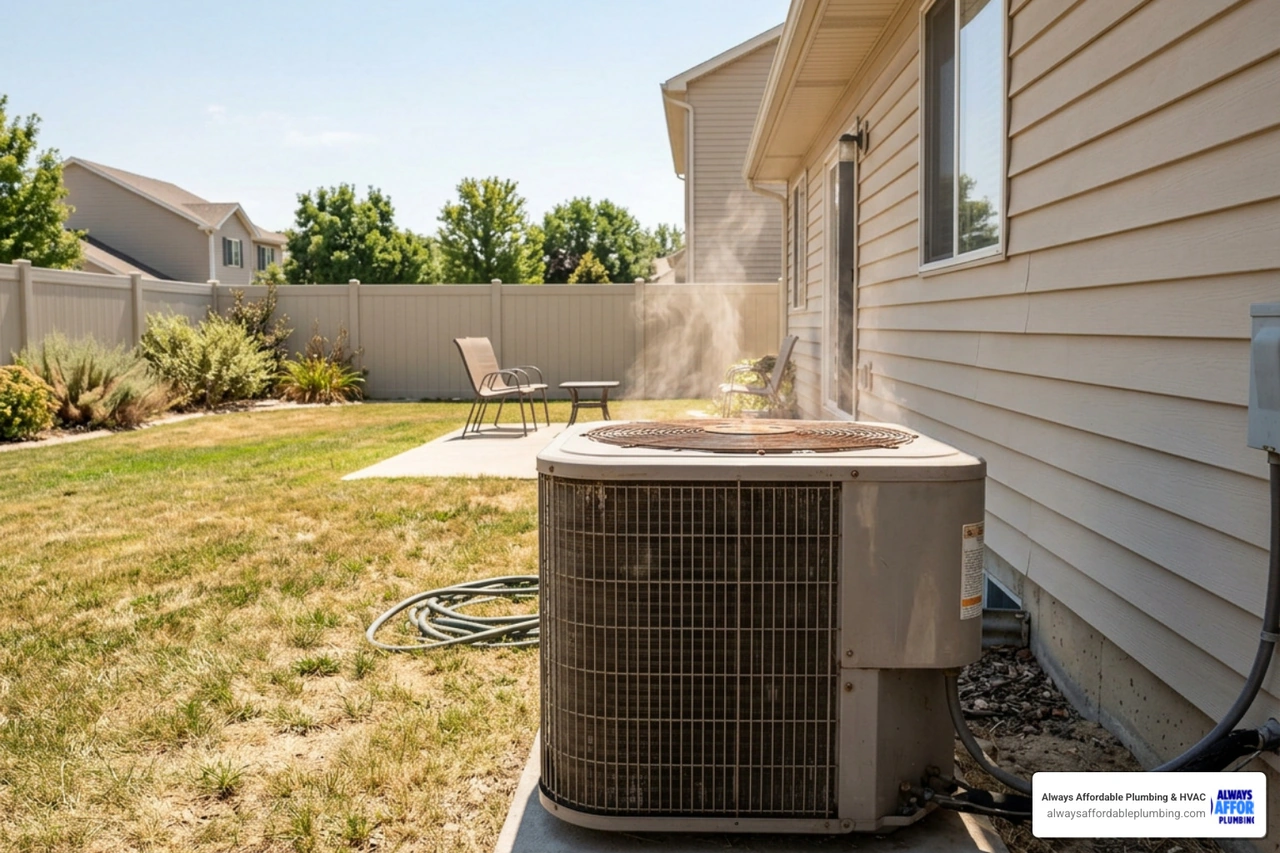
Knowing when to repair vs replace your HVAC system can be the difference between a smart investment and throwing money at a unit that's already on its way out. For homeowners in Sacramento and surrounding areas, where summer temperatures regularly push past 100°F, a failing system isn't just inconvenient — it's a real comfort and safety issue.
Here's a quick answer to help you decide:
Repair your HVAC system if:
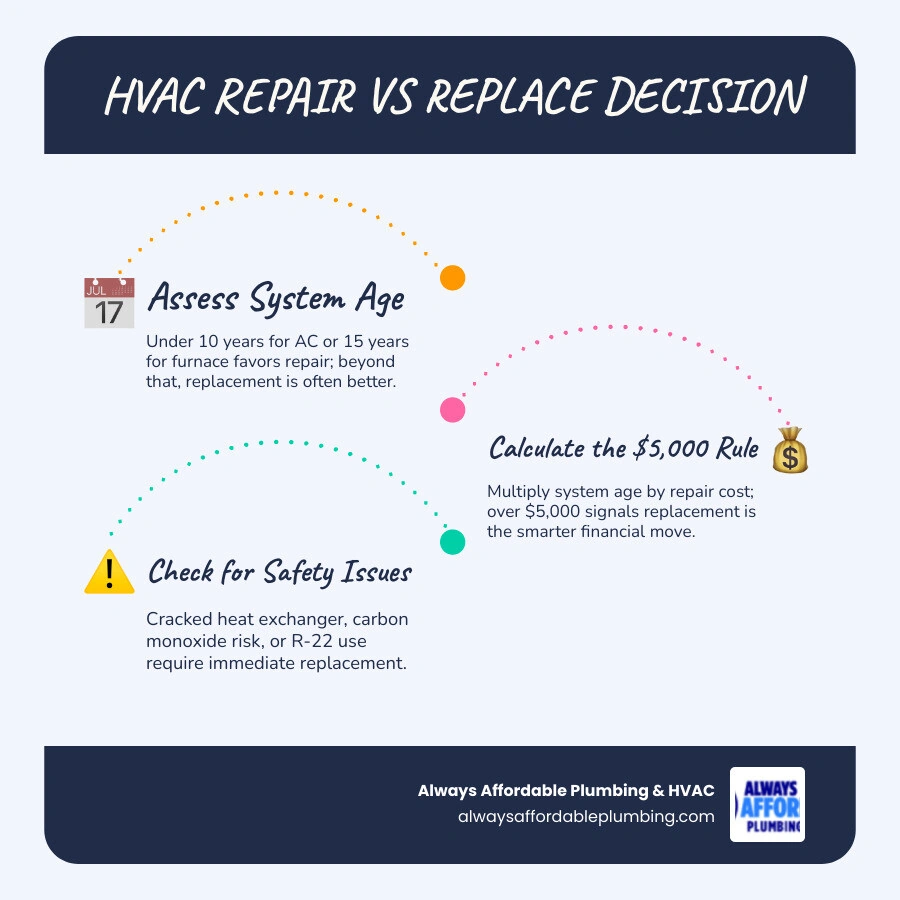
- The system is under 10 years old (AC) or under 15 years old (furnace) - The repair cost is less than 30–50% of the cost of a new system - It's your first or second repair issue - The system is still under manufacturer warranty
Replace your HVAC system if:
- The system is over 10–15 years old and needs a major repair - Repair costs exceed 50% of new system cost - You've had multiple repairs in the past 2–3 years - The system uses R-22 refrigerant (phased out in 2020) - There are safety concerns such as a cracked heat exchanger or carbon monoxide risk - Your energy bills have been steadily climbing with no other explanation
A useful gut-check is the $5,000 rule: multiply your system's age (in years) by the estimated repair cost. If the result is over $5,000, replacement is usually the smarter move. If it's under $5,000, a repair is often worth it.
For example:
- A 6-year-old system with a $400 repair = $2,400 → repair - A 12-year-old system with a $500 repair = $6,000 → consider replacing
Every situation is a little different, and Sacramento's extreme heat adds wear that shortens system lifespans compared to milder climates. The sections below walk through each factor in detail so you can make a confident, informed decision.

When your heating and cooling system begins showing signs of trouble, it is easy to feel overwhelmed. Making the choice between a quick fix and a complete system upgrade is one of the most significant financial decisions you will make as a homeowner. To make this process easier, we look at several core decision rules that balance short-term relief against long-term value.
The most common signs that your system needs attention include uneven cooling, strange clanking or squealing noises, a sudden spike in your monthly utility bills, and a system that constantly cycles on and off. If you are experiencing these issues, you must evaluate the concept of "systemic fatigue."
Just like an old car, once an HVAC system reaches a certain point in its lifespan, its internal components begin to fail in quick succession. Fixing one part often puts extra stress on another older part, leading to a frustrating cycle of endless service calls. If you find yourself scheduling three or more repairs within a three-year period, your system is likely experiencing this type of decline. In these cases, continuing to pay for individual fixes is simply delaying the inevitable. To understand if your cooling unit has reached this tipping point, you can read our guide on When to Upgrade Outdated AC Unit.
The $5,000 rule is an industry-standard mathematical formula designed to take the emotion out of your decision. It provides a clear, objective look at whether a repair is a financially sound choice.
To apply this rule, you multiply the exact age of your unit by the written repair quote provided by your technician.
- The Formula: Age of System (Years) × Cost of Repair = Decision Value - The Threshold: If the total is less than $5,000, you should generally proceed with the repair. If the total exceeds $5,000, the math strongly suggests that replacing the system is the more cost-effective long-term choice.
Let's look at how this applies to real-world scenarios in our hot California summers. Imagine your air conditioner breaks down during a July heatwave in Elk Grove. If the unit is 4 years old and needs a minor part replaced, multiplying its age by the repair cost yields a low number well under the threshold, making a repair the obvious choice. However, if that same air conditioner is 12 years old and requires a more extensive repair, multiplying 12 by that repair quote will easily push you past the $5,000 limit. At this stage, investing in a new unit is a much wiser use of your hard-earned money. For a deeper dive into how system age affects this math, check out our article on How Old Is Too Old for an HVAC System.
Another reliable standard is the 50% rule. This rule states that if the cost of a single repair exceeds 50% of the cost of a brand-new system, you should choose replacement. In fact, many industry experts suggest that even if a repair exceeds 30% of the replacement value, you should seriously consider upgrading, especially if your system is past its tenth year of service.
This rule is particularly important when dealing with major component failures. The two most critical components in your HVAC system are the air conditioning compressor and the furnace heat exchanger. The compressor is the heart of your AC; if it fails on a system that is over a decade old, replacing just the compressor is rarely advisable. Similarly, a cracked heat exchanger is a severe issue that often makes a furnace unsafe to operate.
When these primary components fail, the labor required to replace them is extensive. Investing that labor cost into an aging, out-of-warranty system is risky. If you are currently facing a sudden breakdown and aren't sure what steps to take next, you can learn more by reading about Emergency HVAC Repair What to Expect.
Beyond simple mathematical formulas, several external factors should influence your decision. These include environmental regulations, energy efficiency standards, and safety concerns.
To help you visualize where your system stands, we have put together a quick-reference comparison table:
• System Age — Favor Repair: AC < 10 years / Furnace < 12 years — Favor Replacement: AC > 12 years / Furnace > 15 years
• Refrigerant Type — Favor Repair: R-410A (in good condition) — Favor Replacement: R-22 (obsolete/phased out)
• Repair Cost — Favor Repair: Less than 30% of replacement cost — Favor Replacement: More than 50% of replacement cost
• Utility Bills — Favor Repair: Stable or minor seasonal changes — Favor Replacement: Up 20% to 40% compared to previous years
• System Performance — Favor Repair: Consistent temperatures throughout the home — Favor Replacement: Uneven cooling, constant cycling, high humidity
• Safety Risks — Favor Repair: None detected — Favor Replacement: Cracked heat exchanger, carbon monoxide risks
The type of refrigerant your air conditioner uses plays a massive role in its serviceability. If your cooling system was installed before 2010, there is a very high chance it runs on R-22 refrigerant (commonly known as Freon). Due to its ozone-depleting properties, the EPA completely phased out the production and import of R-22.
In 2026, finding R-22 is incredibly difficult and highly expensive, as technicians must rely entirely on reclaimed, recycled supplies. If your R-22 system develops a refrigerant leak, simply recharging the system can cost a fortune. Because of this "refrigerant tax," any major repair on an R-22 system should be viewed as a clear signal to replace the unit.
Even older systems utilizing R-410A are facing changes, as the industry transitions to newer, more environmentally friendly refrigerants like R-454B and R-32 to reduce global warming impact. Upgrading to a modern system ensures your home is compliant with current environmental standards and protects you from rising service costs associated with phased-down chemical compounds. Discover how these modern updates improve your daily life by reading about New HVAC Benefits Beyond Comfort.
While financial calculations are helpful, safety concerns must always take priority. There are certain HVAC failures where repair is simply not a safe option, and immediate replacement is required to protect your family.
The most critical safety hazard is a cracked heat exchanger in a gas furnace. The heat exchanger is the metal chamber that prevents toxic combustion gases—including carbon monoxide (CO)—from mixing with the clean air circulating through your home. If this metal chamber cracks due to years of expanding and contracting, carbon monoxide can leak directly into your living spaces.

Carbon monoxide is an odorless, colorless gas that can be fatal. Signs of a cracked heat exchanger or combustion safety issues include:
- Your home's carbon monoxide detectors sounding when the heat turns on - Heavy soot accumulation around the furnace burners - An unusual, dancing, or yellow burner flame (it should be a steady, crisp blue) - Physical symptoms of CO poisoning among family members, such as chronic headaches, dizziness, or nausea
If a licensed technician discovers a cracked heat exchanger, they are legally obligated to shut down your system to prevent a life-threatening emergency. In this scenario, trying to patch or weld the crack is highly dangerous and against safety codes; the heat exchanger, or the entire furnace, must be replaced immediately.
While the upfront cost of a new HVAC installation is a significant investment, it is important to look at the long-term return on that investment. Modern heating and cooling systems are engineered to operate with a level of efficiency that was unimaginable fifteen years ago.
Older systems typically operate on a simple "on/off" cycle, running at 100% capacity and then shutting down completely. This constant starting and stopping consumes massive amounts of electricity and leads to noticeable temperature swings.
In contrast, modern systems utilize variable-speed technology. These units can run at lower, highly efficient speeds for longer periods, maintaining a perfectly consistent temperature while using a fraction of the energy. Upgrading from an old, low-efficiency system to a modern high-efficiency unit can slash your monthly cooling costs by 20% to 40%. If you select an ENERGY STAR certified system, you can expect to save up to 20% on heating and cooling costs compared to standard new models. These monthly savings add up quickly, helping to offset the initial cost of your upgrade over time.
A new system also does wonders for your indoor air quality by managing humidity levels and filtering out allergens more effectively. Additionally, if you plan to sell your home in the near future, a brand-new heating and air system is a major selling point. It gives prospective buyers peace of mind, removes a common inspection obstacle, and directly boosts your property's marketability. To explore this benefit further, read How a New HVAC System Increases Home Value.
Living in the Sacramento Valley means our HVAC systems have to work incredibly hard. Our hot, dry summers and chilly, damp winters put unique demands on residential equipment. Because our systems run so frequently, energy efficiency isn't just an environmental preference — it is a monthly financial necessity.
When selecting a new system, you will want to look at modern efficiency ratings:
- SEER2 (Seasonal Energy Efficiency Ratio 2): Measures cooling efficiency. Standard systems today start around 14.3 SEER2, but high-efficiency models can exceed 22 SEER2. - AFUE (Annual Fuel Utilization Efficiency): Measures gas furnace efficiency. Older conventional furnaces often operate at 80% AFUE, meaning 20% of the fuel is wasted. Modern high-efficiency condensing furnaces can achieve up to 98% AFUE, converting almost all of the gas directly into heat for your home.
In California, new HVAC installations must also comply with Title 24 building energy efficiency standards, which require proper system sizing and duct sealing. A properly sized, professionally installed system will handle our local climate with ease, keeping your home comfortable even during a prolonged July heatwave in Citrus Heights or Rancho Cordova. To keep your current system running at peak performance and delay the need for replacement, regular maintenance is key. Learn more about our local services by visiting HVAC Maintenance Sacramento CA.
Your personal timeline and future plans for your home should play a major role in your decision. If you plan to sell your home and relocate within the next year or two, investing in a complete system replacement might not make financial sense unless the current system is completely non-functional. In this short-term scenario, a reliable repair is often the most practical way to maintain comfort while keeping your expenses low.
However, if you plan to stay in your home for the next five, ten, or twenty years, a replacement is a true long-term investment. You will be the one directly benefiting from the lower utility bills, improved indoor air quality, and the worry-free comfort of a system covered by a fresh 10-year manufacturer warranty.
If you decide to keep your current system running for a few more years, the best way to prevent sudden breakdowns is through proactive care. You can learn how to protect your system by reading our guide on How to Prevent HVAC Emergencies with Maintenance.
In most cases, yes, it is highly recommended to replace both units at the same time, especially if they are of similar age. Your heating and cooling systems share several critical components, including the indoor blower motor and the ductwork system. This is known as a "matched system."
If you pair a brand-new, high-efficiency AC condenser with an old, inefficient furnace blower, the new system will not be able to perform at its rated efficiency. It's like putting a high-performance engine inside an old, worn-out car frame. Additionally, replacing both units during a single service visit saves you significant money on labor costs, as our technicians only have to prepare and seal the installation area once.
Routine maintenance is the single most effective way to extend the lifespan of your heating and cooling equipment. A well-maintained system can easily last 15 to 20 years, whereas a neglected system may begin to fail after just 8 to 10 years.
Regular tune-ups keep internal components clean, reduce friction, and allow technicians to catch minor issues (like a worn capacitor) before they turn into major failures (like a burned-out compressor). Furthermore, most manufacturers require proof of regular professional maintenance to keep your parts warranty valid. To find out if a professional upkeep plan is right for your home, read Is an HVAC Maintenance Plan Worth It and discover what is included in our visits by reading What Does an HVAC Maintenance Visit Include.
The most common warning signs that your system is struggling include:
- Uneven cooling: Some rooms feel like an icebox while others remain uncomfortably warm. - Strange noises: Grinding, squealing, or loud banging sounds indicating mechanical failure. - Rising utility bills: Your energy usage is climbing even though your daily habits haven't changed. - Short-cycling: The system turns on and off rapidly without ever completing a full cooling or heating cycle.
Deciding when to repair vs replace your HVAC system doesn't have to be a guessing game. By using objective tools like the $5,000 rule, evaluating the age of your system, and keeping an eye on your monthly energy bills, you can make a smart, stress-free decision that keeps your home comfortable for years to come.
At Always Affordable Plumbing & HVAC, we are proud to serve families throughout Sacramento, Elk Grove, Roseville, Folsom, Davis, and surrounding communities. We believe in providing transparent, honest, and affordable solutions. Our licensed technicians will never pressure you into an unnecessary replacement; instead, we will provide a thorough, accurate assessment of your system's health so you can make the best choice for your family and your budget.
If your heating or cooling system is struggling to keep up with the California weather, let us help you find the perfect solution. Schedule an HVAC consultation today and experience the comfort of trusted, local service.
See what our satisfied customers have to say about their experience with Always Affordable
Plumbing & HVAC.

"Chappy was very skilled in his knowledge of my HVAC unit. I greatly appreciate the quick response and experienced tech. The whole endeavor was made less stressful by his humor and honest conversation. I find comfort in knowing I now have a shop i trust for the next time."
"Tony, James, Ronnie did an amazing job setting up our new AC! They were quick, efficient, considerate, and polite! We appreciate them scheduling us in on such short notice. Definitely recommend this company!"
"Prompt, professional service with kindness and care. They came out to address both plumbing and AC issues. I received a courtesy call before they arrived. All issues were resolved the same day with integrity and respect. Thankful for businesses like this. Absolutely recommend to those that I love."
"Excellent service! Jason came out promptly and in addition to doing my outside faucet he also put in new irrigation equipment! All done perfectly! Jason was lovely"
"Honest with the assessment; friendly and good manners. No high pressure sales. Just good to honest "tell it like you see it" Thought my kitchen disposer needed an overhaul. But Jason, there Plumber gave me an honest lesson on what was really happening. Saved me hundreds, if I went the route of replacing. Thank you!"
"Absolutely 5 stars. If you are looking for affordable ,professional and kind. Chappy was excellent and very knowledgeable . I called in the morning because my air conditioner stopped working he was here within hours and fixed my air with a smile. I highly recommend Chappy and Always Affordable plumbing and Hvac."
"Scott and James were great. They got there quickly and diagnosed the problem with my A/C.They did a very thorough job testing everything. Sent me pictures and called to keep me informed. Got it done the next day and everything is working fine. Be glad when I get home so I can enjoy my new system. Thanks guys for a great job."
"Chappy was very helpful. He knew our issue right away, cleaned our coils. He also came on the same day we called and got our AC blowing cold air again."
"After some timing ’curfuffles’ the Tech Jason arrived and not only completed a speedy install on my toilet, he was personable & professional. Because of the timing issues Jason was attentive and showed up with everything needed! No extra store runs 😊 I was very comfortable with having this Tech in my Daughter’s home. We will definitely use this Service again."