Common Homeowner Questions Answered: Troubleshooting AC Cooling Failures and Stubborn Clogs
Is your AC running nonstop but your house is still hot? We get these common homeowner questions answered. See when to check a filter vs when to call a pro.



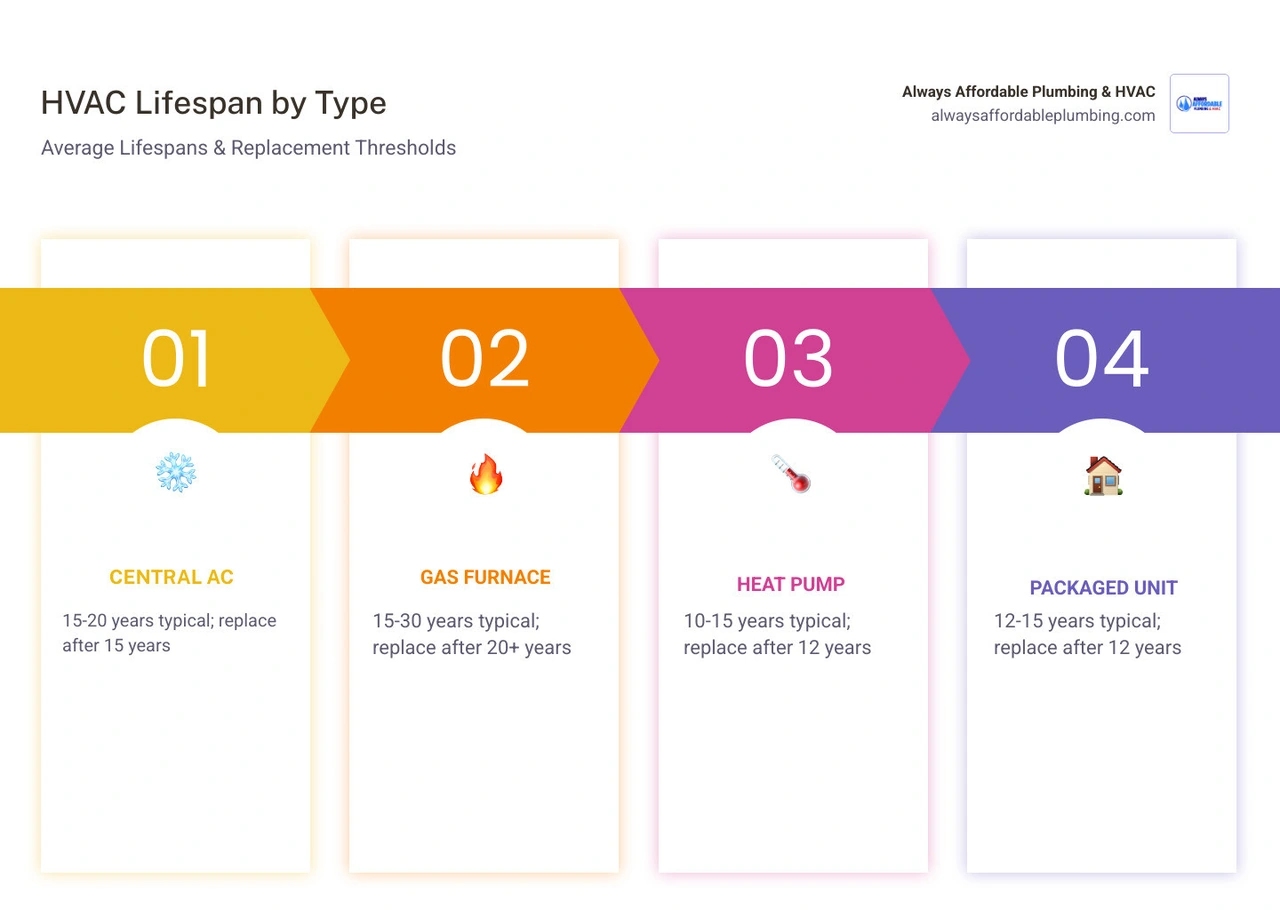
How old is too old for an HVAC system is one of the most common questions homeowners ask — and the answer matters more than most people realize. As a general rule:
• Central Air Conditioner — Typical Lifespan: 15-20 years — Consider Replacement After: 15 years (or 12 in coastal/humid climates)
• Gas Furnace — Typical Lifespan: 15-30 years — Consider Replacement After: 20+ years
• Air-Source Heat Pump — Typical Lifespan: 10-15 years — Consider Replacement After: 12 years
• Packaged HVAC Unit — Typical Lifespan: 12-15 years — Consider Replacement After: 12 years
• Boiler — Typical Lifespan: 20-35 years — Consider Replacement After: 25 years
If your system is pushing or past those thresholds — especially if it's showing performance problems — it's time to take a serious look at what it's costing you to keep it running.
Most HVAC systems are designed to last between 15 and 20 years. But here's the thing: a system that's still "running" isn't necessarily running well. By the time an air conditioner hits the 10-year mark, it may already be operating at just 80 to 85 percent of its original efficiency. At 12 years, that efficiency loss can climb to 20 to 30 percent — meaning your system works harder, wears out faster, and drives up your energy bills every single month.
For Sacramento-area homeowners dealing with triple-digit summers, an aging, underperforming AC isn't just an inconvenience. It's a real risk to your comfort, your budget, and in some cases, your safety.
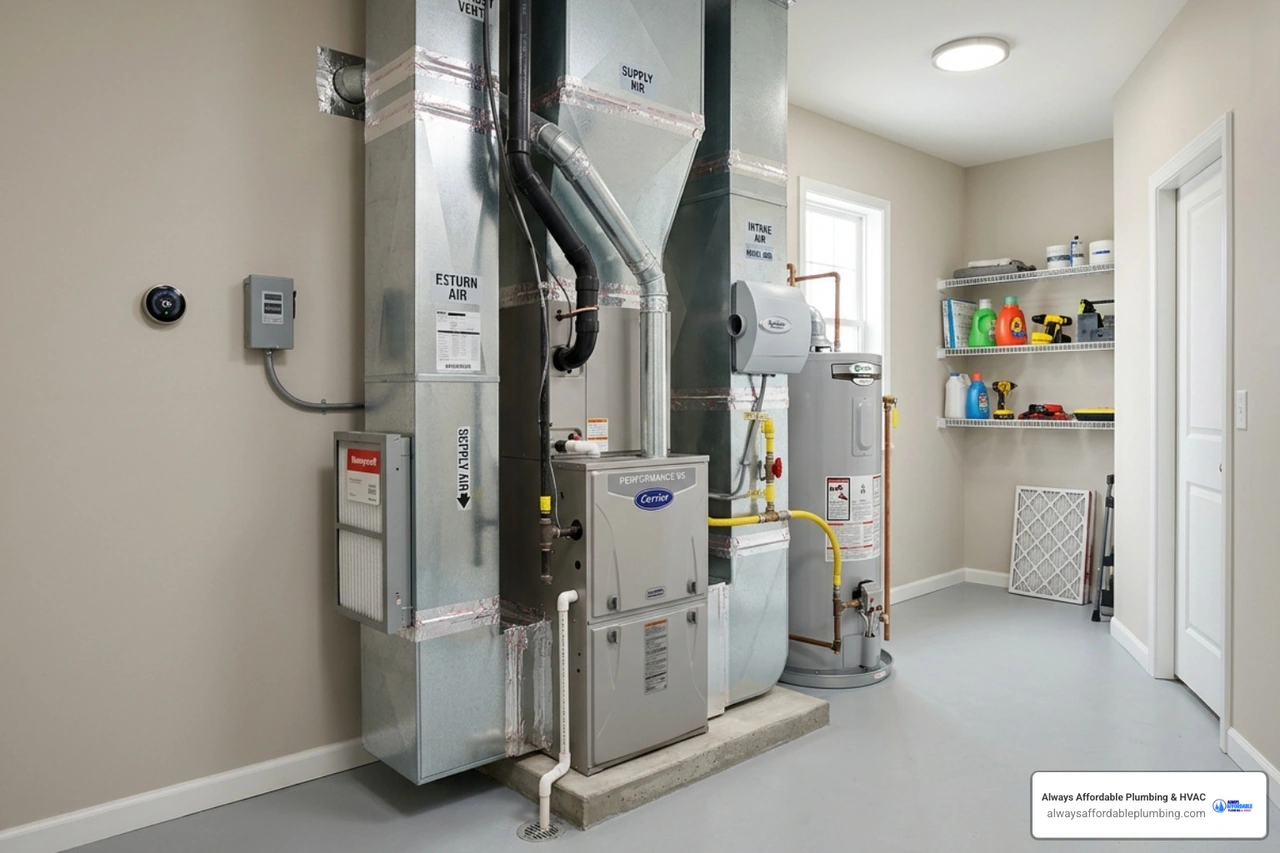
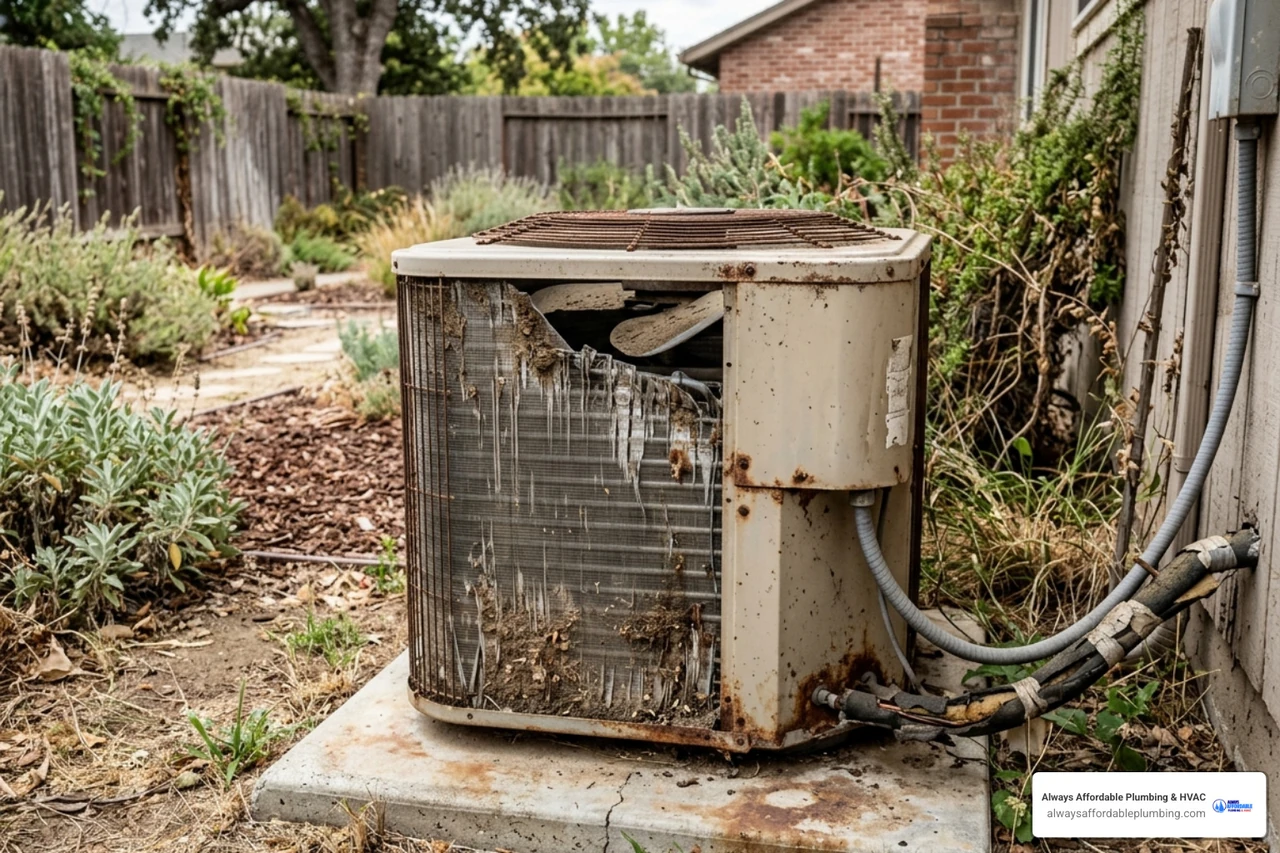
When we talk about the longevity of home comfort systems, it is important to realize that "HVAC" is an umbrella term for several different pieces of equipment, each with its own expiration date. In the Sacramento Valley, our systems work overtime. While a furnace in a milder climate might coast through the decades, our air conditioners face grueling summer cycles that can accelerate wear and tear.
Central air conditioners typically have a design life of 15 to 20 years. However, the median service life for residential AC units is often closer to 12–15 years. If you live in a particularly humid pocket or a coastal area, that number can drop as low as 8–14 years due to corrosion.
Gas furnaces are the marathon runners of the HVAC world, often lasting 15 to 30 years. Because they have fewer moving parts than an AC compressor, they tend to hang on longer, though their efficiency drops significantly as they age. Air-source heat pumps, which handle both heating and cooling, usually see a shorter lifespan of 10 to 15 years because they operate year-round without a seasonal break. Packaged units, which house all components in one outdoor cabinet, generally last about 12 to 15 years due to constant exposure to the elements.
Regardless of the type of system you have, the best way to ensure it reaches the upper end of these ranges is through consistent care. You can learn more about the ideal service schedule in our guide on How Often Should You Service Your HVAC.
Age is just a number until it starts affecting your daily life. If you are constantly adjusting the thermostat or find yourself dreading the arrival of the utility bill, your system is likely trying to tell you something.
One of the most obvious signs that a system is "too old" is a steady climb in energy costs. As internal components like the compressor and blower motor wear down, they require more electricity to move the same amount of air. You might also notice uneven room temperatures—the living room feels like an ice box while the master bedroom remains sweltering. This often indicates that the system can no longer maintain the static pressure required to push air through your entire ductwork system.
Frequent cycling (turning on and off every few minutes) and strange noises are also red flags. If you hear grinding, squealing, or loud banging, these are not just "old house noises." They are mechanical cries for help. If you're noticing these issues, check out our list of the Top Signs You Need HVAC Repair to see if a simple fix will suffice or if the problem is more systemic.
Not sure when your system was installed? You don't need a time machine to find out. Most units have a manufacturer’s nameplate attached to the exterior of the cabinet. For the outdoor AC unit, this is usually on the back or side near the copper refrigerant lines.
Look for a "Manufacture Date" or "MFR DATE." If it isn't clearly labeled, you can use the serial number. Most manufacturers hide the year and week of production within the first few digits of the serial number. For example, a serial number starting with "0412" might mean the unit was built in the 12th week of 2004. If you're struggling to decode the label, our team can help during a routine visit for HVAC Maintenance McClellan CA.
While some systems can technically limp along for 20 years, the 15-year mark is generally the "economic cliff." At this age, a central air system has likely lost 20–30% of its original efficiency. To put that in perspective, a 12-year-old unit with an original 13 SEER rating might be operating like a 9 SEER unit today.
Internal components like the evaporator coil and compressor have undergone thousands of heating and cooling cycles. The metal has expanded and contracted, the lubrication in the motors has broken down, and the electrical connections have weathered. Beyond the 15-year inflection point, the risk of a catastrophic failure during a Sacramento heatwave rises sharply. This is why we often recommend homeowners start planning their next move around the 12-to-15-year mark. Knowing When to Upgrade Outdated AC Unit can save you from an emergency replacement in the dead of July.
Deciding whether to sink more money into an old unit or invest in a new one can be stressful. To make it easier, we use two industry-standard "rules of thumb":
1. The $5,000 Rule: Multiply the age of your system by the cost of the repair. If the result is more than $5,000, it is usually more economical to replace the unit. (For example, a $600 repair on a 10-year-old system equals $6,000—time to consider a new unit).
2. The 50% Rule: If a single repair costs 50% or more of the price of a new system, replacement is the smarter financial move.
• System Age — Repair: Under 10 years — Replace: Over 15 years
• Repair Cost — Repair: Minor (under $500) — Replace: Major (over 50% of new unit)
• Energy Bills — Repair: Consistent — Replace: Rising 20%+ year-over-year
• Comfort — Repair: Even cooling/heating — Replace: Hot/Cold spots throughout home
• Reliability — Repair: First repair in years — Replace: Multiple repairs in last 2 years
If you've spent more than $1,000 on repairs over the last two years for a system that is over a decade old, you are likely throwing good money after bad. When a major component like a compressor or heat exchanger fails, the decision becomes even clearer. For more guidance on handling these moments, see What to Do When Your HVAC Breaks Down Unexpectedly or contact us for HVAC Repair Sacramento CA.
An old HVAC system isn't just inefficient; it can be dangerous. For furnaces, the primary concern is the heat exchanger. This is the component that keeps combustion gases (like carbon monoxide) separate from the air being blown into your home. Over 20 or 30 years, the constant heating and cooling of the metal can cause stress cracks. A cracked heat exchanger can leak carbon monoxide into your living space—a silent and deadly threat.
Older systems also pose fire hazards. Brittle wiring, failing capacitors, and overworked motors can overheat and ignite. If your system is frequently tripping the circuit breaker, it’s a sign that the electrical components are drawing too much power and creating a safety risk. If your heater is showing these signs, it may be Time for Heater Replacement to ensure your family's safety.
One of the biggest "deal-breakers" for older air conditioners is the type of refrigerant they use. Systems manufactured before 2010 typically use R-22 (often called Freon). The U.S. EPA officially phased out the production and import of R-22 in 2020 because it depletes the ozone layer.
If your R-22 system develops a leak today, the cost to recharge it is astronomical because the supply of the gas is so limited. Furthermore, many modern components are simply incompatible with R-22. If your compressor fails on an R-22 unit, you are almost always forced to replace the entire system. Transitioning to a modern, SEER2-compliant system isn't just better for the planet; it’s a necessity for long-term reliability. We specialize in HVAC Replacement Carmichael CA to help homeowners navigate these regulatory changes.
While it is technically possible for a high-quality gas furnace to reach the 30-year mark, it is extremely rare for an air conditioner to do so while remaining functional. Even if a 30-year-old system is still "running," its efficiency is likely abysmal. You could be paying double what you should for utilities. Furthermore, finding replacement parts for a system from the 1990s is nearly impossible, turning a minor fix into a mandatory replacement.
Absolutely. Think of HVAC maintenance like oil changes for your car. Regular tune-ups allow us to clean the coils (which reduces strain on the compressor), check refrigerant levels, and tighten electrical connections. Clean filters and optimized airflow prevent the system from overheating. A well-maintained system can easily last 5 to 7 years longer than a neglected one. For those in the Roseville area, our Heating Installation Guide Roseville CA explains how proper initial setup and ongoing care work together to maximize longevity.
We recommend a professional evaluation at least once a year—ideally in the spring for your AC and the fall for your furnace. However, if your system is over 12 years old, you should consider a "performance audit." This goes beyond a standard tune-up to measure the actual efficiency and safety of your system, helping you budget for a replacement before an emergency occurs.
At Always Affordable Plumbing & HVAC, we know that your home’s comfort is a top priority. Whether you are in Sacramento, Elk Grove, Folsom, or any of our surrounding service areas, we are committed to providing transparent and honest advice about your heating and cooling equipment.
If you are wondering how old is too old for an hvac system in your specific home, don't wait for the next heatwave to find out. Our licensed technicians are experts in both residential and commercial solutions, offering everything from routine maintenance to full-system upgrades. We pride ourselves on being the local choice for reliability and affordability, ensuring your family stays comfortable through every California season.
Ready to see how your system is performing? Explore our full range of HVAC Services or join our Member's Club for priority service and exclusive discounts. Let us help you take the guesswork out of home comfort.
See what our satisfied customers have to say about their experience with Always Affordable
Plumbing & HVAC.

"Chappy was very skilled in his knowledge of my HVAC unit. I greatly appreciate the quick response and experienced tech. The whole endeavor was made less stressful by his humor and honest conversation. I find comfort in knowing I now have a shop i trust for the next time."
"Tony, James, Ronnie did an amazing job setting up our new AC! They were quick, efficient, considerate, and polite! We appreciate them scheduling us in on such short notice. Definitely recommend this company!"
"Prompt, professional service with kindness and care. They came out to address both plumbing and AC issues. I received a courtesy call before they arrived. All issues were resolved the same day with integrity and respect. Thankful for businesses like this. Absolutely recommend to those that I love."
"Excellent service! Jason came out promptly and in addition to doing my outside faucet he also put in new irrigation equipment! All done perfectly! Jason was lovely"
"Honest with the assessment; friendly and good manners. No high pressure sales. Just good to honest "tell it like you see it" Thought my kitchen disposer needed an overhaul. But Jason, there Plumber gave me an honest lesson on what was really happening. Saved me hundreds, if I went the route of replacing. Thank you!"
"Absolutely 5 stars. If you are looking for affordable ,professional and kind. Chappy was excellent and very knowledgeable . I called in the morning because my air conditioner stopped working he was here within hours and fixed my air with a smile. I highly recommend Chappy and Always Affordable plumbing and Hvac."
"Scott and James were great. They got there quickly and diagnosed the problem with my A/C.They did a very thorough job testing everything. Sent me pictures and called to keep me informed. Got it done the next day and everything is working fine. Be glad when I get home so I can enjoy my new system. Thanks guys for a great job."
"Chappy was very helpful. He knew our issue right away, cleaned our coils. He also came on the same day we called and got our AC blowing cold air again."
"After some timing ’curfuffles’ the Tech Jason arrived and not only completed a speedy install on my toilet, he was personable & professional. Because of the timing issues Jason was attentive and showed up with everything needed! No extra store runs 😊 I was very comfortable with having this Tech in my Daughter’s home. We will definitely use this Service again."