Seasonal Home Maintenance Checklist: Preventing HVAC and Plumbing Emergencies
Prevent HVAC emergencies with a seasonal home maintenance checklist. Why proactive scheduling beats waiting for sudden failures. See what needs attention now.



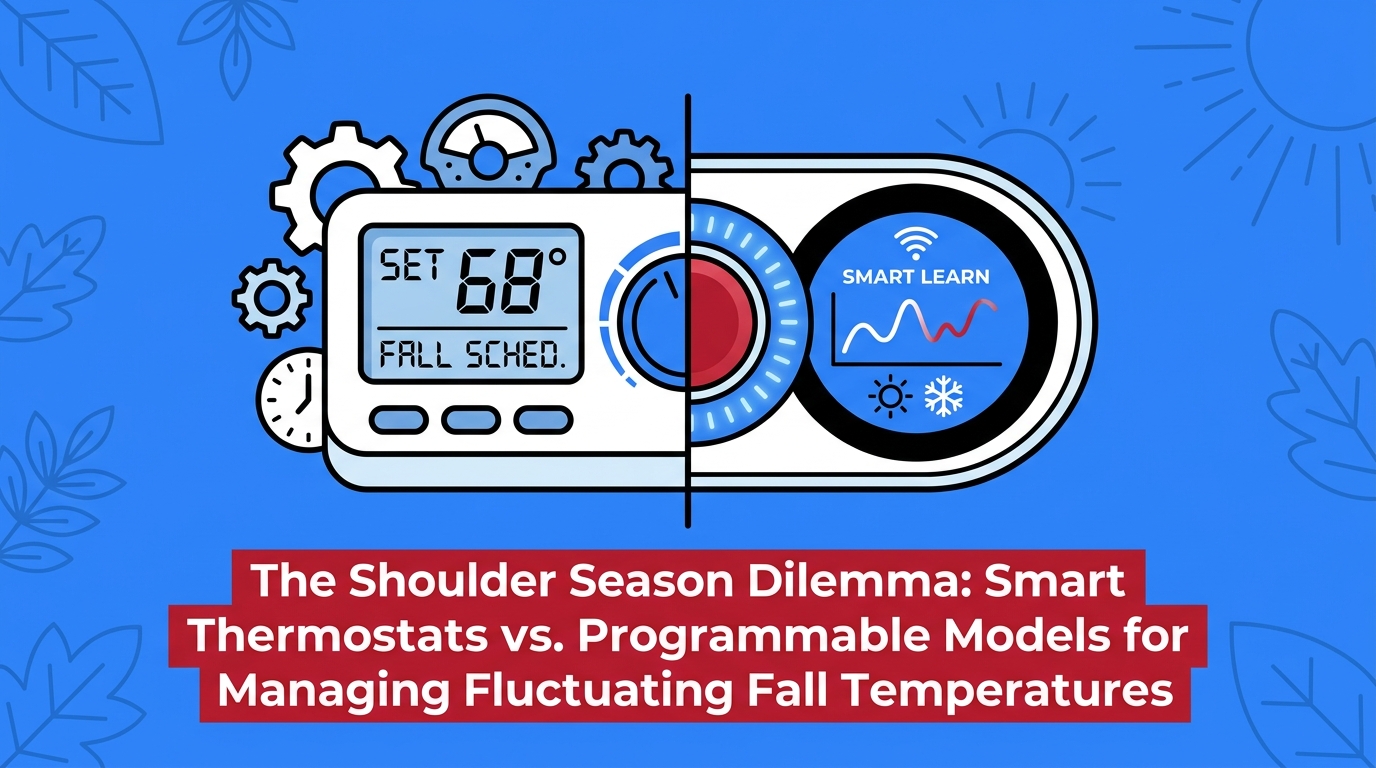
Setting one rigid climate schedule and forgetting it all year long is a common myth, but when evaluating Smart Thermostats vs. Programmable Models for Managing Fluctuating Fall Temperatures, that set-it-and-forget-it approach quickly falls apart. Many homeowners believe that as long as they have programmed their daily routines into a wall unit, their home will automatically maintain perfect comfort and peak efficiency. However, this assumption ignores the physical realities of the fall shoulder season, a transitional period characterized by wildly unpredictable weather patterns. During these weeks, a static schedule that worked perfectly in mid-summer or deep winter becomes a liability rather than a convenience.
At Always Affordable Plumbing & HVAC, our team sees this concrete problem firsthand when managing home comfort and system efficiency as outdoor conditions swing drastically from freezing mornings to sweltering afternoons. When a home is locked into a rigid time-block, the equipment is forced to execute commands that no longer match the reality of the environment. This creates a critical decision point for property owners: deciding whether to upgrade to predictive learning smart thermostats that adapt dynamically, or continue relying on standard programmable models with inflexible schedules. Making the right choice requires understanding exactly how these two distinct technologies process environmental data and command your HVAC system.
When an indoor climate system operates blindly based on the clock rather than the actual temperature, it invariably wastes energy. Traditional scheduling assumes that Tuesday will be exactly like Monday, and that the heat required at 8:00 AM will always be the same. During the fall shoulder season, this is rarely the case. By debunking the myth that time-based programming equals true efficiency, we can take a closer look at how modern predictive algorithms solve the shoulder season dilemma.
To understand why standard controls struggle, we must first look at the unique environmental challenges of autumn. In our years of providing local climate solutions across regions like the Sacramento Valley, we've found that the fall shoulder season is defined by extreme diurnal temperature variation. This meteorological term refers to the difference between a day's high and low temperatures. During these transitional months, it is incredibly common to experience daily swings of 20 to 30 degrees, making adaptable climate control essential for maintaining a comfortable living space.
This drastic daily shift puts immense mechanical strain on traditional climate control setups. When our professional heating services team is called out for autumn breakdowns, the culprit is frequently a system that has been fighting against a poorly calibrated schedule. To illustrate how this environmental challenge unfolds, consider the typical daily cycle during a high-variation autumn day:
1. Early Morning Heating Demand: Before the sun rises, outdoor temperatures often drop to their lowest point. The home's building envelope loses heat overnight, requiring the furnace to actively warm the interior to a comfortable waking temperature.
2. Mid-Day Thermal Lag: As the sun rises and the outdoor air warms rapidly, the home's insulation begins to trap the heat generated earlier in the morning, alongside passive solar heat entering through the windows.
3. Afternoon Cooling Requirements: By 3:00 PM, the outdoor temperature may have spiked by 30 degrees. The interior of the home, still holding residual morning warmth, now becomes uncomfortably hot, often requiring fan circulation or active cooling to remain tolerable.
4. Evening Rapid Cool-Down: As soon as the sun sets, the temperature plummets again, abruptly halting the need for cooling and restarting the cycle of heat loss.
A standard programmable unit simply cannot keep up with this four-stage daily cycle without constant manual intervention. Because it only knows what time it is—not what the weather is doing outside—it forces the equipment to run inappropriate cycles, leading to unnecessary wear and tear.
The Problem: Our technicians frequently hear from homeowners who find themselves dealing with uncomfortable indoor environments and surprisingly high utility bills during the autumn months, despite having a programmable unit installed on their wall. Rooms feel stuffy in the afternoon, freezing in the morning, and the equipment seems to be running constantly without achieving the desired comfort level.
The Cause: The root of this inefficiency lies in the operational mechanics of static time-blocking. Programmable thermostats operate on a very simple logic board: if the clock strikes a specific time, engage a specific temperature setpoint. They inherently assume a consistent daily climate. For example, if a homeowner sets the heat to kick on at 6:00 AM and hold at 72 degrees until 5:00 PM, the unit will blindly enforce that rule. If an unusually warm fall afternoon pushes the indoor temperature to 75 degrees, the system becomes confused. Even worse, if the homeowner manually switches the system to air conditioning to combat the afternoon heat, the static schedule might immediately override it, causing the heating and cooling functions to essentially fight each other. This static approach means the unit lacks the environmental awareness needed to process the fall shoulder season.
The Solution: The only way to manage a rigid programmable unit during variable weather is through constant manual overrides. However, constantly walking over to the wall to adjust the dial up and down defeats the entire purpose of having an automated system. Every time a schedule is manually bypassed, the home loses the efficiency gains that the schedule was supposed to provide. Moving away from static time blocks and toward dynamic, environmentally aware technology is the only permanent solution to this operational limitation.
Unlike their rigid predecessors, predictive learning smart thermostats operate as highly advanced microcomputers. Instead of relying solely on an internal clock, they utilize a combination of dynamic algorithms, Wi-Fi connectivity, and real-time data integration to manage the indoor climate. By continuously analyzing multiple data points, these systems can anticipate changes in the weather rather than merely reacting to them after the fact.
Local Weather Integration: One of the most powerful features of predictive learning smart thermostats is their ability to pull local meteorological data via Wi-Fi. If the algorithm sees that the outdoor temperature is forecasted to jump 25 degrees by noon, it will preemptively adjust the morning heating cycle to prevent the home from overshooting its target temperature. This ensures that the system doesn't waste energy heating a home that is about to be warmed naturally by the sun.
Geofencing and Occupancy Sensors: Dynamic adaptation goes beyond just weather tracking. Using geofencing technology tied to a smartphone, or built-in motion sensors, these units know when the house is actually occupied. If a family leaves for a weekend autumn festival, the system automatically drops into an energy-saving away mode, completely ignoring the standard daily schedule until it detects that someone is returning home.
Thermal Profiling: Over time, these algorithms learn the unique thermal profile of the house. The unit calculates exactly how long it takes the specific HVAC equipment to heat up or cool down the living space based on the current outdoor temperature. This means it never turns the system on a minute earlier than necessary. Because of these advanced operational mechanics, finding the best smart thermostat schedule often means simply letting the algorithm do the heavy lifting. According to ENERGY STAR data, this level of precision allows smart thermostats to save homeowners an average of 8 percent on heating and cooling energy consumption annually.
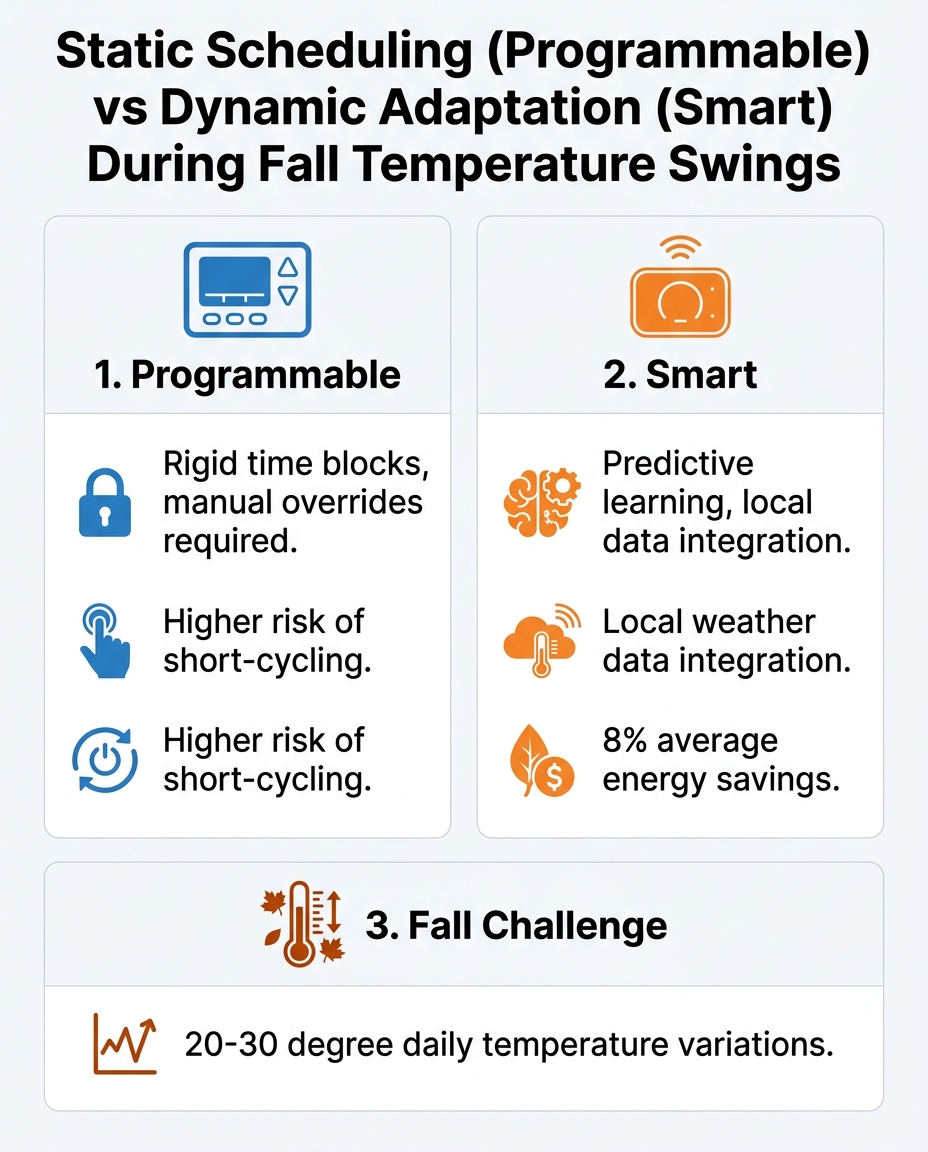
To truly understand the operational differences between these two technologies during the fall shoulder season, it is helpful to look at a direct, side-by-side comparison. The table below breaks down how each system handles the specific challenges of unpredictable autumn weather.
• Response to Sudden Weather — Static Scheduling (Programmable): Requires manual override; blind to outdoor conditions. — Dynamic Adaptation (Smart): Automatic algorithm adjustment using real-time local weather data.
• Energy Efficiency in Autumn — Static Scheduling (Programmable): Wastes energy heating during warm afternoons; rigid setpoints. — Dynamic Adaptation (Smart): Optimizes runtime; ENERGY STAR verified average 8% savings.
• HVAC Equipment Strain — Static Scheduling (Programmable): High risk of short-cycling and mechanical stress. — Dynamic Adaptation (Smart): Smoothed out operational cycles based on thermal profiling.
• Daily User Experience — Static Scheduling (Programmable): Constant manual tweaking required during variable weeks. — Dynamic Adaptation (Smart): True set-it-and-forget-it convenience with predictive learning.

While the convenience of controlling your home's climate from a smartphone is appealing, the most critical reason to evaluate your thermostat technology is pragmatic equipment longevity. The thermostat acts as the central brain of the entire HVAC system. When that brain is rigid and inflexible, it causes severe mechanical stress to the physical components of the heater and air conditioner. Preventing this strain aligns perfectly with our Always Affordable approach to home maintenance, focusing on long-term, budget-friendly efficiency rather than just flashy tech features.
In our extensive field experience, one of the most damaging phenomena an HVAC system can experience is short-cycling. This occurs when the system turns on and off rapidly without ever completing a full, efficient operational cycle. During the fall shoulder season, an inflexible programmable schedule exacerbates this issue. If the thermostat is rigidly demanding heat, but the afternoon sun is already warming the room, the furnace will fire up, immediately hit the target temperature, and shut down just minutes later. This rapid on-and-off sequence places extreme wear and tear on the system's contactors, capacitors, and blower motors.
Smart algorithms are specifically designed to prevent the system from short-cycling or overworking. By understanding the home's thermal drift and anticipating weather changes, predictive learning smart thermostats smooth out the operational cycles. They allow the equipment to run longer, more efficient cycles when necessary, and prevent it from turning on at all when passive environmental factors will achieve the desired temperature. Emphasizing this level of budget-friendly efficiency ensures that the mechanical components are protected. Preventing unnecessary mechanical strain translates directly to fewer emergency repairs, lower seasonal maintenance costs, and a significantly longer lifespan for the entire HVAC installation.
Yes, the fall season is arguably the most beneficial time to upgrade. Because autumn weather features drastic daily temperature swings, standard programmable units struggle to maintain efficiency. A smart upgrade allows the system to adapt dynamically to chilly mornings and warm afternoons without constant manual adjustments. This immediate improvement in efficiency helps protect your equipment right as the heavy heating season approaches.
Smart thermostats adjust to weather changes by continuously pulling local meteorological data via a Wi-Fi connection. If the forecast predicts a sudden spike in afternoon temperatures, the predictive algorithm will preemptively alter the morning heating cycle to prevent overheating. This environmental awareness ensures the system never wastes energy fighting against the natural weather patterns outside.
Programmable thermostats are inefficient in autumn because they rely entirely on static time blocks that assume the weather is exactly the same every day. When a fall day starts at 40 degrees and peaks at 75 degrees, a rigid schedule will often force the heat to run when it is no longer needed. This lack of adaptability leads to wasted energy and uncomfortable indoor temperature spikes.
If you have a manual or standard programmable unit, you will absolutely need to adjust your settings frequently during the fall to account for daily weather variations. You should aim for a lower heating setpoint during the day to allow for passive solar warming. However, if you utilize a predictive learning model, you generally do not need to change your settings, as the algorithm will automatically calculate the most efficient operational times.
Most modern smart thermostats do require a common wire, or C-wire, to ensure a continuous flow of 24-volt power to the unit's advanced logic board and Wi-Fi radio. Unlike older models that could run for months on simple AA batteries, the constant data processing of a smart unit requires dedicated power. If your current setup lacks a C-wire, an HVAC professional can usually install an adapter or run a new wire to accommodate the upgrade.
Absolutely. Smart thermostats are highly effective at preventing short-cycling by utilizing advanced thermal profiling and weather tracking. By calculating exactly how quickly your home gains and loses heat, the algorithm ensures the HVAC equipment only runs in optimal, sustained cycles. This prevents the rapid on-and-off stuttering that causes severe mechanical wear and tear on your system's components.
Ultimately, choosing the right technology provides a clear, objective path to better home management. When evaluating Smart Thermostats vs. Programmable Models for Managing Fluctuating Fall Temperatures, the ability to smoothly navigate unpredictable daily temperature fluctuations is what truly satisfies property owners, enabling an informed upgrade decision that protects both comfort and equipment longevity.
See what our satisfied customers have to say about their experience with Always Affordable
Plumbing & HVAC.

"Chappy was very skilled in his knowledge of my HVAC unit. I greatly appreciate the quick response and experienced tech. The whole endeavor was made less stressful by his humor and honest conversation. I find comfort in knowing I now have a shop i trust for the next time."
"Tony, James, Ronnie did an amazing job setting up our new AC! They were quick, efficient, considerate, and polite! We appreciate them scheduling us in on such short notice. Definitely recommend this company!"
"Prompt, professional service with kindness and care. They came out to address both plumbing and AC issues. I received a courtesy call before they arrived. All issues were resolved the same day with integrity and respect. Thankful for businesses like this. Absolutely recommend to those that I love."
"Excellent service! Jason came out promptly and in addition to doing my outside faucet he also put in new irrigation equipment! All done perfectly! Jason was lovely"
"Honest with the assessment; friendly and good manners. No high pressure sales. Just good to honest "tell it like you see it" Thought my kitchen disposer needed an overhaul. But Jason, there Plumber gave me an honest lesson on what was really happening. Saved me hundreds, if I went the route of replacing. Thank you!"
"Absolutely 5 stars. If you are looking for affordable ,professional and kind. Chappy was excellent and very knowledgeable . I called in the morning because my air conditioner stopped working he was here within hours and fixed my air with a smile. I highly recommend Chappy and Always Affordable plumbing and Hvac."
"Scott and James were great. They got there quickly and diagnosed the problem with my A/C.They did a very thorough job testing everything. Sent me pictures and called to keep me informed. Got it done the next day and everything is working fine. Be glad when I get home so I can enjoy my new system. Thanks guys for a great job."
"Chappy was very helpful. He knew our issue right away, cleaned our coils. He also came on the same day we called and got our AC blowing cold air again."
"After some timing ’curfuffles’ the Tech Jason arrived and not only completed a speedy install on my toilet, he was personable & professional. Because of the timing issues Jason was attentive and showed up with everything needed! No extra store runs 😊 I was very comfortable with having this Tech in my Daughter’s home. We will definitely use this Service again."