
Why Your AC Runs Constantly: Understanding Heat Transfer Degradation and Cooling Cycles
Why is your AC running constantly? We explain heat transfer degradation. Use our local service expertise and area tips to decide when to call a pro on this.




Finding the best smart thermostat schedule for hot dry valley weather is one of the most impactful things a Sacramento-area homeowner can do to control summer energy costs. When outdoor temperatures regularly push past 105°F and your AC runs for 10 to 14 hours a day, a poorly programmed thermostat doesn't just waste money — it shortens the life of your entire HVAC system.
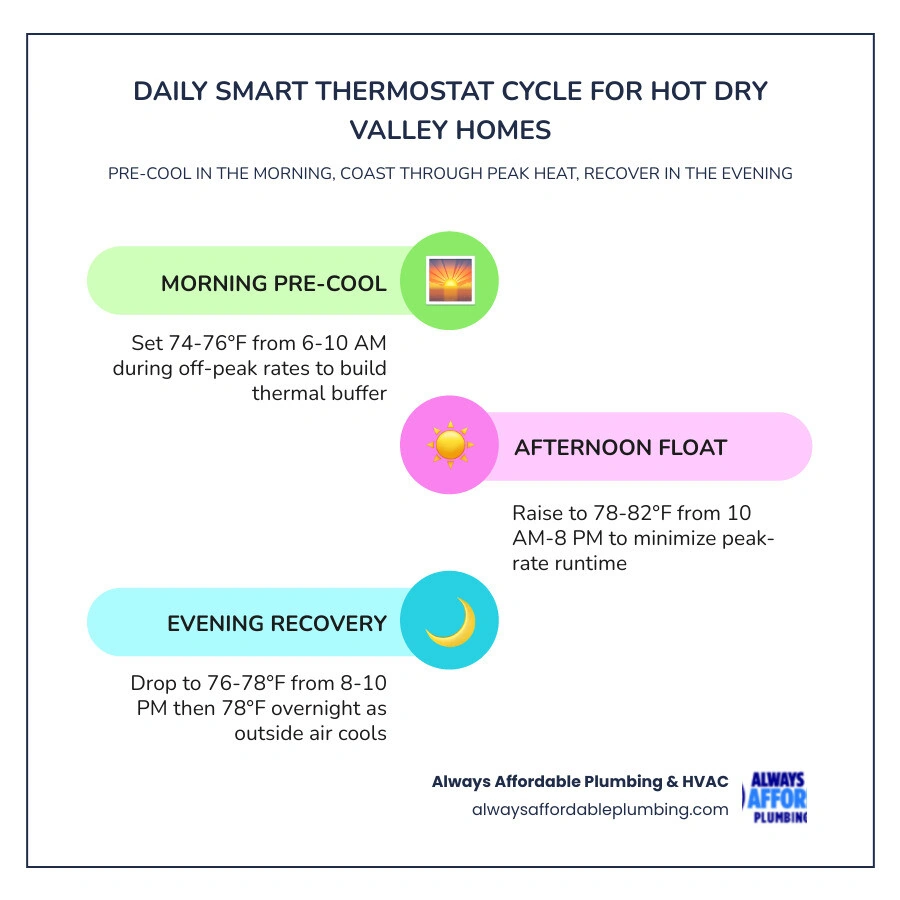
Here's a quick-reference schedule optimized for hot, dry valley conditions like Sacramento, Elk Grove, and Roseville:
• 6:00 AM - 10:00 AM — Recommended Setting: 74-76°F — Notes: Pre-cool during off-peak rates
• 10:00 AM - 3:00 PM — Recommended Setting: 78-80°F — Notes: Let temperature float during mid-heat
• 3:00 PM - 8:00 PM — Recommended Setting: 80-82°F — Notes: Minimize runtime during peak utility rates
• 8:00 PM - 10:00 PM — Recommended Setting: 76-78°F — Notes: Evening recovery as outdoor temps drop
• 10:00 PM - 6:00 AM — Recommended Setting: 78°F — Notes: Sleep setting; use ceiling fans
• Away from home — Recommended Setting: 82-84°F — Notes: Never turn system fully off
• Vacation (1+ week) — Recommended Setting: 85°F — Notes: Protects home without excessive runtime
Unlike milder climates, the Sacramento Valley runs a long cooling season — often six months or more — with daily temperature swings of 25 to 35 degrees between afternoon highs and overnight lows. That combination creates a unique opportunity: pre-cool in the morning when electricity is cheaper, let the home coast through the most expensive hours of the day, and recover in the evening when outside air begins to cool. A properly programmed smart thermostat does all of this automatically.
According to industry data, a well-optimized schedule can cut Las Vegas-comparable valley cooling bills by 23 to 30 percent, saving hundreds of dollars per year — without sacrificing comfort. The same principles apply across California's hot interior valleys.
The sections below walk through exactly how to build that schedule, season by season, and how smart features like geofencing, remote sensors, and vacation mode make it work even when life doesn't follow a perfect routine.
To understand why generic, national thermostat advice fails in our region, we have to look at the unique microclimates of the Sacramento Valley. In many parts of the country, summer humidity keeps temperatures relatively stable overnight. In places like Sacramento, Roseville, and Citrus Heights, we experience dramatic diurnal temperature swings. It is not uncommon for a blistering 103°F July afternoon to drop down to a comfortable 62°F night, thanks to the delta breeze.
This dramatic daily temperature swing changes how we must manage indoor heat. During the peak of the day, the intense sun beats down on our homes. Stucco, drywall, framing, and furniture act as a giant thermal battery, absorbing and storing this heat energy. This is known as thermal mass. Even after the sun goes down and the outdoor air cools, your home's structure continues to radiate that trapped heat inward.
If you rely on a basic, static thermostat setting, your air conditioner will work overtime late into the night just to fight the heat radiating from your own walls. By understanding How Sacramento Climate Affects Your HVAC and Plumbing, we can program our smart thermostats to work with nature rather than against it.
Furthermore, our local utility providers, such as SMUD and PG&E, utilize complex Time-of-Use (TOU) rate plans. On these plans, electricity can cost three to five times more during peak afternoon and evening hours. If your AC is cycling continuously during these peak windows, your monthly bill will skyrocket. This is why a customized, dynamic schedule is essential. It allows us to prepare our homes for How Seasonal Temperature Extremes Create Year-Round Demands while keeping our energy bills highly manageable.
Developing the best smart thermostat schedule for hot dry valley weather requires dividing your day into distinct phases that align with both the outdoor temperature cycle and your utility company's pricing structure. Instead of fighting the hottest parts of the day, we use our smart thermostats to strategically shift our cooling demands to the coolest, cheapest hours.
For a typical Monday-through-Friday routine, your schedule should be split into five distinct blocks to maximize efficiency and comfort:
• The Pre-Cooling Phase (6:00 AM – 10:00 AM): This is the most critical step. While the outdoor air is still cool and electricity rates are at their lowest off-peak pricing, program your thermostat to 74°F or 75°F. By bringing your home's indoor temperature down early, you cool not just the air, but the actual walls, floors, and furniture. This "charges" your home's thermal mass with cold energy.
• The Morning Drift Phase (10:00 AM – 3:00 PM): As the outdoor temperature begins to climb, let your thermostat float up to 78°F or 80°F. Because you pre-cooled the home, your air conditioner will barely need to run during this period. The thermal mass of your pre-cooled home will naturally resist warming up.
• The Peak Rate Float (3:00 PM – 8:00 PM): This is when outdoor temperatures peak and utility companies charge their highest rates. Set your thermostat to 80°F or 82°F. By keeping the setpoint high during these expensive hours, you minimize AC runtime when electricity is most costly.
• The Evening Recovery Phase (8:00 PM – 10:00 PM): As the sun sets and the delta breeze begins to cool the valley, lower your thermostat back to a comfortable 76°F or 78°F. Since the outdoor temperature is dropping, your AC won't have to work nearly as hard to achieve this comfortable temperature.
• The Sleep Phase (10:00 PM – 6:00 AM): Set your thermostat to 78°F and turn on your bedroom ceiling fans. Because our valley weather is dry, the moving air from a ceiling fan creates an evaporative wind-chill effect on your skin, making 78°F feel like a cool 74°F while saving you 6% to 10% on overnight cooling costs.
By structuring your weekdays around these thermal phases, you will see a massive drop in your power bills. For a deeper dive into the financial benefits of these automated adjustments, check out our guide on Can a Smart Thermostat Really Save Me Money.
On weekends, occupancy patterns change. Since families are more likely to be home during the day, we cannot let the indoor temperature float quite as high in the afternoon. However, you can still maintain excellent efficiency with a modified weekend schedule:
• Keep the Pre-Cooling Window: Even on weekends, off-peak electric rates usually apply in the morning. Continue to pre-cool your home to 75°F until 11:00 AM.
• Implement a Moderate Midday Setpoint: Instead of letting the house rise to 82°F, keep the thermostat at 78°F throughout the afternoon. This keeps the home comfortable for weekend activities without forcing the system to work in overdrive.
• Utilize Smart Zoning and Sensors: If you have a multi-story home in Roseville or Folsom, the upstairs will naturally run warmer than the downstairs. Use remote sensors to tell your smart thermostat to prioritize the living areas during the day and the bedrooms at night. To learn more about setting up these advanced zoning features locally, read about our services for a Smart Home Thermostat Roseville CA.
A smart thermostat is only as smart as the features you enable. In our hot, dry valley climate, several specific settings can protect your expensive HVAC equipment from premature failure while keeping your energy bills low:
• Geofencing: This feature uses your smartphone's GPS to detect when you leave the house. When the last family member crosses a set boundary, the thermostat automatically switches to an "Away" setback of 82°F to 84°F. When you head back home, the system detects your approach and begins pre-cooling so you walk into a comfortable home.
• Compressor Lockout and Delay: High summer temperatures put immense stress on electrical grids, occasionally causing brief power flickers or brownouts. If your AC compressor tries to restart immediately after a power interruption, it can experience severe mechanical damage. Ensure your smart thermostat has a five-minute compressor protection delay enabled.
• Managing Vacations: A common mistake is turning the AC completely off when going on a summer vacation. In the Sacramento Valley, indoor temperatures in an uncooled home can easily soar past 115°F, damaging drywall, warping wood cabinets, and putting extreme stress on your refrigerator. Instead, use your thermostat's "Vacation Mode" to maintain a safe, steady 85°F. This minimizes runtime while protecting your home's structural integrity.
• Shoulder Season Changeover: During spring and autumn, our valley experienced massive daily shifts—chilly 45°F mornings followed by 85°F afternoons. Use your smart thermostat's "Auto" mode with a 10-degree deadband range (for example, heat if it drops below 68°F, cool if it rises above 78°F). This prevents your system from constantly switching back and forth and wasting energy.
Operating your HVAC system in extreme conditions requires a reliable, finely tuned setup. To understand how to protect your home during these demanding periods, read about How Extreme Heat and Wildfire Smoke Stress Your Systems. If your thermostat's internal sensors are reading incorrectly, it can cause your system to run too long or short-cycle. Consider scheduling a professional Thermostat Calibration Folsom CA to ensure perfect accuracy. If you are ready to upgrade your old manual model to a modern system, check out our comprehensive Thermostat Installation Sacramento CA Guide.
No, you should never turn your air conditioner completely off during a hot valley summer day. When you turn the system off, your home's walls, furniture, and air will absorb heat all day, easily reaching 90°F to 95°F by the time you get home.
When you turn the AC back on, the system has to run at maximum capacity for four to six hours straight to remove that massive thermal load. This long recovery period puts incredible strain on your compressor and actually uses more energy than if you had maintained a moderate setback of 82°F to 84°F while you were away. A moderate setback keeps the thermal load manageable, allowing your system to cool the home down safely and efficiently in about 30 to 45 minutes.
Ceiling fans do not actually cool the air in a room; instead, they cool the people in it. Because our valley weather is dry, our bodies rely heavily on evaporative cooling (the evaporation of moisture from our skin) to stay cool. The moving air from a ceiling fan speeds up this process, creating a wind-chill effect that makes the room feel 3 to 4 degrees cooler than it actually is. This allows you to set your thermostat to 78°F or 80°F while sleeping or relaxing, saving significantly on your cooling costs. Just remember to turn the fan off when you leave the room, as fans cool people, not empty spaces!
While our summers are generally very dry, late-summer monsoonal moisture can occasionally drift into the valley, raising indoor humidity. If indoor humidity rises above 50%, your sweat won't evaporate as easily, and 78°F will start to feel sticky and hot. Many smart thermostats have built-in humidity sensors that can automatically run the AC for a few extra minutes to extract excess moisture from the air, maintaining comfort without needing to drop the temperature setpoint.
Homeowners in the Sacramento Valley can realistically save between 15% and 30% on their summer cooling costs by switching from a constant, single-temperature setting to an optimized, time-of-use smart thermostat schedule. For a typical single-family home during the peak heat of July and August, this translates to substantial savings on your monthly utility bill.
Beyond the direct monthly savings, an optimized schedule significantly reduces the wear and tear on your HVAC system. By preventing your system from running during the hottest, most stressful hours of the afternoon, you extend the lifespan of your compressor, fan motors, and electrical components, saving you from premature system replacements.
Mastering the best smart thermostat schedule for hot dry valley weather is the ultimate way to stay comfortable in our beautiful but blazing Sacramento summers without draining your bank account. By utilizing strategic pre-cooling, setting smart setbacks when away, and taking full advantage of your smart thermostat's advanced features, you can protect your equipment and keep your utility bills highly manageable.
If you want to ensure your heating and air conditioning system is fully optimized, calibrated, and ready to handle the valley's seasonal extremes, our team is here to help. Contact us today to learn more about our comprehensive Always Affordable Plumbing & HVAC cooling services and let us keep your home running efficiently all year long.
See what our satisfied customers have to say about their experience with Always Affordable
Plumbing & HVAC.

"Chappy was very skilled in his knowledge of my HVAC unit. I greatly appreciate the quick response and experienced tech. The whole endeavor was made less stressful by his humor and honest conversation. I find comfort in knowing I now have a shop i trust for the next time."
"Tony, James, Ronnie did an amazing job setting up our new AC! They were quick, efficient, considerate, and polite! We appreciate them scheduling us in on such short notice. Definitely recommend this company!"
"Prompt, professional service with kindness and care. They came out to address both plumbing and AC issues. I received a courtesy call before they arrived. All issues were resolved the same day with integrity and respect. Thankful for businesses like this. Absolutely recommend to those that I love."
"Excellent service! Jason came out promptly and in addition to doing my outside faucet he also put in new irrigation equipment! All done perfectly! Jason was lovely"
"Honest with the assessment; friendly and good manners. No high pressure sales. Just good to honest "tell it like you see it" Thought my kitchen disposer needed an overhaul. But Jason, there Plumber gave me an honest lesson on what was really happening. Saved me hundreds, if I went the route of replacing. Thank you!"
"Absolutely 5 stars. If you are looking for affordable ,professional and kind. Chappy was excellent and very knowledgeable . I called in the morning because my air conditioner stopped working he was here within hours and fixed my air with a smile. I highly recommend Chappy and Always Affordable plumbing and Hvac."
"Scott and James were great. They got there quickly and diagnosed the problem with my A/C.They did a very thorough job testing everything. Sent me pictures and called to keep me informed. Got it done the next day and everything is working fine. Be glad when I get home so I can enjoy my new system. Thanks guys for a great job."
"Chappy was very helpful. He knew our issue right away, cleaned our coils. He also came on the same day we called and got our AC blowing cold air again."
"After some timing ’curfuffles’ the Tech Jason arrived and not only completed a speedy install on my toilet, he was personable & professional. Because of the timing issues Jason was attentive and showed up with everything needed! No extra store runs 😊 I was very comfortable with having this Tech in my Daughter’s home. We will definitely use this Service again."


