Seasonal Home Maintenance Checklist: Preventing HVAC and Plumbing Emergencies
Prevent HVAC emergencies with a seasonal home maintenance checklist. Why proactive scheduling beats waiting for sudden failures. See what needs attention now.



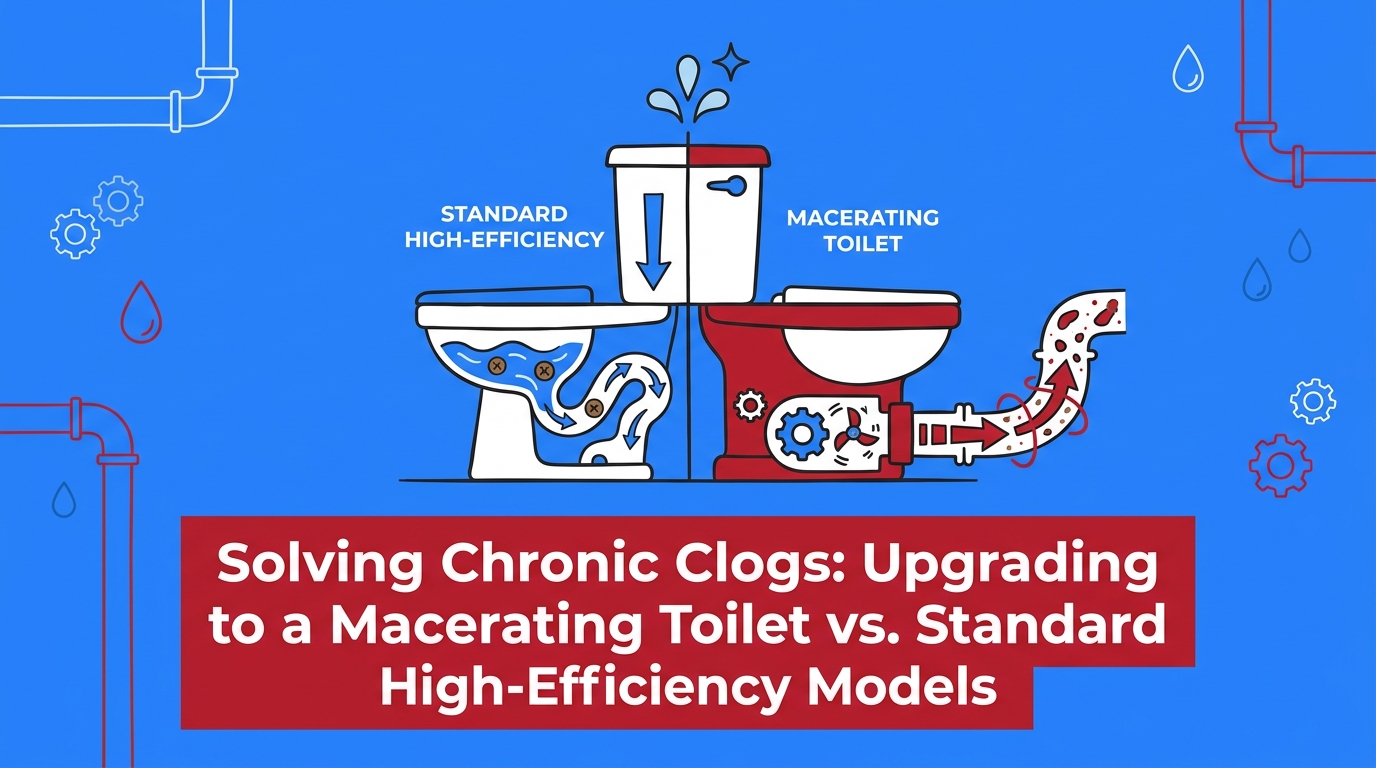
If your bathroom fixture is constantly backing up and leaving you dreading the next flush, researching the benefits of Upgrading to a Macerating Toilet vs. Standard High-Efficiency Models is a critical first step. For many homeowners, chronic toilet clogs are more than just an occasional nuisance—they are a daily disruption. When a household deals with specific medical conditions or dietary factors that produce heavy waste profiles, standard bathroom fixtures often fail to keep up. The frustration of constant plunging and overflowing bowls quickly forces a reevaluation of the home's plumbing capabilities.
The core conflict lies in modern plumbing design. In our years serving the local area, our team at Always Affordable Plumbing & HVAC has noticed that the widespread push for water conservation physically limits a standard toilet's ability to clear dense, heavy waste. Most modern fixtures are restricted by 1.28 to 1.6 Gallons Per Flush (GPF) flow limitations, which simply do not provide the kinetic energy required to move difficult solid material through the trapway. This leaves homeowners facing a critical decision point: evaluating premium standard high-efficiency upgrades versus investing in an active waste-breakdown mechanism.
If you are tired of battling constant blockages, exploring your options with professional plumbing and HVAC services is the first step toward a permanent solution. Upgrading your system through professional plumbing installation can restore reliability and eliminate the stress of recurring bathroom emergencies.
To understand why chronic clogs happen, you have to look at the mechanics of modern bathroom fixtures. Standard gravity models rely entirely on two passive forces: water volume and trapway design. When the flush lever is pressed, a specific amount of water drops from the tank into the bowl, creating a siphon effect that pulls waste down into the main sewer line. There is no active mechanical assistance; the system depends completely on the sheer weight and momentum of the water.
The problem arises when that water volume is drastically reduced. Due to strict water conservation efforts, modern fixtures operate under stringent 1.28 to 1.6 Gallons Per Flush (GPF) flow limitations. While these regulations are excellent for the environment, they severely restrict the kinetic energy available during a flush. In regions with strict environmental mandates, this issue is amplified. For instance, California's Title 20 appliance efficiency regulations mandate a maximum of 1.28 GPF for toilets sold in the state. This makes standard gravity toilets particularly susceptible to heavy waste clogs in this region, as there is simply not enough water mass to force dense material through the curved trapway.
Certain medical or dietary waste profiles easily overwhelm these passive, low-flow systems. Dense, heavy solids require a significant amount of force to navigate the internal bends of a toilet's plumbing. When the minimal 1.28 gallons of water rushes in, it often bypasses the heavier material, flowing right over it and down the drain while leaving the solid blockage behind. This lack of physical pushing power is exactly why your toilet leaves solid waste behind, leading to inevitable, stubborn blockages that a plunger struggles to clear.
When passive gravity systems fail to clear specific types of waste, a macerating unit offers an alternative mechanism. A macerating toilet—often referred to as an upflush toilet—differs fundamentally from traditional gravity-fed fixtures. Instead of relying on a dropping column of water to push waste through a trapway, these systems actively process and break down the material before it ever reaches the home's main drain lines.
The core of this technology is a powerful, motor-driven processing unit located either behind the bowl or hidden within the wall. Here is how the active mechanism operates during a standard cycle:
1. Initial Flush: The user flushes the toilet, sending waste and water into the macerating chamber rather than directly into the floor drain.
2. Active Liquefaction: A fast-rotating stainless steel blade engages automatically, rapidly grinding and liquefying the solid waste and toilet paper into a fine slurry.
3. Pressurized Pumping: Once the material is fully processed, an integrated pump forcefully ejects the slurry out of the chamber and into the main sanitary sewer line.
4. Chamber Reset: The chamber empties completely, and the system resets for the next use, leaving the bowl clean and clear.
Historically, macerating systems were primarily known as logistical workarounds for basement bathroom additions where plumbing lines sat below the main sewer grade. However, modern units have evolved significantly. Today, when comparing standard gravity-fed high-efficiency vs. macerating pump systems, the latter serves as a highly effective primary bathroom solution for households dealing with chronic cloggers. By actively destroying the solid mass before it enters the pipes, these units eliminate the reliance on gravity and high water volume, solving the physical blockage issue at the source.
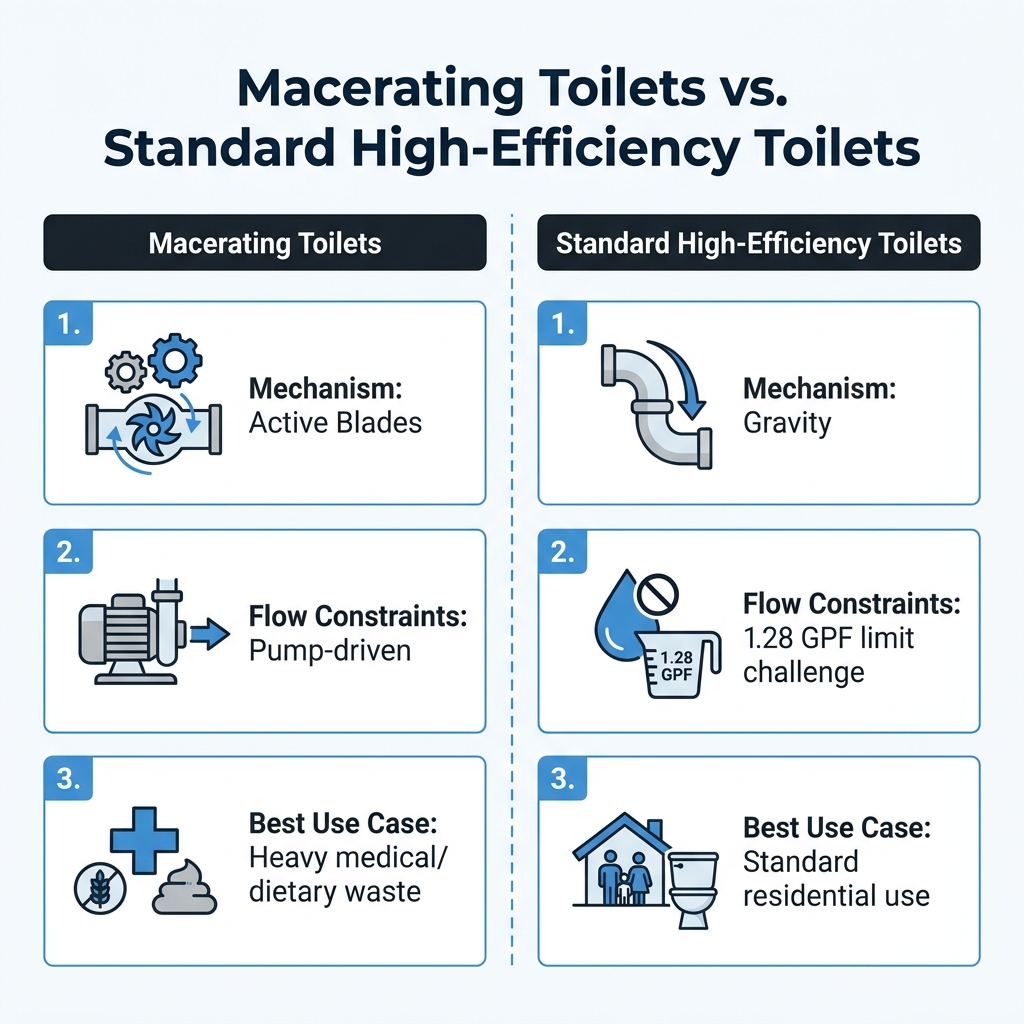
Choosing the right fixture requires a clear understanding of how these two distinct technologies operate under daily household stress. When evaluating standard gravity-fed high-efficiency vs. macerating pump systems, the mechanical differences dictate their performance with heavy waste profiles. The table below breaks down the functional contrasts to help guide your upgrade decision.
• Waste Processing Mechanism — Macerating (Upflush) Toilets: Active liquefaction via a motorized stainless steel blade. — Standard High-Efficiency Toilets: Passive water push relying entirely on gravity and siphon action.
• Susceptibility to Heavy Waste Clogs — Macerating (Upflush) Toilets: Virtually none; solid waste is ground into a fine slurry before draining. — Standard High-Efficiency Toilets: High risk for specific medical/dietary profiles due to limited pushing force.
• Water Usage Limitations — Macerating (Upflush) Toilets: Unaffected by low flow; the motorized pump handles the waste ejection. — Standard High-Efficiency Toilets: Severely impacted by 1.28 GPF limits, lacking kinetic energy for dense solids.
• Maintenance Profile — Macerating (Upflush) Toilets: Requires occasional pump maintenance and electrical component checks. — Standard High-Efficiency Toilets: Standard upkeep involving flappers, fill valves, and wax ring seals.

Upgrading a primary bathroom fixture is a significant decision, and the financial implications extend far beyond the initial purchase price. Macerating toilets do require a higher initial investment for both the specialized unit and the professional installation required to integrate the electrical and plumbing components. However, evaluating this cost requires looking at the long-term operational expenses of your home.
For households dealing with dense medical or dietary waste, a standard toilet often leads to a cycle of constant blockages. This means cumulative expenses from repeated emergency plumber visits to clear stubborn obstructions. Our team at Always Affordable Plumbing & HVAC frequently sees how these costs add up for local homeowners. Just this past spring, a resident reached out because their bathroom faucet stopped providing hot water. While our technician was there diagnosing and fixing the faucet, they also had to clear out a stubborn kitchen drain. Whether it is a kitchen sink or a primary bathroom toilet, recurring drain issues accumulate quickly. Paying for professional drain cleaning services every few months to resolve heavy waste blockages will rapidly surpass the cost of a permanent hardware upgrade.
True value in home maintenance comes from fixing the root cause, not just treating the symptoms. The Always Affordable approach means recognizing that the most affordable plumbing solution is the one that permanently solves the problem. By investing in a system that actively processes difficult waste, you eliminate the need for expensive, recurring emergency calls. When analyzing standard gravity-fed high-efficiency vs. macerating pump systems, the peace of mind that comes with a permanent, active hardware solution heavily outweighs the temporary, frustrating fixes of constant plunging and snaking.
While macerating technology offers a definitive cure for chronic, heavy-waste blockages, it is not universally necessary for every home. There are many scenarios where a standard gravity toilet remains the most appropriate and practical choice for a bathroom upgrade.
If your household waste profiles do not include heavy medical or dietary factors, a modern high-efficiency toilet is highly effective. For standard daily use, the 1.28 to 1.6 Gallons Per Flush (GPF) flow limitations are perfectly adequate to clear the bowl and maintain sanitary conditions. Manufacturers have spent decades optimizing bowl shapes and siphon jets to maximize the clearing power of low-volume flushes.
Homeowners looking to upgrade can also benefit from premium features within the high-efficiency category. High-end gravity models often feature specialized trapway glazing—an ultra-smooth ceramic coating applied to the internal plumbing bends. This reduces friction, allowing waste to glide through the trapway much easier, which helps mitigate the impact of lower water volumes. Additionally, gravity models offer the distinct advantage of simplicity. Because they lack motors, blades, and electrical connections, their maintenance profile is incredibly straightforward. When active maceration isn't strictly necessary, sticking with a premium gravity model provides reliable performance with minimal long-term upkeep.
If you determine that an active waste-breakdown mechanism is the right solution for your home, the next step is understanding the installation process. Transitioning from a passive fixture to a motorized appliance introduces new structural and logistical requirements to your bathroom space.
The most significant difference during installation is the need for electricity. Macerating systems require access to a standard electrical outlet to power the pump and the internal stainless steel blades. This often means coordinating with an electrician to safely route power to the area behind the toilet. On the plumbing side, while these units can tie into existing main lines, the specialized nature of the pressurized pump requires precise discharge routing. The system forcefully ejects the slurry, meaning the discharge pipe must be properly sized and securely fitted to handle the pressure without leaking.
Proper venting is another critical component. Macerating pumps must breathe to operate correctly, requiring connection to the home's main vent stack to prevent vacuum locks and sewer gas buildup. Because of these electrical, venting, and pressurized plumbing requirements, professional installation is absolutely essential. Licensed professionals ensure that the unit is integrated safely, complies with local building codes, and maintains the manufacturer's warranty. When comparing standard gravity-fed high-efficiency vs. macerating pump systems, remember that adding a macerator is a permanent structural upgrade to the home's plumbing capabilities, requiring exact technical execution.
Yes, they are specifically designed with stainless steel blades to actively liquefy heavy solid waste and toilet paper before it enters the drain. This active grinding mechanism destroys the solid mass, making it incredibly effective for households dealing with dense medical or dietary waste profiles. By turning solids into a fine slurry, the system easily pumps the material away without relying on gravity.
High-efficiency models are limited to 1.28 - 1.6 GPF, meaning they lack the water volume and kinetic energy to push heavy medical or dietary waste through the trapway. When dense solids enter the bowl, the minimal water flow often bypasses the waste, failing to create a strong enough siphon to pull it down. This physical limitation is the primary reason for chronic blockages in modern gravity fixtures.
No, because they actively process waste into a slurry before it ever reaches the pipes, virtually eliminating standard waste clogs. However, the internal blades can jam if non-flushable items are introduced into the bowl. Items like sanitary products, paper towels, or flushable wipes must be kept out of the system to ensure the motorized pump operates smoothly.
They require electrical power to operate, produce some noise during the pumping cycle, and have a higher initial installation cost than gravity models. Because they utilize a motorized blade and pump, they also introduce mechanical components that may eventually require servicing. Additionally, if the home loses power, the toilet's active flushing mechanism will not function.
Yes, by changing the mechanism from passive gravity to active grinding, it permanently addresses the physical cause of the blockage. Instead of repeatedly plunging or calling for emergency drain clearing, the macerator destroys the dense waste at the source. It transforms a recurring plumbing headache into a permanently managed, reliable bathroom experience.
Dealing with a bathroom fixture that cannot handle your household's needs is a frustrating, unsanitary, and expensive cycle. Upgrading your fixture to a system capable of actively processing heavy waste is the key to stopping constant plumbing headaches. Whether you need the motorized power of a macerating unit or a premium glazed gravity model, consulting with an expert ensures you get the exact performance your home requires. If you are ready to permanently solve your chronic drainage issues, schedule your professional plumbing installation today and restore peace of mind to your daily routine.
See what our satisfied customers have to say about their experience with Always Affordable
Plumbing & HVAC.

"Chappy was very skilled in his knowledge of my HVAC unit. I greatly appreciate the quick response and experienced tech. The whole endeavor was made less stressful by his humor and honest conversation. I find comfort in knowing I now have a shop i trust for the next time."
"Tony, James, Ronnie did an amazing job setting up our new AC! They were quick, efficient, considerate, and polite! We appreciate them scheduling us in on such short notice. Definitely recommend this company!"
"Prompt, professional service with kindness and care. They came out to address both plumbing and AC issues. I received a courtesy call before they arrived. All issues were resolved the same day with integrity and respect. Thankful for businesses like this. Absolutely recommend to those that I love."
"Excellent service! Jason came out promptly and in addition to doing my outside faucet he also put in new irrigation equipment! All done perfectly! Jason was lovely"
"Honest with the assessment; friendly and good manners. No high pressure sales. Just good to honest "tell it like you see it" Thought my kitchen disposer needed an overhaul. But Jason, there Plumber gave me an honest lesson on what was really happening. Saved me hundreds, if I went the route of replacing. Thank you!"
"Absolutely 5 stars. If you are looking for affordable ,professional and kind. Chappy was excellent and very knowledgeable . I called in the morning because my air conditioner stopped working he was here within hours and fixed my air with a smile. I highly recommend Chappy and Always Affordable plumbing and Hvac."
"Scott and James were great. They got there quickly and diagnosed the problem with my A/C.They did a very thorough job testing everything. Sent me pictures and called to keep me informed. Got it done the next day and everything is working fine. Be glad when I get home so I can enjoy my new system. Thanks guys for a great job."
"Chappy was very helpful. He knew our issue right away, cleaned our coils. He also came on the same day we called and got our AC blowing cold air again."
"After some timing ’curfuffles’ the Tech Jason arrived and not only completed a speedy install on my toilet, he was personable & professional. Because of the timing issues Jason was attentive and showed up with everything needed! No extra store runs 😊 I was very comfortable with having this Tech in my Daughter’s home. We will definitely use this Service again."