Home Maintenance Tips and Troubleshooting: What to Do When Your AC Freezes Up
Ice on your AC coil? Why we recommend turning it off immediately. Apply these home maintenance tips and troubleshooting steps to safely thaw it and avoid



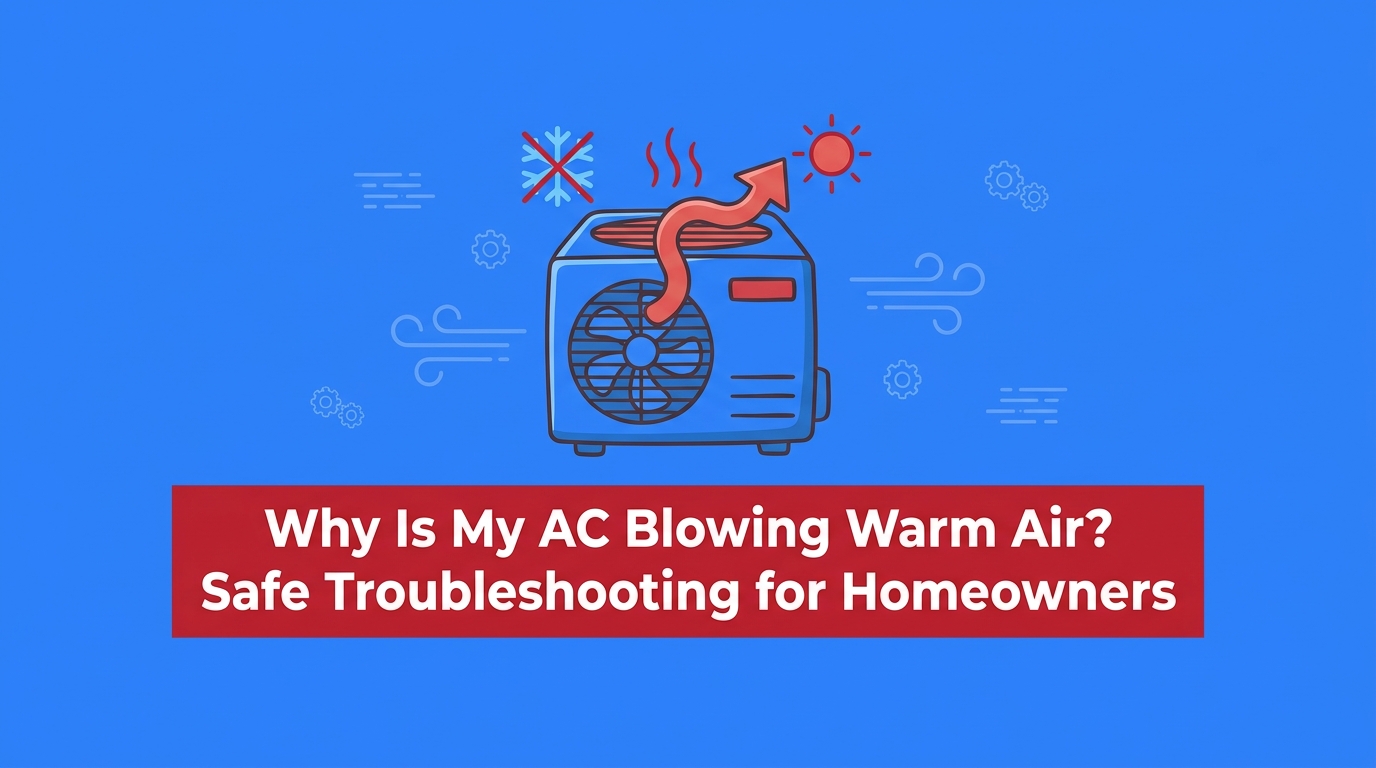
Your thermostat says the system is running, you can hear the blower motor working, but the house still feels uncomfortably warm. When your cooling system breaks down in the middle of a mid-August heat wave, you need reliable answers fast. In fact, in our years of serving the local area, one of the most common homeowner questions answered by our HVAC technicians at Always Affordable Plumbing & HVAC is simply: why is my system circulating warm air instead of cooling the house?
Feeling room-temperature air from registers when you expect cold relief is incredibly frustrating. It immediately forces a critical decision: should you try to fix it yourself, or is it time to call for emergency repairs? Knowing which quick diagnostic checks are safe for a homeowner to perform—and when emergency professional intervention is absolutely required—can save you time, stress, and severe equipment damage.
Just as homeowners rely on our experts for professional plumbing services and severe underground issues like sewer line clearing and repair, HVAC emergencies require a balanced approach. You need to know the safe DIY checks you can handle right now, and recognize the mechanical failures that demand a licensed expert's touch.
To understand why your vents are blowing warm air, it helps to understand how your system operates. When our team at Always Affordable Plumbing & HVAC dispatches to a no-cool call, we often have to explain that an air conditioner does not actually "create" cold air. Instead, it acts like a sponge, absorbing heat from inside your home and pumping it outside. This process relies entirely on unrestricted airflow and a properly functioning refrigerant cycle. When either of these fails during the peak summer cooling season—especially in older 10 to 12 SEER units installed before 2015—the system stops absorbing heat, and the indoor fan simply pushes uncooled air back into your rooms.
• Weak airflow and warm air — Likely Mechanical Cause: Clogged filter or frozen coil — Immediate Action Required: Turn off system, check filter
• Indoor fan runs, outdoor unit is silent — Likely Mechanical Cause: Failed capacitor or tripped breaker — Immediate Action Required: Check electrical panel, call pro
• Hissing sound near indoor unit — Likely Mechanical Cause: Refrigerant leak — Immediate Action Required: Turn off system, call pro
The role of the evaporator coil: Inside your home sits the evaporator coil, a series of copper tubes filled with cold refrigerant. Warm indoor air blows over this coil, transferring its heat to the refrigerant.
How freezing happens: If there is a lack of warm air moving over that coil—usually due to a blockage—the temperature of the coil drops rapidly. Our technicians frequently discover that once the temperature drops below the 32-degree Fahrenheit freezing mark, the natural condensation that forms on the coil during operation quickly turns to ice.
The snowball effect: Once a thin layer of ice forms, it acts as an insulating barrier, preventing any further heat transfer. The ice then builds up thicker and thicker, eventually blocking airflow entirely. The result is a system that runs constantly but only circulates warm, room-temperature air.
Indoor vs. outdoor operation: Your HVAC system has two main halves. The indoor blower pushes air through your ducts, while the outdoor compressor pumps the refrigerant. It is entirely possible for the indoor blower to run perfectly fine while the outdoor compressor sits idle.
Electrical stress: During intense late-July heat waves, the electrical components face massive load stress. The capacitor, which acts like a powerful battery to jump-start the compressor, is highly susceptible to heat damage. If the capacitor fails, the outdoor compressor cannot start. Your indoor fan will continue to run, but without the compressor pumping refrigerant, the air will never get cold.
Before assuming the worst, you should always start with the easiest, safest troubleshooting steps. A surprising number of service calls we receive are resolved by simply adjusting a setting or flipping a switch. Follow these safe homeowner checks to rule out basic user errors or minor electrical trips.
1. Check the thermostat mode: Ensure the thermostat is explicitly set to "Cool." Sometimes, a brief power surge or an accidental bump can switch the system to "Heat" or "Off." Lower the target temperature three degrees below the current room temperature (for example, to 72°F if the room is 75°F) to force the system to call for cooling.
2. Verify the fan setting: Look at the fan setting on your thermostat. It should be set to "Auto" rather than "On." If the fan is set to "On," the indoor blower will blow air constantly, 24 hours a day. When the outdoor compressor naturally cycles off between cooling rounds, the indoor fan will continue blowing uncooled air, making it feel like the system is broken.
3. Inspect the electrical panel: Locate your home's main electrical panel and look for the circuit breaker dedicated to the AC condenser (the outdoor unit). If the breaker is tripped, it will sit halfway between the "On" and "Off" positions.
4. Reset with caution: If the breaker is tripped, push it firmly to the "Off" position, then snap it back to "On." Listen to the outdoor unit. If the breaker immediately trips again, stop. Do not reset it a second time. A breaker that refuses to stay on indicates a serious electrical short or a grounded compressor, which requires immediate professional diagnosis from our team.
If your thermostat and power settings are correct, the very next step is checking your air filter. A severely clogged air filter is the single most common preventable cause of frozen coils and warm air. When the filter is choked with debris, it starves the HVAC system of the return air it desperately needs to function properly.
This is especially true in regions dealing with intense weather. Our team consistently notices that Sacramento's prolonged dry summer heat forces HVAC systems to run continuous, heavy cycles, which drastically accelerates how quickly filters become clogged with dust, pollen, and particulates. What normally takes three months to clog might happen in just four weeks during a peak heat wave, particularly for homes using dense MERV 11 or 13 filters.
How to safely check your filter:
• Locate the housing: Find the filter compartment. This is usually located at the return air grille in a hallway, ceiling, or directly on the side of the indoor air handler unit.
• Remove and inspect: Pull the filter out and hold it up to a light source. If you cannot see light shining through the material, the filter is completely blocked.
• Replace immediately: If the filter is heavily coated in a thick blanket of dust, pet hair, or debris, throw it away. Slide a brand-new, clean filter into the slot, making sure the airflow arrows point toward the equipment.
• Monitor the system: Once the new filter is in place, monitor the air coming from your vents. If the airflow restriction was the only issue, the system should begin cooling normally within thirty minutes.
If you checked your filter and found it completely blocked, there is a very high chance your evaporator coil has frozen over. You might even see physical ice on the copper refrigerant lines running outside, or frost building up on the indoor unit. If you see ice, our technicians highly recommend taking immediate action to protect the equipment.
1. Turn the system off immediately: Go to your thermostat and switch the cooling mode to "Off." Continuing to run a frozen system places immense strain on the outdoor compressor. The compressor is designed to pump refrigerant gas, but a frozen coil can cause liquid refrigerant to flow backward into the compressor, causing catastrophic mechanical failure.
2. Leave the fan running: While the cooling mode must be off, you can switch the thermostat fan setting from "Auto" to "On." This forces warm indoor air to circulate over the block of ice, speeding up the melting process safely.
3. Wait for a complete thaw: Be patient. A severely frozen coil on a standard 3-ton to 5-ton residential system can take up to 24 hours to completely thaw naturally. Never use a hair dryer, heat gun, or sharp tools to chip the ice away, as this can easily puncture the delicate copper coils and cause a massive refrigerant leak.
4. Watch for water damage: As the ice melts, it will drain into the condensate pan. If the ice buildup was severe, the pan might overflow. Keep some towels handy near the indoor unit to wipe up any excess water.
5. Call for professional diagnostics: As we often remind our customers, a licensed technician cannot perform accurate diagnostic tests on refrigerant pressures or airflow until the ice is completely melted. Once the system is fully thawed, we can determine exactly why it froze in the first place.
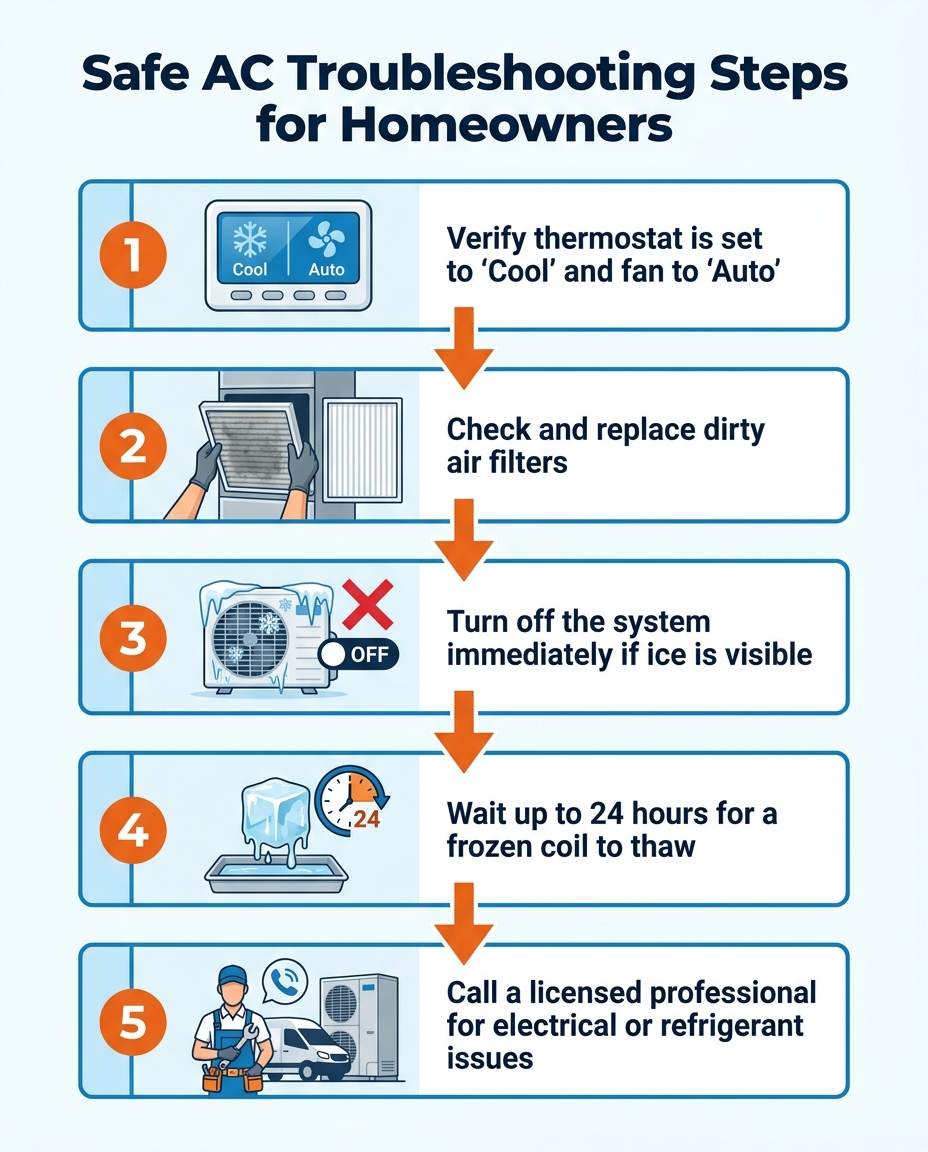

There is a strict limit to safe homeowner troubleshooting. Once you have checked the thermostat, verified the breaker panel, replaced the air filter, and turned the system off to thaw any ice, DIY efforts must stop. The mechanical components inside your air conditioner are highly complex and carry significant safety risks, a reality our crews see daily in the field.
High-voltage electrical hazards: Testing or replacing a dual run capacitor involves high-voltage electricity that is extremely dangerous for untrained individuals. Even when the main power is turned off at the breaker, a capacitor stores a massive, potentially lethal electrical charge. Only a trained professional with specialized discharge tools and multimeters should ever open the electrical access panel.
Refrigerant regulations: Air conditioners do not "consume" refrigerant like a car consumes gas. If your system is low on R-410A or older R-22 refrigerant, it means there is a physical leak in the copper lines. Handling, recovering, and charging refrigerant requires federal EPA certification, highly specialized gauges, and strict environmental compliance.
"A proper repair doesn't just treat the symptom—it diagnoses the root cause. Adding refrigerant without finding the leak guarantees the system will fail again."
Reassure yourself that calling a professional from Always Affordable Plumbing & HVAC for these issues ensures a safe, long-term fix rather than a dangerous temporary patch. A trustworthy technician will provide transparent, budget-conscious solutions and a 100% satisfaction guarantee, ensuring you aren't overcharged when complex electrical or refrigerant repairs are necessary.
Emergency failures almost always stem from small, overlooked maintenance issues that compound over time. A slightly dirty filter forces the blower motor to work harder. The overworked motor draws more electricity, which overheats the capacitor. The weakened capacitor eventually fails, leaving you with a warm house on the hottest day of the year.
The greatest benefit of regular professional tune-ups is catching these degrading parts before they cause a total breakdown. During a routine visit, our maintenance team tests the microfarad readings on a capacitor, clears out the condensate drain line, and measures the precise refrigerant subcooling levels (often aiming for a specific 10 to 12-degree window depending on the model) long before you ever notice a drop in performance.
This proactive approach applies to everything in your house. Comprehensive home care programs often cover multiple systems, ensuring everything runs efficiently year-round. Looking into structured maintenance plans, like a comprehensive plumbing maintenance membership alongside your HVAC care, helps you stay ahead of seasonal demands and prevents surprise utility emergencies entirely.
Our technicians find the short answer is that the system has lost its ability to absorb heat, usually due to restricted airflow or a failed outdoor component. When a dirty filter blocks air, or a bad capacitor prevents the outdoor compressor from turning on, the indoor fan will simply circulate room-temperature air. Check your air filter first, ensure your thermostat fan is set to "Auto," and if the problem persists, call a licensed technician.
Yes, you should turn the system off immediately at the thermostat. Continuing to run an air conditioner that is blowing warm air puts tremendous mechanical strain on the compressor and can pull liquid refrigerant into places it shouldn't go. Turning it off prevents catastrophic equipment damage and allows any hidden ice on the evaporator coil to begin thawing.
When an AC capacitor goes bad, it loses the ability to deliver the massive jolt of electricity required to start the outdoor compressor or fan motor. You will typically hear a clicking or humming sound from the outdoor unit, but the fan blades will not spin, and the compressor will not pump refrigerant. Because capacitors store high voltage, they must be tested and replaced by a trained professional from our team.
A severely frozen evaporator coil on a standard residential unit can take anywhere from 12 to 24 hours to completely thaw naturally. You can speed up the process slightly by turning the cooling mode off and switching the thermostat fan setting to "On," which blows warm indoor air over the ice. Never use sharp tools or heated tools to chip away the ice, as this will puncture the delicate coil.
Yes, a severely clogged air filter is the most common cause of a frozen AC system. When the filter blocks warm indoor air from passing over the cold evaporator coil, the condensation on the coil drops below freezing and turns to ice. This ice builds up rapidly until it forms a solid block, completely starving the system of airflow and causing it to blow warm air.
Dealing with a warm house during peak cooling demand is stressful, but a methodical approach keeps you safe and protects your equipment. While checking a filter or adjusting a thermostat setting is easy, resolving persistent warm air issues often requires expert intervention. Remember that turning off a frozen or struggling system is the best immediate action you can take to prevent further damage.
If you have verified your settings, replaced your filter, and the air is still warm, do not attempt to open electrical panels or handle refrigerant. Reach out to our team for professional diagnostics to get your system cooling efficiently again, ensuring your home remains a comfortable refuge from the heat.
See what our satisfied customers have to say about their experience with Always Affordable
Plumbing & HVAC.

"Chappy was very skilled in his knowledge of my HVAC unit. I greatly appreciate the quick response and experienced tech. The whole endeavor was made less stressful by his humor and honest conversation. I find comfort in knowing I now have a shop i trust for the next time."
"Tony, James, Ronnie did an amazing job setting up our new AC! They were quick, efficient, considerate, and polite! We appreciate them scheduling us in on such short notice. Definitely recommend this company!"
"Prompt, professional service with kindness and care. They came out to address both plumbing and AC issues. I received a courtesy call before they arrived. All issues were resolved the same day with integrity and respect. Thankful for businesses like this. Absolutely recommend to those that I love."
"Excellent service! Jason came out promptly and in addition to doing my outside faucet he also put in new irrigation equipment! All done perfectly! Jason was lovely"
"Honest with the assessment; friendly and good manners. No high pressure sales. Just good to honest "tell it like you see it" Thought my kitchen disposer needed an overhaul. But Jason, there Plumber gave me an honest lesson on what was really happening. Saved me hundreds, if I went the route of replacing. Thank you!"
"Absolutely 5 stars. If you are looking for affordable ,professional and kind. Chappy was excellent and very knowledgeable . I called in the morning because my air conditioner stopped working he was here within hours and fixed my air with a smile. I highly recommend Chappy and Always Affordable plumbing and Hvac."
"Scott and James were great. They got there quickly and diagnosed the problem with my A/C.They did a very thorough job testing everything. Sent me pictures and called to keep me informed. Got it done the next day and everything is working fine. Be glad when I get home so I can enjoy my new system. Thanks guys for a great job."
"Chappy was very helpful. He knew our issue right away, cleaned our coils. He also came on the same day we called and got our AC blowing cold air again."
"After some timing ’curfuffles’ the Tech Jason arrived and not only completed a speedy install on my toilet, he was personable & professional. Because of the timing issues Jason was attentive and showed up with everything needed! No extra store runs 😊 I was very comfortable with having this Tech in my Daughter’s home. We will definitely use this Service again."