Seasonal Home Maintenance Checklist: Preventing HVAC and Plumbing Emergencies
Prevent HVAC emergencies with a seasonal home maintenance checklist. Why proactive scheduling beats waiting for sudden failures. See what needs attention now.



Nearly 85% of premature plumbing breakdowns in heavy groundwater regions trace back to untreated mineral buildup, which perfectly illustrates how Davis's hard water impacts the lifespan of tankless water heaters. Our team at Always Affordable Plumbing & HVAC sees this firsthand in local neighborhoods, especially in homes retrofitted with high-efficiency units between 2015 and 2022. If you live in the Davis municipal water service area, this statistic is a daily reality rather than a distant possibility. While high-efficiency tankless systems provide endless hot water and lower energy bills, their narrow internal components are uniquely vulnerable to untreated water.
The core issue lies in the high mineral content scale accumulation that naturally occurs in our local supply. When these minerals enter your plumbing, they do not just pass through harmlessly. Ignoring this local water quality reality leads directly to premature heat exchanger failure, turning a highly efficient appliance into a major liability. For homeowners in this region, annual maintenance is a strict requirement, not an optional upgrade. To protect your home and your high-efficiency appliances, you need professional plumbing services from a team that understands exactly what local water does to modern plumbing.
To understand why your plumbing appliances are at risk, you have to look at where your water comes from. The Davis municipal water service area is known for exceptionally hard municipal water derived from specific local deep groundwater aquifers. This environment is particularly hostile to high-efficiency plumbing appliances. Unlike surface water from rivers or lakes, which is relatively soft, groundwater spends decades filtering through layers of subterranean rock, absorbing heavy concentrations of dissolved minerals along the way.
In a municipal context, "hard water" refers specifically to the concentration of dissolved calcium carbonate and magnesium in the supply. When you look at national averages, many regions consider water to be "hard" at around 120 milligrams per liter (mg/L). However, our technicians routinely test local Davis water and find concentrations well above 300 mg/L in certain neighborhoods. This stark contrast highlights a localized risk that generic plumbing advice simply does not cover.
The hidden danger: These dissolved minerals travel seamlessly through standard cold water pipes. You cannot see them, and they do not immediately block flow. However, they react violently to sudden temperature changes, which is exactly what happens inside a water heater.
The geological factors beneath the valley play a massive role in our local water quality. As rain and winter snowmelt percolate down into the deep aquifers, the water acts as a natural solvent. It picks up calcium and magnesium from the surrounding limestone and bedrock.
While municipal treatment plants do an excellent job of making the water safe to drink and removing harmful contaminants, their primary goal is public health, not appliance protection. The treatment processes leave these dissolved hard minerals entirely intact. By the time the water reaches your home, it carries a heavy load of calcium that is ready to precipitate out of the liquid the moment it is heated.
To see why hard water is so destructive, you have to understand the mechanics of a tankless heat exchanger. Unlike a traditional tank that heats a large volume of water slowly, a tankless unit features narrow, winding metal channels. These channels are engineered for rapid thermal transfer. When you open a hot water tap, the unit fires up and flash-heats the water to your set temperature—typically around 120°F—as it speeds through these tight pathways.
This rapid heating triggers a chemical reaction. As the water temperature spikes, the calcium and magnesium can no longer stay dissolved. They precipitate out of the liquid and instantly bond to the hot metal walls of the heat exchanger. This creates high mineral content scale accumulation, a chalky, rock-like substance that coats the inside of the unit.
Scale buildup acts as a powerful insulator. As the layer of scale grows thicker, the heat from the burner struggles to reach the water. The system is then forced to burn more fuel and run hotter just to achieve your desired water temperature. This progression from minor scaling to severe blockage introduces extreme thermal stress to the metal.
• Clean / New — Impact on Heat Exchanger: Water flows freely; rapid heat transfer. — System Efficiency: Operating at peak efficiency.
• Early Scaling — Impact on Heat Exchanger: Thin mineral film forms on metal walls. — System Efficiency: Unit burns slightly more fuel to heat water.
• Moderate Blockage — Impact on Heat Exchanger: Thick chalky layers restrict water flow. — System Efficiency: Noticeable efficiency drop; longer heating times.
• Severe Accumulation — Impact on Heat Exchanger: Channels are choked; extreme thermal stress. — System Efficiency: High risk of overheating and structural metal fractures.
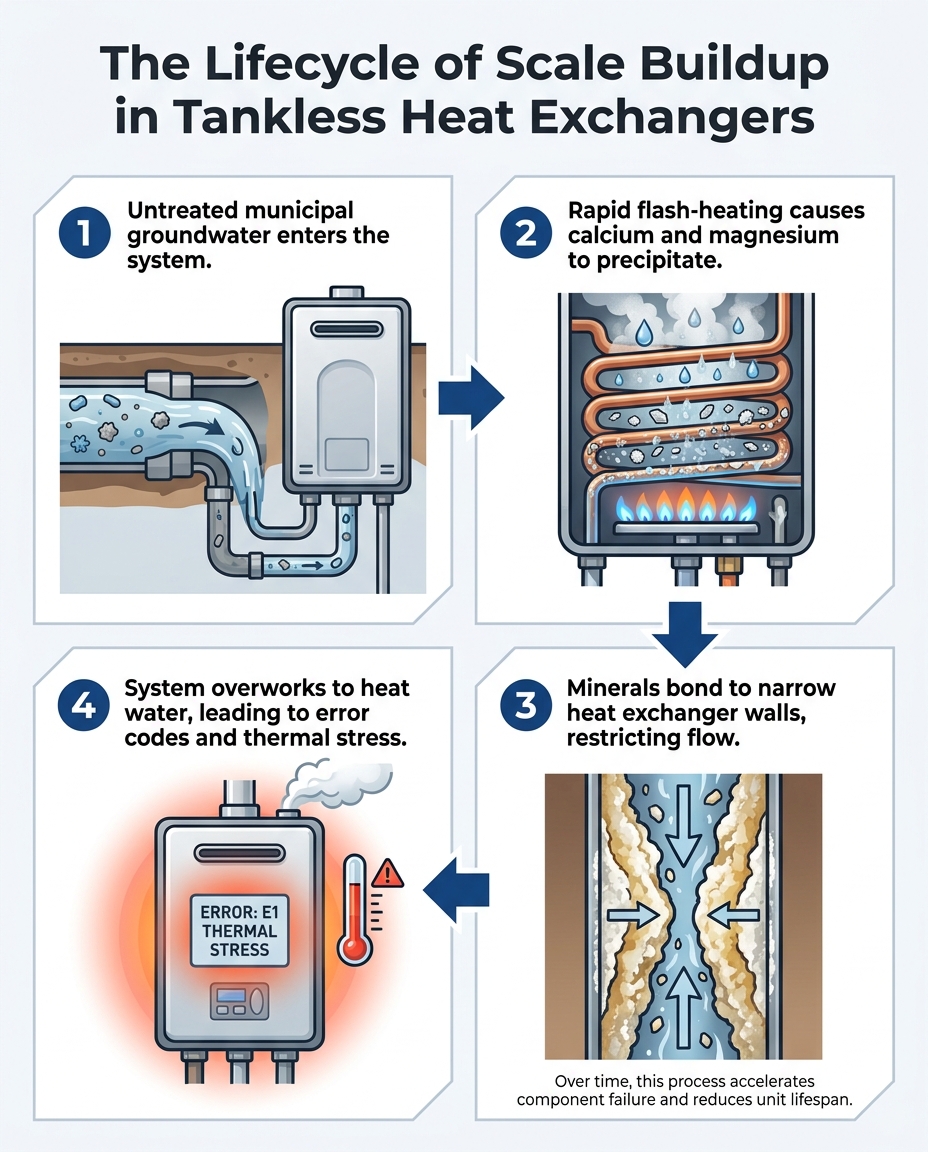

Catching hard water damage early can mean the difference between a routine service call and a complete system replacement. Because you cannot see inside the heat exchanger, you have to rely on the symptoms your plumbing displays. One of the primary indicators of restricted flow is reduced water pressure specifically on the hot side. If your cold water flows strong but your hot water trickles, high mineral content scale accumulation has likely choked the internal channels.
Another major warning sign is inconsistent hot water delivery. If your shower randomly goes cold and then hot again, the unit is struggling to transfer heat through the mineral barrier. Eventually, this overworking triggers the system's internal safety sensors. You will start seeing common system lockouts and error codes flashing on the digital display, which are designed to shut the unit down before it melts its own components.
One local homeowner reached out last January during a severe winter cold snap when they suddenly had no hot water at all. Their three-year-old system had completely locked out overnight. While an Always Affordable technician was able to provide a fast repair, clear the immediate issue, and restore their hot water, the root cause was severe scale buildup. Catching the subtle signs early changes how long a tankless water heater lasts.
• Unusual noises: A popping, rumbling, or "kettling" sound means water is boiling and trapped behind scale deposits.
• Longer ignition times: The unit takes noticeably longer to fire up and deliver hot water to the tap.
• Frequent error codes: The digital panel repeatedly flashes warnings related to exhaust blockage or ignition failure.
Our team emphasizes this rule of thumb: waiting for a complete lack of hot water often means the thermal stress has already caused irreversible damage to the heat exchanger.
When you read the generic manufacturer guidelines that come with a new tankless unit, they often assume your home has average water hardness. They might suggest maintenance every few years. However, the realities of the Davis municipal water service area demand strict, at least annual, intervention. Local conditions make routine maintenance the primary defense mechanism for preserving the unit's lifespan.
A professional descaling service is a specialized process that goes far beyond a simple flush. Our licensed technicians isolate the water heater from your home's plumbing. We then connect a specialized circulation pump and run a heavily diluted, non-toxic descaling solution through the heat exchanger for exactly 45 minutes. This continuous circulation safely dissolves the hardened mineral bonds without damaging the copper or stainless steel walls inside.
The dangers of ignoring this service are severe. Compromised efficiency means you pay more on your utility bills every single month, but the structural failure of the heat exchanger is the real threat. When a heat exchanger cracks from thermal stress, it cannot be patched or repaired; the entire component must be replaced.
Through the Always Affordable lens, scheduling this annual descaling is a highly budget-friendly, preventative measure. It actively protects homeowners from the massive, unexpected expense of a premature, out-of-warranty system replacement down the road.
While annual descaling is vital, it is ultimately a reactive measure. It removes the existing buildup, but it does not stop new minerals from entering the system the very next day. If you want to permanently address the root cause of the scaling issue, the logical upgrade path is whole-home water softening.
A water softener acts as a proactive barrier for your entire house. Installed at the main water line, it uses an ion-exchange process to trap and remove calcium and magnesium before the water ever reaches your tankless heater. By the time the water hits the heat exchanger, the minerals responsible for high mineral content scale accumulation are already gone, often dropping the hardness level down to less than 1 grain per gallon (GPG). The water can be flash-heated without leaving a chalky residue behind.
The benefits of softened water extend far beyond the utility closet. This upgrade protects the tankless unit, but it also extends the life of other expensive plumbing fixtures. Your dishwasher, washing machine, showerheads, and faucets all benefit from water that does not leave hard scale behind.
Our experts agree that positioning a water softener alongside your tankless system is the ultimate longevity strategy. If you are tired of battling hard water damage, investing in professional water softener installation completely changes the environment your plumbing operates in, making your annual maintenance faster, easier, and far more effective.
Many homeowners assume that if their tankless water heater breaks within the first ten years, the manufacturer will automatically cover the replacement. In areas with heavy groundwater reliance, this is a dangerous assumption. Major tankless water heater manufacturers explicitly exclude damage caused by scale buildup and poor water quality from their warranties.
If a heat exchanger fractures because of thermal stress caused by calcium insulation, the manufacturer will request photos of the internal components. Once they see the scale buildup, the warranty claim is instantly denied. The burden of proof falls entirely on the homeowner. In fact, our team has seen warranty claims denied on units as new as 2023 simply because the heat exchanger was caked in untreated calcium.
Furthermore, proof of professional, annual maintenance is often required to honor claims on other internal components, like sensors or gas valves. Manufacturers want to see that the unit was cared for according to the demands of the local environment.
How to protect your warranty:
• Keep detailed records: Save every invoice and receipt from your professional descaling and flushing services.
• Follow local timelines: Do not rely on national averages; adhere to an annual schedule dictated by the Davis municipal water service area.
• Use licensed professionals: DIY flushing often voids the warranty outright, as manufacturers require proof of service from a licensed contractor.
Local environmental factors make strict adherence to these warranty terms critical. If you ignore the water quality, you are effectively self-insuring the appliance.
The relationship between local water mineral density and heat exchanger health is undeniable. High mineral content scale accumulation forces your system to overwork, wastes energy, and ultimately leads to premature structural failure. However, this damage is entirely preventable.
With the right preventative strategies in place, your high-efficiency system will perform reliably for years to come. Do not wait for an error code or a sudden drop in hot water pressure to take action. Secure your home's comfort by scheduling an inspection or routine descaling with the Always Affordable team, who deeply understands our regional water challenges. Take the next step and explore our comprehensive water heater services to keep your system running flawlessly.
How does hard water affect a tankless water heater?
Hard water causes severe mineral buildup inside the narrow channels of the heat exchanger. When the water is flash-heated, calcium and magnesium precipitate out and stick to the metal walls. This scale acts as an insulator, forcing the unit to overwork and leading to thermal stress, reduced water pressure, and eventual component failure.
How often should a tankless water heater be flushed in California?
In areas with high mineral density in the groundwater, a tankless water heater should be professionally flushed at least once a year, particularly before the heavy usage of winter months. While some generic manuals suggest longer intervals, local municipal water conditions demand annual intervention to prevent irreversible scale damage and maintain warranty validity.
Why is my tankless water heater scaling so fast?
Rapid scaling occurs because the deep aquifers supplying the local municipal water are naturally rich in dissolved calcium and magnesium. Every time the unit rapidly heats this untreated water, the minerals instantly drop out of suspension and bond to the heat exchanger, causing buildup to accumulate much faster than in soft water regions.
Do I need a water softener for a tankless water heater?
While not strictly mandatory, a water softener is highly recommended as the most effective proactive defense. A softener removes the hard minerals from the water before they ever reach the heat exchanger, drastically reducing scale buildup, improving efficiency, and extending the overall lifespan of the unit.
What happens if you don't flush a tankless water heater?
If you skip regular flushing, scale will continue to build up until it completely chokes the internal water flow. The system will burn more fuel to heat the water, trigger frequent error codes, and eventually suffer a cracked heat exchanger due to extreme thermal stress, requiring a costly replacement.
Can scale buildup in a tankless water heater be reversed?
Yes, early scale buildup can be successfully removed through a professional 45-minute descaling service. A technician circulates a specialized, non-toxic acidic solution through the unit to dissolve the mineral bonds. However, if the scale has been ignored for too long and the metal has already fractured from thermal stress, the damage is irreversible.
See what our satisfied customers have to say about their experience with Always Affordable
Plumbing & HVAC.

"Chappy was very skilled in his knowledge of my HVAC unit. I greatly appreciate the quick response and experienced tech. The whole endeavor was made less stressful by his humor and honest conversation. I find comfort in knowing I now have a shop i trust for the next time."
"Tony, James, Ronnie did an amazing job setting up our new AC! They were quick, efficient, considerate, and polite! We appreciate them scheduling us in on such short notice. Definitely recommend this company!"
"Prompt, professional service with kindness and care. They came out to address both plumbing and AC issues. I received a courtesy call before they arrived. All issues were resolved the same day with integrity and respect. Thankful for businesses like this. Absolutely recommend to those that I love."
"Excellent service! Jason came out promptly and in addition to doing my outside faucet he also put in new irrigation equipment! All done perfectly! Jason was lovely"
"Honest with the assessment; friendly and good manners. No high pressure sales. Just good to honest "tell it like you see it" Thought my kitchen disposer needed an overhaul. But Jason, there Plumber gave me an honest lesson on what was really happening. Saved me hundreds, if I went the route of replacing. Thank you!"
"Absolutely 5 stars. If you are looking for affordable ,professional and kind. Chappy was excellent and very knowledgeable . I called in the morning because my air conditioner stopped working he was here within hours and fixed my air with a smile. I highly recommend Chappy and Always Affordable plumbing and Hvac."
"Scott and James were great. They got there quickly and diagnosed the problem with my A/C.They did a very thorough job testing everything. Sent me pictures and called to keep me informed. Got it done the next day and everything is working fine. Be glad when I get home so I can enjoy my new system. Thanks guys for a great job."
"Chappy was very helpful. He knew our issue right away, cleaned our coils. He also came on the same day we called and got our AC blowing cold air again."
"After some timing ’curfuffles’ the Tech Jason arrived and not only completed a speedy install on my toilet, he was personable & professional. Because of the timing issues Jason was attentive and showed up with everything needed! No extra store runs 😊 I was very comfortable with having this Tech in my Daughter’s home. We will definitely use this Service again."