Seasonal Home Maintenance Checklist: Preventing HVAC and Plumbing Emergencies
Prevent HVAC emergencies with a seasonal home maintenance checklist. Why proactive scheduling beats waiting for sudden failures. See what needs attention now.



If your air conditioner is struggling to keep your house cool, you might assume a simple equipment swap is all you need, but upgrading outdated electrical panels for new HVAC installations in Citrus Heights is often the unexpected roadblock that halts the project. When our team at Always Affordable Plumbing & HVAC arrives at a home, customers often expect to just pick out a new unit and schedule an installation date. Instead, after a quick inspection of the utility closet or garage, our technicians sometimes have to deliver frustrating news: your home's existing electrical infrastructure is inadequate to support the equipment.
For many homeowners, this realization that their power supply is a bottleneck can feel incredibly frustrating. You are already investing in a new AC installation, and being told you need a panel upgrade can easily lead to concerns about unnecessary upselling. It is completely natural to wonder if this extra step is truly required or just a contractor padding the bill.
However, understanding the technical and safety reasons behind this requirement helps homeowners make informed decisions about their home comfort. Upgrading from an original 100-amp panel is rarely an optional upsell; it is a fundamental necessity for modernizing your home's climate control. The systems designed today operate far differently than the units manufactured thirty years ago, and they demand a robust, stable supply of electricity that older infrastructure simply was not built to deliver.
Homes built before the 1980s were designed for an entirely different era of electrical consumption. In our years of working in older Citrus Heights residential neighborhoods, our team typically sees 60-amp to 100-amp panels because the average family's electrical needs were relatively modest back then. A home in the 1970s might have had a single television, a basic refrigerator, incandescent lighting, and perhaps a smaller, less demanding air conditioning unit.
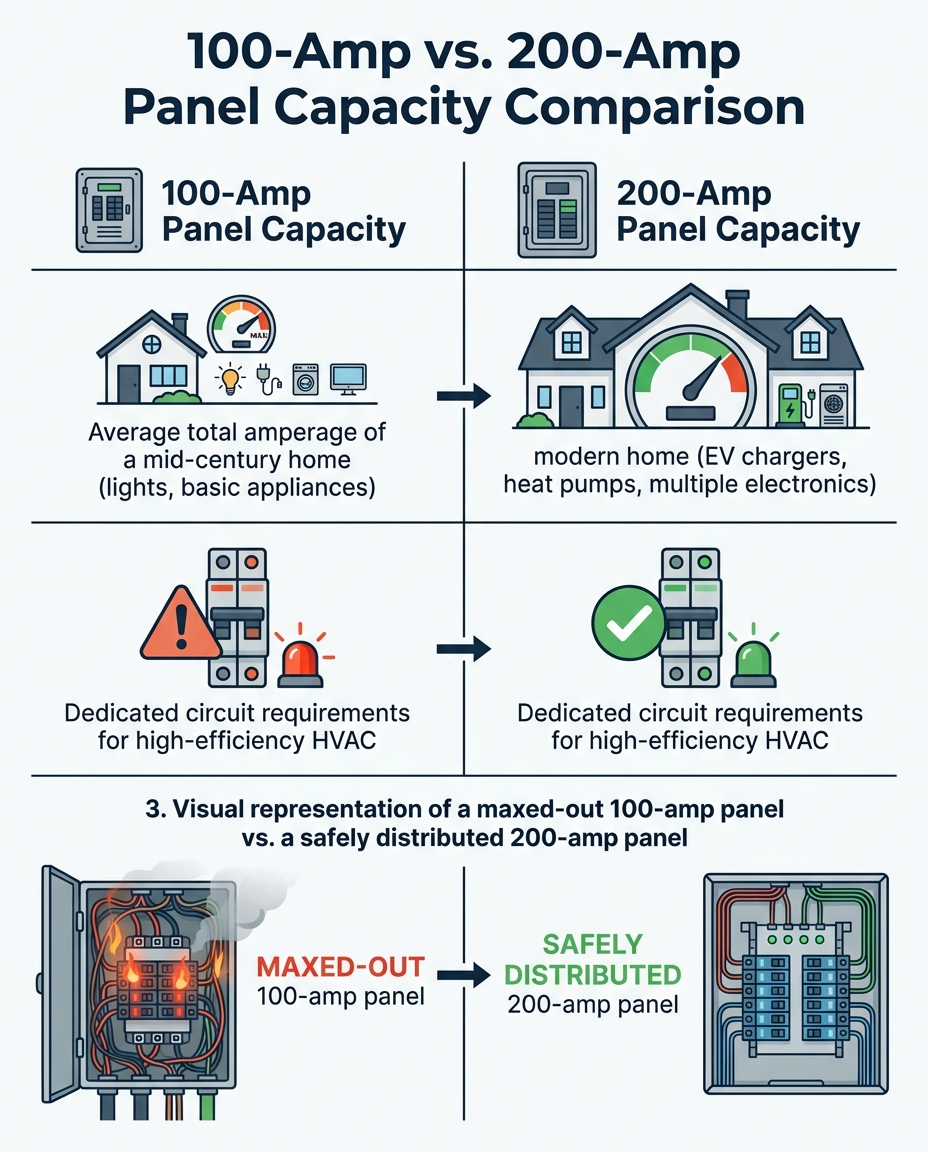
Today, modern households run multiple high-draw appliances simultaneously. We have home offices with multiple computers, large smart TVs, electric vehicle chargers, advanced kitchen appliances, and electric dryers. When you add all these devices together, there is very little spare capacity left on a 100-amp service. Installing a modern high-efficiency heat pump requires dedicated circuits and sustained electrical capacity that older panels simply cannot safely provide.
The Climate Factor: This capacity issue is especially critical in our region. With intense summer heat in Citrus Heights causing HVAC systems to run continuously at peak draw, we find these older electrical panels are severely taxed. An air conditioner pulling maximum amperage for hours on end during a 105-degree afternoon leaves zero margin for error if someone decides to run the microwave or the electric dryer at the same time.
To understand why a 100-amp panel falls short, it helps to look at how household electrical demands have shifted over the decades. The modern home requires a significantly wider pipe for electricity to flow safely.
• Lighting — Mid-Century Home (Typical Draw): 10-15 amps (Incandescent) — Modern Home (Typical Draw): 2-5 amps (LED)
• Kitchen Appliances — Mid-Century Home (Typical Draw): 10-20 amps (Basic fridge, oven) — Modern Home (Typical Draw): 30-50 amps (Smart fridge, microwave, air fryer)
• Entertainment / Tech — Mid-Century Home (Typical Draw): 5 amps (One TV, radio) — Modern Home (Typical Draw): 15-20 amps (Multiple PCs, large TVs, servers)
• HVAC System — Mid-Century Home (Typical Draw): 20-30 amps (Smaller, lower efficiency) — Modern Home (Typical Draw): 40-60+ amps (High-capacity heat pumps, EV chargers)
As the table illustrates, while we have saved some amperage on LED lighting, our overall reliance on high-draw electrical devices has skyrocketed, rendering the original 100-amp panels in older Citrus Heights residential neighborhoods completely maxed out even before a new HVAC system is introduced.

When our technicians tell you that an electrical upgrade is required, we are not just making a recommendation based on preference. Electrical upgrades for major appliances are heavily regulated to protect property and public safety. Bypassing these regulations is illegal and can void your homeowner's insurance policy in the event of an electrical fire.
In older Citrus Heights residential neighborhoods, bringing a home up to current standards involves navigating a strict set of local and state guidelines. These rules exist to ensure that the broader electrical grid remains stable and that individual homes are not pushed beyond their physical limits.
California Title 24 energy standards mandate the installation of high-efficiency equipment to reduce the state's overall carbon footprint. While these modern systems are incredibly efficient at heating and cooling your home, they operate differently than older units. Fulfilling modern heat pump electrical requirements often means installing dedicated 220V or 240V circuits. When a contractor pulls a permit to install a Title 24-compliant system, it triggers strict electrical compliance reviews by local inspectors.
Local utility guidelines play an equally important role. The Sacramento Municipal Utility District (SMUD) has specific residential service rules that dictate how much power a home can safely draw from the grid. Furthermore, Citrus Heights municipal building codes require proper load calculations and permits before any major electrical or HVAC work can commence. If an inspector reviews the permit application and sees that a new 4-ton heat pump is being wired into a heavily loaded 100-amp panel, the permit will be denied. The upgrade is a mandatory step for legal compliance.
Beyond the red tape of permits and building codes, a pattern we see often during peak summer calls is the severe physical safety hazard of overloading undersized electrical panels. Your home's electrical panel is the central nervous system of the house. It is designed to take the massive flow of electricity from the street and distribute it safely to your outlets and appliances. When you force a modern, high-capacity HVAC system onto an undersized 100-amp panel, you create a dangerous bottleneck.
Electricity generates heat as it travels through wires. Circuit breakers are designed to trip and cut off the power when the wires get too hot, preventing a fire. However, if your panel is constantly running at or near its maximum capacity, our electricians frequently spot several hazardous conditions:
• Frequently tripped breakers: This is the most obvious sign of an overload. If turning on the vacuum cleaner while the AC is running causes the power to shut off, your system is crying out for help.
• Thermal degradation: Continuous overload causes the copper wiring to heat up repeatedly. Over years, this constant heating and cooling degrades the plastic insulation wrapping the wires, making it brittle and prone to cracking.
• Hidden fire hazards: When wire insulation fails inside your walls, the exposed copper can arc against other metal components or wood framing, creating a severe fire hazard that remains completely hidden until it is too late.
• Voltage drops: An overloaded panel can cause power fluctuations, which forces the motors in your new HVAC system and your refrigerator to work harder, significantly shortening their lifespans.
An electrical panel upgrade ensures that the home's infrastructure can safely manage peak loads without compromising the safety of the residents. It provides the necessary physical space for new, dedicated circuit breakers and the total amperage capacity to keep the wires cool and safe.
One of the biggest anxieties homeowners face is the fear of being sold something they do not actually need. How can you be sure that your specific 100-amp panel is truly inadequate? The answer lies in the math. A proper electrical assessment involves a formal load calculation, not a visual guess by a technician standing in your garage.
Our team at Always Affordable Plumbing & HVAC provides transparent, honest assessments based on precise calculations, so homeowners know exactly what electrical upgrades are truly necessary without fear of upselling. We believe that when you see the numbers for yourself, the decision becomes clear and logical rather than stressful.
When assessing your home for heating system upgrades, our licensed professionals use a standardized formula dictated by the National Electrical Code (NEC). Here is what that mathematical breakdown looks like behind the scenes:
1. Calculating General Lighting and Receptacle Load: The technician measures the total square footage of your home and multiplies it by a standard wattage requirement to account for all basic plug-in devices and lighting fixtures.
2. Accounting for Small Appliance Circuits: Dedicated circuits in the kitchen and dining room (where high-draw appliances like toasters and blenders live) are added to the calculation at a fixed wattage rate.
3. Factoring in Fixed Appliances: The technician adds the specific electrical requirements for large, hardwired appliances like your electric range, water heater, dishwasher, and electric dryer.
4. Adding the Proposed HVAC Load: Finally, the starting and running amperage of the exact air conditioner or heat pump you plan to install is added to the total.
Once these numbers are tallied, the total concurrent amperage is calculated. If that final number exceeds the safe operating capacity of your existing 100-amp service, the upgrade is mathematically required. Understanding this breakdown empowers homeowners to see the exact capacity shortfall, confirming the upgrade is a structural necessity.
Usually no, especially in homes with other modern electric appliances. The starting amp draw of central air often exceeds the safe capacity of a 100-amp system when combined with refrigerators, computers, and lighting. Even if the AC manages to turn on, it will likely cause voltage drops that dim your lights and strain the compressor motor, leading to premature equipment failure.
Yes, modern heat pumps require dedicated 220V/240V circuits that demand significant power. Older panels rarely have the physical space on the breaker bus bar or the total amperage capacity to support this addition safely. Because heat pumps provide both heating and cooling, they are essential to your home's comfort year-round, meaning they need a reliable, uninterrupted power source that only a 200-amp panel can guarantee. (Note: Qualifying heat pump installations may be eligible for general energy efficiency rebates or federal tax credits—be sure to verify current programs with your utility provider or a tax professional!)
A new AC requires a panel upgrade because modern, high-efficiency units pull sustained electrical loads that older infrastructure was never designed to handle. Furthermore, building codes and utility regulations have become much stricter over the decades to prevent electrical fires. A panel upgrade ensures your home meets current safety standards and can handle the electrical demand without overheating the wiring hidden inside your walls.
The most common sign of an overloaded electrical panel is circuit breakers that trip frequently when multiple appliances are running. You might also notice lights dimming or flickering when the AC kicks on, a buzzing sound coming from the breaker box, or a panel that feels warm to the touch. If you experience any of these symptoms, it is critical to have a licensed professional perform a load calculation immediately.
SMUD requires homeowners to pull appropriate permits and pass a load calculation before connecting a new heavy-draw appliance to the grid. They mandate that the home's electrical service entrance, meter main, and grounding systems meet current safety standards. This ensures that the increased electrical demand from your home does not negatively impact the local power grid or create a fire hazard on your property.
Upgrading an electrical panel is an investment in the long-term safety, efficiency, and value of your home. While it may feel like an unexpected hurdle when you set out to replace your air conditioner, addressing the limitations of older Citrus Heights residential neighborhoods head-on is the best way to protect your property. A proper evaluation ensures your HVAC system runs optimally without risking electrical hazards or frequent breakdowns.
As a trusted local team, Always Affordable Plumbing & HVAC knows you deserve a home that stays perfectly comfortable during the hottest summer days without the fear of tripping a breaker or straining your wiring. Schedule an honest, transparent electrical assessment today to understand your home's specific infrastructural needs, and take the first step toward safe, reliable, and highly efficient climate control.
See what our satisfied customers have to say about their experience with Always Affordable
Plumbing & HVAC.

"Chappy was very skilled in his knowledge of my HVAC unit. I greatly appreciate the quick response and experienced tech. The whole endeavor was made less stressful by his humor and honest conversation. I find comfort in knowing I now have a shop i trust for the next time."
"Tony, James, Ronnie did an amazing job setting up our new AC! They were quick, efficient, considerate, and polite! We appreciate them scheduling us in on such short notice. Definitely recommend this company!"
"Prompt, professional service with kindness and care. They came out to address both plumbing and AC issues. I received a courtesy call before they arrived. All issues were resolved the same day with integrity and respect. Thankful for businesses like this. Absolutely recommend to those that I love."
"Excellent service! Jason came out promptly and in addition to doing my outside faucet he also put in new irrigation equipment! All done perfectly! Jason was lovely"
"Honest with the assessment; friendly and good manners. No high pressure sales. Just good to honest "tell it like you see it" Thought my kitchen disposer needed an overhaul. But Jason, there Plumber gave me an honest lesson on what was really happening. Saved me hundreds, if I went the route of replacing. Thank you!"
"Absolutely 5 stars. If you are looking for affordable ,professional and kind. Chappy was excellent and very knowledgeable . I called in the morning because my air conditioner stopped working he was here within hours and fixed my air with a smile. I highly recommend Chappy and Always Affordable plumbing and Hvac."
"Scott and James were great. They got there quickly and diagnosed the problem with my A/C.They did a very thorough job testing everything. Sent me pictures and called to keep me informed. Got it done the next day and everything is working fine. Be glad when I get home so I can enjoy my new system. Thanks guys for a great job."
"Chappy was very helpful. He knew our issue right away, cleaned our coils. He also came on the same day we called and got our AC blowing cold air again."
"After some timing ’curfuffles’ the Tech Jason arrived and not only completed a speedy install on my toilet, he was personable & professional. Because of the timing issues Jason was attentive and showed up with everything needed! No extra store runs 😊 I was very comfortable with having this Tech in my Daughter’s home. We will definitely use this Service again."