Seasonal Home Maintenance Checklist: Preventing HVAC and Plumbing Emergencies
Prevent HVAC emergencies with a seasonal home maintenance checklist. Why proactive scheduling beats waiting for sudden failures. See what needs attention now.



Nearly 100% of the original sewer lines installed during the mid-century housing boom have reached or exceeded their maximum 50-year lifespan. When addressing the unique plumbing challenges of mid-century homes in Fair Oaks, the first thing our team at Always Affordable Plumbing & HVAC looks at is the hidden infrastructure buried beneath your lawn. These beautiful, established neighborhoods were built during a time of rapid expansion, utilizing materials that were simply never designed to last into the modern era.
Today, homeowners in these 1950s-1960s properties are facing a concrete problem: the rapid degradation, severe tree root intrusion, and structural failure of their original plumbing lines. What starts as a slow-draining shower or a gurgling toilet is often the first warning sign of a much larger collapse happening underground. The pipes connecting your home to the municipal sewer system are actively deteriorating, creating a ticking clock for major plumbing emergencies.
This puts property owners at a critical decision point. You can either continue paying for temporary drain snaking—clearing away roots and blockages every few months while the pipe continues to rot—or you can invest in a permanent diagnostic and replacement solution before a total system collapse forces an emergency excavation. To make the right choice, it is vital to partner with professionals who understand comprehensive residential plumbing services and specialize in modern sewer line repair and replacement.
The reality of mid-century plumbing:
• Expired materials: The primary pipes used during this era have long surpassed their intended expiration dates.
• Hidden deterioration: Pipes can look fine where they exit the house, while the buried sections are completely crushed.
• Landscaping threats: The mature trees that make Fair Oaks beautiful are actively seeking out the moisture leaking from failing pipe joints.
To understand why your plumbing is struggling today, you have to look at the specific materials used during the post-war construction boom. During the 1940s through the 1970s, material shortages and rapid development led builders to rely heavily on Orangeburg and cast iron sewer pipes. While these materials met the building codes of their time, their long-term performance has proven to be deeply flawed.
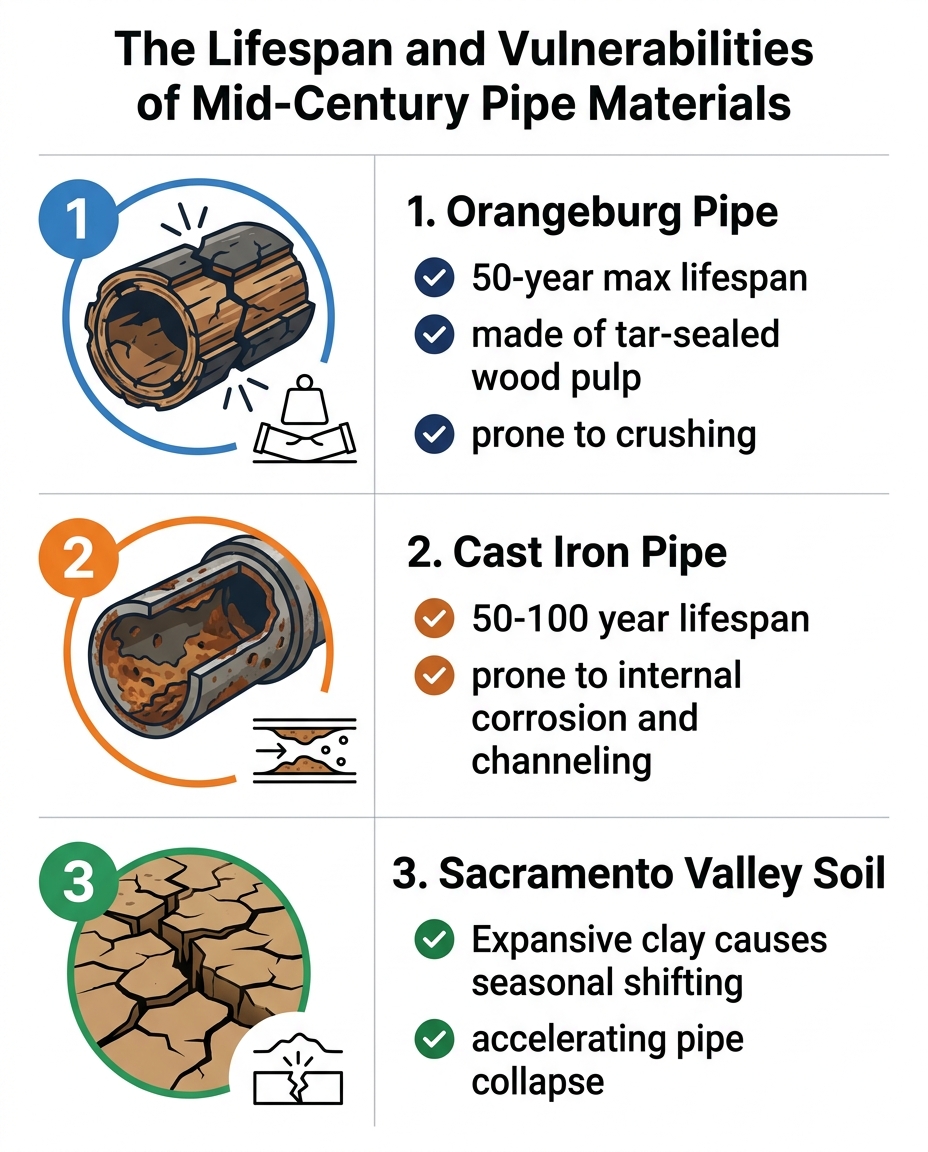
The local climate plays a massive role in accelerating this destruction. In our years of servicing the Sacramento Valley, we've seen firsthand how dry summers and wet winters cause expansive clay soils to shrink and swell dramatically throughout the year. This constant seasonal movement exerts massive hydrostatic pressure on aging buried utility lines. When brittle, degrading pipes are squeezed and shifted by heavy, expanding clay, they crack, belly, and eventually collapse entirely.
Orangeburg pipe is perhaps the most notorious plumbing material found in mid-century properties. It is essentially constructed from wood pulp tightly bound and sealed with hot coal tar. Because it was lightweight, easy to cut, and cheap to produce, it became a favorite among builders looking to construct homes quickly.
However, Orangeburg was only rated for a maximum lifespan of about 50 years. Decades of constant exposure to water, soil acidity, and shifting ground cause the tar to break down. Once the tar degrades, the wood pulp layers absorb moisture, leading to a condition known as "blistering" or delamination. The pipe walls bubble inward, restricting water flow and creating a soft, sponge-like surface that tree roots easily pierce. Eventually, the weight of the soil above simply flattens the pipe into a completely impassable oval.
Cast iron was the premium alternative to Orangeburg and is widely found in homes from the 1950s-1960s. Under perfect conditions, cast iron can last 50 to 100 years. Unfortunately, real-world conditions are rarely perfect. Cast iron is highly susceptible to internal corrosion caused by the hydrogen sulfide gases naturally present in household wastewater.
Over decades, this corrosion creates a process called "channeling," where the bottom of the pipe rots away entirely, leaving the wastewater to flow directly into the soil. The interior walls of the pipe also suffer from severe flaking and scaling. This creates a jagged, rusted surface that catches paper, hair, and debris, leading to chronic blockages even when the pipe is structurally intact.
• Orangeburg — Primary Composition: Wood pulp and coal tar — Expected Lifespan: 30 to 50 years — Common Failure Modes: Blistering, crushing, root intrusion, delamination
• Cast Iron — Primary Composition: Heavy iron alloy — Expected Lifespan: 50 to 100 years — Common Failure Modes: Internal scaling, bottom-channeling, joint failure
• Clay (Vitrified) — Primary Composition: Fired clay — Expected Lifespan: 50 to 100+ years — Common Failure Modes: Snapping due to soil shift, heavy root intrusion at mortar joints

When a sink backs up or a toilet overflows, the instinct is to call for a standard drain clearing service or reach for a bottle of liquid plumber. In newer homes with modern PVC piping, a mechanical snake is a perfectly safe and highly effective tool. But in Fair Oaks older mid-century neighborhoods, a pattern we see often is that aggressive clearing methods can instantly turn a slow drain into a catastrophic plumbing emergency.
The Problem: Recurring backups in a 60-year-old home are rarely just simple clogs caused by too much toilet paper. They are almost always a symptom of structural failure. The pipe has either blistered inward, rusted shut, or become heavily infested with tree roots.
The Cause of Further Damage: Sending a heavy-duty mechanical steel auger down an Orangeburg pipe is like running a chainsaw through wet cardboard. The spinning metal blades can easily catch on the delaminated layers of tar-paper and shred the pipe walls to pieces, causing an immediate collapse. Similarly, utilizing harsh chemical cleaners accelerates the deterioration of cast iron. We always warn our customers about the severe dangers of using acid-based drain cleaners on older cast iron pipes, which essentially eat away the remaining healthy metal alongside the clog.
The Solution: Recently, our team responded to a local homeowner who woke up to a backed-up sewer line and couldn't get other plumbers to come out until the next day. Our technicians were dispatched within hours, worked carefully to clear the immediate blockage without damaging the fragile line, and then sat down to discuss long-term prevention options rather than just leaving them with a temporary fix. In our professional opinion, this is the only safe approach. Treating the symptom without diagnosing the structural integrity of the line is a massive risk to your property.
Because you cannot safely snake an unknown, aging pipe, our team considers professional camera diagnostics the mandatory first step for any mid-century property experiencing drainage issues. Guesswork is the enemy of older plumbing systems. Establishing the exact material, condition, and layout of your sewer line before attempting any mechanical clearing prevents accidental destruction.
When our technicians perform high-resolution sewer camera inspections, they feed a flexible fiber-optic cable tipped with a waterproof, illuminated camera deep into your plumbing system. The technician watches a real-time video feed on a monitor, allowing them to inspect every inch of the pipe's interior from the house all the way to the municipal connection.
What our technicians look for during a camera inspection:
• Material identification: Confirming whether you have Orangeburg and cast iron sewer pipes, clay, or a mix of materials from previous partial repairs.
• Root masses: Identifying exactly where and how severely tree roots have penetrated the pipe joints.
• Bellied pipes: Locating sections of the pipe that have sunk into the soil, creating a "belly" where standing water and waste constantly collect.
• Scaling and channeling: Assessing the level of rust buildup or bottom-rot in cast iron lines.
• Total blockages: Pinpointing collapsed sections that require immediate excavation.
The camera head is also equipped with a radio transmitter (a sonde). If our technician spots a collapsed section of Orangeburg under your front lawn, they can use a surface receiver to pinpoint the exact location and depth of the problem. This targeted approach means that if a repair is necessary, it can be done with surgical precision rather than digging up your entire yard to find the leak.
If diagnostics reveal that your 1950s-1960s pipes have finally reached the end of their lifespan, the thought of replacing them can be incredibly stressful. Older neighborhoods are known for their beautiful, mature landscaping, custom hardscaping, and established driveways. The traditional method of sewer replacement—digging a massive, deep trench from your foundation to the street—would destroy decades of property development.
Fortunately, modern trenchless sewer repair and replacement technologies offer a permanent solution that leaves your property largely untouched. Trenchless methods allow our technicians to replace or rehabilitate the underground pipe using only one or two small access holes.
There are two primary trenchless methods used for mid-century homes. The first is pipe bursting. A heavy-duty steel bursting head is pulled through the old pipe by a powerful hydraulic winch. As the head moves through the earth, it shatters the old cast iron or Orangeburg pipe outward into the surrounding soil while simultaneously pulling a brand-new, seamless, high-density polyethylene (HDPE) pipe into place behind it.
The second method is Cured-In-Place Pipe (CIPP) lining. A flexible, epoxy-saturated felt tube is inserted into the existing pipe and inflated. Once the epoxy cures and hardens, it creates a new, structurally sound pipe directly inside the old one, sealing off all cracks and root intrusions.
These methods preserve your mature trees, driveways, and established landscaping. In a recent project, our crew helped a homeowner facing major sewer line issues requiring a full replacement. Even when unforeseen additional problems arose during the repair, our technicians successfully replaced 140 feet of sewer line, installed proper exterior cleanouts to ensure easy future access, and expertly repaired the small sections of driveway concrete that had to be removed, leaving the work area in pristine condition.
Owning a home in Fair Oaks older mid-century neighborhoods is a privilege, but it comes with the responsibility of managing aging infrastructure. Addressing these plumbing challenges before an emergency strikes is the best way to protect the value and safety of your investment. Waiting until raw sewage backs up into your bathtubs or a collapsed line floods your yard will only multiply the damage and the stress.
Proactive signs we recommend monitoring around your property:
• Chronic slow drains: If multiple fixtures in the house drain slowly, the main line is compromised.
• Unusual yard odors: The smell of raw sewage in your front yard or near the street indicates a leaking line.
• Exceptionally green patches: Sewage acts as a powerful fertilizer. If one patch of your lawn is suddenly much greener and faster-growing than the rest, there is likely a broken pipe beneath it.
• Indentations in the lawn: Soil washing away into a broken sewer line will cause the ground above to sink or dip.
Navigating major plumbing replacements requires a trusted local partner who thoroughly understands regional building history and soil conditions. It also means finding a partner who offers affordable, transparent pricing and a 100% satisfaction guarantee. This ensures that when you face a major project, you aren't left worrying about hidden costs or subpar workmanship. We encourage all homeowners to review our local service areas to verify if their neighborhood falls within our primary zones for specialized diagnostic care.
How long do cast iron pipes last?
Under ideal conditions, cast iron pipes are rated to last between 50 and 100 years. However, in areas with shifting clay soils or highly acidic wastewater, internal corrosion and external pressure can cause them to fail much closer to the 50-year mark. In our experience, most cast iron systems installed in the 1950s and 1960s that we inspect are currently showing severe signs of channeling, rust scaling, and joint failure.
What is Orangeburg pipe made of?
Orangeburg pipe is made from layers of wood pulp that have been tightly compressed and heavily saturated with hot coal tar pitch. It was designed as a lightweight, low-cost alternative to metal piping during periods of material shortages. Because it lacks structural rigidity, it is highly vulnerable to crushing, blistering, and tree root intrusion as it ages.
How to tell if I have Orangeburg pipes?
We typically tell customers that the only definitive way to know if your home utilizes Orangeburg pipe is through a professional sewer camera inspection. However, if your home was built between 1945 and 1972 and you are experiencing frequent, unexplainable sewer backups, there is a high statistical probability that Orangeburg or early cast iron is present in your main line.
Can Orangeburg pipe be lined?
In some rare cases, if the Orangeburg pipe has maintained its perfectly round shape and has not yet blistered or collapsed, it can be lined using CIPP trenchless technology. However, because the material degrades and flattens out so severely over time, we typically recommend complete replacement via pipe bursting rather than lining for most Orangeburg pipes.
Why do old cast iron pipes fail?
Old cast iron pipes fail primarily due to internal oxidation and channeling. Hydrogen sulfide gas from household waste reacts with moisture to create a mild sulfuric acid, which slowly eats away the bottom of the iron pipe over decades. Additionally, the rigid metal joints can snap when the surrounding soil heavily expands and contracts during seasonal weather changes.
Is snaking bad for Orangeburg pipes?
Yes, mechanical snaking is incredibly dangerous for Orangeburg pipes. The heavy steel blades of a plumbing auger can easily catch on the soft, deteriorating tar-paper walls, tearing the pipe apart and causing an immediate, total collapse. This is exactly why our team insists that professional camera diagnostics must always be performed before attempting to clear a mid-century drain line.
Living in Fair Oaks older mid-century neighborhoods shouldn't mean living in constant fear of the next plumbing disaster. A clear, geographically relevant diagnostic plan is your absolute best defense against unexpected pipe failure. Knowing exactly what materials are buried in your yard and understanding their current condition puts the control back in your hands.
If you are experiencing recurring clogs, slow drains, or suspect your original pipes are finally giving out, do not settle for another temporary fix. Schedule a professional camera inspection today to permanently solve your recurring drainage issues. Our local experts at Always Affordable Plumbing & HVAC are ready to provide safe, highly accurate diagnostics and transparently priced solutions tailored to the unique needs of your historic property.
See what our satisfied customers have to say about their experience with Always Affordable
Plumbing & HVAC.

"Chappy was very skilled in his knowledge of my HVAC unit. I greatly appreciate the quick response and experienced tech. The whole endeavor was made less stressful by his humor and honest conversation. I find comfort in knowing I now have a shop i trust for the next time."
"Tony, James, Ronnie did an amazing job setting up our new AC! They were quick, efficient, considerate, and polite! We appreciate them scheduling us in on such short notice. Definitely recommend this company!"
"Prompt, professional service with kindness and care. They came out to address both plumbing and AC issues. I received a courtesy call before they arrived. All issues were resolved the same day with integrity and respect. Thankful for businesses like this. Absolutely recommend to those that I love."
"Excellent service! Jason came out promptly and in addition to doing my outside faucet he also put in new irrigation equipment! All done perfectly! Jason was lovely"
"Honest with the assessment; friendly and good manners. No high pressure sales. Just good to honest "tell it like you see it" Thought my kitchen disposer needed an overhaul. But Jason, there Plumber gave me an honest lesson on what was really happening. Saved me hundreds, if I went the route of replacing. Thank you!"
"Absolutely 5 stars. If you are looking for affordable ,professional and kind. Chappy was excellent and very knowledgeable . I called in the morning because my air conditioner stopped working he was here within hours and fixed my air with a smile. I highly recommend Chappy and Always Affordable plumbing and Hvac."
"Scott and James were great. They got there quickly and diagnosed the problem with my A/C.They did a very thorough job testing everything. Sent me pictures and called to keep me informed. Got it done the next day and everything is working fine. Be glad when I get home so I can enjoy my new system. Thanks guys for a great job."
"Chappy was very helpful. He knew our issue right away, cleaned our coils. He also came on the same day we called and got our AC blowing cold air again."
"After some timing ’curfuffles’ the Tech Jason arrived and not only completed a speedy install on my toilet, he was personable & professional. Because of the timing issues Jason was attentive and showed up with everything needed! No extra store runs 😊 I was very comfortable with having this Tech in my Daughter’s home. We will definitely use this Service again."