Home Maintenance Tips and Troubleshooting: What to Do When Your AC Blows Warm Air
AC blowing warm air? Review essential home maintenance tips and troubleshooting to spot simple airflow issues. Decide with confidence when to call a pro.



Understanding the benefits of regular HVAC maintenance in hot dry valley regions like Sacramento comes down to one simple reality: your system works far harder here than almost anywhere else in the country.
Here's a quick summary of what regular maintenance delivers:
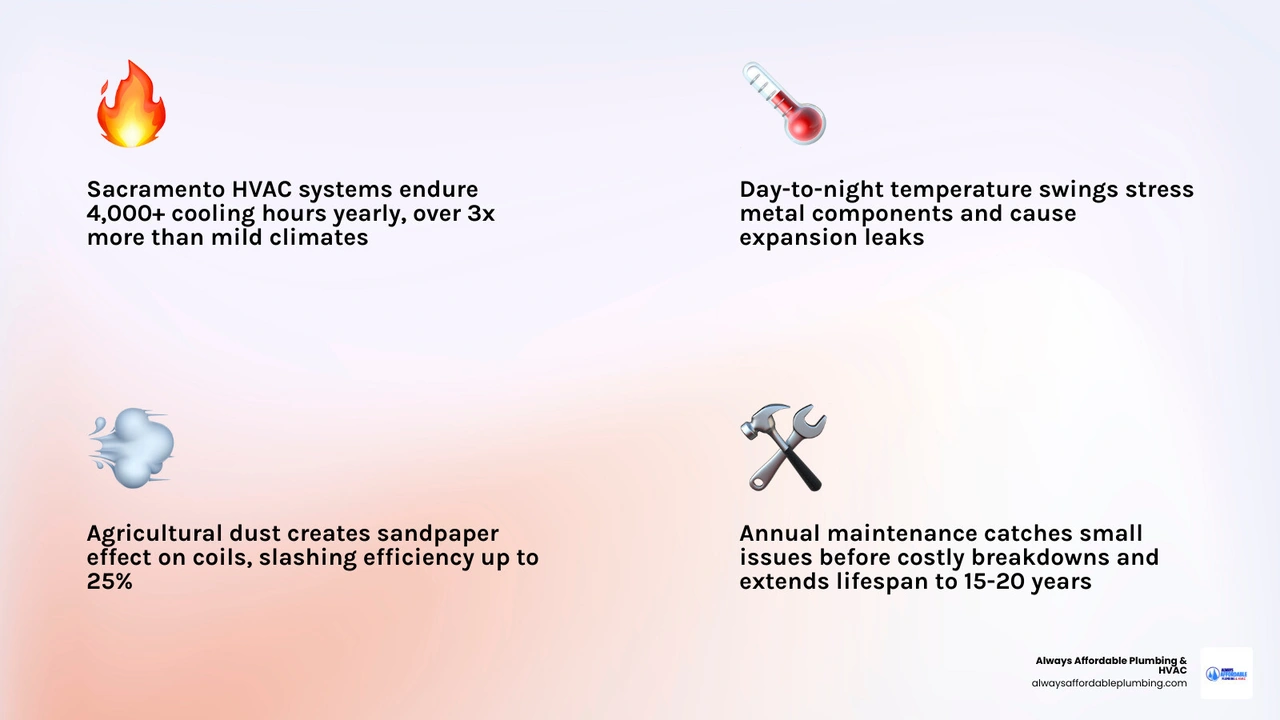
• Lower energy bills - Well-maintained systems run up to 25% more efficiently than neglected ones
• Longer system life - Proper care can extend your HVAC's lifespan to 15-20 years vs. as few as 7-10 years without it
• Fewer emergency breakdowns - Routine tune-ups catch small problems before they become expensive failures
• Better indoor air quality - Clean filters and coils reduce dust, allergens, and pollutants inside your home
• Warranty protection - Most manufacturers require documented annual maintenance to keep warranties valid
• Consistent comfort - A tuned system cools and heats evenly, with no hot or cold spots
Sacramento Valley summers regularly push past 100°F, and HVAC systems here can log 4,000 or more cooling hours in a single year - compared to just 800-1,500 hours in milder climates. Add in agricultural dust, seasonal winds, and dramatic day-to-night temperature swings, and you have conditions that stress every component in your system much faster than normal.
The good news is that regular, professional maintenance directly counters these stressors. It keeps your system running efficiently when you need it most, and it keeps surprise repair bills to a minimum.
Glossary for benefits of regular hvac maintenance in hot dry valley:
• annual hvac maintenance is it worth it
• how often should you service your hvac
Living in the Sacramento Valley—whether you are in Elk Grove, Davis, or Roseville—means enjoying beautiful sunny days, but it also means subjecting your home’s climate control system to some of the most punishing environmental conditions in California. Unlike mild coastal regions where air conditioners gently hum for a few weeks a year, our valley systems operate under a state of constant, high-intensity stress.

The primary culprit is our unique combination of intense summer heat and heavy agricultural dust. The Sacramento Valley is a major agricultural hub, which means the air is constantly filled with fine soil, pollen, and harvesting debris. When the wind picks up, this dust travels directly into residential neighborhoods in Folsom, Citrus Heights, and Rancho Cordova.
Additionally, during the dry summer and autumn months, we frequently face the added challenge of wildfire smoke. This airborne cocktail of fine particulates doesn't just make it hard to breathe outdoors; it acts as a physical barrier that suffocates your HVAC system. To understand how these combined environmental factors put a massive physical strain on your home's mechanical systems, read our detailed guide on How Extreme Heat and Wildfire Smoke Stress Your Systems.
When temperatures soar past 100°F, your air conditioner's compressor has to work up to 30% harder just to reject heat from inside your home to the scorching outdoor air. If your outdoor condenser unit is coated in a layer of fine valley dust, that dust acts like a thermal blanket. Instead of releasing heat, the unit traps it, forcing the compressor to run hotter and longer.
This heat stress is the primary reason for premature capacitor failure. Capacitors are the small, cylindrical components that store electrical energy and deliver the high-voltage jolt needed to start your compressor and fan motors. In hot valley attics and outdoor electrical panels, temperatures can easily exceed 140°F. When you combine this ambient heat with the internal heat generated by a struggling system, capacitors can literally pop, leaving you without cooling on the hottest day of July.
Furthermore, the fine silica dust common in our soil has a "sandpaper effect" on the moving parts of your system. As dust bypasses cheap or neglected filters, it enters the blower motor housing. Here, the microscopic, abrasive particles grind away at motor bearings and fan shafts. Over time, this friction leads to motor burnouts, noisy operation, and eventual system failure. To learn how proactive seasonal care can prevent these exact issues, see our expert advice on How to Prevent HVAC Emergencies with Maintenance.
Another unique challenge of the Sacramento Valley is our dramatic diurnal temperature swings. Thanks to the "Delta Breeze"—a cool sea breeze that sweeps in from the Sacramento-San Joaquin River Delta—our hot summer days often give way to remarkably cool nights. While this temperature drop is a welcome relief for residents, it creates a physical phenomenon known as thermal cycling or the "paperclip effect" on your HVAC system.
During the heat of the day, the copper refrigerant lines in your system heat up and expand. At night, as the temperature drops by 30 to 40 degrees, the metal rapidly contracts. This constant cycle of expansion and contraction puts immense physical stress on the soldered joints, valves, and fittings throughout your system.
Over time, this joint stress can lead to tiny, microscopic pinhole refrigerant leaks. A system that is even 10% low on refrigerant can lose up to 20% of its cooling capacity, forcing the compressor to run continuously and driving your utility bills through the roof.
To combat these harsh local conditions, proactive homeowners rely on routine professional service. The differences between a system that receives regular maintenance and one that is neglected are stark, especially when operating in our local climate.
• Average Lifespan — Well-Maintained Valley HVAC System: 15 to 20 years — Neglected Valley HVAC System: 7 to 10 years (or fewer)
• Energy Efficiency — Well-Maintained Valley HVAC System: Operates at peak SEER2/EER2 ratings — Neglected Valley HVAC System: Loses 5% to 30% efficiency over time
• Monthly Utility Bills — Well-Maintained Valley HVAC System: Optimized and predictable — Neglected Valley HVAC System: 10% to 30% higher due to system strain
• Air Filter Condition — Well-Maintained Valley HVAC System: Changed every 30-90 days; high airflow — Neglected Valley HVAC System: Clogged; restricts airflow by up to 50%
• Emergency Repair Risk — Well-Maintained Valley HVAC System: Extremely low; issues caught early — Neglected Valley HVAC System: High; likely to fail during peak heat waves
• Indoor Air Quality — Well-Maintained Valley HVAC System: Excellent; dust, pollen, and dander filtered — Neglected Valley HVAC System: Poor; dusty air recirculated throughout home
• Manufacturer Warranty — Well-Maintained Valley HVAC System: Fully valid with documented service — Neglected Valley HVAC System: Often voided due to lack of professional care
When you keep your system maintained, you are directly protecting your wallet from the high cost of valley electricity. Air conditioners are rated by SEER2 (Seasonal Energy Efficiency Ratio) and EER2 (Energy Efficiency Ratio). While SEER2 measures efficiency over an entire season, EER2 is particularly important for hot, dry valleys because it measures how efficiently the unit operates at a specific, high outdoor temperature (typically 95°F).
A system clogged with dust and suffering from restricted airflow cannot achieve its rated EER2. When our technicians perform a professional tune-up, we clean the evaporator and condenser coils, calibrate the thermostat, and optimize the airflow. This ensures your system requires less electrical energy to move heat out of your home.
According to the U.S. Department of Energy, proper maintenance can save you anywhere from 5% to 20% annually on your heating and cooling costs. In areas like Sacramento, Roseville, and Folsom, where summer AC usage is exceptionally high, those percentage points translate to significant dollar savings on your monthly utility bills. For a deeper dive into how often these bill-saving services should be performed, check out our guide on How Often Should You Service Your HVAC?.
An HVAC system is one of the most expensive mechanical investments in your home. In milder climates, a neglected system might limp along for 12 to 15 years simply because it isn't used very often. In the Sacramento Valley, however, neglect is a fast track to a premature system replacement.
Routine maintenance reduces mechanical wear by ensuring all moving parts are properly lubricated, electrical connections are secure, and system pressures are balanced. When a system doesn't have to work twice as hard to push air through a dirty filter or over a dust-insulated coil, its components experience significantly less fatigue. This keeps the system running smoothly for its full design life of 15 to 20 years.
Furthermore, skipping professional service can have major legal and financial consequences for your equipment warranties. Almost all major HVAC manufacturers (such as Carrier, Trane, and Lennnox) explicitly state in their warranty terms that the equipment must be professionally serviced annually. If your compressor fails in year five but you cannot provide documented proof of regular maintenance, the manufacturer can void your warranty, leaving you to pay for a costly replacement out of pocket. To make sure your system is fully protected, check out our Annual HVAC Maintenance Guide 2026.
Maintaining an HVAC system in a dry, dusty valley requires a specialized approach that goes beyond basic, national checklist standards.
Our licensed technicians focus on several critical tasks designed to counter the specific environmental threats of the Sacramento region:
• Chemical Coil Cleaning: Simply hosing off an outdoor unit with water isn't enough when agricultural dust and pollen have baked onto the coils. We use specialized, self-rinsing chemical cleaners that safely dissolve the stubborn, baked-on grime without damaging the delicate aluminum fins. This restores maximum heat transfer efficiency.
• Electrical Connection Tightening: The thermal expansion and contraction we discussed earlier can actually loosen electrical screws and terminals over time. Loose wires are responsible for nearly 60% of all compressor failures. We inspect, tighten, and test all electrical connections, relays, contactors, and capacitors.
• Condensate Line Flushing: You might think that dry climates don't produce much condensation, but our air conditioners still pull significant moisture out of the indoor air. When this moisture mixes with fine indoor dust, it creates a thick, muddy sludge in your condensate drain pan. If not cleared annually, this sludge will clog the drain line, causing water to back up and flood your ceilings or closets.
• Airflow and Static Pressure Calibration: We measure the temperature split (the difference in temperature between the air entering and exiting your system) and test the static pressure within your ductwork. This ensures your blower motor is pushing the exact volume of air required for optimal cooling without overworking itself.
Indoor air quality (IAQ) is a massive concern in the Sacramento Valley. The EPA notes that indoor air can be two to five times more polluted than outdoor air. In our region, outdoor pollutants like agricultural dust, vehicle emissions from local freeways, and wildfire smoke easily find their way inside our homes.
Your HVAC system is your home's primary defense against these airborne hazards. However, if your system's coils and blower assembly are coated in dust, the system actually becomes a source of pollution, blowing allergens and mold spores through your registers every time it turns on.
During a professional maintenance visit, we evaluate your filtration setup. For dry, dusty environments, we recommend utilizing high-quality pleated filters with a MERV (Minimum Efficiency Reporting Value) rating between 8 and 11. These filters are highly effective at capturing fine dust, pollen, and mold spores without restricting the system's airflow. We also inspect your ductwork for leaks; unsealed ducts in attics or crawlspaces can suck in dusty, unconditioned air and distribute it directly into your living spaces, completely bypassing your air filters.
If you are looking to maximize your comfort and efficiency in our local climate, there are several modern technology upgrades that work beautifully alongside regular maintenance:
• Smart Thermostats: Devices like the Nest or Ecobee use advanced algorithms to learn your daily routine and adjust temperatures automatically. In our valley climate, you can program these devices to take advantage of the cool Delta Breeze at night, reducing your reliance on mechanical cooling.
• Zoning Systems: Many homes in Sacramento and Roseville are two-story structures that suffer from dramatic temperature imbalances, with the upstairs remaining uncomfortably hot while the downstairs is freezing. A zoned system uses motorized dampers in your ductwork to direct cool air precisely where it is needed, improving comfort and reducing energy waste.
• Variable-Speed Heat Pumps: Unlike traditional single-stage systems that run at either 100% capacity or 0%, modern variable-speed heat pumps constantly adjust their output to match your home's exact cooling or heating needs. This results in incredibly precise temperature control, quieter operation, and unmatched energy efficiency.
To learn how you can bundle your regular maintenance visits with priority service and discounts on these advanced upgrades, read our analysis on Is an HVAC Maintenance Plan Worth It?.
While standard national advice often suggests changing filters every 90 days, the high dust volume in the Sacramento Valley demands a stricter schedule. During the peak summer cooling season, you should check your air filter every 30 days. If you live near active farmland in Woodland, Davis, or Galt, or if you have pets inside the home, your filter will likely need to be replaced monthly.
Using a MERV 8 to 11 filter strikes the perfect balance for valley homes, capturing fine agricultural dust and pollen without placing an excessive load on your blower motor.
Homeowners can—and should—handle basic maintenance tasks between professional visits. This includes replacing your air filters on schedule, keeping a clear two-foot boundary around your outdoor condenser unit, and gently rinsing away loose dust from the outdoor unit with a garden hose (never use a pressure washer, as it will bend the delicate aluminum fins).
However, deep technical tasks like measuring refrigerant pressures, testing electrical voltages, cleaning the internal evaporator coil, and calibrating the blower assembly require specialized diagnostic tools, safety gear, and licensed expertise. Attempting these tasks yourself can result in severe electrical shock, system damage, and will almost certainly void your manufacturer's warranty.
We recommend scheduling professional service twice a year: once in the spring (March or April) to prepare your air conditioner for the brutal summer heat, and once in the fall (October or November) to inspect your heating system before the winter chill sets in.
Scheduling your spring tune-up early ensures that any worn-out parts, weak capacitors, or low refrigerant levels are resolved before the first major heatwave hits the valley. If you are located in the Sacramento area and are ready to book your seasonal service, you can learn more about our local tune-up options by visiting our HVAC Maintenance Sacramento, CA service page.
At Always Affordable Plumbing & HVAC, we are proud to provide reliable, transparent, and affordable home comfort solutions to our neighbors throughout the greater Sacramento region. From Folsom and Roseville to Elk Grove and Davis, our team of fully licensed, highly trained technicians is dedicated to keeping your heating and cooling systems operating at peak performance.
Whether you need a seasonal AC tune-up, an emergency repair on a scorching afternoon, or are looking to upgrade to a high-efficiency heat pump or smart thermostat, we have you covered. We also offer a specialized Member's Club that provides priority scheduling, valuable discounts, and regular maintenance visits to give you complete peace of mind all year long.
Don't wait for your air conditioner to break down in the middle of a triple-digit valley heatwave. Take control of your home's comfort, protect your equipment, and start saving on your monthly utility bills today.
To schedule your professional HVAC maintenance or to request a free quote, visit our Always Affordable Plumbing & HVAC service page or give our friendly local team a call today!
See what our satisfied customers have to say about their experience with Always Affordable
Plumbing & HVAC.

"Chappy was very skilled in his knowledge of my HVAC unit. I greatly appreciate the quick response and experienced tech. The whole endeavor was made less stressful by his humor and honest conversation. I find comfort in knowing I now have a shop i trust for the next time."
"Tony, James, Ronnie did an amazing job setting up our new AC! They were quick, efficient, considerate, and polite! We appreciate them scheduling us in on such short notice. Definitely recommend this company!"
"Prompt, professional service with kindness and care. They came out to address both plumbing and AC issues. I received a courtesy call before they arrived. All issues were resolved the same day with integrity and respect. Thankful for businesses like this. Absolutely recommend to those that I love."
"Excellent service! Jason came out promptly and in addition to doing my outside faucet he also put in new irrigation equipment! All done perfectly! Jason was lovely"
"Honest with the assessment; friendly and good manners. No high pressure sales. Just good to honest "tell it like you see it" Thought my kitchen disposer needed an overhaul. But Jason, there Plumber gave me an honest lesson on what was really happening. Saved me hundreds, if I went the route of replacing. Thank you!"
"Absolutely 5 stars. If you are looking for affordable ,professional and kind. Chappy was excellent and very knowledgeable . I called in the morning because my air conditioner stopped working he was here within hours and fixed my air with a smile. I highly recommend Chappy and Always Affordable plumbing and Hvac."
"Scott and James were great. They got there quickly and diagnosed the problem with my A/C.They did a very thorough job testing everything. Sent me pictures and called to keep me informed. Got it done the next day and everything is working fine. Be glad when I get home so I can enjoy my new system. Thanks guys for a great job."
"Chappy was very helpful. He knew our issue right away, cleaned our coils. He also came on the same day we called and got our AC blowing cold air again."
"After some timing ’curfuffles’ the Tech Jason arrived and not only completed a speedy install on my toilet, he was personable & professional. Because of the timing issues Jason was attentive and showed up with everything needed! No extra store runs 😊 I was very comfortable with having this Tech in my Daughter’s home. We will definitely use this Service again."