Seasonal Home Maintenance Checklist: Preventing HVAC and Plumbing Emergencies
Prevent HVAC emergencies with a seasonal home maintenance checklist. Why proactive scheduling beats waiting for sudden failures. See what needs attention now.



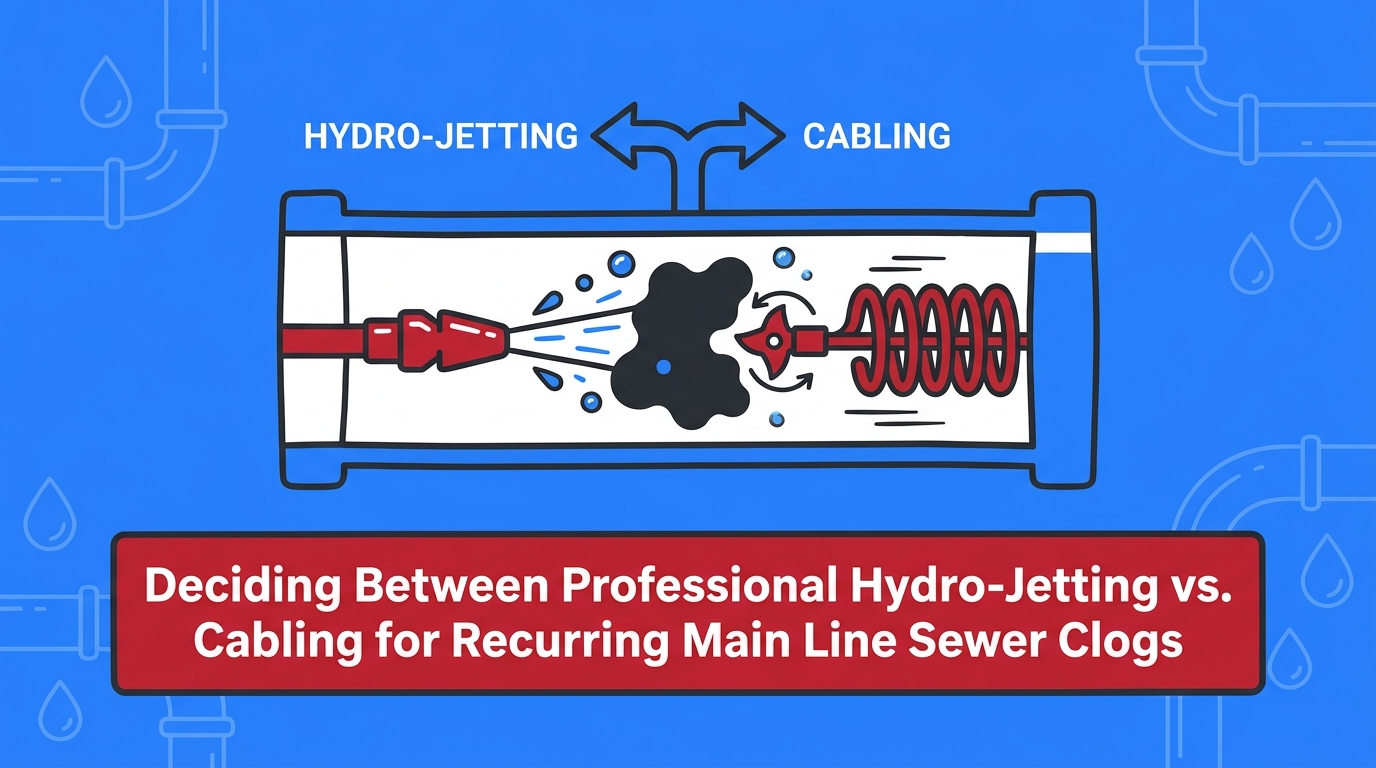
A common plumbing myth is that once a drain is cleared, your pipes are permanently fixed. However, if you are weighing professional hydro-jetting vs. cabling for recurring main line sewer clogs, you already know that assumption simply is not true. Dealing with repeated waste backups is one of the most frustrating experiences a homeowner can face. When the lowest drains in your house start gurgling, or raw sewage begins backing up into your bathtub, it signals a severe restriction in your primary waste system.
These repeated blockages disrupt your daily life and create unsanitary conditions inside your home. At Always Affordable Plumbing & HVAC, our team often sees homeowners who find themselves calling a plumber every few months for the exact same issue. If you are caught in this cycle, it usually means your previous interventions only provided temporary relief. To break this pattern, you need a long-term strategy and professional plumbing solutions that address the root cause of the buildup.
Today, professionals rely on two primary methods for clearing out underground pipes: traditional metal cabling (often called snaking) and high-pressure water jetting. Both methods have their place in the industry, but they achieve very different mechanical results. Understanding the technical differences between these two approaches is the key to making an informed, objective decision for your home's plumbing health.
Traditional cabling has been the standard method for clearing household drains for decades. This process utilizes a flexible metal cable with an attachment on the end, driven by an electric motor. As the cable feeds down into your plumbing, it rotates rapidly to physically break apart whatever is blocking the flow of water.
While this method is highly effective for soft, localized clogs, it has significant mechanical limitations when dealing with recurring main line sewer clogs. Here is exactly what happens during a standard cabling service:
1. Insertion and Navigation: The technician feeds the heavy-duty metal auger down the cleanout, navigating the bends of your underground pipe.
2. Physical Impact: Once the auger head hits the blockage, the rotational force punches a hole directly through the center of the mass.
3. Flow Restoration: Because a channel has been opened, the standing wastewater immediately drains away, making it appear as though the pipe is completely fixed.
4. The Leftover Residue: The cable does not expand to the full diameter of the pipe. It leaves behind thick layers of sludge, congealed grease, and root remnants clinging to the pipe walls.
Because the pipe walls remain coated in debris, new waste easily catches on the rough surfaces, guaranteeing that the blockage will rebuild rapidly. One fall, a local homeowner reached out to our team after dealing with a massive mess created by previous inadequate interventions. Those earlier attempts had relied solely on generic cabling for a severe blockage, providing only a temporary patch. It took one of our professional technicians with advanced diagnostic equipment to finally step in, identify the leftover residue, and resolve the issue effectively.
When a pipe is heavily compromised by thick scale or aggressive root intrusion, simply punching a hole through the center is not enough. This is where the advanced technology of high-pressure water jetting becomes necessary. Hydro-jetting is a highly specialized process that uses a heavy-duty hose and a custom-engineered nozzle to deliver up to 4,000 PSI water pressure for hydro-jetting directly into your sewer lines.
The mechanical advantage of this method lies in how the water is dispersed. The specialized nozzle features a single forward-facing jet that blasts through the immediate obstruction. More importantly, it features multiple rear-facing jets that spray water in a continuous 360-degree pattern. As the hose propels itself down the line, these rear jets aggressively scour the entire interior diameter of the pipe.
Complete Debris Removal: Unlike a metal cable, the high-pressure water physically strips away years of hardened scale buildup and congealed grease. It cuts through the grime like a laser, washing all the debris down into the municipal sewer system.
Obliterating Root Masses: When equipped with a specialized cutting nozzle, the intense water pressure can slice through aggressive tree root masses flush with the pipe wall. This leaves the interior of the pipe smooth and clean.
By returning the pipe walls to a near-original condition, hydro-jetting provides significant long-term preventative benefits. Waste and toilet paper no longer have rough edges or sticky grease traps to catch on, drastically reducing the chances of a future backup.
If you live in the Sacramento area or the broader Central Valley, you are likely familiar with our long, dry summers. In our years of experience serving the local area, our team sees firsthand how this specific regional climate directly impacts your underground plumbing. Extended dry periods force mature tree root systems to expand aggressively underground in a desperate search for moisture.
Older underground sewer lines—particularly those made of clay or cast iron—naturally release slight condensation into the surrounding soil. Over time, these older pipes also develop micro-fissures or experience slight shifting at their joints. Thirsty tree roots are naturally drawn to this constant source of water and nutrients. Once a tiny root hair breaches a pipe joint, it rapidly expands inside the nutrient-rich environment of the sewer line.
As these roots grow into dense, fibrous masses, they act like a net, catching solid waste and toilet paper as it flows out of your house. This is the leading cause of recurring main line sewer clogs in dry climates. If you are interested in how our professionals tackle these specific underground challenges, learning more about cleaning out clogged underground drain pipes can provide helpful context.
Because these root systems are incredibly resilient, basic cabling often fails to solve the problem. The metal auger might tear away the center of the root ball, but it leaves the thickest, strongest roots attached to the pipe walls. As soon as the dry weather continues, those remaining roots immediately begin growing back into the center of the pipe.
Choosing the right clearing method depends entirely on what is causing your blockage. Our technicians always use a video camera inspection to determine the exact nature of the clog before recommending a solution. Here is a clear, side-by-side breakdown to help you understand when each method is appropriate.
• Clearing immediate, soft blockages: Perfect for a simple buildup of toilet paper or a localized clog near the house.
• Retrieving solid foreign objects: If a child flushes a toy or a solid object is dropped down a drain, a cable with a retriever head can often pull it back out.
• Initial diagnostic clearing: Sometimes a pipe is completely full of dark wastewater. A technician will use a cable to drain the standing water so they can clearly see the pipe walls with a camera.
• Obliterating dense tree root masses: Utilizing up to 4,000 PSI water pressure for hydro-jetting, this method cuts roots flush against the pipe wall.
• Removing years of hardened scale and sludge: Essential for older homes where grease and mineral deposits have severely narrowed the pipe diameter.
• Preventative maintenance: Highly recommended for properties with a documented history of severe, recurring backups.
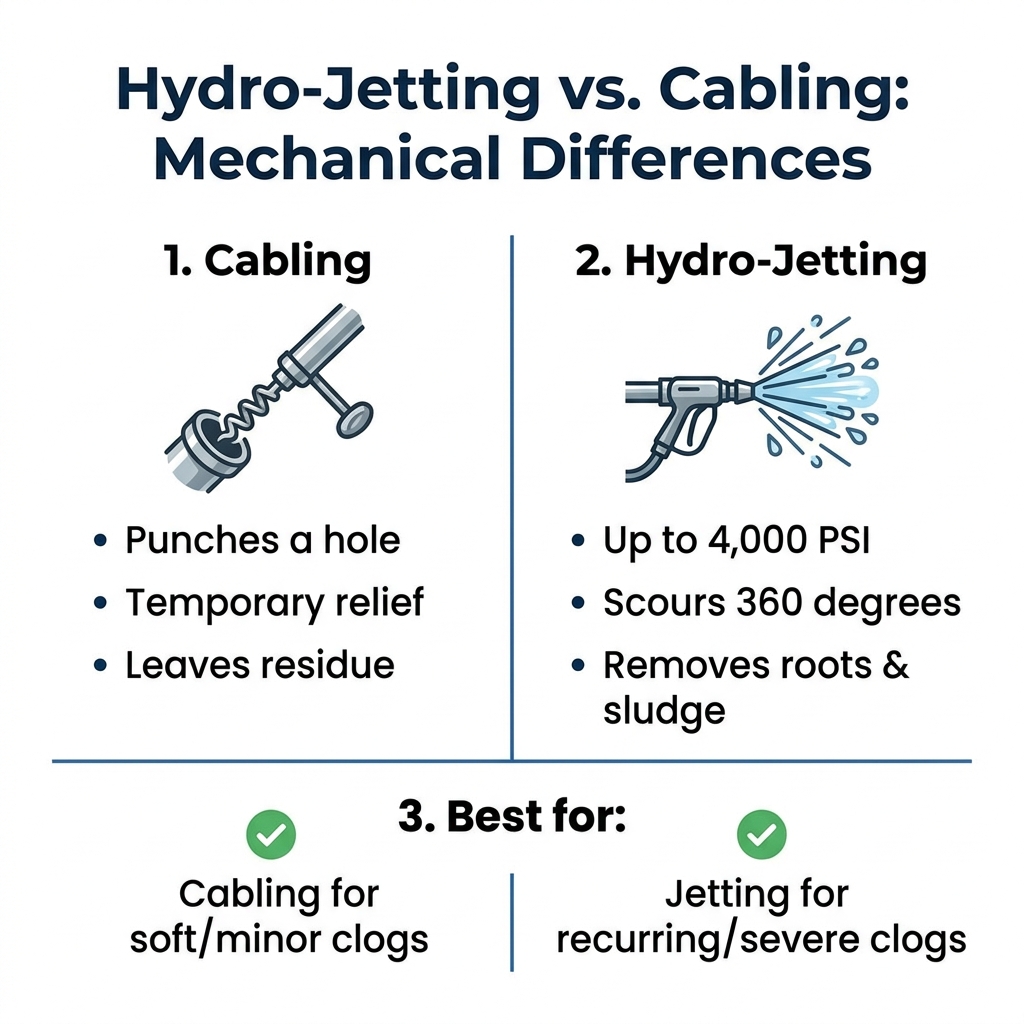
• Primary Mechanism — Traditional Cabling (Snaking): Rotating metal auger physically breaks the clog — High-Pressure Hydro-Jetting: 360-degree high-pressure water scours the pipe
• Effect on Pipe Walls — Traditional Cabling (Snaking): Leaves grease, scale, and root remnants behind — High-Pressure Hydro-Jetting: Washes walls completely clean to near-original state
• Best Used For — Traditional Cabling (Snaking): Soft clogs, foreign objects, temporary relief — High-Pressure Hydro-Jetting: Severe sludge, heavy roots, long-term prevention
• Effectiveness on Roots — Traditional Cabling (Snaking): Punches a hole; roots grow back quickly — High-Pressure Hydro-Jetting: Slices roots flush with the pipe wall
• Longevity of Fix — Traditional Cabling (Snaking): Short-term for severe issues — High-Pressure Hydro-Jetting: Long-term restoration of flow capacity

A common concern among homeowners is whether the intense force of hydro-jetting will destroy their older plumbing. It is a valid question: can up to 4,000 PSI water pressure for hydro-jetting crack a fragile cast iron or clay pipe? The short answer is that in the hands of an untrained individual, yes, it could. However, our professional technicians at Always Affordable Plumbing & HVAC follow strict safety protocols to ensure your plumbing remains intact.
The most critical step in this process is the pre-jetting video camera inspection. Before a drop of water is pressurized, our technician will run a high-definition camera down your main line. They are looking for structural compromises, such as collapsed sections, massive bellies (sags in the pipe), or severely deteriorated cast iron that is flaking away. If your pipe is structurally unsound, we will never recommend jetting, as the pressure could cause a weak pipe to fail completely.
If the pipe is structurally sound but simply older, professionals adjust their approach. They can dial back the water pressure significantly and select specific nozzles designed to be gentle on older materials while still effectively clearing out the sludge. Whether you need a simple clearing or more comprehensive complete plumbing services, safety and pipe integrity are always our top priorities during the assessment.
While traditional cabling offers a quick fix, it is often a false economy when dealing with severe, recurring main line sewer clogs. Paying for a cheaper snaking service two or three times a year quickly adds up, costing you more in the long run than investing in a permanent solution the first time.
One winter morning, a local homeowner woke up to a completely backed-up sewer line and called our team. After receiving a prompt response, our technician provided an affordable quote and successfully unclogged the immediate blockage. More importantly, we took the time to sit down and discuss long-term future maintenance options, ensuring the homeowner understood how to prevent the emergency from happening again.
This is where transparent diagnostics make all the difference. You should always ask to see the camera footage of your sewer line. Seeing the exact problem with your own eyes removes the guesswork. Working with a company like ours that values transparent, budget-conscious pricing means you receive an honest recommendation based on visual evidence. You are empowered with the facts to choose the right solution for your home, without ever feeling pressured into an unnecessary upsell.
Your main sewer line keeps clogging because the underlying cause of the blockage has not been fully removed. Traditional snaking often punches a temporary hole through the clog, leaving sticky grease, scale, and tree root remnants on the pipe walls. In dry climates, tree roots quickly grow back into the pipe, catching new waste and causing the system to back up repeatedly.
The main difference lies in the mechanical approach to clearing the pipe. Cabling uses a rotating metal auger to physically break through the center of a blockage, which restores flow but leaves debris behind. Hydro-jetting uses a 360-degree spray of high-pressure water to scour the entire interior diameter of the pipe, washing all buildup and debris completely out of the system.
Yes, hydro-jetting is safe for older pipes, provided a professional performs a video camera inspection first. A trained technician will assess the structural integrity of your cast iron or clay pipes before proceeding. They can adjust the water pressure and use specialized nozzles to safely clean the line without causing damage to structurally sound, albeit older, plumbing.
No, cabling does not completely remove tree roots from a sewer line. The metal auger will tear through the center of the root mass to allow water to flow, but the thickest parts of the roots remain firmly attached to the pipe joints. To completely slice roots flush with the pipe wall, you need up to 4,000 PSI water pressure for hydro-jetting equipped with a cutting nozzle.
The most common signs of tree root infiltration include slow drains throughout your entire house, frequent gurgling noises from your toilets, and recurring main line sewer clogs that happen every few months. The only way to confirm root intrusion with absolute certainty is to have a professional plumber perform a video camera inspection of your underground pipes.
If you are tired of dealing with recurring main line sewer clogs and temporary fixes that never seem to last, it is time for a professional diagnosis. You do not have to guess what is happening underground or settle for another short-term patch. Schedule a comprehensive video camera inspection to see the exact condition of your pipes and weigh your options objectively. Reach out to the team at Always Affordable Plumbing & HVAC today for expert main line sewer services and get the honest, transparent assessment you need to restore your plumbing for the long haul.
See what our satisfied customers have to say about their experience with Always Affordable
Plumbing & HVAC.

"Chappy was very skilled in his knowledge of my HVAC unit. I greatly appreciate the quick response and experienced tech. The whole endeavor was made less stressful by his humor and honest conversation. I find comfort in knowing I now have a shop i trust for the next time."
"Tony, James, Ronnie did an amazing job setting up our new AC! They were quick, efficient, considerate, and polite! We appreciate them scheduling us in on such short notice. Definitely recommend this company!"
"Prompt, professional service with kindness and care. They came out to address both plumbing and AC issues. I received a courtesy call before they arrived. All issues were resolved the same day with integrity and respect. Thankful for businesses like this. Absolutely recommend to those that I love."
"Excellent service! Jason came out promptly and in addition to doing my outside faucet he also put in new irrigation equipment! All done perfectly! Jason was lovely"
"Honest with the assessment; friendly and good manners. No high pressure sales. Just good to honest "tell it like you see it" Thought my kitchen disposer needed an overhaul. But Jason, there Plumber gave me an honest lesson on what was really happening. Saved me hundreds, if I went the route of replacing. Thank you!"
"Absolutely 5 stars. If you are looking for affordable ,professional and kind. Chappy was excellent and very knowledgeable . I called in the morning because my air conditioner stopped working he was here within hours and fixed my air with a smile. I highly recommend Chappy and Always Affordable plumbing and Hvac."
"Scott and James were great. They got there quickly and diagnosed the problem with my A/C.They did a very thorough job testing everything. Sent me pictures and called to keep me informed. Got it done the next day and everything is working fine. Be glad when I get home so I can enjoy my new system. Thanks guys for a great job."
"Chappy was very helpful. He knew our issue right away, cleaned our coils. He also came on the same day we called and got our AC blowing cold air again."
"After some timing ’curfuffles’ the Tech Jason arrived and not only completed a speedy install on my toilet, he was personable & professional. Because of the timing issues Jason was attentive and showed up with everything needed! No extra store runs 😊 I was very comfortable with having this Tech in my Daughter’s home. We will definitely use this Service again."