Home Maintenance Tips and Troubleshooting: Why Your AC Blows Warm Air
Why is your AC blowing warm air? Get clear answers on safe home maintenance tips and troubleshooting to decide when to check your filter or call for repair.




The first freeze of winter is fast approaching, and your heating system is about to face its biggest test in months. At Always Affordable Plumbing & HVAC, our team typically fields a massive spike in emergency calls during that crucial late-autumn window when overnight temperatures first dip below 40 degrees. If you want to avoid waking up to an icy house, following a comprehensive seasonal home maintenance checklist is the most effective way to prepare. Every year, dormant mechanical systems face immense strain during sudden temperature drops. When a furnace has been sitting idle since early spring, forcing it to suddenly run at full capacity often exposes hidden vulnerabilities that developed during the off-season.
There is a specific, sinking feeling that comes with turning up the thermostat on a freezing morning only to hear silence—or worse, to feel cold air blowing from the vents. A thorough checklist bridges the gap between hoping your system works and knowing it is ready. This preparation covers both HVAC readiness and essential plumbing safeguards to prevent compounding disasters when the weather turns harsh. Whether you are inspecting your air filters or relying on home plumbing services to secure your pipes, early action is the best defense against unexpected breakdowns.
As you work through your preparations, the most important distinction you will learn is the boundary between safe homeowner maintenance and issues that require professional intervention. Taking the right steps now ensures a warm, safe home when the temperatures finally plummet.
Understanding why heating systems struggle after a long period of inactivity helps clarify why proactive checks are so valuable. During the warmer months, dust, pet dander, and airborne debris settle onto critical ignition components inside the furnace cabinet. Whether we are servicing older 80% AFUE standard-efficiency models or modern high-efficiency condensing furnaces, we constantly find that this buildup is a leading culprit. Modern furnaces rely on highly sensitive sensors to operate safely. Even a microscopic layer of dust—as thin as 0.1 millimeters—on a flame sensor can prevent the system from registering that a fire has successfully ignited, prompting the control board to immediately shut down the gas valve as a safety precaution.
The sequence of operations in a heating system is complex and precise. When the thermostat sends a signal calling for heat, the furnace control board runs a series of diagnostic checks. It verifies that the inducer draft motor is venting properly, activates the igniter, and finally opens the gas valve. If any single step in this communication chain breaks down—often due to dormant lubrication, stiffened mechanical parts, or dirty sensors—the sequence halts. The furnace will either fail to start entirely or run for a few seconds before shutting off.
Mechanical parts that sit idle can become stiff, and the lubrication that keeps blower motors spinning freely can degrade over the summer. When these components are suddenly forced to activate on the first freeze of winter, the resulting friction can cause motors to overheat or draw too much electrical current, tripping safety switches. Addressing these airflow and mechanical issues early prevents the need for emergency professional plumbing repair or urgent HVAC diagnostics when local technicians are already booked solid with emergency no-heat calls.
If you find your thermostat calling for heat but system blowing cold air, there are several safe, non-invasive troubleshooting steps we recommend you take before picking up the phone. These basic checks often resolve simple communication errors or power disruptions without requiring you to open the furnace cabinet.
• Verify thermostat settings: Ensure the system is explicitly set to the "heat" position. Next, check the fan setting. The fan should be set to "auto" rather than "on." When set to "on," the blower runs continuously, even when the burners are off, which pushes unheated air through your vents and makes the house feel drafty.
• Check the breaker panel: A sudden power surge or a strained blower motor can trip the circuit breaker. For homes built between 1990 and 2010, we frequently see 15-amp furnace breakers trip when aging blower motors strain against initial startup friction. Locate your home's electrical panel and look for switches labeled for the furnace or HVAC system. If a switch is out of alignment with the others, firmly push it to the "off" position, then back to "on" to reset the connection.
• Inspect indoor vents and registers: Walk through every room to ensure all supply and return vents are fully open. It is a common misconception that closing vents in unused rooms saves energy; in reality, it restricts airflow, increases pressure inside the ductwork, and forces the blower motor to work harder. Remove any rugs, furniture, or curtains blocking the grilles.
• Examine the outdoor unit (for heat pumps): If you rely on a heat pump, check the exterior condenser. Ensure it is not encased in ice, buried in fallen leaves, or blocked by overgrown shrubs. Heat pumps need clear airflow on all sides to extract heat from the outside air efficiently.
Visual inspections remain one of the most effective tools for a homeowner. Without opening any access panels, look for obvious signs of external damage, water pooling around the base of the indoor unit, or severe soot marks near the exhaust flue. Listen closely during the startup cycle. In our daily service calls, we observe that a healthy furnace should start with a gentle click, followed by the hum of the draft motor, and finally the whoosh of the burners igniting. If you hear loud grinding, scraping, or repetitive clicking without ignition, shut the system off at the thermostat immediately to prevent further damage.
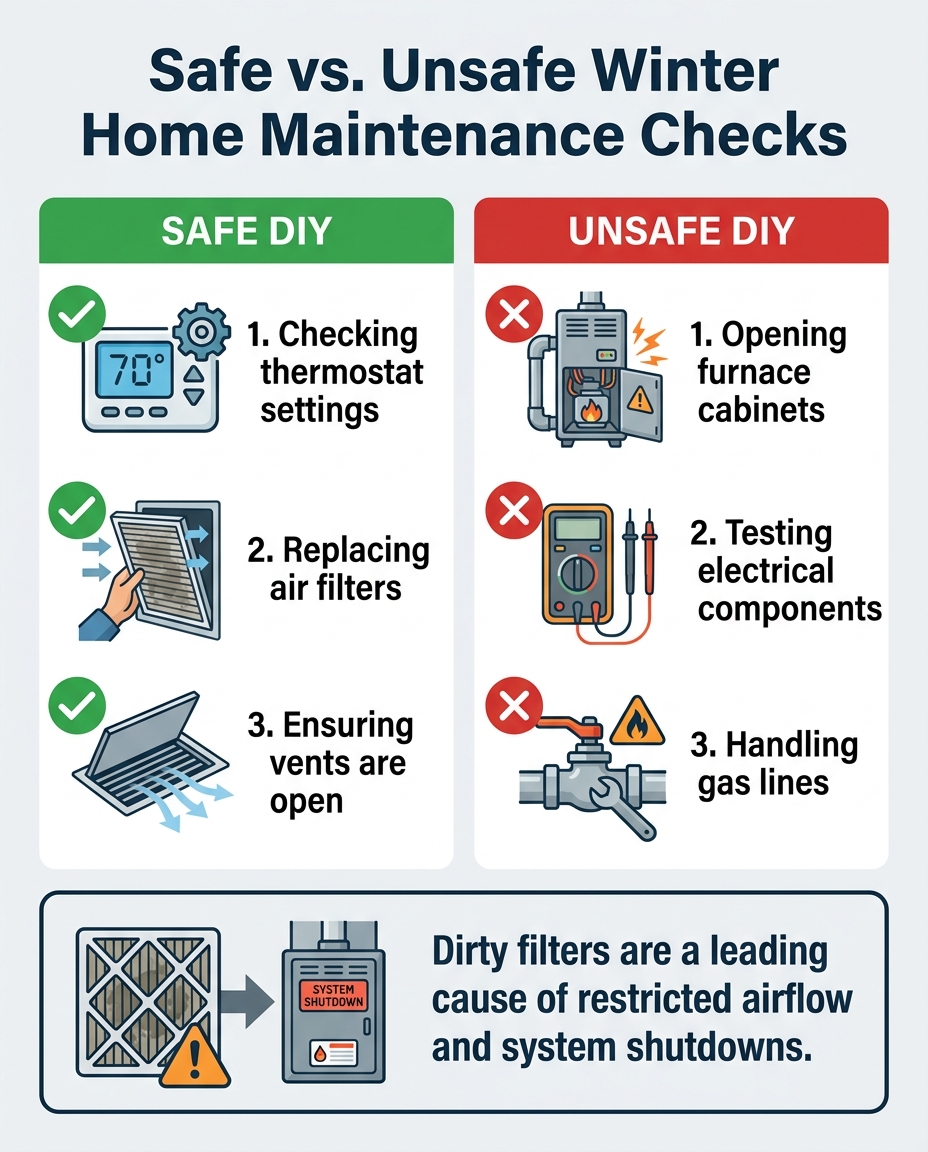

One of the most frequent culprits behind a system failing to perform is severely restricted airflow. When you experience the frustrating scenario of a thermostat calling for heat but system blowing cold air, the condition of your air filter is the very first thing that should be checked. In our experience testing static pressure in local ductwork, a standard filter left in place for over 90 days can restrict airflow by up to 40%. The filter's primary job is to protect the internal mechanical components from dust and debris, not just to clean the air you breathe.
When a filter becomes clogged with months of accumulated dust, the blower motor has to work exceptionally hard to pull air through the dense barrier. This leads to a predictable sequence of failures:
1. Restricted intake: The blower cannot pull enough cold return air into the system to be heated.
2. Heat buildup: Because there is not enough air moving across the heat exchanger to absorb the generated heat, the internal temperature of the furnace spikes rapidly.
3. Safety shutdown: A component called the high limit switch detects this dangerous internal temperature and immediately shuts down the burners to prevent a fire or a cracked heat exchanger.
4. Cold air circulation: The blower motor often continues to run to cool the overheated cabinet down, resulting in cold air blowing from your vents while the burners remain locked out.
Department of Energy data consistently indicates that dirty filters are a primary cause of HVAC failure and inefficiency. We constantly remind our customers that a clogged filter can increase energy consumption by forcing the system to run longer cycles just to maintain the target temperature. To prevent this, filters should be checked monthly and replaced at least every 90 days—or more frequently if you have pets or live in an area prone to high dust. Maintaining proper airflow ensures consistent indoor temperatures, reduces strain on the blower motor, and prevents the system from triggering protective shutdowns.
While the furnace often takes center stage during winter preparations, freezing temperatures threaten your home's plumbing pipes just as aggressively. A truly comprehensive seasonal checklist must transition from HVAC readiness to whole-home plumbing survival. When water freezes inside a pipe, it expands with immense force, easily bursting exposed lines. Our plumbing crews have witnessed firsthand the severe water damage caused by frozen half-inch copper and PVC lines during sudden late-December cold snaps, making plumbing winterization a non-negotiable part of your fall routine.
• Insulate exposed pipes: Any water supply lines located in unheated areas—such as basements, crawlspaces, attics, and exterior walls—should be wrapped in foam pipe insulation. Pay special attention to pipes near exterior vents.
• Disconnect exterior hoses: Remove all garden hoses from outdoor spigots. If a hose is left attached, water remains trapped in the spigot assembly, where it can freeze and crack the fixture deep inside the exterior wall.
• Schedule main line maintenance: Winter holidays bring increased household strain from guests and cooking. Arranging for main sewer line clearing before the ground freezes and the house fills with visitors prevents disastrous backups during gatherings.
• Maintain drains safely: Keep drains flowing freely by using enzyme-based treatments rather than harsh chemical drain cleaners. Chemical cleaners generate intense heat that can warp or damage older plumbing infrastructure.
Regional climate factors also play a significant role in plumbing health. In areas like Sacramento, hard water is a persistent issue. The high concentration of calcium and magnesium in the water supply leads to scale buildup inside plumbing fixtures and water heaters. In fact, our plumbers routinely flush 5 to 10 pounds of calcium scale out of standard 40- and 50-gallon water heaters during annual maintenance visits. During the colder months, water heaters have to work much harder to raise the temperature of the incoming cold municipal water.
This increased workload causes minerals to precipitate out of the water faster, settling as a thick layer of sediment at the bottom of the tank. This sediment insulates the heating element, forcing the unit to run longer, waste energy, and endure heavier structural strain. Flushing the water heater to remove this hard water scale should be a priority on your seasonal checklist to ensure reliable hot water throughout the winter.
While basic maintenance is highly encouraged, there is a definitive, safety-first threshold where homeowners must abandon DIY efforts and hire a licensed professional. Heating systems utilize high-voltage electricity, combustible gases, and complex venting procedures to operate safely. Attempting to repair these systems without the proper training and diagnostic tools puts your home and family at severe risk. Our licensed technicians rely on specialized manometers and multimeters to safely diagnose these exact issues.
Opening the furnace cabinet, testing electrical components, or handling gas lines is strictly off-limits for unlicensed individuals. If you have verified the thermostat, checked the breaker, and replaced the air filter, but you still have a thermostat calling for heat but system blowing cold air, it is time to call an expert.
Watch for these specific warning signs that require immediate professional attention:
• Strong odor of gas or rotten eggs — What It Usually Means: A potential leak in the gas supply line or valve assembly. — Required Action: Evacuate immediately and call your utility company or emergency services.
• Rapid short-cycling (turning on and off every few minutes) — What It Usually Means: Overheating issues, a failing flame sensor, or a malfunctioning control board. — Required Action: Turn the system off at the thermostat and schedule a professional diagnostic.
• Persistent cold air despite a clean filter — What It Usually Means: Ignition failure, a broken gas valve, or a cracked heat exchanger. — Required Action: Leave the system off and contact a licensed HVAC technician.
Beyond the immediate physical dangers, unauthorized DIY repairs often void manufacturer warranties. Most equipment manufacturers stipulate that any internal repairs or parts replacements must be performed by a certified technician to keep the warranty valid. Just as you need to know the best way to clean drain pipes safely without destroying your plumbing, you must know when to step back from your furnace. Professional diagnostics remain the only safe resolution for complex ignition failures.
The most reliable way to avoid the stress of a system failure on the first freeze of winter is to invest in professional preventative maintenance before the cold weather arrives. A comprehensive fall tune-up breaks the cycle of unexpected breakdowns by catching minor wear and tear before it escalates into a freezing-day emergency.
During a professional seasonal tune-up, our licensed technicians perform a deep dive into the system's mechanics. We test all safety controls to ensure the furnace will shut down properly in an emergency. We carefully clean the burners and the flame sensor, removing the off-season dust that causes so many early-winter ignition failures. Our team will also verify all electrical connections, measure the amperage draw on the blower motor, and inspect the heat exchanger for microscopic cracks that could leak carbon monoxide into the home.
Consistent maintenance does more than just prevent sudden failures; it actively extends the lifespan of both your HVAC and plumbing systems. Equipment that is cleaned, calibrated, and properly lubricated runs more efficiently, reducing monthly energy consumption and delaying the need for costly replacements. Federal tax credits or utility incentive programs may even apply to qualifying high-efficiency upgrades, though it is always best to verify current programs with your utility provider.
Working with Always Affordable Plumbing & HVAC means partnering with a team committed to transparent, reliable service. When professional intervention is required, having a provider that stands behind their work with a 100% satisfaction guarantee makes seasonal maintenance accessible and completely stress-free.
There is an undeniable peace of mind that comes with knowing your home is fully prepared for whatever the changing seasons bring. By following a structured seasonal home maintenance checklist, you take control of your home's comfort and safety. From clearing away debris and changing filters to insulating vulnerable pipes, these proactive steps form the first line of defense against the cold.
However, you do not have to tackle the winterization process alone. Whether you are facing a stubborn heating issue that refuses to resolve, or you need professional plumbing repair to secure an aging water heater before the first freeze of winter, expert help is readily available. With decades of combined local experience, we know exactly what it takes to keep your systems running strong. Do not wait for the temperature to drop below freezing to find out if your systems are ready. Schedule a professional inspection today to ensure your home remains a warm, safe sanctuary all season long.
Why is my furnace blowing cold air at the start of winter?
This usually happens because the burners have failed to ignite, but the blower motor is still running. In our experience, common causes include a dirty flame sensor, a clogged air filter causing the system to overheat and lock out, or a thermostat mistakenly set to "on" instead of "auto." If replacing the filter and checking the thermostat doesn't fix it, a professional diagnostic is required.
What HVAC checks should be on my seasonal maintenance list?
We recommend prioritizing your thermostat operation, replacing the air filter, and ensuring all indoor vents are unobstructed. You should also visually inspect the outdoor unit to ensure it is clear of leaves and debris. Finally, scheduling a professional tune-up to clean the internal burners and test safety controls is highly recommended.
Why won't my furnace ignite on the first cold day?
Furnaces often fail to ignite after sitting dormant because dust and debris have settled on the sensitive electronic ignition components. If the flame sensor is insulated by dust, it cannot detect a fire and will immediately shut off the gas supply. Stiff mechanical parts and degraded lubrication from months of inactivity can also prevent the system from starting properly.
How do I prepare my house's plumbing for winter?
You should start by insulating any exposed water supply lines in unheated areas like basements, crawlspaces, and exterior walls. Disconnect all outdoor garden hoses to prevent water from freezing inside the spigots. Additionally, having your main sewer line cleared and your water heater flushed will reduce strain on your plumbing during the heavy-use holiday season.
What is the safest way to test my heating system before freezing temperatures arrive?
The safest method is to turn your thermostat to "heat" and raise the temperature a few degrees above the current room temperature on a mild fall day. Listen for the system to click on, the draft motor to start, and the burners to ignite smoothly. Let it run for at least fifteen minutes to ensure it produces consistent warm air without short-cycling or producing strange odors.
When should I stop troubleshooting my furnace and call a professional?
You should stop immediately if you smell gas, hear loud grinding noises, or notice the system rapidly turning on and off. Homeowners should never open the sealed furnace cabinet, test electrical components, or attempt to clean sensors themselves. If basic checks like replacing the filter and resetting the breaker do not restore heat, it is time to call a licensed technician.
See what our satisfied customers have to say about their experience with Always Affordable
Plumbing & HVAC.

"Chappy was very skilled in his knowledge of my HVAC unit. I greatly appreciate the quick response and experienced tech. The whole endeavor was made less stressful by his humor and honest conversation. I find comfort in knowing I now have a shop i trust for the next time."
"Tony, James, Ronnie did an amazing job setting up our new AC! They were quick, efficient, considerate, and polite! We appreciate them scheduling us in on such short notice. Definitely recommend this company!"
"Prompt, professional service with kindness and care. They came out to address both plumbing and AC issues. I received a courtesy call before they arrived. All issues were resolved the same day with integrity and respect. Thankful for businesses like this. Absolutely recommend to those that I love."
"Excellent service! Jason came out promptly and in addition to doing my outside faucet he also put in new irrigation equipment! All done perfectly! Jason was lovely"
"Honest with the assessment; friendly and good manners. No high pressure sales. Just good to honest "tell it like you see it" Thought my kitchen disposer needed an overhaul. But Jason, there Plumber gave me an honest lesson on what was really happening. Saved me hundreds, if I went the route of replacing. Thank you!"
"Absolutely 5 stars. If you are looking for affordable ,professional and kind. Chappy was excellent and very knowledgeable . I called in the morning because my air conditioner stopped working he was here within hours and fixed my air with a smile. I highly recommend Chappy and Always Affordable plumbing and Hvac."
"Scott and James were great. They got there quickly and diagnosed the problem with my A/C.They did a very thorough job testing everything. Sent me pictures and called to keep me informed. Got it done the next day and everything is working fine. Be glad when I get home so I can enjoy my new system. Thanks guys for a great job."
"Chappy was very helpful. He knew our issue right away, cleaned our coils. He also came on the same day we called and got our AC blowing cold air again."
"After some timing ’curfuffles’ the Tech Jason arrived and not only completed a speedy install on my toilet, he was personable & professional. Because of the timing issues Jason was attentive and showed up with everything needed! No extra store runs 😊 I was very comfortable with having this Tech in my Daughter’s home. We will definitely use this Service again."