
AC vs. Heat Pump: Options Comparisons for Homeowners Facing a System Failure
When your AC fails, choosing a replacement is a major choice. Review these options comparisons for homeowners to weigh SEER2 ratings and decide with confidence.



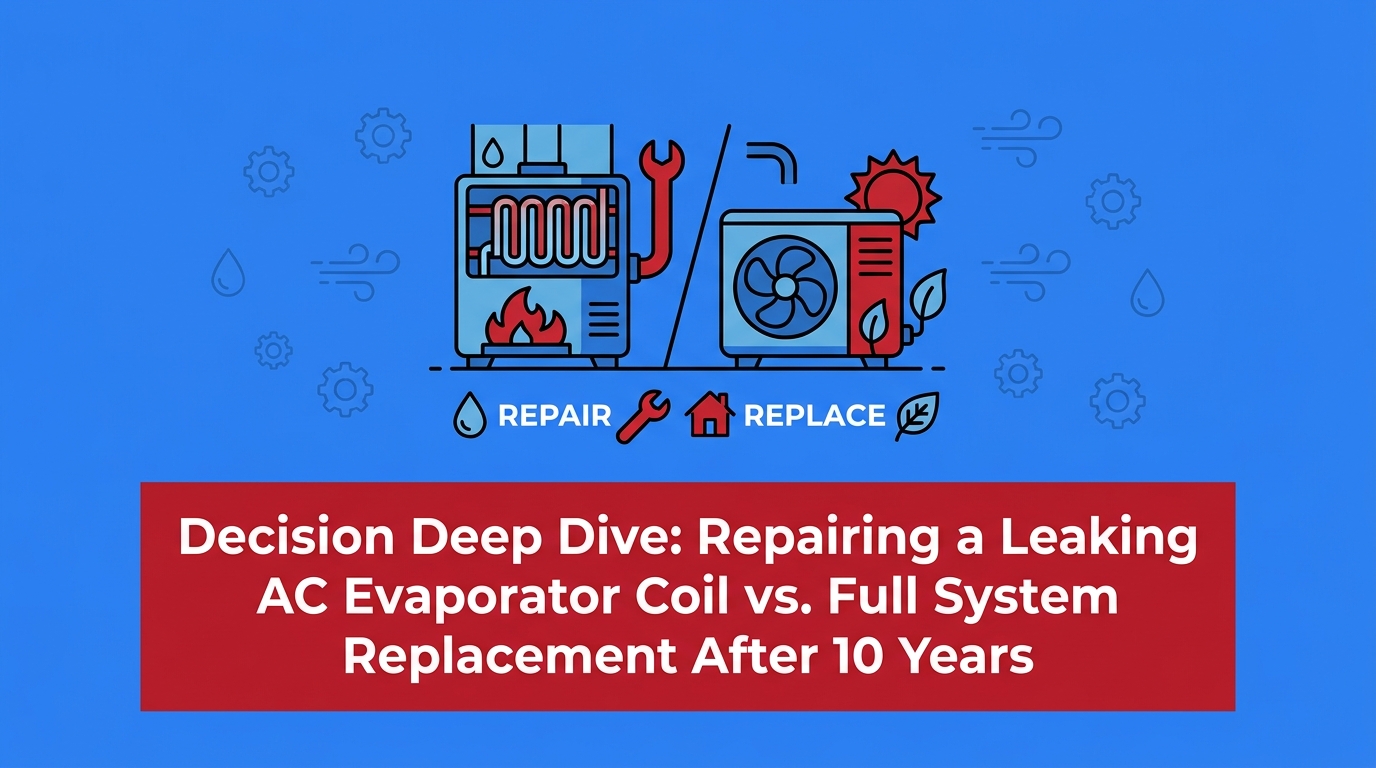
Is your air conditioning system running nonstop but still blowing warm air throughout the house? When one of our technicians at Always Affordable Plumbing & HVAC diagnoses a refrigerant leak on an evaporator coil inside a unit that is entering its second decade of service, you face a significant mechanical crossroad. Repairing a leaking AC evaporator coil vs. full system replacement after 10 years is one of the most critical structural decisions a homeowner will make regarding their property's comfort infrastructure.
The immediate frustration of discovering a compromised indoor coil is undeniable. Your home is uncomfortable, the system is struggling, and you are suddenly looking at a major repair on older equipment. Whether you are seeking immediate diagnostic help or comprehensive air conditioning services, understanding the mechanics of your system is the first step toward a lasting solution.
Making the right choice requires looking beyond the immediate leak to evaluate the overall health of your aging equipment. The evaporator coil is responsible for absorbing the heat and humidity from your indoor air. Over a decade of constant condensation, thermal expansion, and exposure to airborne volatile organic compounds, the copper or aluminum tubing naturally weakens. This leads to microscopic holes known as formicary corrosion. While replacing this single component might seem like the most direct fix, a neutral, mechanical evaluation of the entire system often reveals a more complex reality. A 10-year system age means every other moving part has also endured a decade of continuous operation.
Central air conditioners typically last 10 to 15 years, meaning a 10-year-old unit is already entering its final operational phase. Even if you have maintained a rigorous routine HVAC maintenance plan over the life of the equipment, baseline mechanical degradation is inevitable. In our experience serving the local area, framing a coil failure as an isolated incident often leads to repeated, frustrating service calls. Instead, it helps to view the leaking coil as a primary symptom of broader system aging.
Here is what the 10-year mark means for the rest of your air conditioning system:
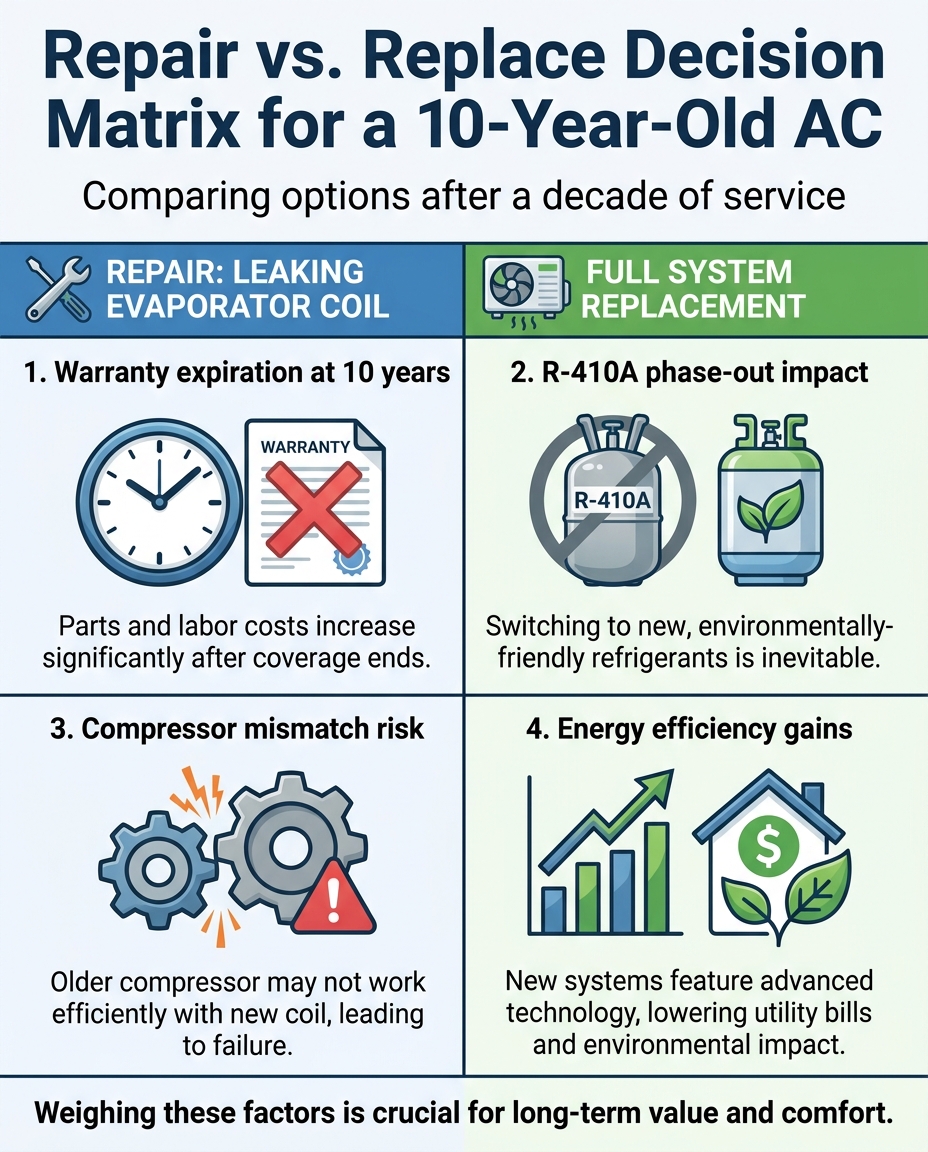
1. Warranty Expiration: Standard HVAC manufacturer parts warranties typically expire exactly at the 10-year mark. Once that anniversary passes, you assume full financial responsibility for every subsequent component failure, from a blown capacitor to a seized compressor.
2. Compressor Wear and Tear: The outdoor compressor is the heart of your system. After a decade of compressing refrigerant gas, its internal valves, bearings, and motor windings have experienced significant wear. It no longer operates with the same volumetric efficiency it had on day one.
3. Condenser Coil Degradation: The outdoor coil, which releases the heat absorbed from your home, has spent ten years exposed to rain, dirt, debris, and UV degradation. Its ability to transfer heat efficiently is likely compromised.
4. Electrical Component Fatigue: Contactors, which act as heavy-duty switches to turn the system on and off, become pitted and burned over thousands of cycles. Blower motors and condenser fan motors experience bearing wear that increases their electrical draw and heat output.
When you evaluate a 10-year system age, the leaking indoor coil is rarely the only component nearing the end of its functional life. Investing heavily into repairing one side of the system leaves the other half highly vulnerable to imminent failure.
The Problem: A pattern we see often is homeowners choosing to replace the compromised indoor coil, assuming the system will return to normal operation. However, shortly after the repair, the outdoor unit completely fails, leaving them with a much larger disaster.
The Cause: Air conditioning systems operate on a delicate balance of pressure and thermodynamics. A brand new evaporator coil operates at peak efficiency. It absorbs heat perfectly and processes refrigerant at the exact high pressures the system was originally designed to handle. However, your 10-year-old outdoor compressor has gradually weakened over time. It is accustomed to pushing against the lower resistance of an aging, inefficient system. Sometimes, what looks like a simple drainage issue—such as an AC unit leaking water in the garage—is actually a symptom of a freezing coil caused by low refrigerant and poor pressure balance.
The Solution: When you connect a high-efficiency new coil to a worn compressor, you introduce sudden, severe mechanical strain. The old compressor must suddenly work much harder to meet the pressure demands of the new indoor unit. This engineering mismatch frequently causes the compressor's aging seals or valves to blow out entirely. Because of this chain reaction, replacing just the indoor coil is often considered a short-term band-aid rather than a permanent, reliable solution.
Beyond the mechanical risks we evaluate in the field, regulatory changes play a massive role in deciding whether to repair or replace an older system. The Environmental Protection Agency (EPA) heavily regulates the types of refrigerants used in residential cooling systems due to their environmental impact.
If your system is 10 years old, it almost certainly uses R-410A refrigerant. The EPA is currently in the process of a massive phase-down of R-410A, transitioning the industry toward newer, more environmentally friendly A2L refrigerants like R-454B and R-32. This phase-out directly impacts the long-term viability and serviceability of older AC units.
As R-410A production decreases, the supply becomes restricted. If you choose to replace your leaking evaporator coil today, you are locking yourself into keeping an R-410A system. If that system develops another leak or requires major service three or four years from now, accessing the necessary refrigerant will be significantly more difficult. Investing heavily into a system that relies on outdated, increasingly scarce refrigerant technology rarely makes long-term sense. Upgrading to a new system ensures you are compliant with modern standards and have access to readily available materials for the next decade or more.
Our team knows firsthand that the local climate is a ruthless tester of mechanical limits. With intense summer heatwaves putting severe strain on aging AC systems in the local area, a 10-year-old unit with a compromised coil is highly susceptible to total failure during peak temperatures. Air conditioners are not tested during mild spring afternoons; they are pushed to their absolute breaking point when the thermometer crosses the 100-degree mark.
During a severe heatwave, your system is tasked with removing both sensible heat (temperature) and latent heat (humidity) from your home. A compromised system with a refrigerant leak on the evaporator coil struggles to maintain cooling capacity. Because it cannot absorb heat efficiently, the thermostat never reaches its target temperature. The system runs in continuous, unending cycles.
This constant operation prevents the outdoor compressor from ever cooling down. The internal motor windings overheat, the oil breaks down, and the mechanical wear accelerates exponentially. What might have been a slow, manageable decline during the spring quickly turns into a catastrophic, permanent system failure during a July heatwave. Relying on a patched, aging system during the hottest weeks of the year is a significant gamble with your home's comfort.
Navigating this decision requires an objective, non-salesy framework. At Always Affordable Plumbing & HVAC, our approach focuses on providing honest, transparent cost-benefit analyses to help homeowners make the best financial choice without fear of unnecessary upsells. By weighing the upfront investment against long-term reliability and efficiency gains, you can determine the most logical path forward.
• Upfront Investment — Repairing the Evaporator Coil: Requires a lower initial output, but involves significant labor for a single component. — Full System Replacement: Requires a larger initial commitment, but resets the lifespan of the entire HVAC infrastructure.
• Warranty Status — Repairing the Evaporator Coil: The new coil may have a limited warranty, but the aging outdoor unit remains completely unprotected. — Full System Replacement: Provides a brand new 10-year manufacturer parts warranty covering the entire system.
• Compressor Risk — Repairing the Evaporator Coil: High risk of secondary failure due to the pressure mismatch between new and old components. — Full System Replacement: Zero mismatch risk; indoor and outdoor units are engineered and matched from the factory.
• Energy Efficiency — Repairing the Evaporator Coil: Retains the older, less efficient SEER rating of the original 10-year-old equipment. — Full System Replacement: Upgrades to modern SEER2 standards, offering significant reductions in monthly utility consumption.
• Refrigerant Compatibility — Repairing the Evaporator Coil: Locks the home into using older R-410A refrigerant, which is currently being phased out. — Full System Replacement: Utilizes modern, EPA-compliant refrigerants that will be readily available for decades.
While replacement is generally the most stable long-term option for a decade-old system, there are specific scenarios where repairing the coil makes sense. You might consider an isolated repair if:
• Recent Partial Upgrades: If the outdoor condenser was recently replaced due to a separate issue and is still under its active manufacturer warranty.
• Imminent Relocation: If you are planning to move out of the property in the next few months and need a functional system to facilitate a home sale.
• Strict Budget Limitations: If immediate constraints require a short-term fix while you actively plan and budget for a professional HVAC replacement in the near future.
For most homeowners facing a major component failure at the 10-year mark, full replacement provides the most logical return on investment. You should strongly consider a new system if:
• The Warranty Has Expired: If the system is over 10 years old and entirely out of manufacturer parts warranty.
• Avoiding Mismatch Risks: If you want to eliminate the high probability of the outdoor compressor failing shortly after the indoor coil is replaced.
• Seeking Efficiency Gains: If you want to take advantage of modern SEER2 efficiency ratings to lower your monthly utility consumption.
• Long-Term Reliability: If you plan on staying in the home for the foreseeable future and want confidence during extreme weather.
• Incentives and Rebates: If you want to maximize value, as federal tax credits or local utility incentive programs may apply to qualifying high-efficiency installations (we advise verifying current programs with your utility or a tax professional).

In most cases, replacing an evaporator coil on a 10-year-old system is not recommended due to the high risk of subsequent compressor failure. At ten years, the system's original warranty has typically expired, meaning you have no protection against other aging components breaking down. Investing heavily into a single part often acts as a short-term band-aid rather than a lasting solution. Upgrading the entire system usually provides a better long-term return on investment.
Yes, it is mechanically possible to replace just the indoor coil, but it introduces significant engineering risks. A brand new indoor coil operates at factory-level pressures, which forces the older, weakened outdoor compressor to work much harder. This mechanical mismatch frequently causes the aging outdoor unit to fail shortly after the indoor repair is completed. Matching new indoor components with old outdoor components is generally discouraged by industry professionals.
When an AC coil leaks, the system loses refrigerant, which forces the compressor to run longer cycles to achieve the same cooling effect. This constant operation causes the compressor's internal motor windings to overheat and degrades the lubricating oil inside the unit. Over time, running a system with a leaking coil will cause catastrophic damage to the compressor valves and bearings, often resulting in complete mechanical seizure.
AC evaporator coils typically last between 10 and 15 years, which aligns with the overall expected lifespan of a central air conditioning system. Their longevity heavily depends on indoor air quality, the presence of volatile organic compounds, and how often routine maintenance is performed. Once a coil reaches the 10-year mark, the metal tubing naturally weakens, making it highly susceptible to formicary corrosion and microscopic leaks.
Yes, replacing the entire system provides substantial energy efficiency benefits compared to a simple coil repair. A 10-year-old system operates on outdated SEER standards and has likely lost efficiency due to mechanical wear over time. A full replacement introduces modern SEER2 technology, variable-speed blowers, and high-efficiency compressors, which work together to significantly reduce the electrical consumption required to cool your home.
Deciding between repairing a compromised indoor coil and upgrading your entire system requires weighing mechanical wear, warranty status, and future refrigerant availability. While a targeted repair might seem appealing in the moment, the strain it places on a decade-old compressor often leads to larger, more complex failures down the road. By evaluating the system as a complete infrastructure rather than a collection of isolated parts, you can avoid throwing good money after bad.
Our team at Always Affordable Plumbing & HVAC encourages a professional, transparent assessment of your entire HVAC setup before committing to a major repair on aging equipment. Having a clear mechanical framework leads to the most cost-effective long-term decision for your household. If a system upgrade proves to be the most logical path forward, exploring financing options for full system replacement can help make the transition smooth and manageable. Ultimately, understanding the true condition of your 10-year-old system ensures you achieve lasting comfort and reliability.
See what our satisfied customers have to say about their experience with Always Affordable
Plumbing & HVAC.

"Chappy was very skilled in his knowledge of my HVAC unit. I greatly appreciate the quick response and experienced tech. The whole endeavor was made less stressful by his humor and honest conversation. I find comfort in knowing I now have a shop i trust for the next time."
"Tony, James, Ronnie did an amazing job setting up our new AC! They were quick, efficient, considerate, and polite! We appreciate them scheduling us in on such short notice. Definitely recommend this company!"
"Prompt, professional service with kindness and care. They came out to address both plumbing and AC issues. I received a courtesy call before they arrived. All issues were resolved the same day with integrity and respect. Thankful for businesses like this. Absolutely recommend to those that I love."
"Excellent service! Jason came out promptly and in addition to doing my outside faucet he also put in new irrigation equipment! All done perfectly! Jason was lovely"
"Honest with the assessment; friendly and good manners. No high pressure sales. Just good to honest "tell it like you see it" Thought my kitchen disposer needed an overhaul. But Jason, there Plumber gave me an honest lesson on what was really happening. Saved me hundreds, if I went the route of replacing. Thank you!"
"Absolutely 5 stars. If you are looking for affordable ,professional and kind. Chappy was excellent and very knowledgeable . I called in the morning because my air conditioner stopped working he was here within hours and fixed my air with a smile. I highly recommend Chappy and Always Affordable plumbing and Hvac."
"Scott and James were great. They got there quickly and diagnosed the problem with my A/C.They did a very thorough job testing everything. Sent me pictures and called to keep me informed. Got it done the next day and everything is working fine. Be glad when I get home so I can enjoy my new system. Thanks guys for a great job."
"Chappy was very helpful. He knew our issue right away, cleaned our coils. He also came on the same day we called and got our AC blowing cold air again."
"After some timing ’curfuffles’ the Tech Jason arrived and not only completed a speedy install on my toilet, he was personable & professional. Because of the timing issues Jason was attentive and showed up with everything needed! No extra store runs 😊 I was very comfortable with having this Tech in my Daughter’s home. We will definitely use this Service again."


