Home Maintenance Troubleshooting: Fixing HVAC Short-Cycling & Stubborn Plumbing Clogs
Why is your HVAC short-cycling? See how basic home maintenance tips and troubleshooting prevent extreme weather breakdowns, and decide when to call a pro.



Your AC is running nonstop, but the house still feels warm. When you are looking for reliable home maintenance tips and troubleshooting, a sudden cooling failure during peak summer heat is the ultimate test of your home's systems. That immediate discomfort quickly turns into a stressful guessing game. Is the system completely broken, or is it just a minor glitch you can fix yourself? Before you panic, it helps to understand that in our years of serving the local area, our team at Always Affordable Plumbing & HVAC has found that not every cooling issue requires a major repair, provided you know exactly where to look first.
The go/no-go checklist: To keep you safe and prevent accidental damage to your system, you need a strict go/no-go troubleshooting checklist. This framework separates the basic, safe checks you can perform immediately from the complex mechanical issues that require a licensed technician. Following this process ensures you do not waste time or risk your safety when the temperatures inside start climbing to uncomfortable levels.
Comprehensive home care encompasses everything from the air you breathe to the water flowing through your pipes. A trusted local provider handles both residential plumbing services and professional drain and sewer clearing alongside your HVAC needs, ensuring your entire house operates smoothly when the weather pushes it to the limit.
Before you start inspecting equipment, you need to define the exact symptoms of your cooling failure. A vague sense that the house is too warm is not enough information to diagnose the baseline issue. You must look at the data your system is giving you, starting directly at the control center on your wall.
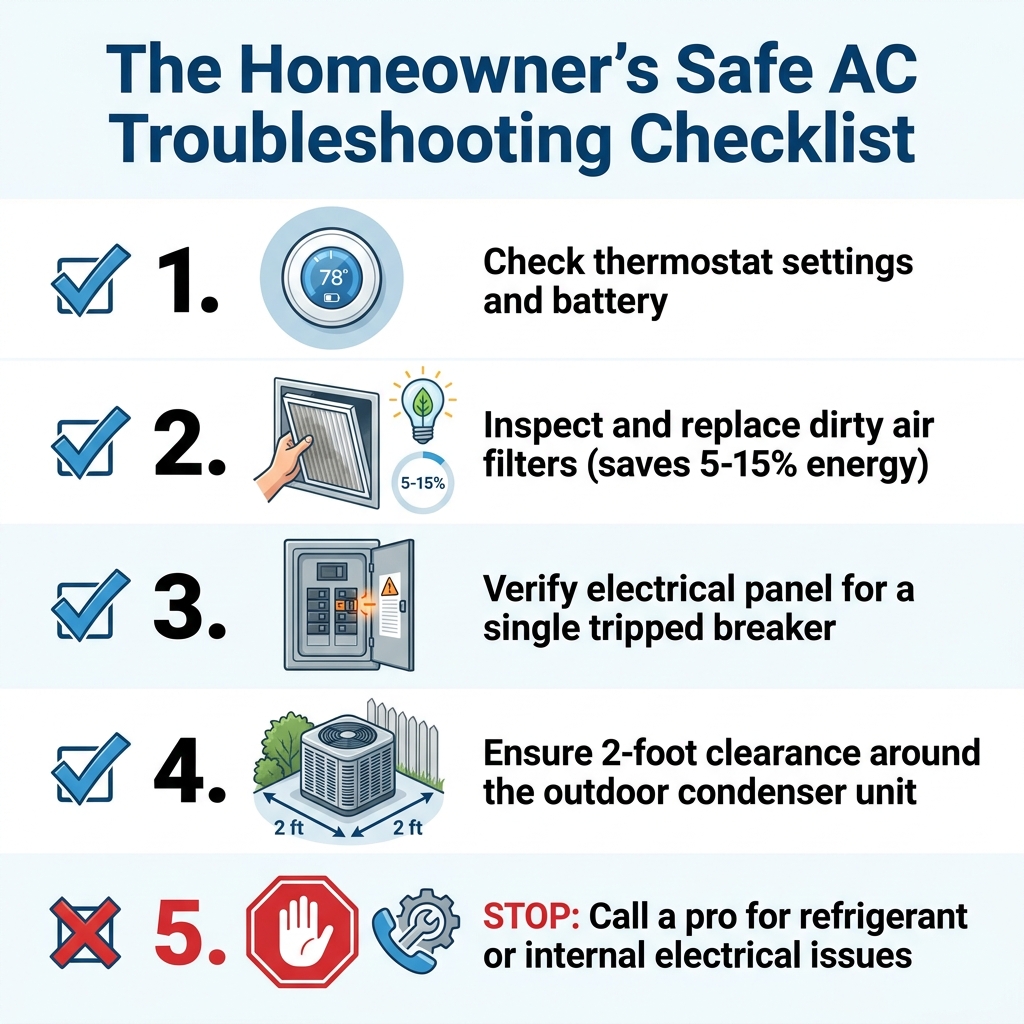
Checking the thermostat data: The first step is accurately reading the thermostat to confirm a genuine failure. If you notice the thermostat indoor temp rising above setpoint—for example, you have it set to 72°F, but the display reads 78°F and continues to climb—you have a confirmed cooling deficit. Modern thermostats often display error codes, flashing lights, or specific warning messages. Write down any codes you see, as these will guide your next steps and provide vital information if you eventually need to call a technician.
Our technicians see this constantly: with extreme summer temperatures in the Sacramento area forcing AC units to work at maximum capacity, these systems become highly susceptible to overheating if airflow is restricted. The difference between a minor airflow issue and a major mechanical failure often comes down to how the system behaves when it tries to turn on.
• Running constantly but blowing warm air — Common Causes: Clogged filter, dirty condenser coils, refrigerant leak — Immediate Action: Check airflow components and outdoor unit clearance
• System won't turn on at all (blank thermostat) — Common Causes: Tripped breaker, dead thermostat batteries, blown fuse — Immediate Action: Replace batteries, check the main electrical panel
• Short-cycling (turning on and off rapidly) — Common Causes: Oversized unit, severe airflow restriction, failing capacitor — Immediate Action: Inspect air filter, listen for strange noises at the unit
Your HVAC system will usually tell you it is struggling before it completely shuts down. Listen carefully for unusual noises at both the indoor air handler and the outdoor condenser. A loud grinding sound often points to a failing motor bearing, while a high-pitched hissing noise can indicate a dangerous pressure buildup or a refrigerant leak. Hissing or bubbling sounds should prompt you to turn the system off immediately.
Next, feel the airflow at the vents in various rooms. You need to determine if the air is blowing weakly, or if it is blowing forcefully but feels entirely warm. Weak airflow usually points to a physical blockage, like a collapsed duct or a severely clogged filter. Strong but warm airflow indicates that the blower motor is working perfectly, but the refrigeration cycle itself has failed to extract heat from your home.
The safest, most common DIY troubleshooting step that any homeowner can perform immediately is checking the air filter. It sounds overly simple, but a dirty filter is the leading cause of restricted airflow, system strain, and completely frozen evaporator coils. When warm return air cannot physically pass over the cold indoor coil, the condensation on that coil turns to solid ice, completely stopping the cooling process.
The efficiency impact: According to the Department of Energy, replacing a clogged filter with a clean one can lower your air conditioner's energy consumption by 5% to 15%. During peak summer heat, that translates to significant energy savings and a drastically reduced risk of a mid-season breakdown.
Here is how to safely locate, inspect, and replace your standard HVAC filters:
1. Turn off the system: Always switch the thermostat to the "off" position before pulling the filter. If the system kicks on while the filter is removed, it will suck dust and debris directly into the sensitive blower motor.
2. Locate the filter housing: Filters are typically located in the return air grille on a wall or ceiling, or sliding into a slot directly next to the indoor air handler in the garage, closet, or attic.
3. Perform the light test: Pull the filter out and hold it up to a light bulb or a bright window. If you cannot see light shining through the material, the filter is completely clogged and must be replaced.
4. Check the directional arrows: When inserting the new filter, look at the cardboard frame. There will be an arrow indicating the direction of airflow. This arrow must always point toward the air handler (the main equipment), not toward the living space.
5. Secure the cover: Ensure the filter door or grille is securely latched so air does not bypass the filter entirely.
If the filter is clean but the system refuses to turn on, your next step is checking the power supply. A central air conditioner requires a massive amount of electricity to start up, especially the compressor. Guide yourself through checking basic power connections without ever crossing the line into dangerous electrical work.
Checking the main panel: Locate your home's main electrical panel. Look for the breakers labeled "AC," "Condenser," or "HVAC." You are looking for a breaker that is sitting in the middle position—not fully "on" and not fully "off." Sometimes, a tripped breaker looks like it is still in the "on" position, but it will feel slightly loose or spongy if you push it.
If you see a tripped breaker while the thermostat indoor temp rising above setpoint is making the house unbearable, you can safely reset it one time. Push the breaker firmly all the way to the "off" position until you hear a solid click, and then push it firmly back to the "on" position. Wait five minutes to see if the system powers up normally.
The strict rule of one reset: Our technicians always advise homeowners to establish a hard boundary right here. If the breaker trips a second time, stop immediately. Do not reset it again. A breaker that repeatedly trips is doing its job—it is protecting your home from a serious electrical fault, a short circuit, or a seized compressor that is drawing too much amperage. Forcing it back on can cause catastrophic damage to the equipment or even start an electrical fire. At this point, professional diagnosis is mandatory.
The outdoor component of your AC system, known as the condenser, is responsible for taking the heat removed from your house and releasing it into the outside air. If this unit cannot breathe, the heat stays trapped inside, leading to warm air blowing from your vents.
Visual inspection for blockages: Walk outside and visually inspect the outdoor unit. You are looking for heavy layers of dirt, overgrown vegetation, accumulated leaves, or debris blocking the metal fins on the sides of the unit. During peak summer heat, the condenser needs maximum airflow to dissipate heat effectively.
The clearance rule: The golden rule for outdoor units is maintaining a strict two-foot clearance all the way around the cabinet, and at least five feet of clearance above it. Trim back any bushes, tall grass, or tree branches that have encroached on this space. If you store garden hoses, trash cans, or lawn furniture near the unit, move them away immediately.
What NOT to do: While you can gently brush away loose leaves from the outside, you should never attempt to open the condenser cabinet yourself. Furthermore, never try to clean the delicate aluminum fins with a high-pressure washer or a harsh chemical spray. The fins are incredibly fragile and will bend flat under high pressure, permanently ruining the unit's ability to transfer heat. Proper chemical coil cleaning is a core component of a preventative maintenance membership and should be handled by a professional using the correct low-pressure techniques.

While the air conditioner gets all the attention when the weather heats up, increased indoor activity during the summer puts extra strain on all your household systems. Kids are home from school, guests are visiting for barbecues, and water usage spikes dramatically. Broadening your maintenance scope to include vital plumbing checks helps prevent a secondary disaster while you are already dealing with peak summer heat.
Seasonal plumbing strain: Summer brings a unique set of plumbing challenges. Garbage disposals become overworked with fibrous vegetable peels and leftover barbecue scraps. Bathrooms see more traffic, leading to stubborn clogs and slow drains. Our plumbers recently helped a local customer who experienced this exact cascade of issues during the spring season when a clogged kitchen drain occurred on the exact same day a bathroom faucet stopped producing hot water. A swift professional response cleared the drain and repaired the fixture efficiently, highlighting how interconnected home systems truly are.
The hard water factor: In our experience serving the Sacramento area, we know firsthand that hard water is a constant underlying issue. The high mineral content can cause scale buildup inside toilet siphon jets and delicate fixtures over time. This mineral scaling makes routine plumbing maintenance just as critical as AC care, as it slowly chokes off water pressure and causes toilets to flush weakly.
If you face a minor bathroom backup, you can often handle it without harsh chemicals. Learning a few plunger-free toilet unclogging techniques using hot water and dish soap can safely clear soft blockages without damaging the wax ring. However, to catch both HVAC vulnerabilities and hidden plumbing leaks early, scheduling a routine whole-house checkup is the smartest preventative move you can make.
The most important part of home maintenance is knowing exactly where your capabilities end. Establishing a definitive safety boundary protects your home from severe damage and protects you from physical harm. There are specific repairs that are either illegal or highly unsafe for an unlicensed homeowner to attempt.
The legal and safety limits:
• Refrigerant handling: State and federal laws mandate that handling, recovering, or charging refrigerants requires strict EPA certification. You cannot legally buy or add freon to your system yourself.
• Sealed electrical panels: Never open the metal access panels on your indoor air handler or outdoor condenser. The capacitors inside hold a lethal electrical charge even when the main power is turned off.
• Blower motor repairs: Attempting to lubricate or repair a modern, sealed ECM blower motor will usually destroy the electronic module attached to it.
• Gas furnace components: If your AC shares an air handler with a gas furnace, never tinker with the gas valve or exhaust flues while trying to access the evaporator coil.
If you have verified the thermostat indoor temp rising above setpoint is not caused by a dirty filter, you have checked for a tripped breaker, and you have confirmed the outdoor unit is clear of debris, your DIY checks have run their course. Professional intervention is now mandatory.
When you reach this boundary, our team at Always Affordable Plumbing & HVAC serves as your honest, transparent fallback. With a commitment to budget-conscious service and a 100% satisfaction guarantee, you can trust that the transition from homeowner troubleshooting to professional repair will be handled with integrity and clear communication.
What should I check before calling an AC repairman?
You should check the most common airflow and power issues first. Start by verifying your thermostat is set to "cool" and has fresh batteries, then inspect your air filter for clogs, and finally check your main electrical panel for a tripped breaker. Completing these three steps ensures you don't pay a service fee for a simple oversight.
Why is my AC running but blowing warm air?
This usually indicates that the system has lost its ability to absorb heat from the house. The most frequent causes are a severely clogged air filter, a dirty outdoor condenser coil that cannot release heat, or a low refrigerant charge due to a leak. If the airflow is strong but warm, the blower is working but the refrigeration cycle is failing.
How do you troubleshoot a central air conditioner safely?
Safe troubleshooting means sticking strictly to external, visual inspections and basic maintenance. You can safely replace filters, clear brush away from the outdoor unit, and reset a tripped breaker exactly one time. You cross the line into unsafe territory the moment you unscrew an access panel, touch wiring, or attempt to clean delicate internal coils.
Can a clogged air filter completely stop my AC from cooling?
Yes, a clogged filter is a primary reason systems stop cooling entirely. When air cannot flow through the filter, the indoor evaporator coil gets too cold and freezes solid, encasing the equipment in ice. Once the coil is frozen, the system will only blow warm air or stop blowing air altogether until it thaws.
What are the signs that my home needs a comprehensive plumbing and HVAC checkup?
Signs include multiple systems acting up simultaneously, such as slow drains occurring alongside weak AC airflow, or unusual utility bill spikes during the summer. If you notice strange noises from your vents, scale buildup on your faucets, or if it has been more than a year since a professional looked at your equipment, a whole-house checkup is necessary to catch developing problems.
When the heat is relentless, knowing exactly what to check gives you control over your home's comfort. By sticking to a safe go/no-go diagnostic routine, you can solve minor airflow issues instantly and know exactly when it is time to call in the experts. A definitive, safe checklist clearly separates basic homeowner tasks from professional repairs, ensuring you stay cool, safe, and entirely satisfied with your home's performance all summer long.
See what our satisfied customers have to say about their experience with Always Affordable
Plumbing & HVAC.

"Chappy was very skilled in his knowledge of my HVAC unit. I greatly appreciate the quick response and experienced tech. The whole endeavor was made less stressful by his humor and honest conversation. I find comfort in knowing I now have a shop i trust for the next time."
"Tony, James, Ronnie did an amazing job setting up our new AC! They were quick, efficient, considerate, and polite! We appreciate them scheduling us in on such short notice. Definitely recommend this company!"
"Prompt, professional service with kindness and care. They came out to address both plumbing and AC issues. I received a courtesy call before they arrived. All issues were resolved the same day with integrity and respect. Thankful for businesses like this. Absolutely recommend to those that I love."
"Excellent service! Jason came out promptly and in addition to doing my outside faucet he also put in new irrigation equipment! All done perfectly! Jason was lovely"
"Honest with the assessment; friendly and good manners. No high pressure sales. Just good to honest "tell it like you see it" Thought my kitchen disposer needed an overhaul. But Jason, there Plumber gave me an honest lesson on what was really happening. Saved me hundreds, if I went the route of replacing. Thank you!"
"Absolutely 5 stars. If you are looking for affordable ,professional and kind. Chappy was excellent and very knowledgeable . I called in the morning because my air conditioner stopped working he was here within hours and fixed my air with a smile. I highly recommend Chappy and Always Affordable plumbing and Hvac."
"Scott and James were great. They got there quickly and diagnosed the problem with my A/C.They did a very thorough job testing everything. Sent me pictures and called to keep me informed. Got it done the next day and everything is working fine. Be glad when I get home so I can enjoy my new system. Thanks guys for a great job."
"Chappy was very helpful. He knew our issue right away, cleaned our coils. He also came on the same day we called and got our AC blowing cold air again."
"After some timing ’curfuffles’ the Tech Jason arrived and not only completed a speedy install on my toilet, he was personable & professional. Because of the timing issues Jason was attentive and showed up with everything needed! No extra store runs 😊 I was very comfortable with having this Tech in my Daughter’s home. We will definitely use this Service again."