
Why Your AC Runs Constantly: Understanding Heat Transfer Degradation and Cooling Cycles
Why is your AC running constantly? We explain heat transfer degradation. Use our local service expertise and area tips to decide when to call a pro on this.



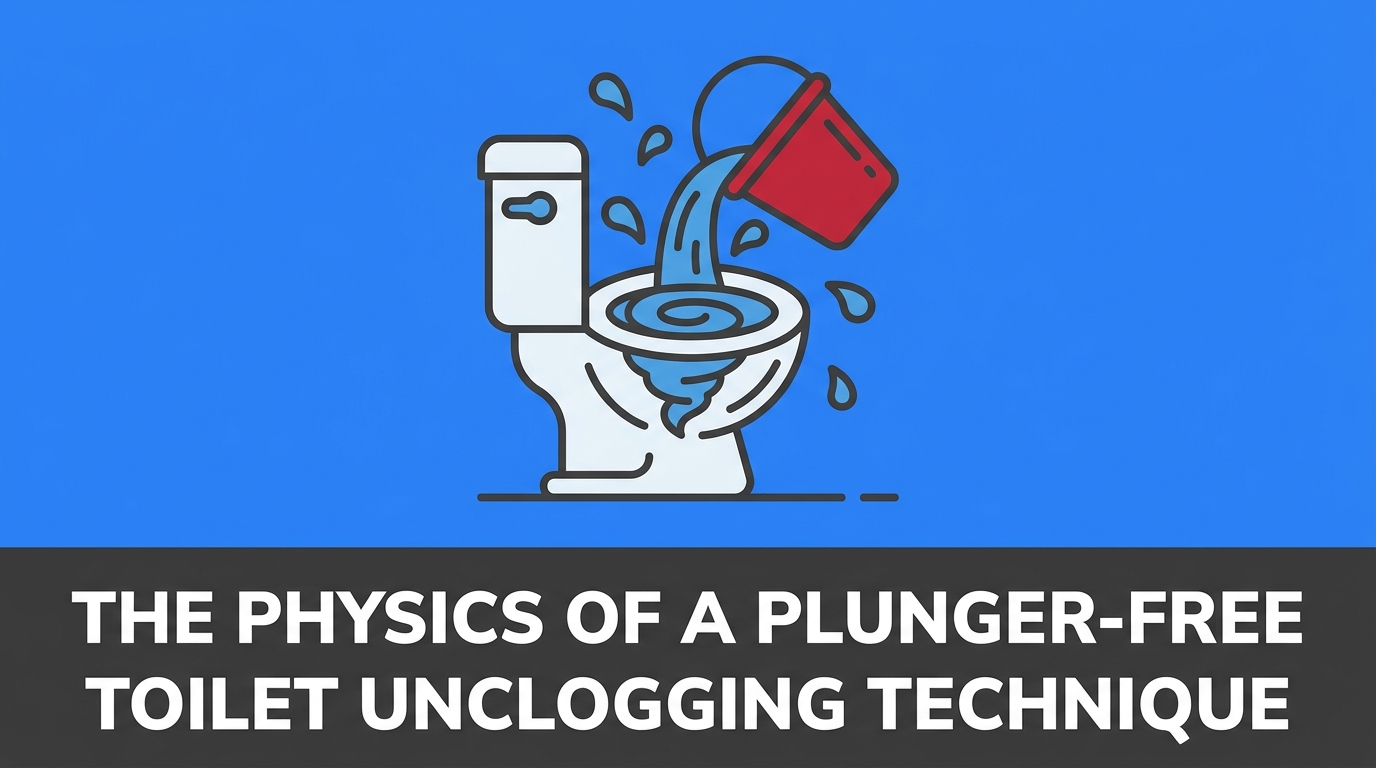
Understanding The Physics of a Plunger-Free Toilet Unclogging Technique is the scientifically safest way to clear a bowl when you lack the proper tool. You are staring down a rising waterline in a clogged fixture, you do not have a plunger, and flushing again guarantees a bathroom flood. This is the concrete problem facing anyone researching the search pattern: unclogging a toilet without a plunger. Rather than panicking or forcing more water into an already compromised system, the solution lies in understanding the physics of water displacement and surfactant mechanics.
Toilets operate on simple physics. A standard gravity-fed toilet relies on a siphon effect to pull waste through the trapway and into the main sewer line. When that siphon is blocked by a physical mass, the flow of water stops entirely. While securing professional plumbing services is the ultimate safety net for recurring issues, a localized soft clog can often be resolved immediately by manipulating surface tension and thermal dynamics. By utilizing common household items, you can alter the physical state of the blockage without relying on mechanical force.
The core principle behind this technique is straightforward: reduce the friction holding the clog in place while increasing the downward pressure acting upon it. When you understand the science of how water volume, temperature, and chemical emulsifiers interact inside a vitreous china bowl, you can clear a blockage safely and predictably. This approach removes the guesswork and prevents the catastrophic overflows that occur when frustrated homeowners repeatedly pull the flush lever hoping for a different result.
To understand why this plunger-free technique works, you must first understand what a surfactant is. In the context of household dish soap, a surfactant (surface-active agent) is a chemical compound that lowers the surface tension between two liquids, or between a liquid and a solid. When you pour dish soap into a clogged toilet, you are introducing a highly concentrated surfactant into a stagnant pool of water.
Dish soap is composed of amphiphilic molecules. These molecules have two distinct ends: a hydrophilic (water-loving) head and a hydrophobic (water-repelling) tail. Human waste and many types of food debris contain high concentrations of lipids, which are naturally hydrophobic fats. When dish soap enters the bowl, the hydrophobic tails immediately seek out and attach themselves to the lipids in the waste, while the hydrophilic heads remain bonded to the surrounding water molecules.
This molecular action creates tiny structures called micelles, which encapsulate the fats and lift them away from the surrounding mass. This process, known as emulsification, breaks down the solid structural integrity of the clog. Simultaneously, the soap coats the unglazed interior of the porcelain trapway, dramatically reducing friction.
Teaching this free, science-backed DIY method aligns perfectly with the Always Affordable brand ethos. In our years of providing plumbing solutions throughout the local area, our team typically sees homeowners panic and cause unnecessary water damage when faced with a sudden clog. We believe in empowering homeowners with genuine, practical knowledge and building trust before a paid service call is ever necessary. By understanding the chemistry at play, you can resolve minor issues safely on your own.
The optimal application:
• Volume: You need a generous squirt of dish soap, roughly half a cup, to achieve the necessary chemical reaction in a standard toilet bowl.
• Distribution: Pour the soap evenly around the water line so it can sink and coat the entire trapway.
• Soap Type: Liquid dish detergent is required. Hand soaps contain moisturizers and lack the heavy-duty degreasing surfactants necessary for rapid emulsification.
The problem: Pouring cold water into a clogged toilet does absolutely nothing to accelerate the chemical breakdown of waste and toilet paper. In fact, cold temperatures cause lipids to congeal and harden, making the blockage even more stubborn.
The cause: Molecular movement slows down in cold environments. To speed up the emulsification process initiated by the dish soap, you need to introduce thermal energy. However, this introduces a significant physical danger. Many DIY guides mistakenly recommend pouring boiling water (212°F) into the bowl. Toilets are manufactured from vitreous china, a ceramic material that is exceptionally strong under compression but highly brittle when subjected to rapid temperature changes.
When you introduce 212°F water to a room-temperature (or colder) porcelain bowl, the interior surface expands rapidly while the exterior remains contracted. This differential expansion creates immense structural stress, leading to a phenomenon called thermal shock. Thermal shock can cause the vitreous china to crack catastrophically, instantly turning a simple clog into a major bathroom flood and requiring a complete replacement of the fixture.
The solution: The scientifically safe temperature range for this procedure is hot tap water, which typically registers between 120°F and 130°F. This specific temperature range is warm enough to synergize with the dish soap surfactants, rapidly softening the organic material and accelerating the breakdown of paper fibers, but cool enough to remain well within the safe thermal expansion limits of standard plumbing fixtures. Always draw this water directly from your bathroom or kitchen sink rather than heating a kettle on the stove.
Once the chemistry and thermal dynamics are established, the next critical phase relies on water displacement mechanics. Adding volume to a clogged bowl inherently risks an overflow. You must calculate the available volume and utilize kinetic energy precisely.
1. Analyze the current water level: Before adding anything, assess the bowl. A standard toilet bowl holds roughly one to two gallons of water. If the water level is already at the rim, you must wait for the hydrostatic pressure to slowly push water past the clog, or manually bail out a portion of the water into a bucket before proceeding. You need at least a gallon of empty space.
2. Calculate the safe remaining volume: Determine exactly how much hot tap water you can safely introduce. Never plan to fill the bowl higher than two inches below the rim.
3. Harness kinetic energy: The manner in which you pour the hot water is just as important as the temperature. Pouring the 120°F to 130°F water from waist height creates kinetic energy. As the water falls, it accelerates, hitting the stagnant pool in the bowl with concentrated downward force.
4. Generate hydrostatic pressure: This downward force translates into hydrostatic pressure pushing against the clog. The combination of the heavy water column pushing down and the surfactants reducing friction along the pipe walls is often enough to dislodge the mass.
5. Observe the strict waiting period: Once the hot water and soap are applied, you must step back. The chemical reaction and gravitational pressure require 15 to 30 minutes to take full effect. Do not attempt to flush during this window.
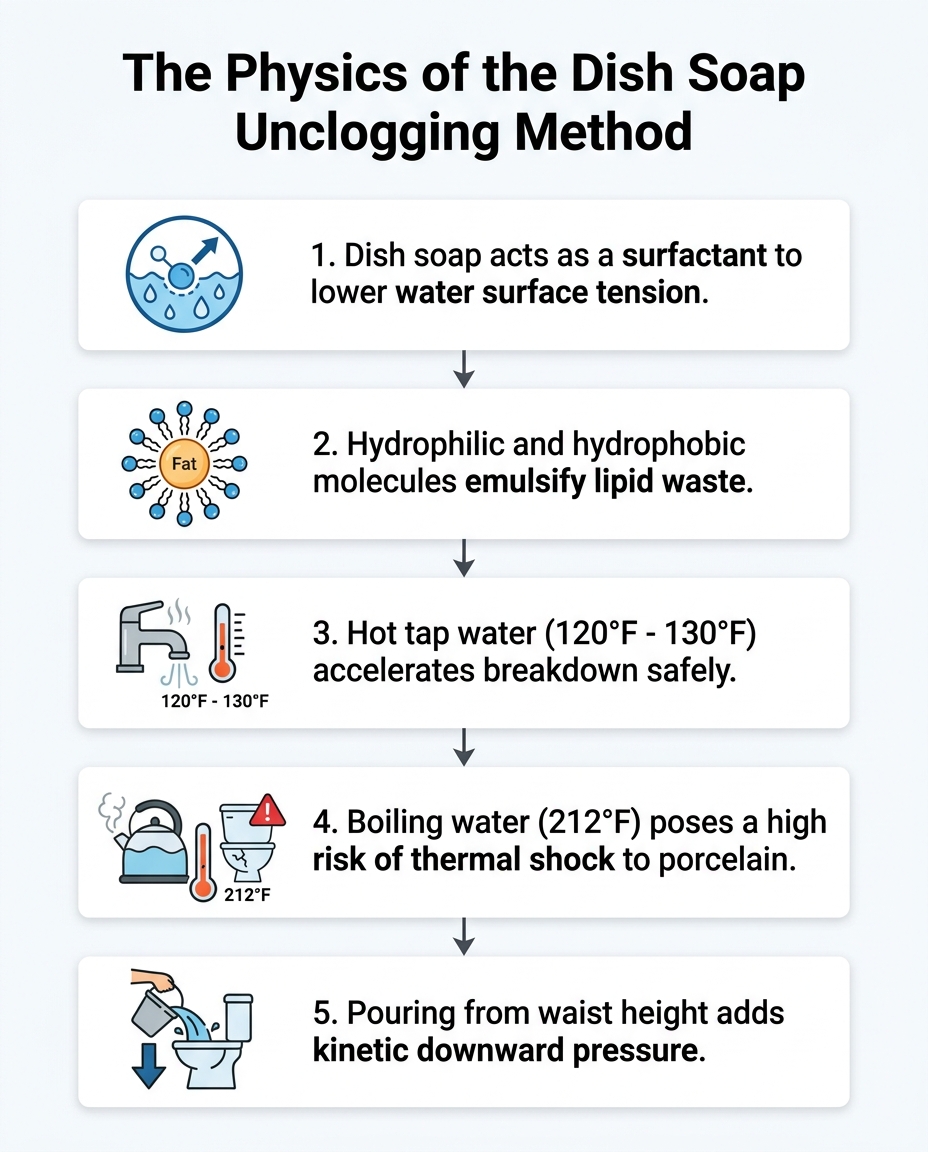

The Physics of the Dish Soap Unclogging Method
Addressing a toilet clogged with solid organic waste and heavy paper usage requires a direct application of the physics and chemistry principles outlined above. This specific scenario is challenging because the combination of dense lipids and intertwined paper fibers creates a highly water-resistant matrix within the P-trap.
When you apply the dish soap and hot water method to this specific type of clog, the chemistry is highly targeted. The surfactants immediately seek out the fats in the solid waste. As the hot water raises the ambient temperature of the bowl, the lipids begin to melt and emulsify, losing their structural integrity. Simultaneously, the paper fibers, which were previously glued together by the organic matter, begin to separate and suspend in the water column.
You do not need to guess if the chemical process is working; the physics will provide clear visual indicators. After the 15 to 30-minute waiting period, watch for these signs:
• Dropping water levels: The most obvious sign is the waterline slowly receding as water begins to seep past the softening clog.
• Bubbling: As the dense mass breaks down, trapped air inside the P-trap will escape, rising to the surface as distinct bubbles.
• Cloudy suspension: The water may turn highly opaque as the lipids fully emulsify into the surrounding liquid.
If the bowl begins to drain slowly, exercise patience. Do not immediately flush. Instead, pour another bucket of hot tap water from waist height to flush the remaining debris through the lubricated trapway. If you eventually acquire the right tool, knowing how to use a plunger like a pro will help you clear any residual paper fibers clinging to the pipe walls.
While the dish soap and hot water method is highly effective for soft organic clogs, it is bound by the laws of physics. Identifying the limitations of this DIY hack is critical to preventing plumbing damage. Surfactants and thermal dynamics are completely ineffective against hard, mechanical blockages.
• Soft Organic Clog — Typical Cause: Excessive paper, human waste, flushable wipes — Physics-Based Response: Responds well to surfactants, heat, and hydrostatic pressure.
• Hard Mechanical Blockage — Typical Cause: Toys, plastic caps, heavy calcification, toothbrushes — Physics-Based Response: Fails to emulsify. Water pressure may wedge the item tighter.
• Main Line Backup — Typical Cause: Tree roots, collapsed pipes, deep structural clogs — Physics-Based Response: Requires mechanical clearing. Bowl level remains static.
The physics of a hard blockage in the P-trap differ entirely from a soft clog. A plastic toy creates a mechanical wedge. Pouring water on top of it simply increases the hydraulic pressure pushing the wedge tighter against the porcelain walls. If the water level has not dropped a single millimeter after an hour of waiting, or if you notice water backing up into your bathtub or shower drain when you attempt to clear the toilet, the clog has moved deeper into the main sewer line.
These diagnostic signs indicate that gravity and chemistry have reached their limit. In our experience responding to emergency calls across the local area, a pattern we see often is homeowners repeatedly trying DIY methods on hard mechanical blockages, which only compacts the issue. The transition from DIY chemistry to professional diagnostics is now required. Technicians operating throughout our local service areas utilize advanced tools like motorized closet augers and high-definition sewer cameras to physically break apart or retrieve hard blockages that defy chemical emulsification.
Dish soap acts as a highly concentrated surfactant, lowering the surface tension of the water inside the bowl. It effectively lubricates the unglazed porcelain pipe and emulsifies the lipids found in organic clogs. This chemical reaction allows the softened mass to slide through the curved P-trap with minimal friction.
The chemical reaction required to break down waste requires time; 15 to 30 minutes is the optimal window for most standard clogs. Leaving a dish soap clogged toilet overnight can be highly effective for severe organic blockages, allowing maximum emulsification of fats and complete saturation of paper fibers.
Yes, pouring 212-degree Fahrenheit water into a room-temperature vitreous china bowl causes rapid and uneven thermal expansion. This intense thermal shock can cause the porcelain to crack catastrophically, destroying the fixture. Always use hot tap water (between 120 and 130 degrees) to safely introduce heat.
Utilize the hot water and dish soap method to chemically break down the organic lipids present in the waste. Pour the hot tap water from waist height to generate kinetic downward pressure, then wait 30 minutes for the mixture to fully emulsify the blockage before attempting to clear the line.
It relies entirely on altering the physical properties of the blockage rather than using mechanical force. Surfactants reduce friction and dissolve fats, hot water accelerates the thermal breakdown of the material, and gravity provides the necessary hydrostatic pressure to push the weakened clog through the plumbing system.
Understanding the physics of unclogging a toilet without a plunger provides a safe, scientifically backed solution to a highly stressful household problem. By leveraging the chemical power of surfactants, the thermal dynamics of hot tap water, and the kinetic energy of water displacement, you can confidently clear most organic blockages without risking damage to your vitreous china fixtures.
While chemistry and gravity easily solve standard organic clogs, remember that mechanical blockages and deep system backups require advanced diagnostic tools. If the scientific method fails to restore flow to your fixture, do not attempt to force the issue. Protect your home's infrastructure by scheduling professional sewer and drain clearing to ensure long-term plumbing health and reliability.
See what our satisfied customers have to say about their experience with Always Affordable
Plumbing & HVAC.

"Chappy was very skilled in his knowledge of my HVAC unit. I greatly appreciate the quick response and experienced tech. The whole endeavor was made less stressful by his humor and honest conversation. I find comfort in knowing I now have a shop i trust for the next time."
"Tony, James, Ronnie did an amazing job setting up our new AC! They were quick, efficient, considerate, and polite! We appreciate them scheduling us in on such short notice. Definitely recommend this company!"
"Prompt, professional service with kindness and care. They came out to address both plumbing and AC issues. I received a courtesy call before they arrived. All issues were resolved the same day with integrity and respect. Thankful for businesses like this. Absolutely recommend to those that I love."
"Excellent service! Jason came out promptly and in addition to doing my outside faucet he also put in new irrigation equipment! All done perfectly! Jason was lovely"
"Honest with the assessment; friendly and good manners. No high pressure sales. Just good to honest "tell it like you see it" Thought my kitchen disposer needed an overhaul. But Jason, there Plumber gave me an honest lesson on what was really happening. Saved me hundreds, if I went the route of replacing. Thank you!"
"Absolutely 5 stars. If you are looking for affordable ,professional and kind. Chappy was excellent and very knowledgeable . I called in the morning because my air conditioner stopped working he was here within hours and fixed my air with a smile. I highly recommend Chappy and Always Affordable plumbing and Hvac."
"Scott and James were great. They got there quickly and diagnosed the problem with my A/C.They did a very thorough job testing everything. Sent me pictures and called to keep me informed. Got it done the next day and everything is working fine. Be glad when I get home so I can enjoy my new system. Thanks guys for a great job."
"Chappy was very helpful. He knew our issue right away, cleaned our coils. He also came on the same day we called and got our AC blowing cold air again."
"After some timing ’curfuffles’ the Tech Jason arrived and not only completed a speedy install on my toilet, he was personable & professional. Because of the timing issues Jason was attentive and showed up with everything needed! No extra store runs 😊 I was very comfortable with having this Tech in my Daughter’s home. We will definitely use this Service again."


