Home Maintenance Troubleshooting: Fixing HVAC Short-Cycling & Stubborn Plumbing Clogs
Why is your HVAC short-cycling? See how basic home maintenance tips and troubleshooting prevent extreme weather breakdowns, and decide when to call a pro.



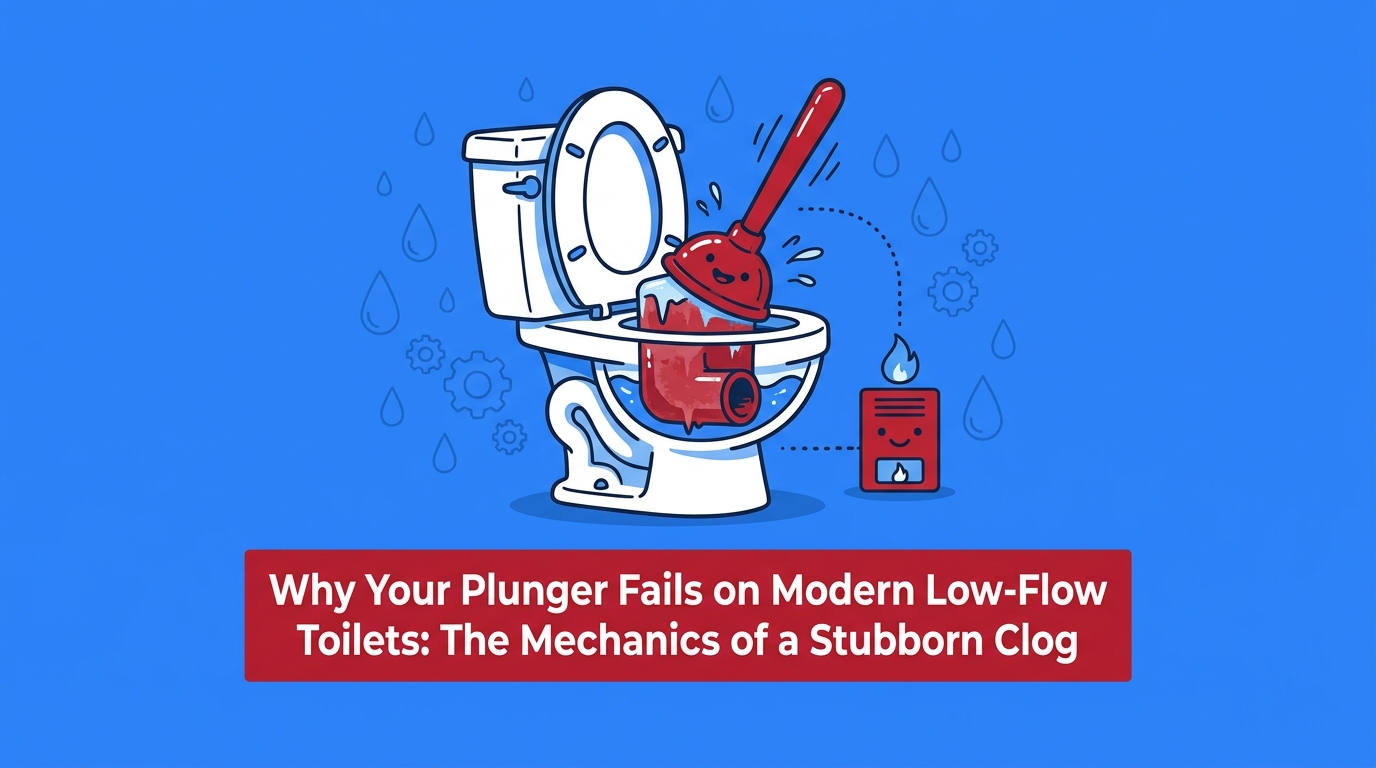
Your toilet is stubbornly clogged, the water level is rising dangerously close to the rim, and understanding exactly why your plunger fails on modern low-flow toilets is the only way to prevent a messy overflow. You grab the standard plunger from under the sink, place it over the drain, and push down with all your might. Instead of clearing the blockage, dirty water sprays back out the sides, the bowl remains full, and the clog refuses to budge. As local plumbers who have serviced countless homes across the area, we frequently encounter homeowners who are highly stressed and completely baffled when their trusty tool fails. Before you assume the worst about your plumbing system, it is important to evaluate the tool in your hand.
When facing this specific issue, many people immediately seek residential plumbing services, assuming the blockage is deep within the pipes. However, our team typically sees that the short answer is usually much simpler: you are likely using the wrong type of plunger for your specific fixture. While a standard flat-cup plunger works perfectly for the flat surface of a sink or bathtub drain, it is functionally incompatible with modern low-flow and elongated toilet bowl designs.
This mismatch is not a failure of your plunging technique; it is a failure of basic geometry. Modern bathroom fixtures have evolved significantly over the last few decades, but the tools many homeowners keep in their closets have not. To effectively clear a stubborn blockage without damaging your fixture, you need to understand the structural differences in your toilet bowl and why a completely different tool is required to restore proper drainage.
To understand why your current tool is ineffective, you have to look at the history of plumbing regulations and how they physically altered the fixtures inside your home. Decades ago, standard toilets utilized 3.5 to 5 gallons of water per flush. With that massive volume of water, engineers could design wide, sweeping trapways—the internal S-shaped curve that carries waste out of the bowl and into the sewer line. A wide trapway rarely clogged, and when it did, the drain opening at the bottom of the bowl was large and relatively circular.
As water conservation became a priority, regulations forced a drastic change in plumbing engineering. Driven by the California Energy Commission (CEC) appliance efficiency regulations and historic droughts, 1.28 gallon-per-flush (GPF) toilets became the standard in the Sacramento area and beyond. In our years of installing and repairing these high-efficiency fixtures, we've seen firsthand how moving the same amount of solid waste with a fraction of the water required a complete redesign of the toilet's internal mechanics.
The resulting physical changes included:
• Steeper trapway angles: To utilize gravity more effectively, the internal curve became much steeper to accelerate the water.
• Narrower keyhole openings: The drain at the bottom of the bowl transitioned from a wide circle to a narrow, elongated slot to force water through at a higher pressure.
• Elongated bowl shapes: The overall footprint of the bowl stretched outward to accommodate the new trapway geometry while maintaining user comfort.
These structural changes successfully reduced water consumption, but they created a new challenge for homeowners. The narrow, uniquely shaped drain opening makes it incredibly difficult to clear a blockage using traditional methods. When a clog forms in these high-efficiency trapways, it is often tightly packed, requiring significant, focused pressure to dislodge. If your efforts continue to fail, a deeper mainline issue might be present, which is when professional sewer and drain clearing becomes necessary.
Clearing a clogged pipe is not about pushing air; it is about utilizing fluid dynamics to force a blockage through a tight space. To understand why a traditional flat-cup sink plunger cannot clear a clog in a modern toilet, you have to look at the physics of a vacuum seal.
A plunger works by creating a 100% airtight vacuum seal over a drain. When you push down, you force the water trapped inside the plunger cup directly down the pipe. Because water is incompressible, that force transfers directly to the clog, pushing it forward. When you pull up, the suction pulls the clog backward. This rhythmic push-and-pull action breaks the blockage apart.
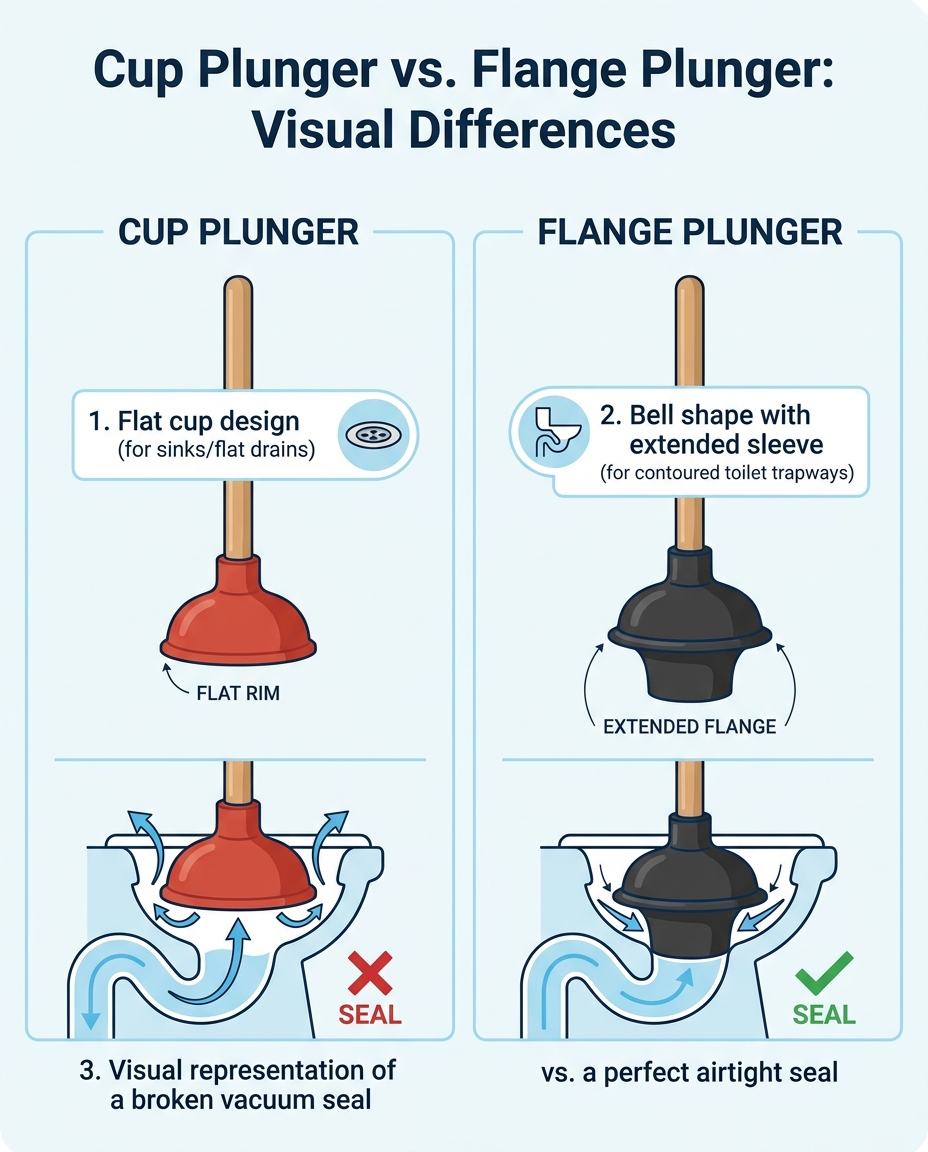
However, this entire process relies on a perfect seal. If air or water can escape from the edges of the plunger, the force is lost. This is exactly what happens when a flat rubber cup meets a contoured, elongated ceramic trapway opening. The rigid, circular lip of a standard plunger physically cannot mold to the steep angles and narrow keyhole shape of a high-efficiency toilet.
When our technicians arrive at a home after a frantic call, a pattern we see often is the aftermath of the "blowback" effect. When you attempt to use a flat-cup plunger on a modern toilet, the seal is incomplete, and the pressure you apply does not travel down the pipe. Instead, it takes the path of least resistance, escaping out the sides of the plunger cup and splashing dirty water back into the bowl. You can plunge aggressively for an hour, but without an airtight seal, you are simply displacing water inside the bowl rather than applying force to the clog.
• Shape — Flat-Cup Sink Plunger: Perfectly circular and flat — Modern Toilet Trapway: Elongated, sloped, keyhole design — Compatibility Result: Mismatched geometry
• Seal Surface — Flat-Cup Sink Plunger: Requires a flat, even basin — Modern Toilet Trapway: Steeply contoured ceramic bowl — Compatibility Result: Gaps allow pressure to escape
• Force Transfer — Flat-Cup Sink Plunger: Pushes water straight down — Modern Toilet Trapway: Requires angled insertion — Compatibility Result: Blowback occurs immediately
This physical impossibility is why we always tell our customers to never blame their plunging technique when a standard cup fails on a bathroom fixture. You are simply using a tool designed for a flat surface on a heavily contoured opening.
If the flat-cup plunger is the wrong tool, the solution is upgrading your equipment. The correct tool for a modern bathroom fixture is called a flange plunger (often referred to as a toilet plunger). This specific tool was engineered explicitly to solve the geometry problem created by low-flow and elongated bowl designs.
At first glance, a flange plunger looks similar to a standard plunger, but it features a critical addition. It has the familiar rubber bell shape, but extending from the bottom center of the bell is a soft rubber sleeve, or "flange." This sleeve is designed to unfold and insert directly into the toilet's trapway opening.
How the dual-action design works:
• The inner sleeve: The extended flap slides down into the narrow, elongated keyhole drain, acting as an internal plug that directs pressure straight into the pipe.
• The outer bell: The wider bell portion collapses over the outside of the drain opening, molding to the contoured ceramic to lock the seal in place.
• The result: Even on the steepest, most uniquely shaped high-efficiency bowls, this dual-layer approach creates the necessary 100% airtight vacuum seal.
At Always Affordable Plumbing & HVAC, we believe in honest, transparent service that empowers our local community. We would rather you visit the local hardware store to purchase a flange plunger and solve the problem yourself than pay for an unnecessary professional service call. Equipping your home with the right tool is the first and most effective step in maintaining your plumbing system.

Even with the correct tool in hand, technique still matters. To maximize the fluid dynamics of the flange plunger and clear a stubborn blockage in a high-efficiency fixture, follow these specific steps to ensure you are applying maximum force directly to the clog.
1. Preparation and Water Level: Ensure there is enough water in the bowl to completely submerge the plunger bell. Remember, water creates the driving force, not air. If the bowl is empty, pour a few cups of water in from the sink. If the bowl is dangerously full, use a bucket to remove some excess water to prevent splashing.
2. Insertion and "Burping": Angle the plunger so the flange sleeve slides smoothly into the drain opening. Before plunging, press down gently and slowly. This crucial step "burps" the plunger, expelling the trapped air out from under the bell and allowing it to fill with water. Plunging with a bell full of air drastically reduces your pushing power.
3. The Plunge: Once the air is expelled, align the handle vertically. Maintain the airtight seal and use forceful, rhythmic push-and-pull motions. Keep the strokes short and aggressive. You are trying to create a rapid hydraulic wave that breaks the solid waste apart.
4. The Release: After 15 to 20 seconds of rhythmic plunging, sharply pull the plunger straight up to break the seal. The sudden negative pressure often dislodges the loosened waste, allowing the bowl to drain with a satisfying gurgle.
Breaking the seal: The most common error our technicians see homeowners make is tilting the handle during the push-and-pull phase. If you hear a squelching sound or see bubbles escaping the sides of the bell, you have broken the vacuum seal and need to reset your position.
While a flange plunger is highly effective for localized blockages, there is a reasonable limit to do-it-yourself plumbing. If the water hasn't drained after 10 to 15 minutes of dedicated effort, continuing to plunge will only exhaust you. At this stage, the blockage is either too dense, wedged too tightly, or located further down the sewer line.
For hard blockages that suction cannot clear—such as accidentally flushed toys, heavy paper buildup, or dense obstructions—the next logical step is a toilet auger. Unlike a standard drain snake, a toilet auger features a protective rubber sleeve that prevents the metal cable from scratching the delicate ceramic bowl. Knowing exactly when to use a toilet auger instead of a plunger can save you hours of frustration.
When plunging fails, many homeowners instinctively reach for chemical drain cleaners. Our professional plumbing team highly discourages this. Chemical cleaners rely on extreme exothermic reactions (generating intense heat) to melt blockages. When these chemicals sit stagnant in a toilet bowl, that localized heat can literally crack the porcelain, destroying the fixture entirely. Furthermore, these caustic chemicals are terrible for the environment and pose a severe burn risk to any technician who later has to dismantle the plumbing to fix the issue.
Sometimes, a stubborn clog indicates a deeper mainline issue rather than a localized bathroom blockage. For example, one local homeowner woke up during the winter to a completely backed-up sewer line that a plunger couldn't touch. Technicians Chris and Curtis from Always Affordable Plumbing & HVAC were dispatched within a few hours, arriving on-site to provide rapid relief. They successfully unclogged the main sewer line when other companies might have aggressively pushed for a full replacement, proving that sometimes a stubborn backup requires heavy-duty professional equipment rather than a simple hand tool.
The best way to avoid a standoff with your plunger is to prevent the clog from forming in the first place. High-efficiency fixtures require a slightly different approach to usage than older, high-volume models. Because they rely on a strict 1.28 GPF limit, keeping the trapway clear requires consistent flush discipline.
A pattern we see often during our daily service calls is the introduction of items that simply do not belong in the plumbing system. To keep your system flowing freely, enforce strict rules about what goes down the drain:
• "Flushable" wipes are a myth: Despite the marketing on the package, wet wipes do not dissolve like toilet paper. They snag on the tight curves of modern trapways and build up over time.
• Feminine hygiene products: These products are designed to expand and absorb moisture, making them the ultimate enemy of a narrow drain pipe.
• Excessive paper usage: If a large amount of toilet paper is needed, utilize the "courtesy flush" method. Flush the solid waste first, then use a second flush for the paper to avoid overwhelming the water volume limit.
Beyond daily habits, routine drain maintenance is essential to keep your entire plumbing system clear of slow-building obstructions. Hard water scaling, soap scum, and minor debris can narrow the internal diameter of your pipes over time, making clogs more frequent. By investing in a comprehensive plumbing maintenance membership, you can ensure that flow issues are caught and resolved early, long before they result in a late-night sewage backup.
Why is my plunger not working?
Your plunger is likely not working because it cannot form an airtight seal over the drain opening. Standard flat-cup plungers are designed for flat sinks, not the contoured, sloped bowls of modern toilets. Without a complete vacuum seal, the pressure escapes out the sides instead of forcing the clog down the pipe.
What is the best plunger for a low flow toilet?
The best tool for a low-flow toilet is a flange plunger. This plunger features a standard rubber bell with an extended sleeve (or flange) that folds out from the bottom. The sleeve inserts directly into the narrow drain opening, while the bell seals the outer rim, creating the perfect airtight lock necessary for high-efficiency fixtures.
Can you use a regular plunger on an elongated toilet?
Using a regular sink plunger on an elongated toilet is generally ineffective. The elongated bowl features a steep, non-circular trapway opening that a flat rubber cup cannot seal against. You will likely experience "blowback," where dirty water splashes out the sides of the cup rather than pushing the blockage forward.
How do you unclog a modern toilet?
To properly unclog a modern toilet, use a flange plunger and ensure the rubber sleeve is fully inserted into the drain hole. Expel the trapped air by pressing down slowly, then use vigorous, rhythmic vertical strokes to dislodge the waste. If the plunger fails after 15 minutes, switch to a toilet auger to physically break up the obstruction.
Why does my low flow toilet keep clogging?
Low-flow toilets frequently clog because they use significantly less water (1.28 gallons or less) to move waste over a steeper, narrower internal trapway. If you are using excessive amounts of toilet paper, flushing non-degradable wipes, or dealing with hard water buildup narrowing the pipe, the limited water volume will struggle to clear the bowl.
How can I tell the difference between a sink plunger and a toilet plunger?
A sink plunger has a simple, flat rubber cup that looks like a bowl cut in half, designed to sit flush against a flat basin. A toilet plunger (flange plunger) has a similar bell shape but features a distinct rubber flap or sleeve extending from the bottom center, designed to fit inside a toilet's drain hole.
Dealing with a clogged bathroom fixture is stressful, but understanding the mechanics of your modern low-flow trapway empowers you to use the right tool for the job. By switching to a flange plunger, you can easily clear most localized blockages on your own. However, if a clog refuses to budge or you suspect a deeper mainline issue, professional intervention from our team is the safest route to protect your home from water damage.
See what our satisfied customers have to say about their experience with Always Affordable
Plumbing & HVAC.

"Chappy was very skilled in his knowledge of my HVAC unit. I greatly appreciate the quick response and experienced tech. The whole endeavor was made less stressful by his humor and honest conversation. I find comfort in knowing I now have a shop i trust for the next time."
"Tony, James, Ronnie did an amazing job setting up our new AC! They were quick, efficient, considerate, and polite! We appreciate them scheduling us in on such short notice. Definitely recommend this company!"
"Prompt, professional service with kindness and care. They came out to address both plumbing and AC issues. I received a courtesy call before they arrived. All issues were resolved the same day with integrity and respect. Thankful for businesses like this. Absolutely recommend to those that I love."
"Excellent service! Jason came out promptly and in addition to doing my outside faucet he also put in new irrigation equipment! All done perfectly! Jason was lovely"
"Honest with the assessment; friendly and good manners. No high pressure sales. Just good to honest "tell it like you see it" Thought my kitchen disposer needed an overhaul. But Jason, there Plumber gave me an honest lesson on what was really happening. Saved me hundreds, if I went the route of replacing. Thank you!"
"Absolutely 5 stars. If you are looking for affordable ,professional and kind. Chappy was excellent and very knowledgeable . I called in the morning because my air conditioner stopped working he was here within hours and fixed my air with a smile. I highly recommend Chappy and Always Affordable plumbing and Hvac."
"Scott and James were great. They got there quickly and diagnosed the problem with my A/C.They did a very thorough job testing everything. Sent me pictures and called to keep me informed. Got it done the next day and everything is working fine. Be glad when I get home so I can enjoy my new system. Thanks guys for a great job."
"Chappy was very helpful. He knew our issue right away, cleaned our coils. He also came on the same day we called and got our AC blowing cold air again."
"After some timing ’curfuffles’ the Tech Jason arrived and not only completed a speedy install on my toilet, he was personable & professional. Because of the timing issues Jason was attentive and showed up with everything needed! No extra store runs 😊 I was very comfortable with having this Tech in my Daughter’s home. We will definitely use this Service again."