Home Maintenance Tips and Troubleshooting: What to Do When Your AC Freezes Up
Ice on your AC coil? Why we recommend turning it off immediately. Apply these home maintenance tips and troubleshooting steps to safely thaw it and avoid



Wondering how much does a tankless water heater save per year? Here's the short answer before we dive into the details:
• Gas tankless (vs. gas tank) — Average Annual Savings: ~$108/year
• Electric tankless (vs. electric tank) — Average Annual Savings: ~$44/year
• ENERGY STAR gas tankless (vs. standard gas tank, family of 4) — Average Annual Savings: ~$95/year
• Condensing gas tankless (vs. tank-style) — Average Annual Savings: Up to $124/year
These figures come from U.S. Department of Energy estimates and ENERGY STAR data. Your actual savings will depend on your household size, how much hot water you use daily, your local energy rates, and the type of unit you choose.
Here's the thing most homeowners don't realize: a traditional tank water heater keeps 40–50 gallons of water hot around the clock — even at 2 a.m. when nobody's showering. That constant reheating, called standby heat loss, quietly drains energy every single day. A tankless water heater heats water only when you need it, which is exactly why it uses less energy and costs less to run.
For Sacramento-area homeowners weighing this upgrade, the savings are real — but the full picture matters. How long you plan to stay in your home, what fuel type you're using, and whether your unit is ENERGY STAR certified all play a major role in what you'll actually save.
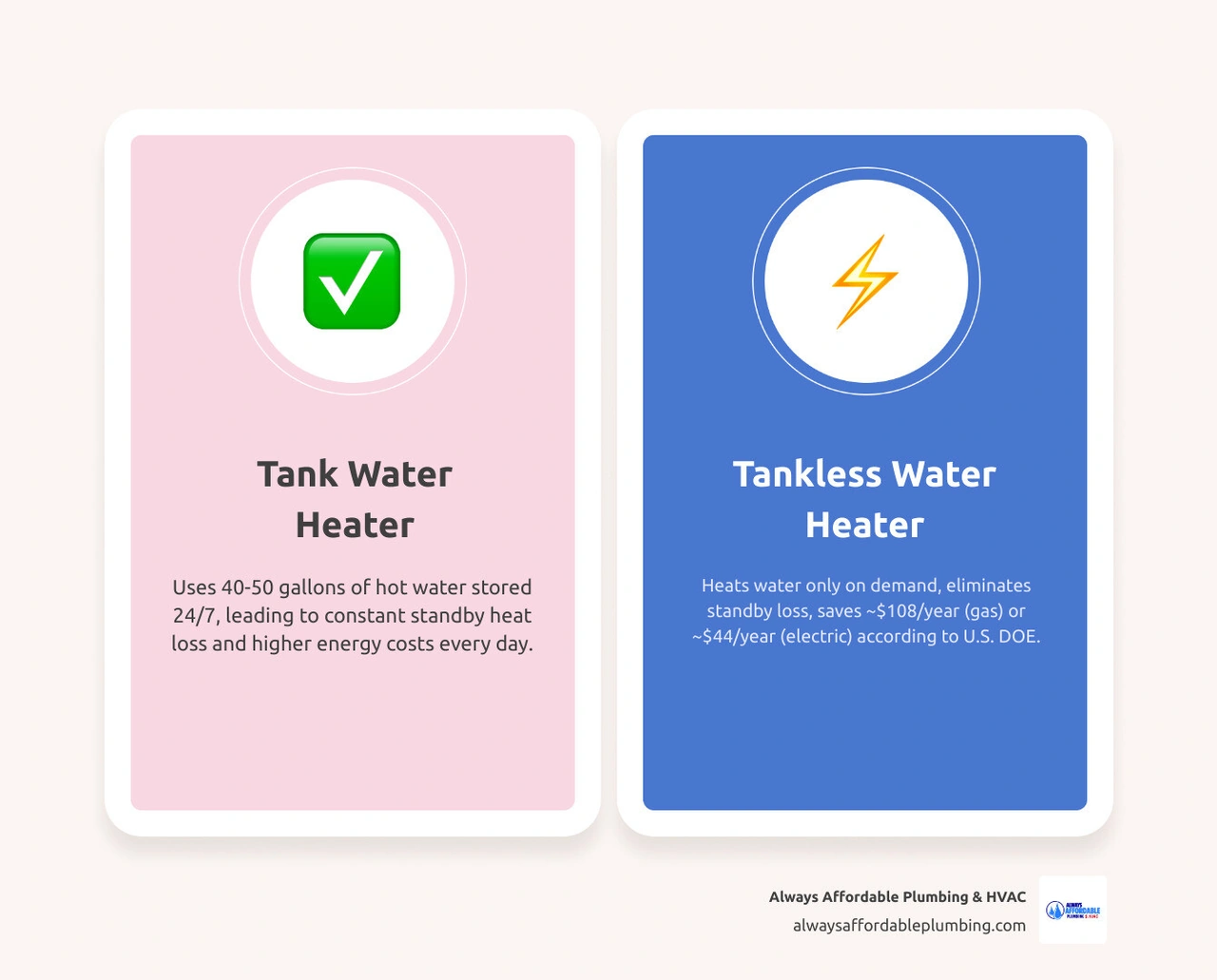
When we look at the raw data for 2026, the energy efficiency of these units is hard to ignore. According to the U.S. Department of Energy, gas-fired tankless units save an average of $108 in energy costs per year compared to their tank counterparts. If you are using an electric system, the savings are more modest but still helpful, averaging about $44 per year.
The reason for these savings is simple: the elimination of standby energy loss. Traditional tanks are essentially giant insulated kettles. They use energy to keep water hot 24/7, even when you’re at work or asleep. By switching to on-demand heating, you only pay for the hot water you actually use. There are many Benefits of a Tankless Water Heater, but the reduction in wasted energy is often the most cited by our customers in Sacramento and Elk Grove.
To give you a clearer picture of the efficiency gap, consider the table below:
• Energy Efficiency (UEF) — Standard Tank Heater: 0.60 – 0.70 — Tankless Water Heater: 0.81 – 0.96
• Standby Heat Loss — Standard Tank Heater: Significant (10-20% of costs) — Tankless Water Heater: Virtually Zero
• Annual Energy Cost (Gas) — Standard Tank Heater: $320 - $450 — Tankless Water Heater: $195 - $250
• Typical Lifespan — Standard Tank Heater: 10 - 15 Years — Tankless Water Heater: 20+ Years
While national averages are a great starting point, your specific lifestyle in Northern California will dictate your actual return. We’ve found that no two households have the exact same savings profile. Several variables come into play when calculating how much does a tankless water heater save per year for your specific home.
First, your household size and daily hot water usage are the biggest drivers of efficiency. Interestingly, tankless units are actually more efficient in homes that use less water. If your home uses 41 gallons or less of hot water daily, a tankless system can be 24%–34% more energy efficient than a storage tank. For high-usage homes (around 86 gallons per day), that efficiency gain drops to about 8%–14%. This is because the "standby loss" of a tank represents a larger percentage of the total energy used in a low-demand home.
If you're asking yourself, "Do I Need to Switch to a Tankless Water Heater," you also need to consider local utility rates and groundwater temperature. In areas like Citrus Heights or Davis, our groundwater is relatively temperate, which means the heater doesn't have to work as hard to raise the temperature as it would in a snowy climate.

For a typical family of four, the numbers get very interesting, especially when choosing high-efficiency models. An ENERGY STAR certified gas tankless water heater can save a family of four approximately $95 per year on gas bills compared to a standard gas storage model. Over the lifetime of the unit, that adds up to about $1,800 in savings.
In our Residential Tankless Heater Sacramento Guide, we often point out that these families benefit most from the "endless" nature of the water supply. While the dollar savings are significant, the value of the fourth person in line getting a hot shower is often considered "priceless" by our clients!
Not all tankless heaters are created equal. If you want to maximize your savings, looking for the ENERGY STAR label is crucial. These units use advanced condensing technology to squeeze every bit of heat out of the fuel.
A condensing tankless water heater uses a secondary heat exchanger to recover extra heat from the exhaust gases. This allows them to achieve a Uniform Energy Factor (UEF) of up to 0.96, compared to around 0.81 for non-condensing tankless models. This extra efficiency translates to an additional $20 in annual savings over a standard tankless unit. If you're planning a new install, checking our Tankless Water Heater Installation Sacramento Guide can help you identify which high-efficiency models are best suited for our local climate.
When evaluating the cost-effectiveness of an upgrade, we have to look past the first year. One of the most significant financial advantages of a tankless system is its durability. While a traditional tank might last 10 to 15 years before the tank corrodes and risks flooding your garage, a well-maintained tankless unit can easily last 20 years or more.
There are 3 Great Things About Tankless Water Heaters and 1 Bad Thing, and longevity is definitely in the "great" column. Because there is no large tank of water sitting and rusting, the risk of a catastrophic leak is significantly lower. Furthermore, many modern homebuyers in Roseville and Folsom actively look for energy-efficient upgrades, which can potentially increase your home’s resale value by $1,500 to $3,000.
The "payback period" is the amount of time it takes for the energy savings to cover the initial investment. Because tankless units require a higher upfront investment for the equipment and specialized installation (like gas line upgrades or venting), the payback period can be long.
Current data for 2026 suggests a payback period of roughly 12–20 years for electric models and 22–27 years for gas models. However, this timeline can be shortened significantly by:
• Federal Tax Credits: The 25C tax credit can provide up to $2,000 for qualified high-efficiency gas models.
• Local Rebates: Many utility providers in the Sacramento area offer incentives for switching to high-efficiency appliances.
• Maintenance: Following a Tankless Maintenance Sacramento Guide ensures the unit runs at peak efficiency, preventing the "scale buildup" that can force the unit to use more energy over time.
To get the most out of your investment in our local area, installation strategy matters just as much as the unit itself. In places like Roseville and Rocklin, we often see large homes where the water heater is located far from the master bathroom. This leads to "wait time" for hot water, which wastes both water and energy.
Our Tankless Water Heater Installation Guide Roseville CA suggests considering point-of-use units or integrated recirculation pumps. Recirculation pumps keep hot water ready in the pipes so you don't have to run the tap for three minutes to get a warm shower. When installed correctly, these systems provide a luxury experience while maintaining the efficiency of the tankless design. For those in a pinch, our Emergency Tankless Installation Roseville Guide covers how to handle a sudden water heater failure without sacrificing long-term efficiency.
Generally, gas tankless water heaters offer higher annual savings (around $108) compared to electric models (around $44). This is largely because gas units are significantly more efficient than gas tanks, whereas electric tanks are already fairly efficient to begin with. However, electric tankless units are often cheaper to install if you don't already have the necessary gas infrastructure. For business owners, we provide specialized insights in our Best Commercial Tankless Install Sacramento guide regarding high-volume fuel efficiency.
As mentioned, the typical range is 12 to 27 years. While this might seem long, a tankless unit is designed to last 20+ years. You are essentially pre-paying for your energy savings. If you are dealing with a sudden breakdown, our Emergency Tankless Water Heater Installation Sloughhouse CA Guide can help you decide if the long-term ROI is worth the immediate upgrade.
Yes! Smaller households (1–2 people) using less than 41 gallons a day see the highest percentage of savings (up to 34%). Larger families see a lower percentage of savings (8%–14%) because they are using so much water that the standby loss of a traditional tank becomes a smaller piece of their total energy "pie." However, larger families often save more total dollars because their overall energy spend is higher.
Determining how much does a tankless water heater save per year is about looking at both the immediate utility bill reduction and the long-term value of the equipment. While a gas-fired unit might save you about $108 annually, the real value lies in the 20-year lifespan, the space saved in your garage, and the peace of mind that comes with a system that won't suddenly flood your home.
At Always Affordable Plumbing & HVAC, we are committed to helping our neighbors in Sacramento, Roseville, Folsom, and the surrounding communities find the most efficient and sustainable solutions for their homes. Whether you need a simple repair or a full system upgrade, our team is here to provide transparent, high-quality service.
If you’re ready to stop paying to heat water you aren't using, contact us today to explore your options. We can help you navigate UEF ratings, tax credits, and installation requirements to ensure your new water heater is a smart investment for years to come.
Expert Water Heater Services in Sacramento
See what our satisfied customers have to say about their experience with Always Affordable
Plumbing & HVAC.

"Chappy was very skilled in his knowledge of my HVAC unit. I greatly appreciate the quick response and experienced tech. The whole endeavor was made less stressful by his humor and honest conversation. I find comfort in knowing I now have a shop i trust for the next time."
"Tony, James, Ronnie did an amazing job setting up our new AC! They were quick, efficient, considerate, and polite! We appreciate them scheduling us in on such short notice. Definitely recommend this company!"
"Prompt, professional service with kindness and care. They came out to address both plumbing and AC issues. I received a courtesy call before they arrived. All issues were resolved the same day with integrity and respect. Thankful for businesses like this. Absolutely recommend to those that I love."
"Excellent service! Jason came out promptly and in addition to doing my outside faucet he also put in new irrigation equipment! All done perfectly! Jason was lovely"
"Honest with the assessment; friendly and good manners. No high pressure sales. Just good to honest "tell it like you see it" Thought my kitchen disposer needed an overhaul. But Jason, there Plumber gave me an honest lesson on what was really happening. Saved me hundreds, if I went the route of replacing. Thank you!"
"Absolutely 5 stars. If you are looking for affordable ,professional and kind. Chappy was excellent and very knowledgeable . I called in the morning because my air conditioner stopped working he was here within hours and fixed my air with a smile. I highly recommend Chappy and Always Affordable plumbing and Hvac."
"Scott and James were great. They got there quickly and diagnosed the problem with my A/C.They did a very thorough job testing everything. Sent me pictures and called to keep me informed. Got it done the next day and everything is working fine. Be glad when I get home so I can enjoy my new system. Thanks guys for a great job."
"Chappy was very helpful. He knew our issue right away, cleaned our coils. He also came on the same day we called and got our AC blowing cold air again."
"After some timing ’curfuffles’ the Tech Jason arrived and not only completed a speedy install on my toilet, he was personable & professional. Because of the timing issues Jason was attentive and showed up with everything needed! No extra store runs 😊 I was very comfortable with having this Tech in my Daughter’s home. We will definitely use this Service again."