Why Do Heavy Flushes Keep Failing? Diagnosing Recurring Toilet Clogs
Why do heavy flushes fail while liquid drains? What we found inside hidden drain lines when diagnosing recurring toilet clogs. See when to scope your pipes.



When peak summer heat waves finally arrive, you might notice your home feeling uncomfortably warm by late afternoon. You check the thermostat, and while it is set to a comfortable 72°F, the indoor temperature is slowly creeping toward 80°F. Your system is running continuously, and you find yourself wondering how high ambient temperatures reduce cooling capacity. More importantly, you are faced with a stressful decision point: do you need to panic and book an emergency repair call, or is your system simply operating at its maximum physical limit?
At Always Affordable Plumbing & HVAC, our team typically fields a flood of panicked calls during the first major heat wave of the year. Whether you want to understand the thermodynamic limits of your current setup or you are looking for comprehensive support for your HVAC systems, relying on our professional air conditioning services can provide the clarity and solutions you need.
It is incredibly frustrating to hear your equipment running non-stop without feeling the relief you expect. Most homeowners immediately assume something is broken, low on refrigerant, or failing altogether. However, the reality is often much less alarming. Air conditioners are bound by the strict laws of thermodynamics, meaning there is a physical cap on how much heat they can move out of your home at any given time.
Here is the thing: understanding the 20-degree rule can save you from unnecessary panic. By learning how your system is engineered to perform during extreme weather, you can set realistic expectations, protect your equipment from unnecessary wear and tear, and keep your home as comfortable as physically possible.
To understand why your home feels warm on the hottest days of the year, we have to look at how residential cooling systems are engineered. The foundational concept at play here is the 20-degree temperature differential limit, often referred to by technicians as "Delta T." This rule dictates that a standard residential air conditioner is designed to cool the indoor air to a maximum of 20 degrees below the outdoor ambient temperature.
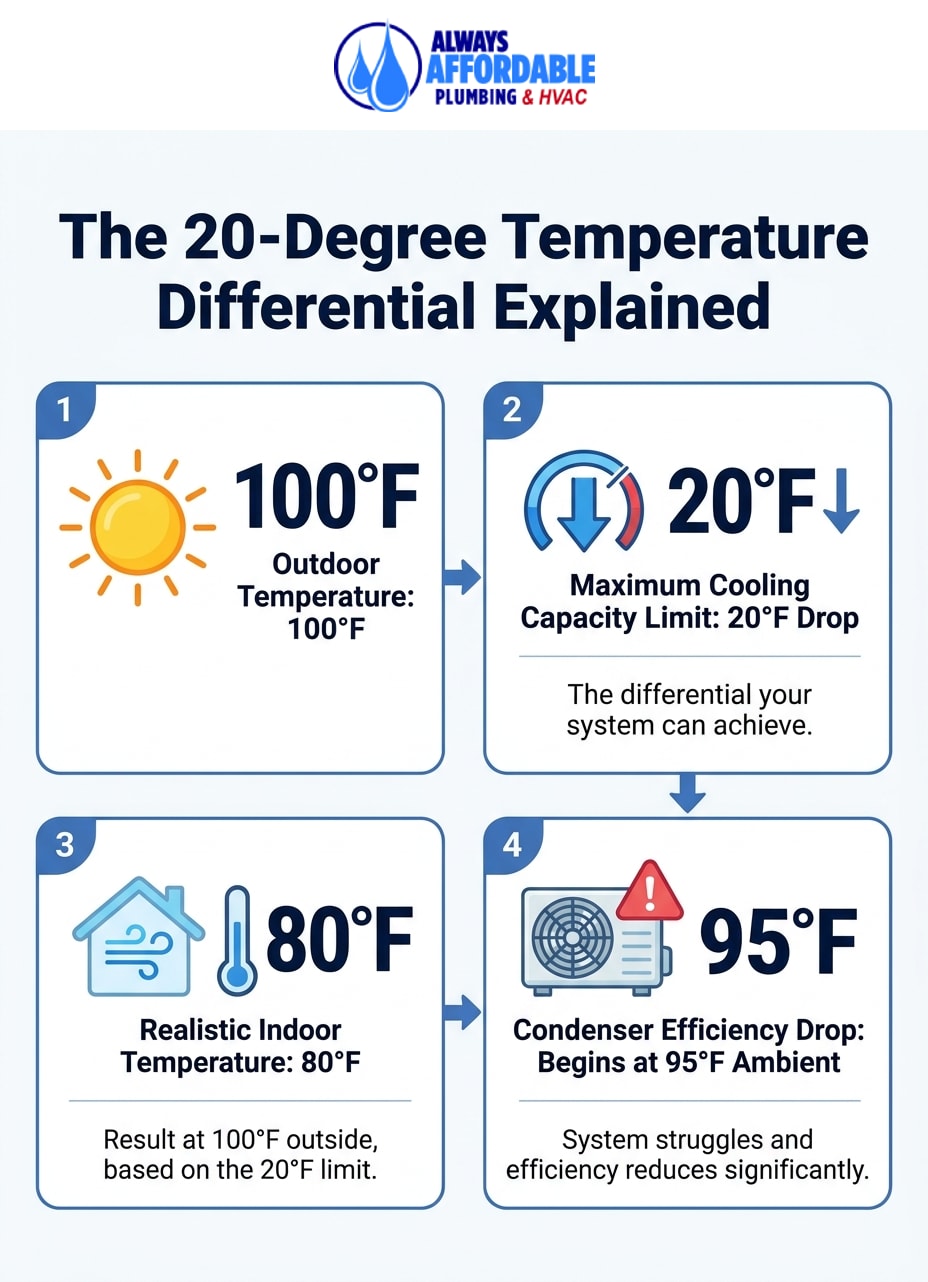
Your cooling system does not magically create cold air out of nowhere. Instead, it absorbs heat from the air inside your home and rejects that heat into the air outside. As the temperature gap between the indoors and outdoors widens, this heat transfer process becomes increasingly difficult. If it is 100°F outside, an indoor temperature of 80°F means your system is functioning exactly as it was designed to perform.
The equipment in your home is not sized arbitrarily. It is engineered based on specific guidelines set by the American Society of Heating, Refrigerating and Air-Conditioning Engineers (ASHRAE). These design conditions account for the historical average high temperatures in your specific climate, rather than the extreme, record-breaking anomalies.
In our experience serving the local area, you might wonder why contractors do not simply install massive, oversized units capable of handling rare 110-degree days with ease. The short answer is efficiency and comfort. If an oversized unit is installed to combat a few extreme days a year, it will be far too powerful for normal summer weather. An oversized system cools the home so rapidly that it shuts off before it has a chance to dehumidify the air. This leads to a phenomenon called "short-cycling," which leaves your home feeling cold but uncomfortably clammy, while drastically increasing wear on the compressor.
Because systems are perfectly sized for typical summer highs, they naturally hit a thermodynamic wall when pushed beyond those historical averages. Respecting the 20-degree temperature differential limit helps you understand that a warmer house during a historic heat wave is a matter of physics, not a mechanical failure.
During peak summer heat waves, the outdoor portion of your cooling system—the condenser—takes an absolute beating. The condenser coil's primary job is to release the heat absorbed from your home into the outside air. However, heat naturally wants to flow toward cooler spaces. When the outside air is scorching, pushing indoor heat into that already-hot environment becomes a monumental thermodynamic struggle.
With local triple-digit heat waves becoming a harsh reality, your outdoor condenser is forced to operate in a punishing environment during the hottest afternoons. According to data from the U.S. Department of Energy, an air conditioner's efficiency begins to drop significantly as outdoor ambient temperatures rise above 95°F. The hotter the air blowing across the outdoor coil, the less heat the refrigerant can successfully release.
The physical toll on the compressor:
• Higher pressures: The compressor has to work much harder to compress the refrigerant into a high-pressure, high-temperature gas that is actually hotter than the 100-degree outdoor air.
• Longer run cycles: Because less heat is rejected per cycle, the system has to run continuously just to maintain the current temperature, let alone lower it.
• Reduced cooling capacity: This thermodynamic bottleneck restricts the volume of properly cooled air returning to your living spaces.
When you understand the immense pressure your condenser is under during these extreme weather events, it becomes clear why the system struggles to drop the indoor temperature below that 20-degree threshold. The equipment is doing everything it can, but the ambient heat simply slows the heat-rejection process to a crawl.
In our years of diagnosing cooling issues across the local area, one of the most common reactions we see to a warm house is assuming the equipment is broken. However, learning to distinguish between a system that is operating at its physical limit and a system experiencing genuine mechanical failure can save you from unnecessary panic. At Always Affordable Plumbing & HVAC, we believe in providing honest, transparent advice—prioritizing your education and peace of mind over booking a profitable but unnecessary emergency visit. If your system is maxed out but healthy, a service call won't change the laws of physics.
Here is a breakdown to help you evaluate what is happening with your equipment during peak summer heat waves:
• Airflow Temperature — Signs of a Maxed-Out System (Normal): Air coming from the vents feels cool, even if the room is warm. — Signs of a Broken System (Needs Repair): Air coming from the vents feels lukewarm or completely unconditioned.
• Run Cycle — Signs of a Maxed-Out System (Normal): Running continuously during the hottest part of the afternoon. — Signs of a Broken System (Needs Repair): Short-cycling (turning on and off rapidly every few minutes).
• Temperature Split — Signs of a Maxed-Out System (Normal): Maintaining exactly a 20-degree temperature differential limit. — Signs of a Broken System (Needs Repair): The indoor temperature is less than 15 degrees cooler than outside.
• System Noises — Signs of a Maxed-Out System (Normal): A steady, consistent hum from both the indoor and outdoor units. — Signs of a Broken System (Needs Repair): Grinding, squealing, banging, or loud buzzing sounds.
If your home is exactly 20 degrees cooler than the blistering heat outside, we strongly advise against immediately booking an emergency repair. Your system is doing its job. However, there are critical failure signs that completely ignore the 20-degree rule and require immediate professional attention.
If you notice ice forming on the indoor evaporator coil, a burning electrical smell, or spot your AC unit leaking water heavily, it is time to call a technician. Please remember: never attempt to perform electrical testing, handle refrigerant, or open sealed system components yourself. These tasks require proper licensing, specialized tools, and safety training. Understanding the difference between a maxed-out unit and a broken one prevents wasted time, but recognizing true failure protects your home.
When the outdoor temperature pushes your system past its 20-degree temperature differential limit, the most effective way to help your equipment is to reduce your home's "heat load." Heat load refers to the total amount of heat entering or being generated inside your living space. By lowering this load, you take immense pressure off your struggling HVAC system during peak summer heat waves.
Implementing a few strategic steps can make a noticeable difference in your indoor comfort:
1. Block out solar heat gain: The sun beating through your windows acts like a greenhouse. Close your blinds, shades, and blackout curtains on south and west-facing windows during the peak afternoon hours. This simple step blocks radiant heat before it can warm up your rooms.
2. Limit heat-generating appliances: Your oven, stove, dishwasher, and clothes dryer generate massive amounts of heat and humidity. Wait until after sunset to run major appliances. Opt for grilling outside, using a microwave, or preparing cold meals during extreme heat waves.
3. Utilize the wind-chill effect: Ceiling fans do not lower the temperature of the room, but they do make you feel cooler. The breeze evaporates moisture from your skin, creating a wind-chill effect that can make a room feel up to 4 degrees cooler. Just remember to turn fans off when you leave the room, as their motors do generate a small amount of heat.
4. Target specific hot spots: If certain rooms (like a sunroom or an upstairs bedroom) are consistently unbearable, consider supplemental cooling. Adding ductless cooling options can target these stubborn areas without forcing your central unit to work harder than it should. Additionally, generally applicable energy rebates or federal tax credits may apply to qualifying high-efficiency installations—we always advise readers to verify current programs with their utility or a tax professional.
5. Upgrade your lighting: If you are still using traditional incandescent bulbs, be aware that they release 90% of their energy as heat. Keeping lights off during the day, or switching to LED bulbs, subtly reduces the overall heat load your system has to fight.
During a brutal heat wave, it is tempting to walk up to the thermostat and crank it down to 65°F in hopes of finding quick relief. This is known as the "thermostat plunge," and it is one of the worst things you can do for your system when it is already fighting the 20-degree temperature differential limit.
Most homeowners don't realize that lowering the thermostat does not make the air coming out of the vents any colder. It simply tells the system to run endlessly until it hits that target number. When it is 100°F outside, the system will never reach 65°F. Instead, the continuous strain can cause the indoor coil to freeze over, leading to a complete system shutdown right when you need it most.
Instead of the plunge, adopt these smarter thermostat strategies:
• Set realistic expectations: Set your thermostat to 78°F or higher during the hottest parts of the day. This reduces the strain on the compressor and keeps the system operating within its safe physical limits.
• Pre-cool your home: Take advantage of lower ambient temperatures in the early morning. Set your thermostat a few degrees lower than normal between 5:00 AM and 9:00 AM. This "banks" cold air into your furniture, walls, and floors, helping the house resist the afternoon heat spike.
• Leverage smart technology: Smart thermostats can automate these temperature adjustments, slowly raising the target temperature as the afternoon heat peaks, ensuring your system aligns perfectly with the 20-degree rule without you having to lift a finger.
Surviving an immediate heat wave is about managing heat load and expectations, but preparing for the next one requires proactive defense. Our technicians at Always Affordable Plumbing & HVAC frequently notice that a well-maintained system has a much better chance of maximizing its cooling capacity and safely hitting that 20-degree temperature differential limit compared to a neglected one.
To ensure your equipment is ready for the next round of peak summer heat waves, take these long-term maintenance steps:
• Change your air filters regularly: A clogged filter acts like a brick wall for airflow. When the system cannot pull in enough warm air, it cannot condition it. Check your filters monthly during the summer and replace them the moment they look dirty.
• Keep the outdoor condenser clear: The outdoor unit needs at least two feet of clearance on all sides to properly reject heat. Trim back bushes, remove tall grass, and gently clear away cottonwood or debris that may be choking the condenser fins.
• Commit to professional upkeep: The best defense against extreme weather is a clean, calibrated system. Establishing a schedule for routine HVAC maintenance before the deep heat sets in ensures your refrigerant levels are precise, electrical connections are tight, and coils are clean enough to transfer heat efficiently.
The 20-degree rule states that a standard residential air conditioner can only cool the indoor air to a maximum of 20 degrees below the outdoor ambient temperature. This is a foundational law of thermodynamics and a core ASHRAE engineering standard. If the outside temperature is 100°F, an indoor temperature of 80°F indicates that the system is operating perfectly at its maximum capacity. Pushing the system harder will not overcome this physical 20-degree temperature differential limit.
Your AC struggles in 100-degree weather because the outdoor condenser has a difficult time rejecting heat into an already scorching environment. Heat naturally moves toward cooler spaces, so pushing indoor heat into 100-degree outdoor air slows down the entire cooling process. Additionally, the compressor must work much harder and longer to compress the refrigerant, resulting in a noticeable drop in overall efficiency and cooling capacity.
While an AC does not completely "stop working" at a specific temperature, its efficiency drops sharply once outdoor temperatures exceed 95°F. At extreme temperatures, such as 115°F or higher, the system may struggle so much to reject heat that the compressor overheats and trips the internal thermal overload switch to protect itself. To prevent this, it is highly recommended to raise your indoor thermostat setting during severe heat waves to reduce the continuous strain on the equipment.
You can help your AC by actively reducing the heat load inside your home. Start by closing blackout curtains and blinds on south and west-facing windows to block radiant solar heat. Avoid using heat-generating appliances like ovens and clothes dryers during the afternoon. Finally, turn on ceiling fans to create a wind-chill effect, making you feel cooler without forcing the AC to work harder.
No, setting your thermostat to a drastically lower number will not make the system cool the house any faster. The system cools at a constant rate regardless of the setting. Lowering the thermostat to 65°F during a heat wave only forces the system to run continuously in a futile attempt to reach an impossible goal, which can lead to frozen coils, extreme wear and tear, and potential system failure.
If your home is maintaining a steady 20-degree difference from the outside temperature, and the air coming out of the vents feels cool, your system is likely maxed out but healthy. Conversely, if the air blowing from the vents is warm, the indoor temperature is matching the outdoors, or you hear loud grinding noises and see heavy water leaks, the system has likely experienced a mechanical failure and requires a professional evaluation.
Navigating peak summer heat waves can be stressful, especially when your home feels warmer than you would like. However, remembering the 20-degree temperature differential limit is the key to managing your expectations and protecting your equipment. An air conditioner that runs non-stop to hold an 80-degree indoor temperature during a 100-degree day is demonstrating a thermodynamic reality, not a mechanical failure.
By implementing proactive heat-reduction strategies—like drawing the curtains, utilizing ceiling fans, and avoiding the oven—you can find immediate relief and take the pressure off your struggling condenser. If you have checked the temperature split, evaluated the airflow, and still suspect that your system is genuinely underperforming beyond the expected physical limits, we encourage you to reach out to our team at Always Affordable Plumbing & HVAC for a professional evaluation. A clear, scientifically grounded understanding of your equipment's capacity provides the peace of mind and realistic expectations you need to stay comfortable all season long.
See what our satisfied customers have to say about their experience with Always Affordable
Plumbing & HVAC.

"Chappy was very skilled in his knowledge of my HVAC unit. I greatly appreciate the quick response and experienced tech. The whole endeavor was made less stressful by his humor and honest conversation. I find comfort in knowing I now have a shop i trust for the next time."
"Tony, James, Ronnie did an amazing job setting up our new AC! They were quick, efficient, considerate, and polite! We appreciate them scheduling us in on such short notice. Definitely recommend this company!"
"Prompt, professional service with kindness and care. They came out to address both plumbing and AC issues. I received a courtesy call before they arrived. All issues were resolved the same day with integrity and respect. Thankful for businesses like this. Absolutely recommend to those that I love."
"Excellent service! Jason came out promptly and in addition to doing my outside faucet he also put in new irrigation equipment! All done perfectly! Jason was lovely"
"Honest with the assessment; friendly and good manners. No high pressure sales. Just good to honest "tell it like you see it" Thought my kitchen disposer needed an overhaul. But Jason, there Plumber gave me an honest lesson on what was really happening. Saved me hundreds, if I went the route of replacing. Thank you!"
"Absolutely 5 stars. If you are looking for affordable ,professional and kind. Chappy was excellent and very knowledgeable . I called in the morning because my air conditioner stopped working he was here within hours and fixed my air with a smile. I highly recommend Chappy and Always Affordable plumbing and Hvac."
"Scott and James were great. They got there quickly and diagnosed the problem with my A/C.They did a very thorough job testing everything. Sent me pictures and called to keep me informed. Got it done the next day and everything is working fine. Be glad when I get home so I can enjoy my new system. Thanks guys for a great job."
"Chappy was very helpful. He knew our issue right away, cleaned our coils. He also came on the same day we called and got our AC blowing cold air again."
"After some timing ’curfuffles’ the Tech Jason arrived and not only completed a speedy install on my toilet, he was personable & professional. Because of the timing issues Jason was attentive and showed up with everything needed! No extra store runs 😊 I was very comfortable with having this Tech in my Daughter’s home. We will definitely use this Service again."