Home Maintenance Tips and Troubleshooting: What to Do When Your AC Freezes Up
Ice on your AC coil? Why we recommend turning it off immediately. Apply these home maintenance tips and troubleshooting steps to safely thaw it and avoid



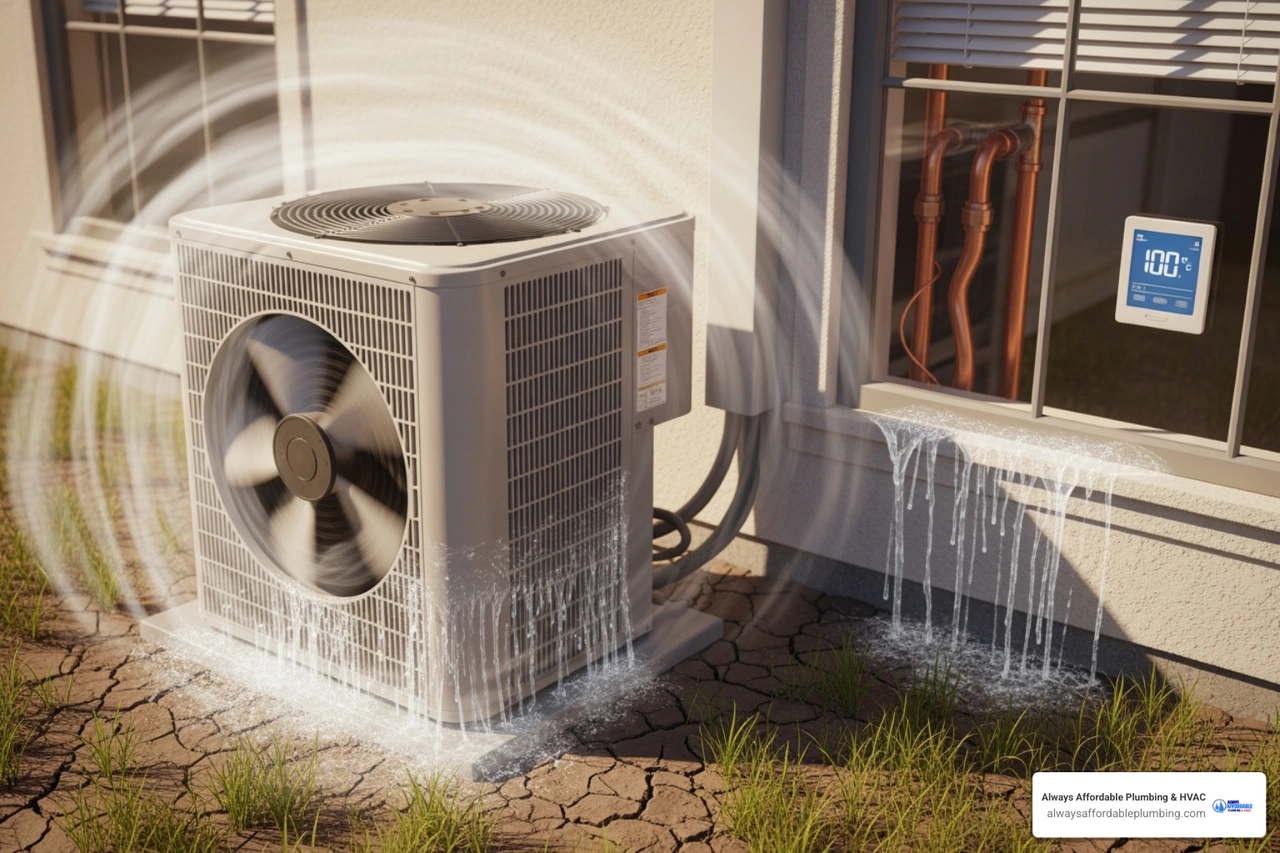
How triple digit temperatures stress your AC and plumbing is something every Sacramento-area homeowner needs to understand before the next Central Valley heatwave arrives. When outdoor temps push past 100°F — sometimes reaching 105°F or higher for days at a stretch — your home's two hardest-working systems are quietly being pushed to their limits.
Here's a quick look at what's happening inside your home when the heat spikes:
How Extreme Heat Stresses Your AC and Plumbing
• AC compressor — What Happens in Triple-Digit Heat: Works against higher refrigerant pressure, wears faster, risks overheating
• AC efficiency — What Happens in Triple-Digit Heat: A 16 SEER unit can drop to 12-13 SEER performance at 100°F+
• Indoor cooling — What Happens in Triple-Digit Heat: Most systems can only cool 15-20°F below outdoor temps — expect upper 70s on 100°F+ days
• Refrigerant lines — What Happens in Triple-Digit Heat: High-side pressure can spike from 350 PSI at 95°F to 480 PSI at 115°F
• Plumbing pipes — What Happens in Triple-Digit Heat: Thermal expansion weakens joints and fittings, especially in exposed or uninsulated areas
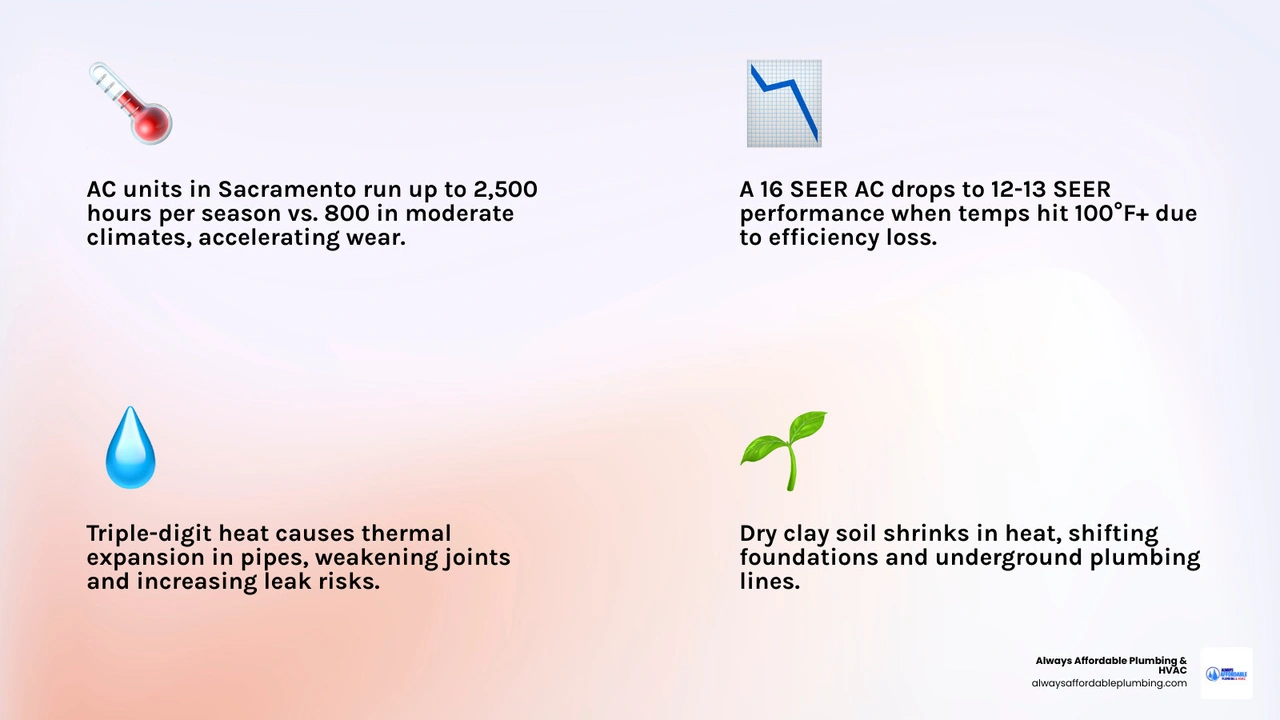
• Clay soil (Sacramento) — What Happens in Triple-Digit Heat: Dries out and shrinks, shifting underground pipes and triggering slab leaks
• Water heaters — What Happens in Triple-Digit Heat: Sediment buildup accelerates in hot garages and attics, forcing the unit to work harder
• Outdoor fixtures — What Happens in Triple-Digit Heat: UV exposure and heat dry out rubber seals, causing leaks at hose bibs and connections
• Tree roots — What Happens in Triple-Digit Heat: Seek moisture more aggressively in drought conditions, infiltrating sewer lines
• Water pressure — What Happens in Triple-Digit Heat: High summer demand from irrigation and municipal use causes pressure swings inside your home
The Sacramento Central Valley is one of the toughest environments for home mechanical systems in California. AC units here can run up to 2,500 hours per season — compared to around 800 hours in more moderate climates — and systems often wear out years earlier than the national average. At the same time, the region's dry heat, clay-rich soil, and wildfire smoke add layers of stress that homeowners in milder areas simply don't face.
This guide breaks down exactly what's happening to your HVAC and plumbing during extreme heat, the warning signs to watch for, and the steps that can help you avoid a costly breakdown at the worst possible time.
In Sacramento, Elk Grove, Folsom, Roseville, Rancho Cordova, and nearby communities, triple-digit weather is not rare drama. It is summer. And that matters because home systems are built with limits.
Your air conditioner is trying to move indoor heat outside. The hotter it gets outdoors, the harder that job becomes. Your plumbing faces a different kind of stress: pipes expand, soil shifts, outdoor fixtures bake in the sun, and demand on the water system rises.
Sacramento-area homes deal with a combination that is especially rough on HVAC and plumbing:
• Dry Central Valley heat that regularly climbs into the 95°F to 105°F range
• Hot attics that can exceed 130°F on summer afternoons
• Dust and wildfire smoke that clog filters and coat coils faster
• Clay-heavy soils that shrink as they dry out
• Strong afternoon cooling demand across neighborhoods at the same time
• Delta breeze patterns that help somewhat at night, but not enough during peak afternoon heat
Dry heat can feel easier on people than sticky humidity, but machines do not get that same comfort. In dry heat, AC systems are often battling high sensible heat load, meaning the home itself is simply getting hotter and hotter. Add attic heat, sun exposure, and dust, and the system works like a marathon runner asked to sprint uphill.
Not every AC that runs a lot is failing. On 102°F days, some signs are normal:
• Long cooling cycles in late afternoon
• Indoor temperatures landing in the upper 70s
• Upstairs rooms staying 5 to 10 degrees warmer than downstairs
• The system recovering better overnight than at 5 p.m.
But some symptoms point to real trouble.
• AC runs for long stretches — Not normal and needs attention: AC turns on and off every few minutes
• House is a little warmer than thermostat setting — Not normal and needs attention: Breaker trips, buzzing, or delayed startup
• Upstairs warmer than downstairs — Not normal and needs attention: Weak airflow or warm air from vents
• Gradual recovery after sunset — Not normal and needs attention: Ice on lines, water leaks, or musty odors
• Outdoor unit sounds steady — Not normal and needs attention: Sewer odor, soggy yard spots, or sudden pressure swings
Your AC is almost always the first system to complain during a heatwave because it is working continuously when the weather is worst. That is why routine air conditioning service matters before the season peaks.
As outdoor temperature rises, refrigerant pressure rises too. Research shows high-side pressure can jump from around 350 PSI at 95°F to roughly 480 PSI at 115°F. That extra pressure means more strain on the compressor, more heat in the cabinet, and more wear on electrical components.
A high-efficiency unit also loses efficiency in extreme heat. A system rated at 16 SEER in standard conditions may perform more like 12 to 13 SEER once temperatures stay above 100°F. At 115°F, efficiency losses can be even steeper.
The 3-minute rule is simple: after your AC shuts off, wait at least three minutes before restarting it.
Why? Because refrigerant pressure needs time to equalize. If the compressor tries to restart too quickly, it may have to start against high pressure. That is like trying to pedal a bike uphill with the brakes on. The result can be hard starts, overheating, nuisance shutdowns, or compressor damage.
This is especially important during:
• Power flickers
• Thermostat adjustments
• Circuit breaker resets
• Manual shutoff and restart
Many modern thermostats and control boards include anti-short-cycle delays for this reason. If yours does not, the best habit is patience. We cover that preventive mindset in Do You Really Need an AC Tune-Up? Yes and Here's Why.
Short-cycling means the system turns on and off too frequently instead of running a full cooling cycle. In triple-digit heat, that is bad news.
Extreme heat can expose existing problems that trigger short-cycling, including:
• Dirty filters
• Low refrigerant
• Dirty condenser coils
• Thermostat problems
• Failing capacitors
• Oversized equipment
• Airflow restrictions
Every restart is hardest on the compressor. In hot weather, repeated restarts pile stress on top of already high refrigerant pressure. Over time that can shorten compressor life, and in hot Sacramento summers that lifespan drop is significant. Systems in hot inland climates often last around 10 to 12 years rather than 15 to 20 in milder areas.
If you suspect compressor trouble, Signs Your AC Compressor Is Failing is a helpful next read.
Heatwave performance often collapses for boring reasons. And boring reasons are expensive when ignored.
A clogged air filter reduces airflow across the indoor coil. That means less heat gets removed from the air. Dirty outdoor coils make it harder to dump indoor heat outside. Blocked return vents, crushed ducts, or a struggling fan make the problem even worse.
The chain reaction looks like this:
1. Airflow drops
2. Cooling capacity falls
3. The system runs longer
4. Coil temperatures and pressures move out of range
5. Components overheat or freeze up
6. You get weak airflow, warm air, or water leaks
That is why we recommend regular filter changes and coil care. Learn more in How Clogged Air Filters Damage AC and AC Airflow Problems Homes.
This is the part many homeowners do not hear soon enough: most residential systems are designed to cool a home about 15 to 20 degrees below outdoor temperature under extreme conditions.
So if it is 102°F outside, a healthy system may only hold the home around 76°F to 82°F, depending on insulation, sun exposure, attic temperature, duct condition, and home layout.
That means:
• A thermostat set to 72°F does not guarantee the house will reach 72°F on a 105°F afternoon
• Two-story homes often have warmer upstairs rooms
• West-facing rooms heat up more late in the day
• Pre-cooling in the morning can help reduce afternoon strain
If your system is not keeping up at all, see Why Is My AC Not Cooling.
Heat stress has a pattern. Usually the system gives warnings before it quits completely.
Common AC distress signals include:
• Runs all day with little temperature drop
• Hot or weak airflow from vents
• Thermostat reading stays above the set point
• Delayed startup
• Frequent on-off cycling
• Buzzing, clicking, or humming
• Ice on refrigerant lines or indoor coil
• Water around the indoor unit
• Musty or burning odors
• Breaker trips
Heatwave breakdowns are often not one big dramatic failure. They are several small weaknesses showing up all at once.
For example:
• A weak capacitor may struggle to start the fan or compressor in extreme heat
• A clogged condensate line may back up when the AC runs constantly
• A dirty coil can cause poor heat rejection and warm air
• Loose electrical connections can expand with heat and create buzzing or intermittent shutdowns
• Dust and smoke can worsen odor and airflow issues
If you are seeing any of these symptoms, these guides can help you narrow it down:
Call for professional AC repair if you notice:
• Ice on the refrigerant line
• Repeated short-cycling
• The breaker keeps tripping
• The outdoor unit runs but the home is not cooling
• Water is leaking indoors
• Condensate is backing up near a ceiling or roof area
• The compressor is loud, struggling, or not starting
Those are not “wait and see” problems in 100°F weather. If you need location-specific guidance, our Elk Grove AC Repair Guide 2025 is a useful resource, and for broader support we also offer full HVAC service throughout the Sacramento area.
AC usually gets the headlines during a heatwave, but plumbing takes a beating too. In fact, summer heat can quietly damage pipes long before a leak becomes obvious.
When pipes heat up, they expand. When temperatures drop at night, they contract. That daily expansion-contraction cycle stresses joints, fittings, and mounting points.
This hits hardest in:
• Uninsulated pipes
• Outdoor hose bibs and exposed water lines
• Attics, garages, and crawlspaces
• Older plumbing with worn seals
• Plastic components exposed to direct UV
Metal pipes conduct heat quickly, while plastic and rubber parts can soften, dry out, or become brittle with age and sun exposure. That is why summer often reveals drips at hose connections, cracks at outdoor fixtures, or leaks at weak joints. If you are tracking down active leaks, our Plumbing Leaks guide can help.
Sacramento-area clay soil is a major reason plumbing trouble shows up in hot weather.
Clay expands when it holds moisture and shrinks when it dries out. During long dry stretches, that shrinkage can remove support from underground water and sewer lines. Pipes may sag, pull at joints, or shift out of alignment. Under slab foundations, that movement can contribute to slab leaks.
Possible signs include:
• New cracks in driveway or foundation areas
• Warm spots on the floor
• Unexplained high water bills
• Damp flooring
• Sewer odor near the home
• Soggy or unusually green patches in the yard
This “shrink-swell” cycle is one of the biggest hidden answers to how triple digit temperatures stress your AC and plumbing in our region.
Roots follow moisture. During drought and extreme heat, sewer lines become attractive because they offer water, nutrients, and cooler conditions than the surrounding dry soil.
That is why root intrusion often worsens in hot summers, especially in:
• Older sewer lines
• Pipes with loose joints
• Lines already slightly cracked or offset
• Properties with mature trees near the sewer path
Signs of root-related sewer trouble include:
• Repeated drain backups
• Slow drains in multiple fixtures
• Gurgling toilets
• Bad sewer smells outside or inside
When this pattern shows up, a professional sewer inspection is usually the fastest way to confirm what is happening.
Summer means sprinklers, hose use, extra showers, laundry, pool filling, and more neighborhood-wide demand at the same time. That can affect pressure in two directions: some homes see low pressure during peak usage, while others experience spikes that strain fixtures.
Healthy household water pressure is typically around 40 to 60 psi. Outside that range, problems become more likely.
Watch for:
• Shower pressure changing at certain times of day
• Banging pipes or water hammer
• Irrigation-related surges
• Appliances taking longer to fill
• Dripping fixtures after outdoor water use
Heatwaves stress the supporting cast too.
Water heaters in hot garages or attics are exposed to higher ambient temperature, and sediment buildup can become a bigger problem over time. A sediment-coated tank has to work harder to heat water properly, which can show up as inconsistent hot water or reduced performance during high-demand periods.
Outdoor fixtures also suffer:
• Hose bib washers dry out
• Plastic hose parts warp
• Sun-baked caulk and seals crack
• Exposed piping ages faster under UV
And your AC actually connects to plumbing through its condensate drain. In summer, constant AC use means constant condensate. If that drain line clogs with algae, dust, or sludge, water can back up and leak into ceilings or wall areas. Related reading: AC Leaking Water from Roof.
The best time to prepare for a heatwave is before your thermostat starts losing the argument.
A simple homeowner prep list:
• Replace or clean AC filters regularly
• Keep 24 inches of clearance around the outdoor unit
• Rinse outdoor coils gently with a garden hose
• Avoid constant thermostat changes
• Use blinds and curtains to reduce solar heat gain
• Check for hose bib drips and dried-out washers
• Drain hoses when not in use
• Watch for foundation cracking or yard soft spots
• Monitor water bills for surprise increases
• Schedule inspections before the hottest stretch, not during it
Preventive AC care matters more in Sacramento than in mild climates because runtime is so much higher.
The most helpful steps are:
• Test the AC before the first major heatwave
• Change filters every 30 to 60 days, or sooner in smoky or dusty periods
• Keep shrubs, weeds, and debris away from the condenser
• Use a steady thermostat setting instead of constant manual adjustments
• Consider a smart thermostat with built-in delay features
• Have coils, refrigerant charge, and electrical parts checked during tune-up visits
• Address weak airflow early, before it becomes a compressor problem
For seasonal guidance, see A/C Summer Tune-Up Beat the Heat and our AC Tune-Up Elk Grove Guide.
You do not need to become a plumber to reduce summer damage.
A few smart habits go a long way:
• Use soaker hoses carefully to help maintain more consistent soil moisture around the foundation during prolonged dry periods
• Insulate exposed piping where practical
• Drain and disconnect hoses that sit in direct sun
• Replace worn washers on outdoor fixtures
• Flush little-used taps occasionally so water does not sit too long
• Check your water meter when no fixtures are running to spot hidden leaks
• Pay attention to new sewer odors, slow drains, or lush green patches in a dry yard
Interestingly, some pipe-protection principles overlap with cold-weather prep. While summer and winter create different problems, both punish weak piping. Our winter resources Protecting Pipes Frozen Pipes and How Do You Prevent Pipe Bursts in Winter also reinforce the value of insulation, leak awareness, and early maintenance.
Homeowner maintenance helps, but some issues need trained eyes and testing equipment.
We recommend a professional inspection when:
• Your AC is older and struggling in afternoon heat
• Cooling has become weaker year over year
• Short-cycling keeps happening
• You have repeated breaker trips or unusual noises
• Water pressure keeps changing
• You suspect a slab leak or sewer problem
• You notice hidden water signs after a heatwave
• You want a post-heatwave system check before the next one arrives
This is especially important in older Sacramento-area homes, where aging equipment, duct loss, soil movement, and plumbing wear can stack up.
Triple-digit weather does not just make your home uncomfortable. It puts real physical stress on the systems that keep it livable. From overheated compressors and clogged coils to expanding pipes, shifting clay soil, and root-invaded sewer lines, Sacramento summers are tough on both HVAC and plumbing.
The good news is that a lot of heat-related damage is preventable with early maintenance, realistic expectations, and quick action when warning signs appear. If you want help protecting your system before the next stretch of extreme heat, Always Affordable Plumbing & HVAC is here for homeowners and businesses across Sacramento, Elk Grove, Roseville, Folsom, Rancho Cordova, Citrus Heights, and surrounding areas.
To learn more about our cooling and comfort services, visit our HVAC page.
See what our satisfied customers have to say about their experience with Always Affordable
Plumbing & HVAC.

"Chappy was very skilled in his knowledge of my HVAC unit. I greatly appreciate the quick response and experienced tech. The whole endeavor was made less stressful by his humor and honest conversation. I find comfort in knowing I now have a shop i trust for the next time."
"Tony, James, Ronnie did an amazing job setting up our new AC! They were quick, efficient, considerate, and polite! We appreciate them scheduling us in on such short notice. Definitely recommend this company!"
"Prompt, professional service with kindness and care. They came out to address both plumbing and AC issues. I received a courtesy call before they arrived. All issues were resolved the same day with integrity and respect. Thankful for businesses like this. Absolutely recommend to those that I love."
"Excellent service! Jason came out promptly and in addition to doing my outside faucet he also put in new irrigation equipment! All done perfectly! Jason was lovely"
"Honest with the assessment; friendly and good manners. No high pressure sales. Just good to honest "tell it like you see it" Thought my kitchen disposer needed an overhaul. But Jason, there Plumber gave me an honest lesson on what was really happening. Saved me hundreds, if I went the route of replacing. Thank you!"
"Absolutely 5 stars. If you are looking for affordable ,professional and kind. Chappy was excellent and very knowledgeable . I called in the morning because my air conditioner stopped working he was here within hours and fixed my air with a smile. I highly recommend Chappy and Always Affordable plumbing and Hvac."
"Scott and James were great. They got there quickly and diagnosed the problem with my A/C.They did a very thorough job testing everything. Sent me pictures and called to keep me informed. Got it done the next day and everything is working fine. Be glad when I get home so I can enjoy my new system. Thanks guys for a great job."
"Chappy was very helpful. He knew our issue right away, cleaned our coils. He also came on the same day we called and got our AC blowing cold air again."
"After some timing ’curfuffles’ the Tech Jason arrived and not only completed a speedy install on my toilet, he was personable & professional. Because of the timing issues Jason was attentive and showed up with everything needed! No extra store runs 😊 I was very comfortable with having this Tech in my Daughter’s home. We will definitely use this Service again."