Seasonal Home Maintenance Checklist: Preventing HVAC and Plumbing Emergencies
Prevent HVAC emergencies with a seasonal home maintenance checklist. Why proactive scheduling beats waiting for sudden failures. See what needs attention now.




How HVAC condition affects home appraisals is one of the most financially significant factors Sacramento homeowners overlook when preparing to sell, refinance, or apply for a home equity line of credit. Your heating and cooling system is not just about comfort — appraisers treat it as a core mechanical system, right alongside your roof and foundation.
Here is a quick summary of what you need to know:
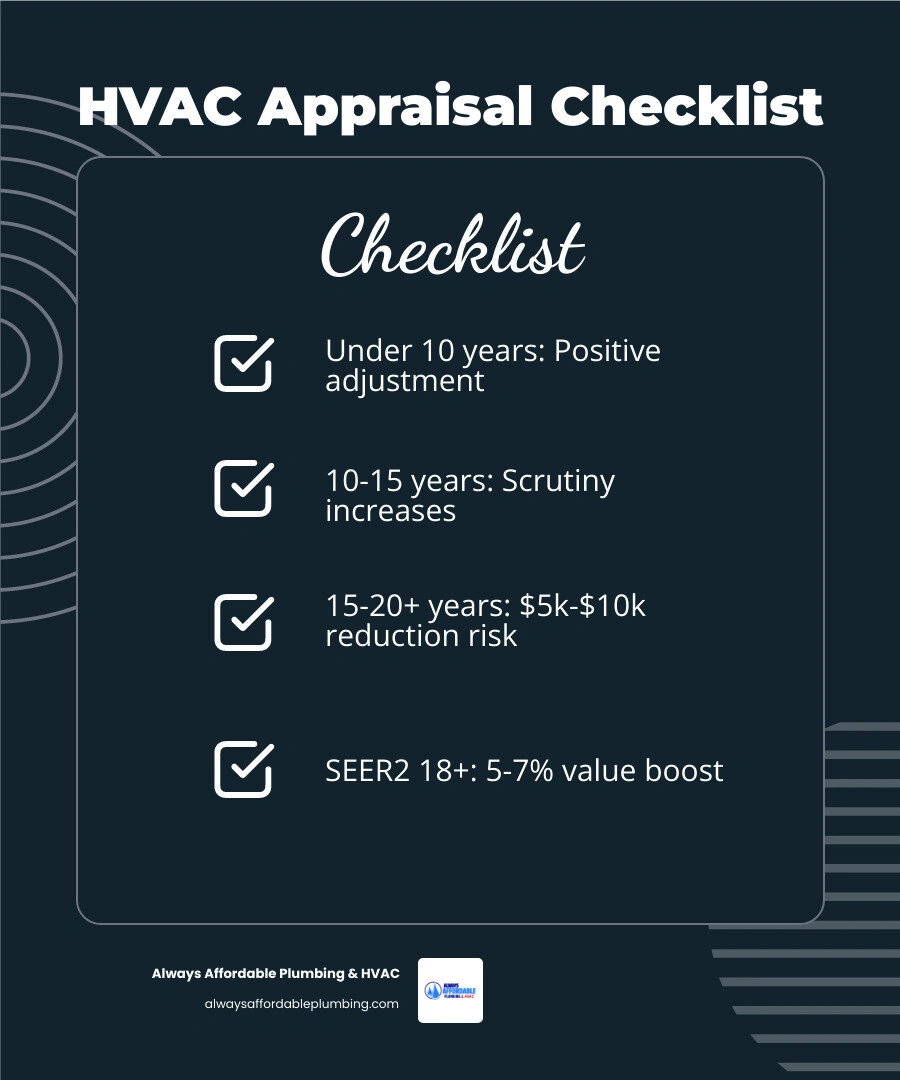
• New system (under 10 years old, well-maintained) — Likely Appraisal Impact: Positive or neutral adjustment; viewed as an asset
• Aging system (10–15 years old) — Likely Appraisal Impact: Increased scrutiny; maintenance history becomes critical
• Older system (15–20+ years) — Likely Appraisal Impact: Often flagged as deferred maintenance; potential $5,000–$10,000 value reduction
• Missing central air (where expected by market) — Likely Appraisal Impact: $5,000–$8,000 functional obsolescence penalty
• High-efficiency upgrade (SEER2 18+, AFUE 95%+) — Likely Appraisal Impact: Potential 5–7% increase in appraised value; 50–80% ROI
• R-22 refrigerant system — Likely Appraisal Impact: Flagged as a liability; treated as near zero remaining useful life
In the Sacramento area — where summers push AC systems hard and year-round performance matters — appraisers pay close attention to your HVAC. A failing or outdated system can quietly erase thousands of dollars in home equity before you ever reach the negotiating table. On the flip side, a well-maintained or recently upgraded system can protect and even grow your property value.
This guide walks you through exactly how appraisers evaluate your HVAC, what red flags to avoid, which upgrades deliver real ROI, and how to document improvements so they actually count.
Discover more about how hvac condition affects home appraisals:
• energy efficient hvac and home value connection
• how a new hvac system increases home value
When an appraiser steps into your home in Sacramento, Elk Grove, or Roseville, they are not looking at your interior design or paint colors first. They are assessing the core structural and mechanical integrity of the property. Your heating, ventilation, and air conditioning (HVAC) system is categorized under "physical condition" alongside other heavy-hitting components like the electrical panel, plumbing, and roof.
Appraisers are not licensed HVAC technicians. They will not perform a deep, diagnostic pull of your compressor's electrical draw or hook up gauges to check your refrigerant pressures. Instead, they rely on a standardized visual inspection, functional testing, and an assessment of the system's Remaining Useful Life (RUL).
First, they will conduct a simple functional test: turning the system on via the thermostat to verify that it blows cold air in the summer and warm air in the winter. Next, they evaluate the physical condition of the indoor furnace, the outdoor condenser unit, and the visible ductwork. They look for obvious signs of neglect, such as heavy rust, crushed condenser fins, or disconnected ducts.
If your system is dirty or struggling, it serves as a "canary in the coal mine" for the appraiser, signaling that other hidden areas of the home might also be neglected. To keep your system from triggering these visual warning signs, it is crucial to stay on top of regular care. You can read up on How to Prevent HVAC Emergencies with Maintenance and follow our practical Hvac Maintenance Tips to keep everything running cleanly.
During the physical walkthrough, the appraiser performs a specific micro-checklist on your climate control setup:
1. Thermostat Response: They will verify that the thermostat powers on, operates smoothly, and successfully signals the heating and cooling units to kick on without unusual delays or grinding noises.
2. Manufacturer Labels: Appraisers will locate the metal data plates on both the indoor furnace and the outdoor condenser. They will photograph these labels to document the model number, serial number, and safety certifications.
3. Tonnage Verification: Using the model numbers, the appraiser confirms the system's capacity (tonnage) to ensure it is sized correctly for the total square footage of your home.
4. Date of Manufacture: The serial number reveals the exact month and year the equipment was manufactured. This is used to determine the chronological age of the system, which is then weighed against its physical condition to estimate its remaining useful life.
If the labels are missing, painted over, or completely illegible due to outdoor wear, the appraiser may have to list the system's age as "unknown" or estimate it conservatively, which rarely works in the homeowner's favor.
If you are applying for a Home Equity Line of Credit (HELOC) or refinancing your mortgage in Citrus Heights, Davis, or Carmichael, how hvac condition affects home appraisals directly impacts your borrowing power.
Lenders use your home's appraised value to calculate your Loan-to-Value (LTV) ratio. If your HVAC system is functional and well-maintained, it protects your home's baseline value, ensuring you keep your equity intact. However, if the appraiser flags your heating and air conditioning system as failing or past its useful life, they will apply a "deferred maintenance" deduction.
This deduction typically ranges from $5,000 to $10,000 or more, representing the estimated cost a buyer would incur to make the home safely habitable. Because HELOC credit limits are determined by subtracting your outstanding mortgage balance from a percentage of your appraised value, a $10,000 drop in appraised value can directly shrink your available credit limit by thousands of dollars. Taking care of your system is not just about keeping cool in July; it is about protecting your financial liquidity.
In May 2026, energy efficiency is no longer just a buzzword — it is a primary driver of real estate value. With hot Central Valley summers and rising utility rates, appraisers and buyers alike look closely at how much a home costs to run. High-efficiency systems reduce operating costs, which appraisers can use to justify positive adjustments when comparing your property to similar homes in the neighborhood.
When appraisers evaluate your system's efficiency, they look at several key standardized metrics:
• SEER2 (Seasonal Energy Efficiency Ratio 2): This measures the cooling efficiency of air conditioners and heat pumps under updated, real-world testing conditions. Older systems might have SEER ratings as low as 10 or 13, whereas modern, high-efficiency units routinely exceed 18 to 22 SEER2.
• AFUE (Annual Fuel Utilization Efficiency): This measures how efficiently a gas furnace converts fuel into heat. Standard older furnaces operate at around 80% AFUE (meaning 20% of the energy is lost up the chimney), while high-efficiency condensing furnaces reach up to 95% to 98% AFUE.
• HSPF2 (Heating Seasonal Performance Factor 2): This rates the heating efficiency of electric heat pumps. Higher numbers indicate a system that requires significantly less electricity to keep your home warm during chilly winter nights.
• ENERGY STAR Certification: Systems carrying this label meet strict energy efficiency guidelines set by the EPA, signaling to appraisers that the home features modern, cost-saving mechanicals.
To understand the long-term equity benefits of upgrading to these units, check out our guide on the Energy Efficient HVAC and Home Value Connection.
To see how these different efficiency levels translate to actual appraisal adjustments, review the comparative table below:
• Standard / Builder Grade — Key Metrics: 14–15 SEER2 80% AFUE 7.5 HSPF2 — Typical Appraisal Adjustment: Baseline / Neutral — Impact on Home Equity: Keeps the home at baseline market value; no positive or negative adjustments.
• Mid-Range Efficient — Key Metrics: 16–17 SEER2 90% AFUE 8.2 HSPF2 — Typical Appraisal Adjustment: +$1,000 to +$2,000 — Impact on Home Equity: Slight positive adjustment; signals to the appraiser that utility costs are controlled.
• High-Efficiency Premium — Key Metrics: 18+ SEER2 95%+ AFUE 9.0+ HSPF2 — Typical Appraisal Adjustment: +$3,000 to +$5,000+ — Impact on Home Equity: Strong positive adjustment; highly marketable; justifies a 5% to 7% total property value boost when compared to homes with older systems.

While a great HVAC system can boost your home's standing, an neglected or outdated setup can actively drag your home's value down. Appraisers are trained to spot specific red flags that indicate a system has transitioned from a functional asset into a financial liability.
The most common HVAC red flags include:
• R-22 Refrigerant (Freon): If your air conditioner was manufactured before 2010, there is a high chance it uses R-22 refrigerant. Because R-22 has been entirely phased out due to environmental regulations, repairing these systems is incredibly expensive, and replacement parts are scarce. Appraisers often treat R-22 systems as having zero remaining useful life, triggering an immediate recommendation for replacement.
• Visible Rust and Corrosion: Heavy rusting on the outdoor cabinet, inside the furnace burner compartment, or on the condensate drain pan indicates moisture issues and advanced wear.
• Leaky, Damaged Ductwork: If the appraiser spots crushed, disconnected, or poorly insulated ducts in the attic or crawlspace, they will note it. According to the U.S. Department of Energy, leaky ducts can easily drop overall system efficiency by 20% to 30%.
• Missing Central Air Conditioning: In the Sacramento region, where summer temperatures regularly cross triple digits, central air conditioning is a standard market expectation. If your home relies solely on window units or portable evaporative coolers in a neighborhood where central HVAC is the norm, appraisers will apply a $5,000 to $8,000 functional obsolescence penalty to your appraisal.
Proper system design is critical to avoiding these pitfalls. A system that is too small will run constantly and fail early, while an oversized unit will short-cycle, leaving your home humid and clammy. You can learn how professional technicians prevent these issues by reading about How Proper HVAC Sizing Affects Comfort and Efficiency and exploring what goes into the Best HVAC Service Sizing a New AC Unit.
If you are planning to upgrade your heating and cooling system before selling or refinancing, it helps to know which improvements offer the best return on investment (ROI). While a standard replacement typically recovers 40% to 60% of its cost in immediate appraised value, strategic upgrades can push that return much higher.
• Heat Pump Conversions: Replacing an old gas furnace and air conditioner with a modern electric heat pump is highly valued in California's current regulatory and utility landscape. These systems offer incredibly high HSPF2 ratings and appeal heavily to energy-conscious buyers.
• Ductless Mini-Split Systems: If you have a converted garage, an attic home office, or a home without existing ductwork, ductless mini-splits are a fantastic choice. They allow you to add fully conditioned square footage to your home's official living area, which can dramatically raise your overall property valuation.
• Smart Thermostats: While installing a smart thermostat won't add thousands of dollars to an appraisal on its own, it acts as a strong visual cue. It signals to the appraiser and potential buyers that the home is modern, efficient, and well-cared-for.
• Zoning Systems: For multi-story homes in areas like Folsom or Rancho Cordova, installing a zoned system with automatic dampers resolves uneven temperature issues. This prevents the classic appraisal issue of a freezing downstairs and a sweltering upstairs.
To keep these upgrades performing at their peak and protect your investment, you might wonder: Is an HVAC Maintenance Plan Worth It? Regular service ensures your system maintains its high efficiency ratings over time. For more details on scheduling, check out our guide on How Often Should You Service Your HVAC.
Do not make the mistake of assuming the appraiser will notice your HVAC upgrades simply by looking at the equipment. Appraisers move quickly, and a clean, newly installed furnace can look remarkably similar to a well-wiped 10-year-old model from the outside.
To ensure you receive full credit for your investments, you should prepare an HVAC Portfolio and hand it directly to the appraiser during their visit.
Your HVAC Portfolio should include:
• Installation Invoices: Showing the exact date of installation, the name of the licensed company that performed the work, and the total scope of the project.
• Permit Records: In California, major HVAC replacements require local municipal permits. Providing copies of finalized permits proves the installation was done legally and meets all local building codes.
• Warranty Documentation: If your system features a 10-year parts warranty that is transferable to the next homeowner, highlight this. It provides immense peace of mind and real financial value.
• Service History Logs: Keep a record of every professional tune-up and safety inspection. If you live in Folsom, you can use our dedicated Hvac Maintenance Guide Folsom to make sure your records cover all the necessary bases.
Having this paperwork ready transforms your HVAC system from a question mark into a verified, documented asset.
Preparing for a home appraisal can bring up a lot of questions. Here are the answers to some of the most common concerns we hear from local homeowners.
A new HVAC system acts primarily as an equity safeguard. While it may not instantly skyrocket your credit limit past your neighborhood's natural ceiling, it prevents the severe $5,000 to $10,000 "deferred maintenance" deductions that appraisers apply to homes with failing mechanical systems. By protecting your home's maximum appraised value, you keep your Loan-to-Value (LTV) ratio in a healthy range, which directly maximizes your available borrowing power.
Generally, the 15-year mark is where an HVAC system begins to transition from an asset into a liability. While most well-maintained furnaces and AC units can last 15 to 25 years, appraisers look closely at "effective age" versus chronological age. A 16-year-old system with a spotless, documented service history may receive a neutral rating, whereas a neglected 10-year-old system covered in rust and dirt can easily trigger a value penalty.
Absolutely. Having your system professionally serviced right before the appraiser arrives is highly recommended. A fresh, dated service sticker on the furnace cabinet, a brand-new air filter, and a clean, debris-free outdoor condenser pad send a powerful message. It shows the appraiser that you are an active, responsible homeowner, building immediate confidence in the overall condition rating of your property.
Your HVAC system is one of the hardest-working components of your home, especially under the demanding climate conditions of the Sacramento area. From scorching summer afternoons in Elk Grove to chilly winter mornings in Roseville, your comfort and your home equity depend directly on the health of your heating and air conditioning equipment.
By understanding how hvac condition affects home appraisals, you can take proactive steps to protect your property value. Whether that means scheduling a routine pre-appraisal tune-up, organizing your service records, or planning a strategic high-efficiency upgrade, staying ahead of the game pays off.
At Always Affordable Plumbing & HVAC, we are proud to provide honest, transparent, and high-quality heating and air conditioning services throughout Sacramento, Roseville, Folsom, Elk Grove, and the surrounding communities. Don't let an aging or neglected system put a dent in your hard-earned home equity. Schedule your professional HVAC evaluation today and ensure your home is fully prepared to stand up to any appraisal.
See what our satisfied customers have to say about their experience with Always Affordable
Plumbing & HVAC.

"Chappy was very skilled in his knowledge of my HVAC unit. I greatly appreciate the quick response and experienced tech. The whole endeavor was made less stressful by his humor and honest conversation. I find comfort in knowing I now have a shop i trust for the next time."
"Tony, James, Ronnie did an amazing job setting up our new AC! They were quick, efficient, considerate, and polite! We appreciate them scheduling us in on such short notice. Definitely recommend this company!"
"Prompt, professional service with kindness and care. They came out to address both plumbing and AC issues. I received a courtesy call before they arrived. All issues were resolved the same day with integrity and respect. Thankful for businesses like this. Absolutely recommend to those that I love."
"Excellent service! Jason came out promptly and in addition to doing my outside faucet he also put in new irrigation equipment! All done perfectly! Jason was lovely"
"Honest with the assessment; friendly and good manners. No high pressure sales. Just good to honest "tell it like you see it" Thought my kitchen disposer needed an overhaul. But Jason, there Plumber gave me an honest lesson on what was really happening. Saved me hundreds, if I went the route of replacing. Thank you!"
"Absolutely 5 stars. If you are looking for affordable ,professional and kind. Chappy was excellent and very knowledgeable . I called in the morning because my air conditioner stopped working he was here within hours and fixed my air with a smile. I highly recommend Chappy and Always Affordable plumbing and Hvac."
"Scott and James were great. They got there quickly and diagnosed the problem with my A/C.They did a very thorough job testing everything. Sent me pictures and called to keep me informed. Got it done the next day and everything is working fine. Be glad when I get home so I can enjoy my new system. Thanks guys for a great job."
"Chappy was very helpful. He knew our issue right away, cleaned our coils. He also came on the same day we called and got our AC blowing cold air again."
"After some timing ’curfuffles’ the Tech Jason arrived and not only completed a speedy install on my toilet, he was personable & professional. Because of the timing issues Jason was attentive and showed up with everything needed! No extra store runs 😊 I was very comfortable with having this Tech in my Daughter’s home. We will definitely use this Service again."