Home Maintenance Troubleshooting: Fixing HVAC Short-Cycling & Stubborn Plumbing Clogs
Why is your HVAC short-cycling? See how basic home maintenance tips and troubleshooting prevent extreme weather breakdowns, and decide when to call a pro.



If you have an ac running but not cooling your home, here are the most common reasons and what to check first:
Quick Answer — Top Reasons Your AC Runs Without Cooling:
1. Thermostat set incorrectly — Fan may be set to "On" instead of "Auto," circulating unconditioned air
2. Dirty or clogged air filter — The single most common cause, responsible for up to 70% of service calls
3. Blocked or dirty outdoor condenser unit — Prevents heat from escaping outside
4. Frozen evaporator coil — Restricts airflow and shuts down heat transfer entirely
5. Low refrigerant from a leak — Refrigerant doesn't get used up; low levels always mean a leak
6. Leaky ductwork — Up to 20–30% of cooled air can be lost before it reaches your rooms
7. Aging or undersized system — Units over 10–15 years old often can't keep up during peak Sacramento heat
There's a particular kind of frustration that comes with hearing your AC hum along normally while your home sits stuffy and warm. In Sacramento, where summer temperatures routinely push past 100°F and agricultural dust and cottonwood seeds clog outdoor units faster than almost anywhere else in California, that frustration can turn into a real problem fast. The good news is that most cases of an AC running but not delivering cool air come down to a handful of fixable issues — and many of them you can check yourself in under five minutes before ever picking up the phone.
This guide walks you through exactly what to look for, what you can handle on your own, and when it's time to call in a licensed technician.
To understand why your air conditioner is running but not cooling your home, it helps to know how the cooling process actually works. Many homeowners believe that an air conditioner creates cold air and blows it into the house. In reality, your AC works by removing heat from your indoor air and transferring it outside.
This heat transfer cycle relies on a continuous loop of airflow and refrigerant. The indoor blower fan pulls warm air from your living spaces across a freezing-cold evaporator coil. The refrigerant inside the coil absorbs the heat from the air, and the newly cooled air is pushed back into your rooms. Meanwhile, the heated refrigerant travels to the outdoor condenser unit, where the outdoor fan dumps that absorbed heat into the open air.
If any part of this continuous cycle is interrupted, the system will keep running, but the heat transfer process fails. In the Sacramento Valley, local environmental factors make these interruptions much more common. Our agricultural region produces heavy dust, and our native cottonwood trees release fluffy seeds that act like a blanket over outdoor condenser coils. When this debris builds up, your system can't release the heat it absorbed from indoors. This leaves you with an air conditioner that sounds like it is working perfectly but leaves your home feeling warm and clammy.
If you notice that the air coming out of your registers feels lukewarm, you might be dealing with a system that has stopped cooling entirely. You can learn more about this specific issue in our guide on Is Your AC Blowing Warm Air. When the airflow itself feels weak, sluggish, or uneven throughout your home, it is often a sign of underlying distribution problems. To troubleshoot airflow issues, check out our breakdown of AC Airflow Problems Homes.
When your cooling system is running but failing to lower the temperature, the problem often starts with simple, everyday maintenance issues:
• Incorrect Thermostat Settings: If your thermostat fan is set to "On" rather than "Auto," the indoor blower fan will run continuously, even when the outdoor cooling unit is cycled off. This circulates unconditioned, warm air through your vents.
• A Clogged Air Filter: A dirty air filter is the single most common cause of an AC running but not cooling. It blocks the essential airflow needed to keep the heat transfer cycle moving. When air can't pass through, the system runs constantly but fails to lower the indoor temperature. If you want to see how a simple filter can impact your entire system, read about How Clogged Air Filters Damage AC.
• A Blocked Outdoor Condenser: Leaves, weeds, agricultural dust, and lawn furniture sitting too close to your outdoor unit block the airflow it needs to release heat. If the condenser can't "breathe," it can't dump the heat it carried out of your home.
When basic maintenance isn't the issue, the problem is likely a mechanical or electrical failure:
• Frozen Evaporator Coils: When airflow is restricted by a dirty filter or blocked vents, the indoor evaporator coil gets too cold. Moisture in the air freezes on the coil, forming a block of ice that completely stops heat transfer. Low refrigerant levels can also cause the coil temperature to drop below freezing, leading to the same icy buildup. If your system is iced over, discover why this happens by reading Why is Your AC Freezing Up During the Summer Heat.
• Failed Capacitor or Contactor: The capacitor acts like a battery that gives your outdoor compressor and fan the electrical "kick" they need to start running. In the extreme heat of Sacramento summers, capacitors degrade rapidly. If the capacitor fails, the outdoor fan might spin, but the compressor won't turn on, meaning no cooling is taking place.
• Compressor Failure: The compressor is the heart of your AC system, pumping refrigerant between the indoor and outdoor units. If the compressor is failing, the system will run its fans but won't be able to cycle refrigerant to cool the air. To spot the warning signs before a complete breakdown, consult our guide on Signs Your AC Compressor is Failing.
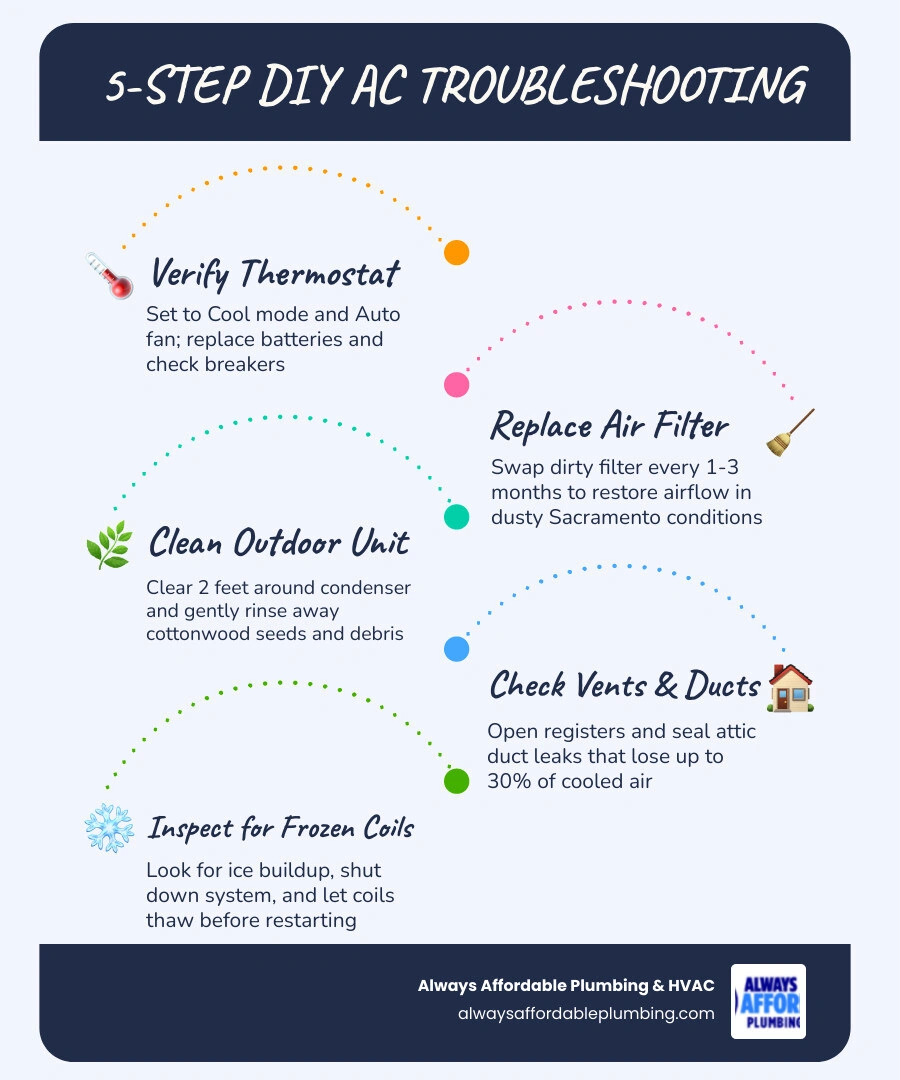
Before you schedule an emergency service call during a July 2026 heat wave, you can perform a quick, safe, five-minute DIY diagnostic check. Many cooling issues can be resolved with these five simple steps.
Start with the brain of your HVAC system. It is surprisingly easy for thermostat settings to get bumped or adjusted accidentally:
1. Check the Mode: Ensure your thermostat is set to "Cool" and not "Heat" or "Fan Only."
2. Adjust the Temperature: Lower the set temperature to at least 5°F below the current indoor room temperature to force the system to call for cooling.
3. Check the Fan Setting: Switch the fan setting from "On" to "Auto." In "Auto" mode, the fan only blows when the system is actively cooling the air.
4. Replace the Batteries: If your thermostat screen is dim or blank, install fresh batteries.
5. Check the Circuit Breaker: Go to your home's electrical panel. Look for the breakers labeled "AC" or "HVAC." If a breaker has tripped to the middle position, flip it completely to "Off" and then back to "On."
If your thermostat is set correctly but the air coming from your vents is weak or warm, check your air filter. Pull the filter out of its slot in your return vent or air handler and hold it up to a light fixture. If you cannot see light passing through the fibers, the filter is clogged with dust, pet hair, and Sacramento Valley pollen.
Replace the dirty filter with a fresh one of the correct size. During heavy summer use, we highly recommend checking your filter every 30 days and replacing it at least every 1 to 3 months to prevent system strain.
Your outdoor unit needs plenty of open space to release heat efficiently. Walk outside and inspect the area around your condenser:
1. Clear the Perimeter: Remove any weeds, tall grass, leaves, branches, or lawn furniture within two feet of the unit.
2. Inspect the Coils: Look at the metal fins on the sides of the unit. If they are coated in a layer of grey dirt, agricultural dust, or cottonwood seeds, they need a gentle cleaning.
3. Rinse Gently: Turn off the power to your AC at the outdoor disconnect box. Grab your garden hose and gently rinse the coils from the top down. Never use a pressure washer, as the high pressure will bend and damage the delicate aluminum fins.
If only one or two rooms in your home feel warm while the rest of the house is cool, your ductwork or registers might be the issue:
1. Open All Registers: Ensure that the supply vents and return air grilles in every room are fully open and not blocked by heavy drapes, rugs, or furniture. Closing too many vents actually increases pressure inside your system, reducing overall cooling efficiency.
2. Inspect Accessible Ductwork: If you can safely access your attic, basement, or crawl space, inspect the visible runs of ductwork. Look for disconnected joints, loose tape, or tears in the flexible ducts. The Department of Energy estimates that the average home loses 20% to 30% of its conditioned air through duct leaks. In a hot attic that reaches 140°F, a leaky duct will actively suck superheated air into your cooling system.
If your system has been running continuously for hours but the indoor temperature is rising, check for ice. Walk over to your indoor air handler or look at the copper refrigerant lines running into your outdoor unit.
If you see ice forming on the copper lines, or if you notice water pooling around the base of your indoor unit, your evaporator coil is frozen. If you see these signs, turn your thermostat to "Off" immediately. Keep the fan setting on "Auto" or "On" to help warm air circulate and melt the ice. Running your system while it is frozen can cause permanent damage to your compressor. For more on managing water issues caused by melting ice, read about Sudden Water Leaks from Your AC.
While basic troubleshooting can resolve minor issues, some cooling problems require professional tools and expertise. If you have completed the five steps above and your system is still running but not cooling, it is time to call a licensed HVAC professional.
Refrigerant handling is strictly regulated, and any diagnostics or repairs involving refrigerant lines require an EPA Section 608 certified technician. Similarly, testing electrical capacitors, contactors, and compressors involves high-voltage circuits that can be dangerous to handle without professional training. If you live in Sacramento, Elk Grove, Folsom, or surrounding areas, our team is ready to help restore your comfort. Learn more about our professional Air Conditioner Repair Sacramento services.
Contact a professional immediately if you notice any of the following warning signs:
• Hissing or Bubbling Noises: Refrigerant travels through a sealed copper loop. If you hear a hissing or bubbling sound coming from your indoor or outdoor unit, it indicates a refrigerant leak. Refrigerant does not get "used up" like fuel; low levels always point to a leak that must be located, sealed, and recharged by a certified technician. You can learn more about identifying strange sounds in our guide to Unusual AC Sounds in Your Home.
• Strange Odors: A musty or mildew-like smell coming from your vents usually points to mold growth inside your evaporator coil or ductwork. A burning, metallic, or electrical odor indicates failing wiring, a burnt-out motor, or a failing compressor. For a complete guide on diagnosing these smells, check out Strange AC Odors in Your Home.
• Frequent Tripping of the Circuit Breaker: If your AC trips the circuit breaker every time it turns on, do not keep resetting it. This is a safety feature indicating a severe electrical short or a compressor that is drawing too much power as it fails.
Sometimes, an air conditioner runs constantly without cooling simply because it cannot keep up with the extreme outdoor heat. This is common in two scenarios:
1. An Undersized AC System: If your cooling system was not properly sized for your home's square footage, layout, and insulation levels, it will struggle during peak summer days. It may run continuously for 24 hours a day but never reach your thermostat's set point.
2. An Aging System: Central air conditioning systems in the Sacramento Valley typically last between 12 and 15 years before the intense summer heat waves take their toll. As a system ages, its mechanical components wear down, and its overall efficiency drops. If your system is over a decade old and requires frequent, expensive repairs, it may be more cost-effective to upgrade to a modern, energy-efficient model.
To help you decide on the best path forward for your home, read our guide on When to Upgrade Outdated AC Unit or explore our advice on Do I Need a New AC Solanos Best HVAC Service.
The best way to handle an AC that runs without cooling is to prevent the issue from happening in the first place. Regular preventative maintenance keeps your system operating at peak efficiency, lowers your monthly utility bills, and extends the overall lifespan of your equipment.
• Air Filter Replacement — Frequency: Every 1-3 Months — DIY or Professional?: DIY — Benefit: Restores airflow and protects the indoor evaporator coil from dust buildup.
• Outdoor Unit Clearance — Frequency: Monthly during summer — DIY or Professional?: DIY — Benefit: Ensures proper heat release and prevents system overheating.
• Condenser Coil Cleaning — Frequency: Annually (Spring) — DIY or Professional?: Professional / DIY (light rinse) — Benefit: Removes caked-on agricultural dust and cottonwood seeds.
• Electrical & Safety Inspections — Frequency: Annually (Spring) — DIY or Professional?: Professional — Benefit: Tests capacitors, contactors, electrical connections, and motor amperages.
• Refrigerant Level Check — Frequency: Annually (Spring) — DIY or Professional?: Professional — Benefit: Ensures optimal system pressures and catches leaks early.
• Condensate Drain Line Flush — Frequency: Annually (Spring) — DIY or Professional?: Professional / DIY — Benefit: Prevents water backups, mold growth, and automatic system shutdowns.
Taking care of your system does not have to be complicated. You can learn the basics of system care in our guide on How to Maintain Your Heating and Cooling System. For a complete breakdown of what to expect during a professional maintenance visit, explore our HVAC Maintenance Plan Complete Guide. If you live in the Folsom area, check out our local AC Maintenance Folsom Guide for tailored tips.
Yes, you should turn off your air conditioner immediately if you notice it is running but failing to cool your home. Running a malfunctioning AC system places immense mechanical strain on the compressor, which is the most expensive component to replace. If the issue is a frozen coil, running the system can damage the compressor permanently. Turning it off also prevents unnecessary energy waste and high utility bills while you troubleshoot or wait for a technician.
Cleaning or replacing a dirty air filter does not change the actual temperature of the refrigerant inside your system, but it does make the air coming out of your vents feel colder and flow much faster. When a filter is clean, maximum airflow passes over the freezing-cold evaporator coil, allowing the system to absorb heat and remove humidity efficiently. This rapid heat absorption and moisture removal are what make your indoor air feel crisp, cool, and comfortable.
If your system takes a long time to lower the temperature, it is often due to high indoor humidity, poor attic insulation, or solar heat gain from uncovered windows. When humidity is high, your AC must spend a significant portion of its cooling capacity removing moisture from the air before you will feel a noticeable drop in temperature. Additionally, during extreme Sacramento heat waves, most residential AC systems are designed to maintain a maximum temperature difference of about 20°F between the outdoor air and indoor air.
Keeping your home cool and comfortable during the hot Sacramento Valley summers requires an air conditioning system that is operating at its best. While finding your ac running but not cooling your home can be incredibly frustrating, walking through simple DIY troubleshooting steps — like checking your thermostat settings, replacing a clogged air filter, and clearing debris from your outdoor unit — can often resolve the issue without a service call.
When mechanical failures, electrical issues, or refrigerant leaks require professional attention, it is important to choose a trusted, local team to get the job done right. To find a service partner you can trust, read our guide on How to Choose the Best HVAC Company in Sacramento.
At Always Affordable Plumbing, Heating & Air, we are proud to provide honest, transparent, and high-quality cooling solutions to homeowners throughout Sacramento, Elk Grove, Roseville, Folsom, Citrus Heights, and the surrounding communities. Whether you need a quick repair, a seasonal tune-up, or a complete system replacement, our licensed technicians are here to help. Contact us today to schedule your service through our Always Affordable Plumbing, Heating & Air cooling solutions page and keep your home comfortable all summer long.
See what our satisfied customers have to say about their experience with Always Affordable
Plumbing & HVAC.

"Chappy was very skilled in his knowledge of my HVAC unit. I greatly appreciate the quick response and experienced tech. The whole endeavor was made less stressful by his humor and honest conversation. I find comfort in knowing I now have a shop i trust for the next time."
"Tony, James, Ronnie did an amazing job setting up our new AC! They were quick, efficient, considerate, and polite! We appreciate them scheduling us in on such short notice. Definitely recommend this company!"
"Prompt, professional service with kindness and care. They came out to address both plumbing and AC issues. I received a courtesy call before they arrived. All issues were resolved the same day with integrity and respect. Thankful for businesses like this. Absolutely recommend to those that I love."
"Excellent service! Jason came out promptly and in addition to doing my outside faucet he also put in new irrigation equipment! All done perfectly! Jason was lovely"
"Honest with the assessment; friendly and good manners. No high pressure sales. Just good to honest "tell it like you see it" Thought my kitchen disposer needed an overhaul. But Jason, there Plumber gave me an honest lesson on what was really happening. Saved me hundreds, if I went the route of replacing. Thank you!"
"Absolutely 5 stars. If you are looking for affordable ,professional and kind. Chappy was excellent and very knowledgeable . I called in the morning because my air conditioner stopped working he was here within hours and fixed my air with a smile. I highly recommend Chappy and Always Affordable plumbing and Hvac."
"Scott and James were great. They got there quickly and diagnosed the problem with my A/C.They did a very thorough job testing everything. Sent me pictures and called to keep me informed. Got it done the next day and everything is working fine. Be glad when I get home so I can enjoy my new system. Thanks guys for a great job."
"Chappy was very helpful. He knew our issue right away, cleaned our coils. He also came on the same day we called and got our AC blowing cold air again."
"After some timing ’curfuffles’ the Tech Jason arrived and not only completed a speedy install on my toilet, he was personable & professional. Because of the timing issues Jason was attentive and showed up with everything needed! No extra store runs 😊 I was very comfortable with having this Tech in my Daughter’s home. We will definitely use this Service again."