Seasonal Home Maintenance Checklist: Preventing HVAC and Plumbing Emergencies
Prevent HVAC emergencies with a seasonal home maintenance checklist. Why proactive scheduling beats waiting for sudden failures. See what needs attention now.



Your aging air conditioner finally gives out in the middle of a sweltering heatwave, and your only priority is getting the house cool again. But when you start gathering replacement quotes, you hit a sudden administrative roadblock. Navigating Title 24 compliance for HVAC replacements in Sacramento County is a critical step that often catches homeowners completely off guard. Our team at Always Affordable Plumbing & HVAC frequently speaks with homeowners who assume that swapping out an old unit for a new one is a simple, straightforward exchange. Discovering that California law mandates specific energy efficiency standards, independent testing, and formal permits can feel like an unnecessary hurdle when all you want is a comfortable living room.
If you need HVAC services or are preparing for a full AC replacement and installation, understanding these regulations will save you significant stress.
Title 24 is not a barrier designed to slow down your project. Instead, it serves as a state-mandated quality control measure ensuring that your new, highly efficient system actually performs exactly as promised. Without these standards, a top-tier unit could be severely handicapped by poor installation or severely leaking ductwork. By understanding how these rules work and why they are in place, you empower yourself as a consumer. You transform a confusing regulatory requirement into a powerful tool that guarantees the long-term efficiency, comfort, and safety of your home in Sacramento County.
California's Building Standards Code, specifically Part 6, outlines the state's energy efficiency regulations. However, in our experience serving the local area, we find that not every visit from a technician requires a permit and a state-certified inspector. Title 24 regulations specifically apply to residential HVAC "alterations." In the eyes of the building code, an alteration means a full system replacement or the swapping out of major, energy-consuming components.
Merely repairing a minor part does not typically trigger full compliance requirements. If your technician replaces a blown fuse, installs a new contactor, or recharges refrigerant for a minor leak, you do not need to undergo state efficiency testing. However, if you are planning a complete furnace replacement, installing a brand-new air conditioning condenser, or replacing a significant portion of your home's ductwork, the law mandates full compliance.
To clarify what requires compliance and what does not, review this breakdown of common residential HVAC projects we typically see:
• Full AC or Furnace Replacement — Triggers Title 24 Compliance?: Yes — Reasoning Under State Code: Considered a major system alteration impacting home energy use.
• Replacing More Than 40 Feet of Ductwork — Triggers Title 24 Compliance?: Yes — Reasoning Under State Code: Significant changes to air distribution require leakage verification.
• Replacing a Blower Motor or Capacitor — Triggers Title 24 Compliance?: No — Reasoning Under State Code: Classified as a standard repair of an existing, permitted system.
• Routine Seasonal Tune-Ups — Triggers Title 24 Compliance?: No — Reasoning Under State Code: Maintenance does not alter the system's original design or footprint.
Local jurisdictions enforce these statewide standards meticulously. Because Sacramento County sits in California Building Climate Zone 12, the region is subject to specific, stringent mechanical requirements designed to offset heavy cooling loads. These triggers are legally mandated across the entire state. They are not optional add-ons suggested by ambitious contractors; they are strict laws that every licensed professional must follow to remain in good standing with the state board.
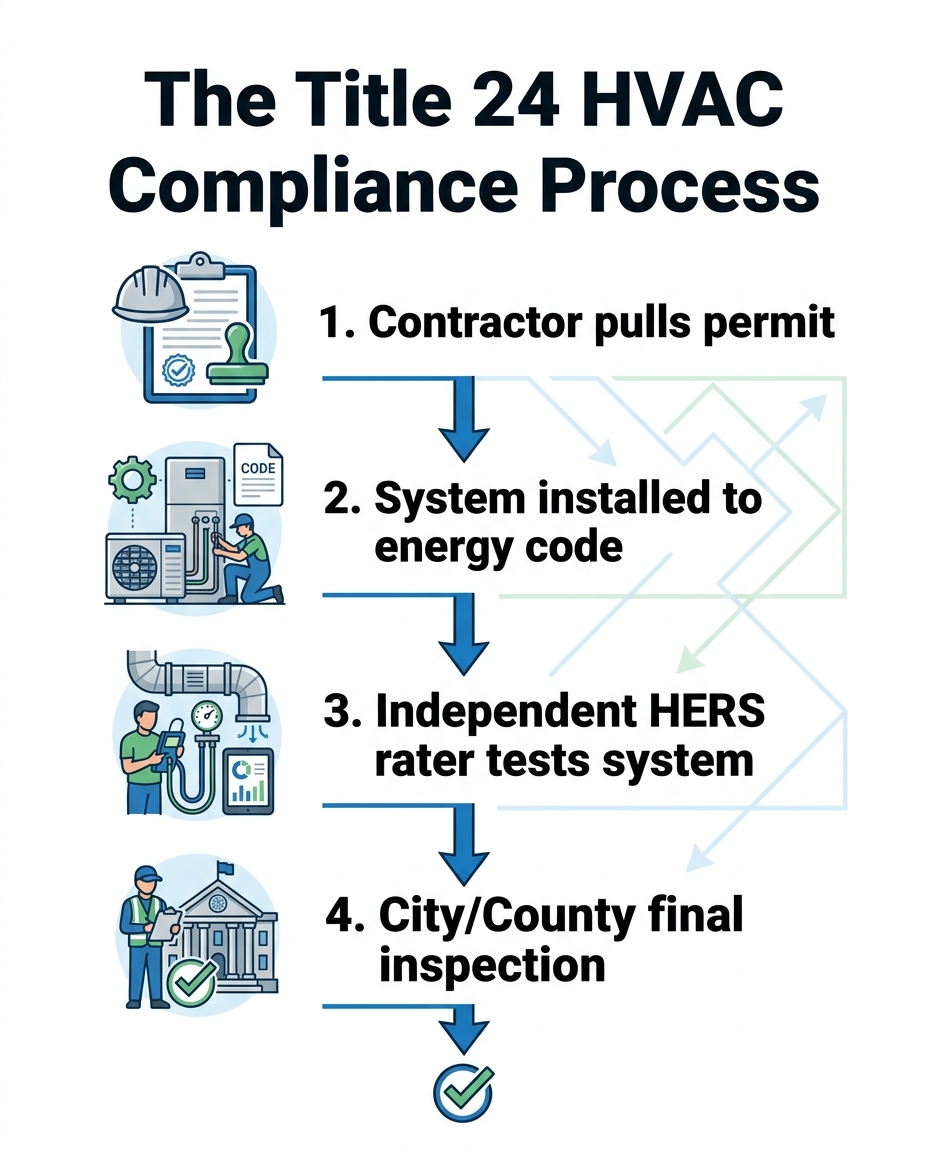
The compliance workflow can seem convoluted from the outside, but it follows a strict, logical sequence. Knowing what happens at each stage demystifies the process and helps you track the progress of your installation.
1. Pulling the Permit: Before a single wrench is turned, your installing contractor files the necessary paperwork with the local building department. This permit registers the project with the city or county, establishing a public record that the upcoming work will be performed by a licensed professional adhering to current building codes.
2. Installing to Code: The installation crew removes your old equipment and installs the new system according to strict state energy efficiency guidelines. This step involves ensuring the equipment is properly sized for your specific square footage, sealing connections meticulously, and often installing a programmable or smart thermostat as required by state energy standards.
3. Third-Party HERS Testing: Once the physical installation is complete, an independent, state-certified Home Energy Rating System (HERS) rater visits your property. This inspector is completely separate from your installation company. They perform specialized diagnostic tests to verify that the contractor's work meets the efficiency promises of the newly installed equipment.
4. Final City/County Inspection: After the HERS rater passes the system and submits the compliance documents to the state registry, a local building inspector from Sacramento County or your specific city makes a final visit. They review the paperwork, check the physical safety of the installation (such as electrical and gas connections), and officially close out the permit.

One of the most confusing aspects of the compliance process for homeowners is the involvement of the HERS rater. A HERS rater is an independent, third-party inspector certified by the state of California. Their primary job is to act as an impartial judge of your HVAC system's efficiency. Because they do not work for the company that installed your equipment, they provide an unbiased assessment of the workmanship.
The most critical evaluation they perform is the duct leakage test. Even the most advanced, high-efficiency air conditioner cannot cool your home effectively if the conditioned air escapes through cracks, disconnected joints, or degraded materials in your ductwork before it ever reaches your living room.
During this evaluation, the HERS rater temporarily seals off all the supply and return registers inside your home. They then attach a calibrated fan—often called a duct blaster—to the main return opening. This machine forces air into the duct system, pressurizing it. By measuring how much air the fan must supply to maintain that pressure, the rater can calculate exactly how much air is leaking out of the hidden ductwork in your attic or crawlspace.
Analyzing HERS duct leakage test results is a vital step in the compliance process. The state dictates allowable leakage thresholds that a system must meet to pass the inspection. If the results show that your ducts are losing more air than the state allows, the installing contractor must return, locate the leaks, and seal them properly before the project can proceed to the final city inspection. This ensures that the cool air you are paying to generate actually reaches your living spaces rather than uselessly cooling your attic.
California is vast and geographically diverse, which is why the state is divided into 16 distinct building climate zones. Sacramento County is located in Climate Zone 12. Having worked extensively throughout the local area, our team knows firsthand that this specific designation means the local building codes place a heavy emphasis on cooling efficiency due to the severe heat the region experiences during the summer months.
When Sacramento's 100+ degree summer days arrive, your air conditioning system works overtime to maintain a livable indoor environment. During these extreme heatwaves, the temperature inside a typical residential attic can easily soar past 140 degrees. If your ductwork runs through this super-heated space and suffers from significant leaks, the consequences are disastrous. Cold air escapes into the sweltering attic, and your system must run twice as long to lower the temperature inside the house.
This scenario causes massive energy waste, driving your monthly utility bills through the roof. On a broader scale, thousands of inefficient systems running simultaneously place immense strain on the local electrical grid, increasing the risk of community-wide power outages. Title 24 compliance ensures that modern systems, including advanced heat pump systems, are installed to handle these severe cooling demands efficiently. By enforcing strict duct sealing and equipment sizing standards, the state protects both your wallet and the regional power infrastructure during the hottest days of the year.
It is entirely natural to feel frustrated by the added costs of permits and third-party testing when you are already investing heavily in a home improvement project. Many homeowners initially view Title 24 compliance as nothing more than bureaucratic red tape or arbitrary contractor markups. However, reframing this process reveals its true purpose: robust consumer protection.
Before these strict testing requirements were enforced, it was common for cut-rate companies to install poorly sized equipment, use substandard materials, and leave massive leaks in the ductwork. The homeowner would pay for a premium system but receive subpar performance, resulting in systems that failed prematurely and cost a fortune to operate. Mandatory testing prevents this scenario entirely. It forces the contractor to prove their work meets the highest standards.
The independent verification provided by the HERS rater ensures you get exactly what you paid for. The rater works to uphold the state's standards, acting as an advocate for your home's energy efficiency. If the contractor cuts corners, the HERS rater will catch it, and the contractor must fix it at their own expense.
Working with an honest professional makes all the difference. Our team at Always Affordable provides transparent pricing and honest guidance, ensuring you are never overcharged for mandatory Title 24 compliance testing, permits, or required upgrades. We make it a point to explain these costs from day one, helping you navigate the process of deciding when to replace your HVAC system with full visibility into the legal and financial requirements.
Occasionally, a homeowner might be tempted by a contractor offering a "cash deal" to swap out an AC unit without pulling permits or scheduling HERS testing. While skipping these steps might seem like a way to save money upfront, it introduces severe legal, financial, and functional risks that can cost thousands of dollars down the road.
• Fines and Penalties: Local building departments actively monitor unpermitted work. If the city discovers an illegal HVAC installation, they can issue steep fines and mandate that you hire a licensed professional to tear out the work and start over legally.
• Real Estate Complications: Unpermitted work is a massive liability when it comes time to sell your home. California real estate law requires sellers to disclose unpermitted modifications. A savvy buyer's inspector will flag an illegal HVAC unit, forcing you to retroactively pull permits, pay penalty fees, and undergo testing just to close escrow.
• Voided Manufacturer Warranties: Modern HVAC equipment comes with valuable warranties protecting major components like the compressor and heat exchanger. However, nearly all major manufacturers stipulate that the warranty is completely void if the system is not installed according to local building codes by a licensed professional.
Beyond the legal headaches, skipping the compliance process directly impacts your home's comfort. Without the verification of excellent HERS duct leakage test results, you have no proof that your system is operating efficiently. You might spend years paying inflated utility bills because your unverified ductwork is leaking conditioned air into the crawlspace. Furthermore, improperly sized or poorly installed systems suffer from short-cycling and excessive wear, drastically reducing the lifespan of the equipment you just paid to install.
Yes, local building codes require a permit for replacing an air conditioning unit to ensure safety and energy efficiency standards are met. Pulling a permit alerts the local building department that major electrical and mechanical work is taking place on your property. This process guarantees that the final installation is inspected for safety hazards and complies with all state energy mandates.
It is an independent verification process that measures system efficiency, primarily focusing on duct leakage and proper airflow. A certified rater uses specialized diagnostic equipment to pressurize your ductwork and measure exactly how much conditioned air is escaping before it reaches your living spaces. This testing ensures your new equipment performs at the efficiency levels promised by the manufacturer.
Replacing a furnace, air conditioner, or installing a large amount of new ductwork triggers the requirement for compliance and testing. Minor repairs, such as replacing a capacitor, changing a filter, or topping off refrigerant, do not trigger these state mandates. The regulations apply specifically to major "alterations" that significantly impact the home's overall energy consumption.
No, if you are replacing the main heating or cooling equipment, the existing ductwork must be tested to ensure it meets minimum efficiency standards. Even if the ducts were installed decades ago, the state requires verification that they are not leaking excessively. If they fail the test, they must be sealed or repaired to meet the allowable leakage thresholds before the project can pass final inspection.
A certified, independent third-party rater performs the test, not the contractor who installed the equipment. This separation of duties is a crucial consumer protection measure. Because the rater has no financial stake in the installation itself, they provide a completely objective, unbiased assessment of the contractor's workmanship and the system's efficiency.
While Title 24 regulations are strict and mandatory, the compliance process does not have to be a stressful burden for you. When you understand that these state mandates act as a robust consumer protection measure, it becomes clear that compliance guarantees a more efficient, long-lasting, and comfortable home. The key to a smooth experience is working with a professional team that handles the administrative heavy lifting behind the scenes.
You should never have to navigate permitting offices or coordinate with independent raters on your own. By choosing our knowledgeable local technicians, you ensure that every step—from the initial load calculation to the final city sign-off—is managed seamlessly. If you are ready to upgrade your home's comfort legally and efficiently, consult with our trusted team for your AC replacement and installation to ensure your new system meets every standard Sacramento County demands.
See what our satisfied customers have to say about their experience with Always Affordable
Plumbing & HVAC.

"Chappy was very skilled in his knowledge of my HVAC unit. I greatly appreciate the quick response and experienced tech. The whole endeavor was made less stressful by his humor and honest conversation. I find comfort in knowing I now have a shop i trust for the next time."
"Tony, James, Ronnie did an amazing job setting up our new AC! They were quick, efficient, considerate, and polite! We appreciate them scheduling us in on such short notice. Definitely recommend this company!"
"Prompt, professional service with kindness and care. They came out to address both plumbing and AC issues. I received a courtesy call before they arrived. All issues were resolved the same day with integrity and respect. Thankful for businesses like this. Absolutely recommend to those that I love."
"Excellent service! Jason came out promptly and in addition to doing my outside faucet he also put in new irrigation equipment! All done perfectly! Jason was lovely"
"Honest with the assessment; friendly and good manners. No high pressure sales. Just good to honest "tell it like you see it" Thought my kitchen disposer needed an overhaul. But Jason, there Plumber gave me an honest lesson on what was really happening. Saved me hundreds, if I went the route of replacing. Thank you!"
"Absolutely 5 stars. If you are looking for affordable ,professional and kind. Chappy was excellent and very knowledgeable . I called in the morning because my air conditioner stopped working he was here within hours and fixed my air with a smile. I highly recommend Chappy and Always Affordable plumbing and Hvac."
"Scott and James were great. They got there quickly and diagnosed the problem with my A/C.They did a very thorough job testing everything. Sent me pictures and called to keep me informed. Got it done the next day and everything is working fine. Be glad when I get home so I can enjoy my new system. Thanks guys for a great job."
"Chappy was very helpful. He knew our issue right away, cleaned our coils. He also came on the same day we called and got our AC blowing cold air again."
"After some timing ’curfuffles’ the Tech Jason arrived and not only completed a speedy install on my toilet, he was personable & professional. Because of the timing issues Jason was attentive and showed up with everything needed! No extra store runs 😊 I was very comfortable with having this Tech in my Daughter’s home. We will definitely use this Service again."