Home Maintenance Tips and Troubleshooting: What to Do When Your AC Blows Warm Air
AC blowing warm air? Review essential home maintenance tips and troubleshooting to spot simple airflow issues. Decide with confidence when to call a pro.



The signs your HVAC needs replacing not just fixing are often easier to spot than most Sacramento homeowners expect — if you know what to look for:
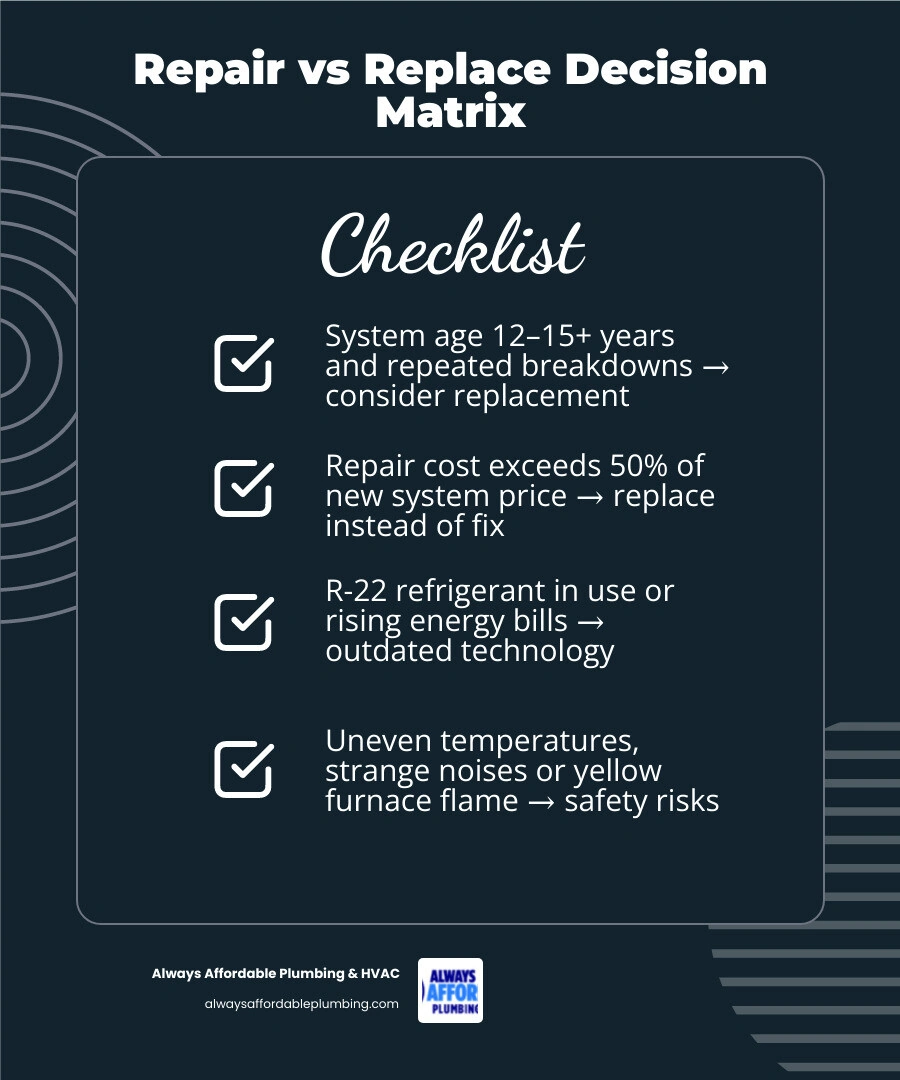
Quick answer — replace (not repair) your HVAC if you notice:
• System is 12–15+ years old and breaking down repeatedly
• Repair costs exceed 50% of what a new system would cost
• Energy bills keep climbing with no clear explanation
• Your home has uneven temperatures or persistent humidity problems
• The system uses R-22 refrigerant (phased out since 2020)
• You hear grinding, banging, or detect burning or musty odors
• The furnace flame is yellow or orange instead of blue
Your HVAC system quietly handles 40–70% of your home's total energy use every single day. When it starts failing, the costs add up fast — in wasted energy, repeated repair bills, and lost comfort. Most systems are built to last 15–20 years, but performance often starts declining around the 12-year mark. At that point, the question stops being "what's broken?" and starts being "is it worth fixing at all?"
This guide walks you through every major warning sign that points toward replacement over repair, so you can make a confident, informed decision before your system leaves you without cooling on a hot Sacramento summer day — or without heat in the middle of winter.
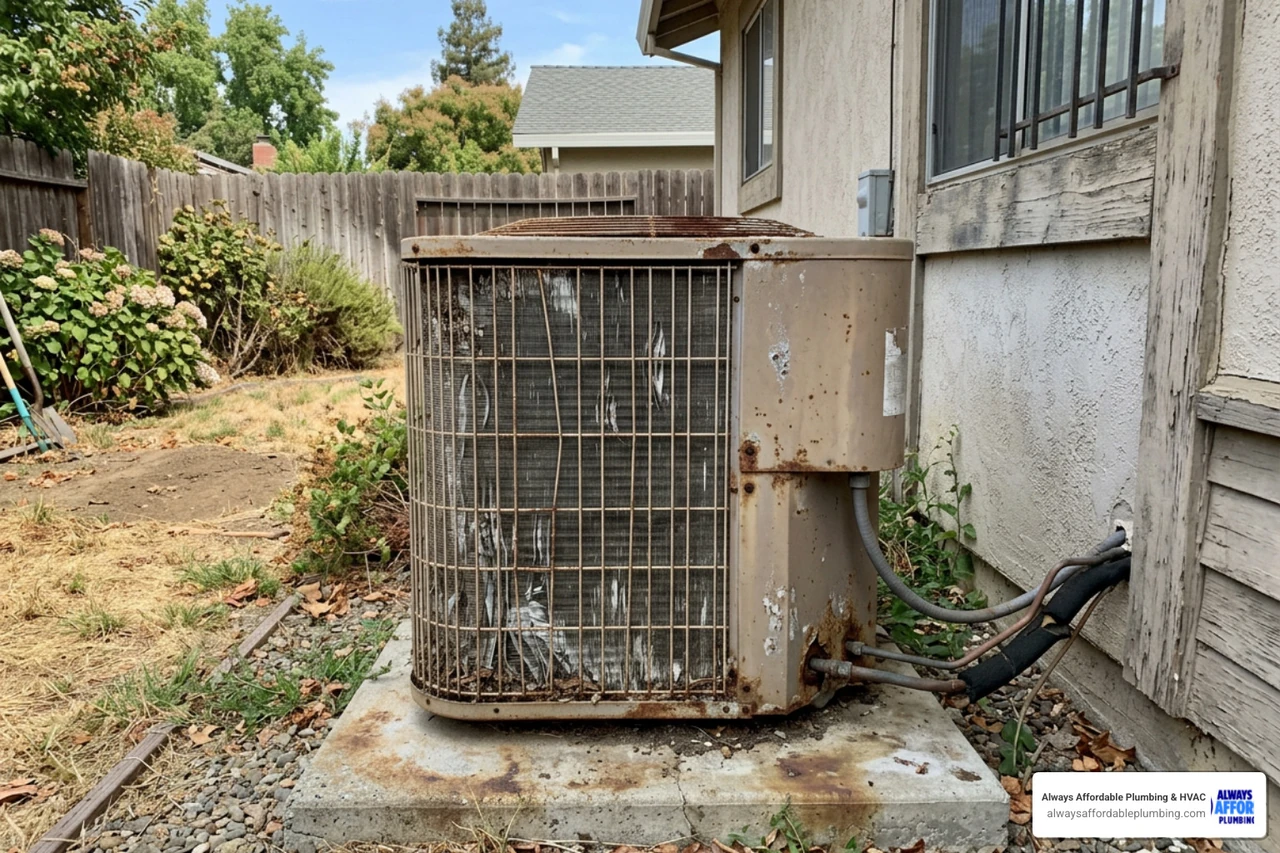
Age is the most objective starting point when evaluating your heating and cooling equipment. While routine maintenance can keep a system running smoothly for years, it cannot stop the march of time.
Most central air conditioners and air-source heat pumps have an expected lifespan of 10 to 15 years. Gas furnaces generally last a bit longer, ranging between 15 and 20 years. However, in the Sacramento Valley, our systems are subjected to extreme seasonal shifts. The blistering heat waves of July and August put immense pressure on cooling components, while chilly winter mornings demand rapid heating.
When your system crosses the 10-year threshold, its internal components have endured thousands of operational cycles. The metal in the heat exchanger has expanded and contracted countless times, the compressor valves have worn thin, and the blower motor bearings have begun to degrade. If you are constantly scheduling service calls for an older system, it is crucial to understand When to Consider Heater Replacement rather than continuing to pour money into temporary fixes. Recognizing the right Time for Heater Replacement ensures you avoid a complete system failure during the most extreme weather of the year.
Once an HVAC system passes the 12-year mark, its overall efficiency begins to drop significantly. A unit that started its life with a 14 SEER (Seasonal Energy Efficiency Ratio) rating may only perform at a 10 or 11 SEER level after a decade of hard work. This degradation represents a 20% to 30% loss in operating efficiency, meaning the system must run longer and work harder to achieve the same indoor temperatures.
In cities like Sacramento, Roseville, and Elk Grove, this drop in performance directly translates to higher utility bills and accelerated wear and tear. If your older system struggles to keep up with summer heat waves, runs constantly without reaching the thermostat setpoint, or requires multiple minor repairs year after year, it is a clear indicator that the system is ready for retirement. For modern, energy-efficient alternatives that can withstand our local climate, consult our comprehensive Heat Pump Replacement Sacramento CA Guide to explore your options.
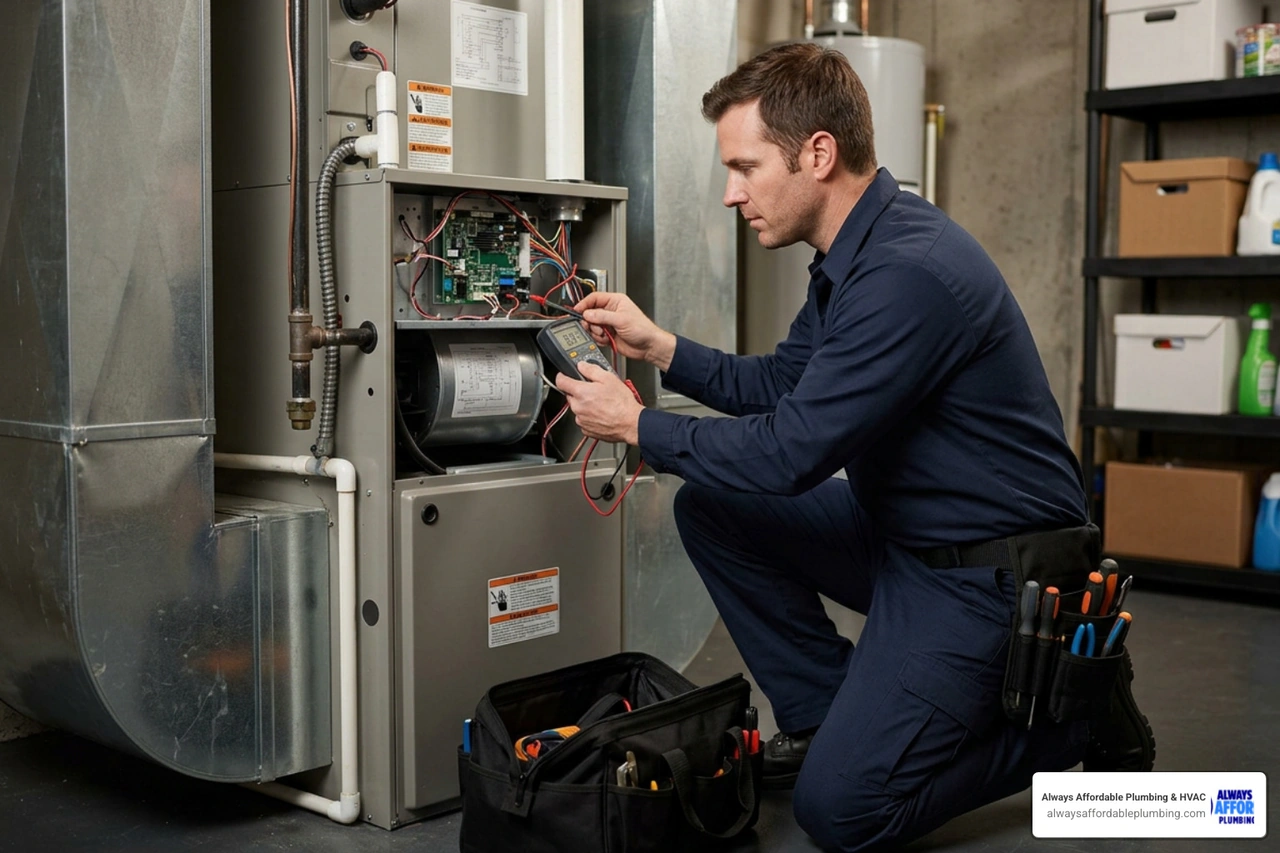
When your HVAC system breaks down, deciding whether to repair or replace it does not have to be a guessing game. Professional technicians and financial advisors rely on two simple mathematical formulas to help homeowners make logical, cost-effective decisions: the 50% Rule and the $5,000 Rule.
These rules remove the emotional stress from the situation, allowing you to view your HVAC system as a long-term investment. Understanding the Importance of Home HVAC Installation helps put these formulas into perspective, as a new, properly sized system often pays for itself over time through energy savings and reduced service calls.
The 50% Rule is straightforward: if the cost of a single repair meets or exceeds 50% of the cost of a brand-new system, you should replace the unit instead of repairing it.
This rule is particularly relevant when dealing with critical component failures, such as:
• A Failed Compressor: The heart of your air conditioner. Replacing a compressor is a labor-intensive job that often requires replacing the refrigerant as well.
• A Cracked Heat Exchanger: The primary safety hazard in a gas furnace. Because a cracked heat exchanger can leak carbon monoxide into your home, the system must be shut down immediately. Replacing this part is incredibly complex and costly.
• A Burned-Out Blower Motor or Evaporator Coil: These major parts are expensive to source and install.
When these heavy-duty components fail on an older system, opting for a repair is rarely a wise investment. The new part will be connected to older, worn-out components, which often triggers a domino effect of subsequent failures.
The $5,000 Rule is another excellent benchmark for decision-making. To apply this formula, multiply the age of your HVAC system by the cost of the proposed repair. If the total is greater than $5,000, replacement is the smarter financial choice. If the total is under $5,000, a repair is generally reasonable.
Let's look at how this plays out for homeowners in Roseville, Citrus Heights, or Folsom:
• Scenario A (Repair): Your 6-year-old air conditioner needs a new condenser fan motor. The repair is moderate. $$text{6 years} times text{Moderate Repair Cost} = text{Well under $5,000 threshold}$$Decision: Repair the system. It is still relatively young and has plenty of useful life left.
• Scenario B (Replace): Your 13-year-old AC unit has a major refrigerant leak. The repair requires sealing the leak and recharging the system.$$text{13 years} times text{High Repair Cost} = text{Well over $5,000 threshold}$$Decision: Replace the system. Pouring money into a 13-year-old unit that is already past its prime is a losing investment.
If you are a Roseville resident weighing these options, our Heat Pump Replacement Guide Roseville CA offers localized insights to help you choose the right path forward.
Sometimes, the signs your hvac needs replacing not just fixing are not found on a repair bill, but in the air quality and comfort levels of your home. If your system is no longer capable of maintaining a consistent, healthy, and comfortable indoor environment, it has failed at its primary job.
Have you noticed that your upstairs bedrooms feel like a sauna while your downstairs living room feels like an icebox? Or perhaps some rooms have strong, cool airflow while others only receive a weak, lukewarm whisper from the vents.
While minor airflow issues can sometimes be attributed to dirty air filters or leaky ductwork, persistent temperature imbalances usually point to a failing system. As compressors and blower motors age, they lose the strength required to push air evenly throughout your home's ductwork. This is especially noticeable during Sacramento's hot summer months, when a weak system simply cannot circulate air fast enough to overcome the thermal load on your roof and walls.
While utility rates fluctuate, your energy usage should remain relatively consistent from year to year when adjusted for extreme weather. If you notice your monthly energy bills climbing 15% to 25% compared to the same month in previous years, your HVAC system is likely losing its efficiency.
As internal components wear down, the system must run longer and cycle more frequently to maintain your desired thermostat settings. This constant strain not only drives up your utility bills but also accelerates the wear on the remaining healthy components of your unit. Learning How to Maintain Your Heating and Cooling System can help prolong your system's life, but once efficiency has permanently degraded, upgrading to a modern system is the only way to restore reasonable utility costs.
While comfort and finances are important, safety should always be your top priority. Aging heating and cooling systems can present serious physical hazards to your home and family. If your system exhibits any of the following safety red flags, replacement is often the only responsible option:
• A Yellow or Orange Furnace Flame: A healthy gas furnace burner should always produce a steady, bright blue flame. A yellow, flickering, or orange flame indicates incomplete combustion, which produces dangerous levels of carbon monoxide (CO).
• Cracked Heat Exchanger: If a technician detects rust, corrosion, or physical cracks on your furnace's heat exchanger during an inspection, the unit must be shut down immediately. A cracked heat exchanger allows deadly, odorless carbon monoxide gas to mix directly with the air being blown into your living spaces.
• Frequent Tripped Breakers: If your outdoor AC condenser or indoor air handler constantly trips your electrical panel's circuit breakers, it is drawing too much electrical current. This is a major fire hazard and usually indicates a failing compressor motor that is seizing up.
• Foul Odors: A persistent musty smell can indicate mold growth inside your ductwork or evaporator coil. More critically, a burning plastic or electrical odor suggests melting wire insulation, which requires an immediate system shutdown.
If you suspect your heating system is compromised, consult our Furnace Replacement Sacramento CA Guide to understand how we safely replace failing systems with modern, reliable equipment.
As of July 2026, the environmental regulations surrounding older air conditioning systems have reached a critical tipping point. R-22 refrigerant (commonly known as Freon) was completely phased out by the EPA. It is no longer manufactured or imported.
If your air conditioner was installed before 2010, it almost certainly runs on R-22. If your system develops a refrigerant leak today, sourcing recycled R-22 is incredibly difficult and extraordinarily expensive. Trying to patch a leak on an old R-22 system is highly impractical. Because there is no simple, direct "drop-in" replacement refrigerant that can be used in an R-22 system without completely replacing the compressor and seals, a refrigerant leak on an older system is a definitive sign that it is time to replace the unit.
To help you weigh your options, we have compiled a direct comparison of what you stand to gain by replacing an outdated system versus trying to keep it running with repairs:
• Energy Efficiency — Continuing to Repair an Old System: Low (SEER ratings of 8–10; performance degrades yearly) — Upgrading to a New HVAC System: High (Modern SEER2 ratings of 16–22+, reducing cooling energy by up to 37%)
• Reliability — Continuing to Repair an Old System: Low (High risk of unexpected breakdowns during extreme weather) — Upgrading to a New HVAC System: High (Years of worry-free operation with minimal maintenance required)
• Warranty Coverage — Continuing to Repair an Old System: None (Most warranties expire after 5 to 10 years) — Upgrading to a New HVAC System: Excellent (Typically comes with a 10-year parts warranty)
• Indoor Air Quality — Continuing to Repair an Old System: Poor (Older systems struggle with humidity control and dust filtration) — Upgrading to a New HVAC System: Superior (Advanced filtration, humidity control, and optional air purifiers)
• Home Resale Value — Continuing to Repair an Old System: Neutral or negative (Buyers worry about immediate replacement costs) — Upgrading to a New HVAC System: Positive (Increases home appeal and value with transferable warranties)
Investing in a new system does more than just lower your monthly bills; it also secures your peace of mind. To learn more about how this upgrade can pay off when selling your property, read our guide on How a New HVAC System Increases Home Value. To ensure your new investment lasts as long as possible, we highly recommend enrolling in a professional protection program, which you can learn about in our HVAC Maintenance Plan Complete Guide.
To determine what type of refrigerant your air conditioner uses, look for the metal manufacturer's rating plate located on the side of your outdoor condenser unit. This plate lists technical specifications, including the model number, serial number, and "Refrigerant Type." If it lists R-22 or HCFC-22, your system uses the phased-out coolant. If it lists R-410A or a newer A2L refrigerant like R-454B, your system uses a modern refrigerant. Any system manufactured before 2010 is highly likely to use R-22.
Yes, in most cases, it is highly recommended to replace both units at the same time. Your furnace and air conditioner share the same blower motor and indoor air handler. These components are engineered to work together as a matched system.
If you connect a brand-new, high-efficiency AC condenser to an old, inefficient furnace blower, the new unit will not be able to achieve its rated SEER efficiency. Additionally, replacing both systems simultaneously saves you a significant amount of money on labor costs, as our technicians only need to prep, install, and configure your home's system once.
To maximize your system's lifespan and keep your manufacturer's warranty active, you should have your HVAC system professionally serviced twice a year: once in the spring for your air conditioner, and once in the autumn for your furnace. Regular maintenance allows technicians to catch minor issues—such as worn contactors, dirty coils, or weak capacitors—before they cause major, system-ending damage. For a complete breakdown of what is covered during these visits, read our guide on How Often Should You Service Your HVAC.
Deciding to replace your heating and cooling system is a major step, but continuing to patch up a failing, inefficient unit is a recipe for ongoing stress and wasted money. By recognizing the signs your hvac needs replacing not just fixing—from system age and safety red flags to rising utility bills—you can make an informed choice that restores comfort, safety, and efficiency to your home.
At Always Affordable Plumbing & HVAC, we are proud to serve homeowners and businesses throughout Sacramento, Elk Grove, Roseville, Folsom, Rancho Cordova, Citrus Heights, and the surrounding communities. We believe in providing transparent, high-quality, and affordable solutions tailored to your unique home and budget.
Want to enjoy priority scheduling, exclusive discounts, and regular maintenance visits to keep your new system running perfectly? Ask our team about joining our Member's Club!
Don't wait for your old system to break down in the middle of a summer heat wave or a winter freeze. Schedule an HVAC consultation today with our licensed, friendly technicians for an honest, pressure-free evaluation of your system's health.
See what our satisfied customers have to say about their experience with Always Affordable
Plumbing & HVAC.

"Chappy was very skilled in his knowledge of my HVAC unit. I greatly appreciate the quick response and experienced tech. The whole endeavor was made less stressful by his humor and honest conversation. I find comfort in knowing I now have a shop i trust for the next time."
"Tony, James, Ronnie did an amazing job setting up our new AC! They were quick, efficient, considerate, and polite! We appreciate them scheduling us in on such short notice. Definitely recommend this company!"
"Prompt, professional service with kindness and care. They came out to address both plumbing and AC issues. I received a courtesy call before they arrived. All issues were resolved the same day with integrity and respect. Thankful for businesses like this. Absolutely recommend to those that I love."
"Excellent service! Jason came out promptly and in addition to doing my outside faucet he also put in new irrigation equipment! All done perfectly! Jason was lovely"
"Honest with the assessment; friendly and good manners. No high pressure sales. Just good to honest "tell it like you see it" Thought my kitchen disposer needed an overhaul. But Jason, there Plumber gave me an honest lesson on what was really happening. Saved me hundreds, if I went the route of replacing. Thank you!"
"Absolutely 5 stars. If you are looking for affordable ,professional and kind. Chappy was excellent and very knowledgeable . I called in the morning because my air conditioner stopped working he was here within hours and fixed my air with a smile. I highly recommend Chappy and Always Affordable plumbing and Hvac."
"Scott and James were great. They got there quickly and diagnosed the problem with my A/C.They did a very thorough job testing everything. Sent me pictures and called to keep me informed. Got it done the next day and everything is working fine. Be glad when I get home so I can enjoy my new system. Thanks guys for a great job."
"Chappy was very helpful. He knew our issue right away, cleaned our coils. He also came on the same day we called and got our AC blowing cold air again."
"After some timing ’curfuffles’ the Tech Jason arrived and not only completed a speedy install on my toilet, he was personable & professional. Because of the timing issues Jason was attentive and showed up with everything needed! No extra store runs 😊 I was very comfortable with having this Tech in my Daughter’s home. We will definitely use this Service again."