Navigating the Spring-to-Summer HVAC Transition: A Safe Homeowner's Maintenance Guide
Why do HVAC systems fail on the first 80-degree day? See what belongs on your seasonal home maintenance checklist and when to call a pro before summer hits.



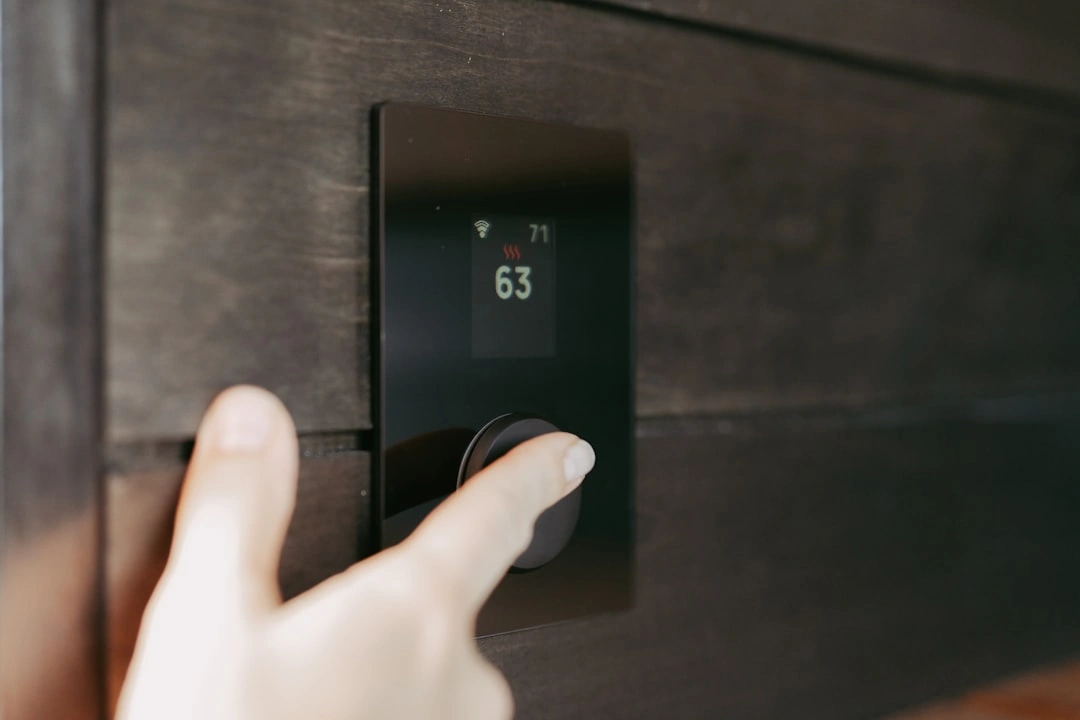
If you've ever wondered what temperature should I set my thermostat to keep your home comfortable without sending your energy bill through the roof, here's the short answer:
• Winter - Home & Awake — Recommended Setting: 68°F
• Winter - Sleeping — Recommended Setting: 62–65°F
• Winter - Away — Recommended Setting: 55–60°F
• Summer - Home & Awake — Recommended Setting: 78°F
• Summer - Sleeping — Recommended Setting: 72–75°F
• Summer - Away — Recommended Setting: 85°F (max)
These settings come straight from the U.S. Department of Energy and ENERGY STAR, and they strike the best balance between comfort and savings for most households.
Now for the bigger picture. Heating and cooling account for roughly 52% of the average American home's energy costs. That's more than half your utility bill tied directly to one device on your wall. And yet most homeowners in Sacramento, Elk Grove, Roseville, and surrounding areas set it once and forget it — leaving real savings on the table every single month.
Whether your household runs hot, cold, or somewhere in between, the right thermostat strategy can trim your annual energy costs by up to 10% without sacrificing comfort. This guide breaks down exactly how to get there.
Finding the "sweet spot" for your thermostat isn't just about personal preference; it’s about understanding the physics of heat transfer and the limitations of your HVAC system. In our Mediterranean climate—where Sacramento summers can be blistering and winters surprisingly damp and chilly—efficiency is key.
According to ENERGY STAR guidelines, the goal is to keep your indoor temperature as close to the outdoor temperature as comfortably possible. The smaller the difference between the two, the slower the heat will "leak" out of your house in the winter or "seep" in during the summer. For more detailed advice on managing your cooling system, check out our guide on How to Set Your AC Thermostat Properly and More Money-Saving Tips.
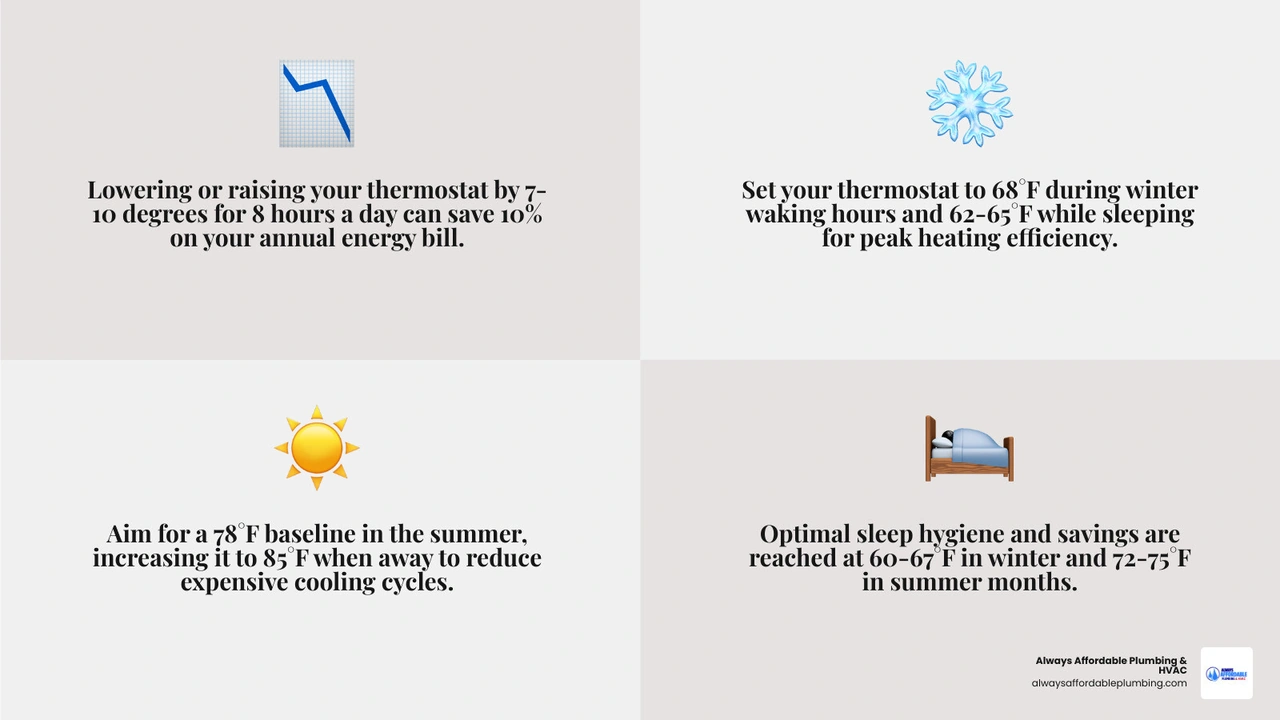
When the Tule fog rolls in and the temperatures drop, the magic number is 68°F while you are awake and at home. This might sound a bit brisk to some, but it is the gold standard for energy efficiency.
Why 68°F? For every degree you lower your thermostat in the winter, you can save roughly 1% to 3% on your heating bill. If you’re used to keeping the house at 72°F, dropping it to 68°F could shave nearly 10% off your monthly costs.
To stay comfortable at 68°F:
• Layer up: Grab those fuzzy slippers and a favorite sweater.
• Manage Humidity: Dry air feels colder. Maintaining indoor humidity between 30% and 50% helps the air retain heat and feels better on your skin.
• Utilize Sunlight: Open your curtains during the day to let the sun naturally warm your rooms, then close them at night to add a layer of insulation.
Sacramento summers are famous for triple-digit heatwaves. While it’s tempting to "crank" the AC down to 70°F, the Department of Energy recommends a setting of 78°F when you are home.
Each degree you set your thermostat above 72°F can save you up to 3% on your cooling costs. If 78°F feels too warm, don't worry—you can bridge the gap with ceiling fans. Ensure your fans are rotating counterclockwise in the summer to create a "wind chill" effect. This won't lower the room temperature, but it can make you feel up to 4 degrees cooler.
Another pro tip: avoid using heat-generating appliances like ovens, clothes dryers, or dishwashers during the hottest parts of the day. Save those chores for after 8:00 PM to keep your AC from fighting internal heat gains.
One of the most effective ways to save money is the "7-10 degree rule." By shifting your thermostat settings by 7 to 10 degrees for eight hours a day (usually while you’re at work or sleeping), you can save up to 10% a year on your utility bills.
• Constant Temperature (No Setbacks) — Estimated Annual Savings: 0% (Baseline)
• 7-Degree Setback for 8 Hours/Day — Estimated Annual Savings: ~7% Savings
• 10-Degree Setback for 8 Hours/Day — Estimated Annual Savings: ~10% Savings
There is a common myth that your HVAC system has to "work harder" to catch up after a setback, negating any savings. In reality, the system actually runs more efficiently when it’s recovering than it does when it’s cycling on and off constantly to maintain a static temperature. To learn more about how automation can handle this for you, read Can a Smart Thermostat Really Save Me Money.
Your body's core temperature naturally drops as you prepare for sleep. Because of this, a cooler room actually facilitates better rest. Most health experts and organizations like the WHO suggest a sleeping temperature between 60°F and 67°F.
In the winter, this is an easy win for your wallet. You can drop the heat significantly and rely on warm blankets. In the summer, keeping the house at 72–75°F at night is a good compromise. If the Sacramento Delta breeze kicks in, you might even be able to turn the AC off entirely and open the windows!
Leaving the AC or heater running at full blast while the house is empty is like leaving your car idling in the driveway. If you’ll be gone for more than four hours, use an 8-degree shift:
• Summer Away: Set to 85°F. This keeps the house from becoming an oven and prevents mold growth by ensuring the AC still runs occasionally to dehumidify the air.
• Winter Away: Set to 55–60°F. This is high enough to prevent pipes from freezing—a real risk in unconditioned spaces like garages or crawlspaces during a cold snap in Folsom or Citrus Heights.
While the general rules work for most, certain members of your household—whether they have two legs, four legs, or leaves—might have specific needs.
Most common household pets like cats and dogs have a comfort range similar to humans, typically between 64°F and 78°F. However, if you have tropical amphibians, reptiles, or specific bird breeds, they may require more consistent warmth.
Houseplants are also sensitive. Most thrive between 60°F and 75°F. If the temperature drops below 50°F, many tropical plants (like Monsteras or Pothos) will stop growing or suffer damage. Keep your plants away from direct drafts or heater vents to prevent "temperature shock." For residents in Folsom, ensuring your system is properly reading the room is vital; learn more about Thermostat Calibration Folsom CA.
Vulnerable populations require a narrower temperature window for safety:
• Infants: A baby's room should ideally be between 68°F and 72°F. Infants only begin to effectively regulate their own body temperature at around 11 weeks of age. Keeping the room in this range helps reduce the risk of SIDS and ensures they don't overheat.
• Seniors: For the elderly or those with circulatory issues, the National Library of Medicine recommends keeping indoor temperatures above 64.4°F to protect against cold-related health effects.
The best thermostat settings won't help if the device itself is giving false readings.
Thermostat Placement Matters:
• Interior Walls: Always install your thermostat on an interior wall near the center of the house.
• Avoid Sunlight: Keep it away from direct sunlight, which can trick the sensor into thinking the house is warmer than it is.
• Keep it Clear: Don't place it near kitchens (where ovens create heat) or drafty windows and doors.
If your home in Elk Grove or Rancho Cordova uses a heat pump, your strategy needs to be a bit different in the winter. Heat pumps are incredibly efficient, but they often have "emergency" or "auxiliary" heat strips that kick in if you raise the temperature too quickly (usually by more than 2 degrees at once).
To save money with a heat pump, avoid large manual jumps. Instead of bumping the heat from 60°F to 68°F at once, use a smart thermostat that can gradually ramp up the temperature without triggering the expensive electric backup heat.
Your thermostat is only one part of the comfort equation. To ensure your system doesn't have to work overtime:
1. Change Filters: Check your air filters every 30 to 90 days. A dirty filter restricts airflow and forces the blower motor to work harder.
2. Seal the Envelope: Use weatherstripping around doors and caulk around windows to stop drafts.
3. Check Insulation: Ensure your attic has adequate insulation. In many older Sacramento homes, heat literally "blows through the roof" because of thin attic padding.
4. Professional Tune-Ups: An annual HVAC inspection can identify efficiency losses of up to 10% caused by dirt buildup or mechanical wear.
While "expensive" is relative, 72°F is significantly more costly than the recommended 68°F. Every degree above 68°F can increase your heating costs by 1% to 3%. If you prefer 72°F, try using localized heating (like a safe space heater in just one room) or layering clothes to offset the cost.
In our region, it’s usually better to use a setback (7-10 degrees) rather than turning the system off entirely. In the summer, turning the AC off can allow humidity to build up, potentially leading to mold or making it nearly impossible for the system to cool the house back down before bedtime.
If your thermostat is in a "hot spot" (like near a sunny window), it will run the AC constantly, even if the rest of the house is freezing. If it’s in a "cold spot" (like a drafty hallway), it will keep the heater running unnecessarily. Proper placement ensures the system runs only when it actually needs to.
The "Thermostat Tug of War" doesn't have to be a daily struggle in your home. By following the 68°F/78°F rule and utilizing smart setbacks, you can maintain a comfortable environment while keeping your utility bills under control.
At Always Affordable Plumbing & HVAC, we take pride in helping our neighbors in Sacramento, Elk Grove, Roseville, Folsom, and throughout the region achieve peak home efficiency. Whether you need a smart thermostat installation, a seasonal HVAC tune-up, or help troubleshooting a system that just won't reach the right temperature, our licensed technicians are here to provide transparent and affordable solutions.
Don't let a poorly tuned system or an outdated thermostat drain your bank account. Schedule your HVAC maintenance with Always Affordable Plumbing & HVAC today and start saving!
See what our satisfied customers have to say about their experience with Always Affordable
Plumbing & HVAC.

"Chappy was very skilled in his knowledge of my HVAC unit. I greatly appreciate the quick response and experienced tech. The whole endeavor was made less stressful by his humor and honest conversation. I find comfort in knowing I now have a shop i trust for the next time."
"Tony, James, Ronnie did an amazing job setting up our new AC! They were quick, efficient, considerate, and polite! We appreciate them scheduling us in on such short notice. Definitely recommend this company!"
"Prompt, professional service with kindness and care. They came out to address both plumbing and AC issues. I received a courtesy call before they arrived. All issues were resolved the same day with integrity and respect. Thankful for businesses like this. Absolutely recommend to those that I love."
"Excellent service! Jason came out promptly and in addition to doing my outside faucet he also put in new irrigation equipment! All done perfectly! Jason was lovely"
"Honest with the assessment; friendly and good manners. No high pressure sales. Just good to honest "tell it like you see it" Thought my kitchen disposer needed an overhaul. But Jason, there Plumber gave me an honest lesson on what was really happening. Saved me hundreds, if I went the route of replacing. Thank you!"
"Absolutely 5 stars. If you are looking for affordable ,professional and kind. Chappy was excellent and very knowledgeable . I called in the morning because my air conditioner stopped working he was here within hours and fixed my air with a smile. I highly recommend Chappy and Always Affordable plumbing and Hvac."
"Scott and James were great. They got there quickly and diagnosed the problem with my A/C.They did a very thorough job testing everything. Sent me pictures and called to keep me informed. Got it done the next day and everything is working fine. Be glad when I get home so I can enjoy my new system. Thanks guys for a great job."
"Chappy was very helpful. He knew our issue right away, cleaned our coils. He also came on the same day we called and got our AC blowing cold air again."
"After some timing ’curfuffles’ the Tech Jason arrived and not only completed a speedy install on my toilet, he was personable & professional. Because of the timing issues Jason was attentive and showed up with everything needed! No extra store runs 😊 I was very comfortable with having this Tech in my Daughter’s home. We will definitely use this Service again."