
Why Your AC Runs Constantly: Understanding Heat Transfer Degradation and Cooling Cycles
Why is your AC running constantly? We explain heat transfer degradation. Use our local service expertise and area tips to decide when to call a pro on this.



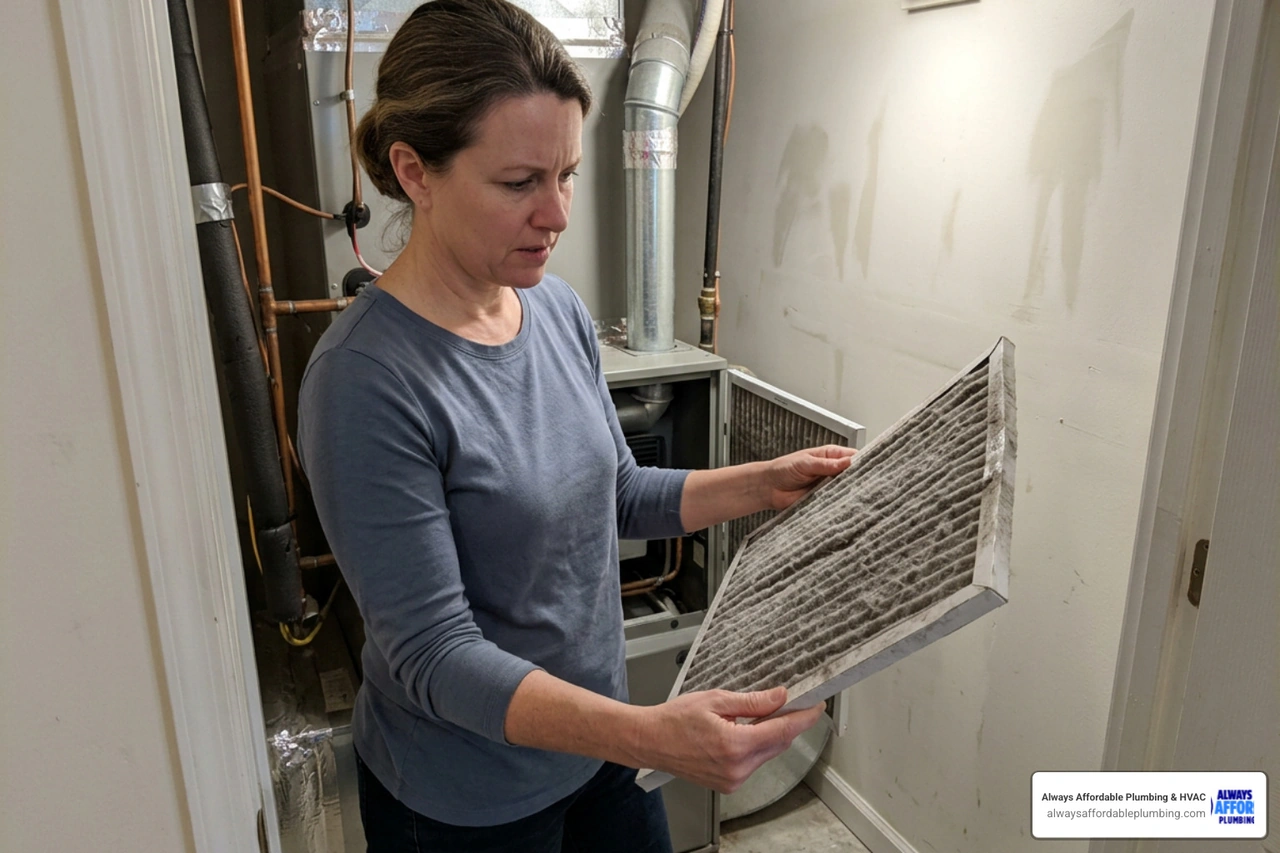
Knowing when to change your HVAC air filter is one of the simplest things you can do to protect your heating and cooling system — and most homeowners either forget about it or guess at the timing. Here's a quick answer based on filter type:
• 1-inch fiberglass — Recommended Replacement Interval: Every 30 days
• 1-inch pleated — Recommended Replacement Interval: Every 30–90 days
• 4-inch media filter — Recommended Replacement Interval: Every 6–12 months
• Any filter (with pets) — Recommended Replacement Interval: Every 20–60 days
• Any filter (with allergies/asthma) — Recommended Replacement Interval: Every 20–45 days
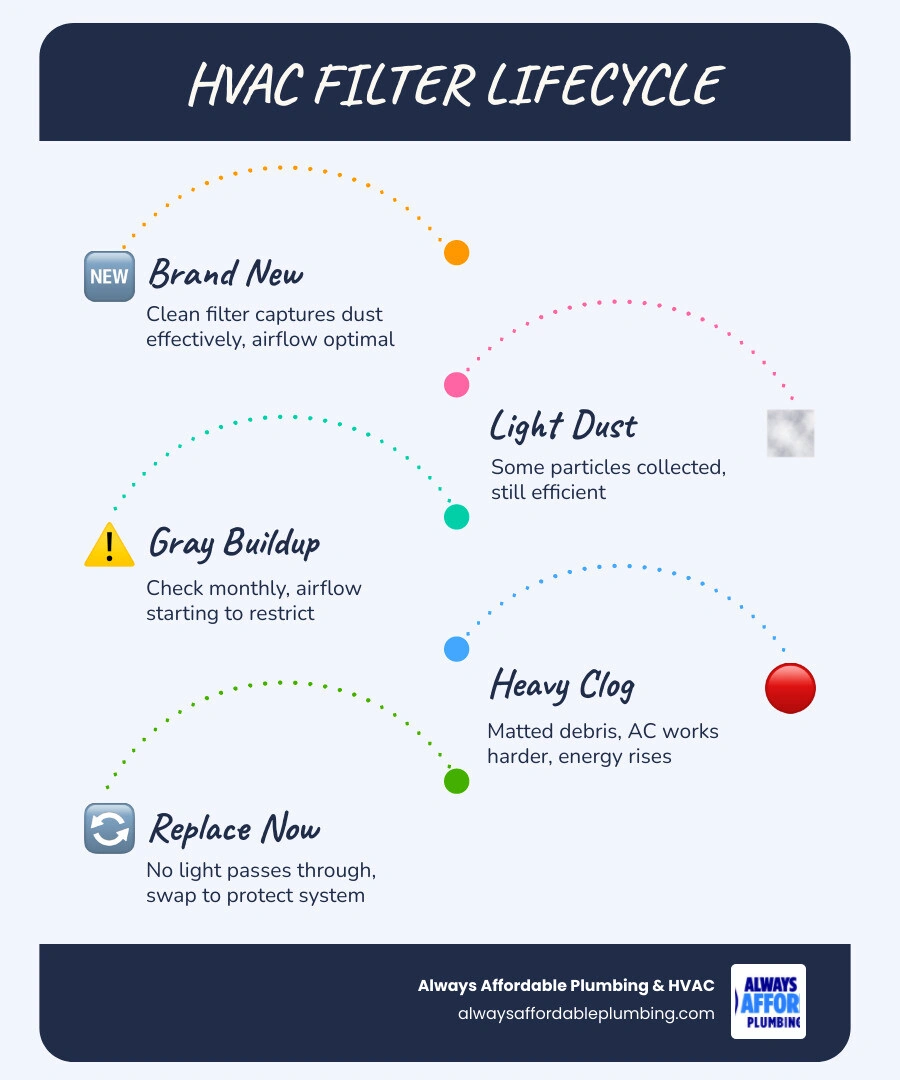
Bottom line: Check your filter every 30 days. If it looks gray, matted, or you can't see light through it when held up to a lamp, it's time to replace it.
Most homeowners don't think about their HVAC filter until something goes wrong — the air feels stuffy, rooms won't cool down evenly, or the energy bill jumps without explanation. In Sacramento, where summers push AC systems hard and wildfire smoke can spike airborne particles overnight, a clogged filter isn't just an inconvenience. It can quietly drive up your utility costs, wear out your equipment faster, and push pollutants back into the air your family breathes every day.
According to the U.S. Department of Energy, simply replacing a dirty filter can improve your system's energy efficiency by 5–15%. That's a meaningful difference — from a task that takes about five minutes.
This guide walks you through exactly when to change your HVAC air filter, what factors speed up that timeline, and how to spot the warning signs before your system pays the price.
Common when to change your hvac air filter vocab:
• benefits of regular furnace and ac tune ups
• how to maintain your heating and cooling system
While the general rule of thumb is to change your air filter every 90 days, this is merely a baseline. Think of it like the recommended oil change interval for your car: it is a safe starting point, but your actual driving habits, the weather, and the environment dictate when you actually need to pull into the shop.
For a standard household with no pets and moderate climate control usage, a high-quality pleated filter can easily last 90 days. However, during peak cooling seasons in Sacramento or the surrounding valley areas like Roseville and Elk Grove, your system runs significantly longer. This increased runtime means more air is cycled through the filter, accelerating the buildup of dust, dander, and fibers.
To prevent unexpected airflow issues, we recommend establishing a monthly check-in habit. Mark a recurring date on your calendar or set a smartphone reminder to pull the filter out and inspect it visually.
The baseline schedule varies dramatically depending on the specific type of filter installed in your system:
• 1-Inch Fiberglass Filters: These are the thin, green or blue translucent filters often sold in cheap multi-packs. They are designed to capture only the largest dust particles to protect the blower motor. Because they have very little surface area, they clog quickly and must be replaced every 30 days without exception.
• 1-Inch Pleated Filters: These filters feature folded fabric or paper media, which dramatically increases the surface area available to trap particles. They are highly effective at capturing smaller allergens like pollen and pet dander. These typically last between 30 and 90 days, depending on household activity.
• 4-Inch to 5-Inch Media Filters: Often installed in dedicated media cabinets next to the indoor air handler or furnace, these thick filters contain deep pleats. They offer massive surface area, allowing them to trap highly concentrated levels of dust without restricting airflow. These robust filters only need to be replaced every 6 to 12 months.
Understanding these differences is key to maintaining your system’s efficiency. If you are wondering how your specific setup influences this timeline, you can read our detailed guide on When to Replace Your Furnace or AC Filter to make sure you are not swapping your filters too early or leaving them in too long.
The physical dimensions of your filter and its MERV (Minimum Efficiency Reporting Value) rating play a massive role in when to change your hvac air filter.
MERV ratings range from 1 to 20, measuring how effectively a filter traps particles of various sizes. Most residential systems are designed to operate safely with filters rated between MERV 8 and MERV 13.
• MERV 8: Captures large particles like dust, pollen, dust mites, and lint. This is the standard baseline for most homes.
• MERV 11: Traps smaller particles, including pet dander, mold spores, and car exhaust fumes.
• MERV 13: Highly efficient; captures microscopic particles such as bacteria, virus carriers, and fine smoke particles (essential during Northern California’s wildfire seasons).
However, as a filter’s MERV rating increases, the weave of the filtration material becomes tighter. This tighter weave creates more resistance to airflow, which is referred to in the HVAC industry as "pressure drop." If you install a high-MERV 1-inch filter in a system that isn't designed to handle the resistance, it can restrict airflow even when completely clean, mimicking the exact symptoms of a clogged filter.
This is where filter thickness becomes a game-changer. A 4-inch deep pleated media filter has significantly more surface area than a standard 1-inch filter. Because the air has a much larger surface to pass through, a 4-inch MERV 11 or MERV 13 filter allows excellent airflow while providing superior filtration, lasting up to four times longer than its 1-inch counterpart.
• 1-Inch — MERV Rating: MERV 1–4 (Fiberglass) — Recommended Replacement Interval: 30 Days — Best Use Case: Basic motor protection; low-occupancy homes
• 1-Inch — MERV Rating: MERV 8 (Pleated) — Recommended Replacement Interval: 60–90 Days — Best Use Case: Standard homes; no pets; moderate dust control
• 1-Inch — MERV Rating: MERV 11–13 (High-Efficiency) — Recommended Replacement Interval: 30–60 Days — Best Use Case: Homes with pets, mild allergies, or light smoke exposure
• 4-Inch — MERV Rating: MERV 8–11 (Media) — Recommended Replacement Interval: 6–9 Months — Best Use Case: High-traffic homes; superior dust and dander capture
• 4-Inch — MERV Rating: MERV 13–16 (Deep Pleated) — Recommended Replacement Interval: 9–12 Months — Best Use Case: Severe allergies; asthma; optimal wildfire smoke protection
No two homes in the Sacramento region are identical. A single occupant living in a clean, modern condo in Folsom will have a completely different filter lifecycle than a large family with multiple pets in a ranch home in Citrus Heights. Understanding the environmental and lifestyle variables under your roof will help you customize your replacement schedule.
Key variables that accelerate filter clogging include:
• Household Size and Activity: More people means more skin cells, hair, clothing lint, and tracked-in dirt circulating through the air. High-traffic households naturally load filters faster.
• Local Climate and Air Quality: Sacramento’s unique geography brings specific challenges. High pollen counts in the spring from local oak trees, agricultural dust in surrounding areas like Woodland and Davis, and regional wildfire smoke can overwhelm standard filters in a matter of weeks.
• System Runtime: During hot summer heatwaves when your AC runs 12 to 18 hours a day, the volume of air passing through the filter increases exponentially compared to the mild spring and fall months.
• Home Renovations or Construction: If you are remodeling a bathroom, sanding drywall, or live near a new housing development in Rancho Cordova, airborne construction dust will clog a new filter within days.
Keeping up with these environmental demands is a core part of home maintenance. To keep your system running smoothly year-round, check out our comprehensive options for HVAC Maintenance Sacramento CA to ensure your system is clean from the inside out.
We love our furry family members, but they are essentially walking, shedding pollution factories when it comes to indoor air quality. Dogs and cats constantly shed hair, dander (microscopic skin flakes), and outdoor debris that they carry inside on their paws.
Pet dander is particularly troublesome because it is lightweight and sticky. It easily bypasses cheap fiberglass filters, coating the internal components of your HVAC system, or quickly mats across the surface of a pleated filter, creating an airtight barrier.
If you have a single dog or cat, you should plan to inspect your filter every 30 days and replace it at least every 60 days. If you have multiple pets, or breeds that shed heavily (like Golden Retrievers or Huskies), your filter will likely need to be replaced every 20 to 45 days. Ignoring this can quickly lead to "dust bunnies" gathering around your return vents and a distinct, lingering pet odor whenever the system kicks on.
For household members dealing with asthma, severe seasonal allergies, or other respiratory conditions, the HVAC filter is the first line of defense against daily triggers. When outdoor pollen counts spike in the Sacramento Valley, or when winter weather keeps windows shut tight, indoor air pollutants become highly concentrated.
To maintain a healthy breathing environment, allergy and asthma sufferers should utilize high-efficiency pleated filters rated MERV 11 or MERV 13. These filters are capable of capturing microscopic irritants like mold spores, dust mite feces, and fine particulate matter.
Because these small particles pack tightly into the filter media, and because maintaining pristine air quality is vital for health, we recommend replacing filters every 20 to 45 days if anyone in the home is highly sensitive. Waiting the full 90 days can allow trapped allergens to accumulate to the point where they restrict airflow, or worse, begin to bypass the filter edges and blow back into your living spaces.
You do not always have to rely on the calendar to tell you when to change your hvac air filter. Your home and your heating and cooling system will drop clear hints when the airflow is suffering.
Here are five undeniable warning signs that it is time to swap your filter immediately:
1. The Light Test Failure: The most reliable DIY check is the light test. Remove your air filter and hold it up to a bright overhead light or a lamp. If the filter material looks dark, gray, and completely blocks the light from passing through the fibers, it is fully loaded with dust and needs to be replaced.
2. Visible Gray Accumulation: If the filter has a thick, fuzzy, or felt-like gray coating on the side facing the incoming air, it is long overdue for a change.
3. Increased Dust Around the Home: Have you noticed a thin layer of gray dust settling on your furniture just a day or two after deep cleaning? When a filter is full, it can no longer capture new particles, allowing dust to bypass the system and settle continuously throughout your rooms.
4. Musty or Smoky Odors on Startup: A dirty filter exposed to humidity and indoor moisture can host microbial growth. If you notice a stale, musty, or slightly burnt smell when your furnace or air conditioner first starts its cycle, the filter is likely the culprit.
5. Weak Airflow from Vents: Go stand under one of your supply registers while the system is running. If the breeze feels weak, or if some rooms are taking much longer to cool down or heat up than usual, a clogged filter is likely choking the system's airflow.
When airflow is restricted, your air conditioner has to work twice as hard to pull air through the system. This can lead to serious mechanical strain. To understand how this simple issue escalates into expensive repairs, read our expert breakdown on How Clogged Air Filters Damage AC.
It is easy to look at a dirty filter and think, "I'll get to it next weekend." But neglecting this simple chore can trigger a cascade of expensive mechanical failures inside your heating and cooling system.
When a filter becomes completely clogged, the blower motor must work significantly harder to pull air through the restricted media. This constant overwork increases your monthly electricity consumption, directly inflating your energy bills. Over time, the excess heat generated by the struggling motor can cause it to burn out entirely.
In the hot Sacramento summer, restricted airflow prevents warm indoor air from passing efficiently over your air conditioner’s cold evaporator coils. Without enough warm air to balance the temperature, the condensation on the coils will rapidly freeze, turning your indoor unit into a solid block of ice. This issue, known as a frozen evaporator coil, completely halts the cooling process and can cause liquid refrigerant to flood back into the compressor, potentially destroying the most expensive component of your AC system.
During the winter, restricted airflow causes the heat exchanger in your furnace to overheat. To protect itself from cracking or catching fire, the system will trigger its high-limit switch, causing it to shut down prematurely (a process known as short cycling). This constant starting and stopping places immense wear and tear on your equipment, dramatically shortening its overall lifespan.
Regular maintenance is the most effective way to prevent these catastrophic breakdowns. Discover how simple, professional checkups protect your investment by reading about the Benefits of Regular Furnace and AC Tune-Ups.
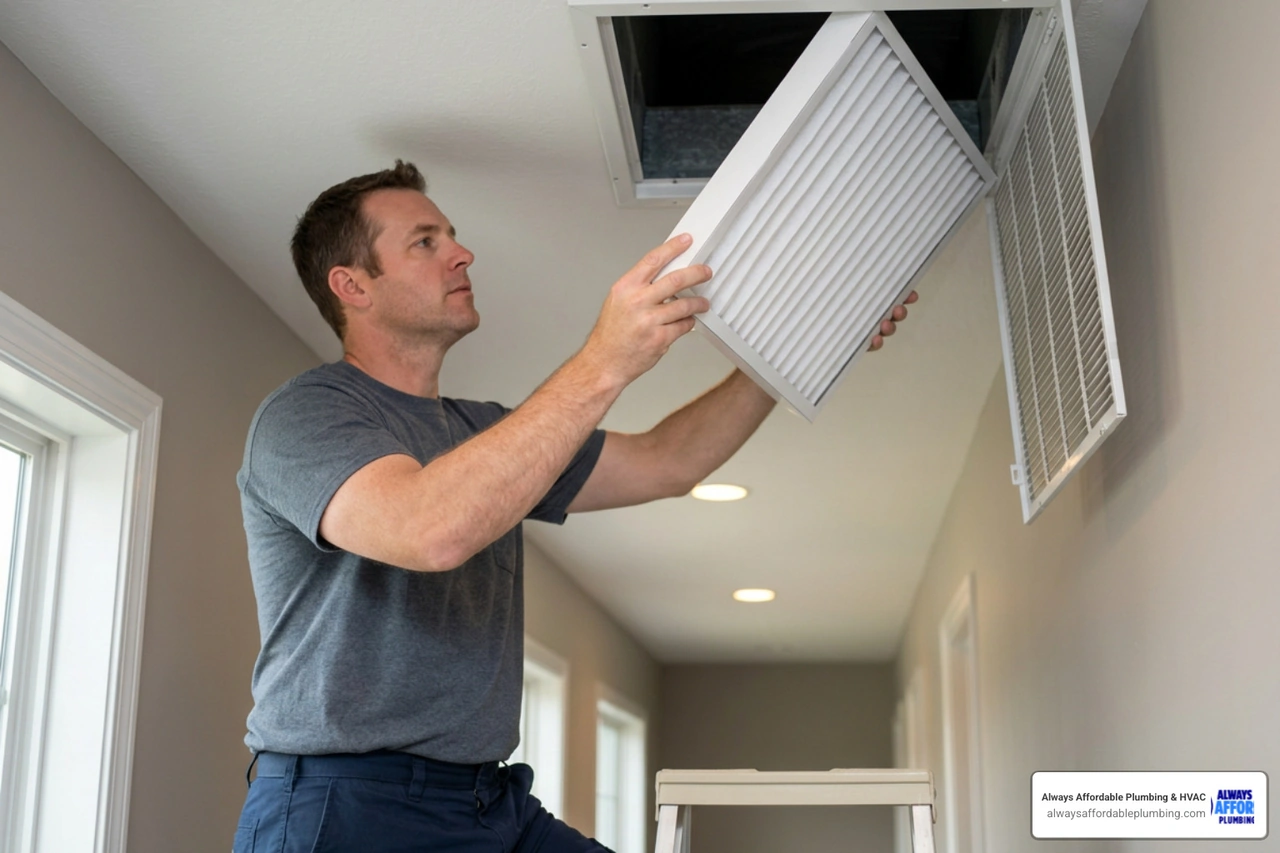
Changing your HVAC filter is a quick, straightforward task that any homeowner can master. Follow these steps to ensure a safe, clean, and perfect fit:
1. Turn Off the System: Never replace an air filter while the system is actively running. The powerful suction from the blower fan can pull loose dust, debris, or even the new filter itself directly into the fan cabinet. Switch your thermostat to the "Off" position before proceeding.
2. Locate the Filter: Your filter is typically located in one of two places: inside a dedicated slot on the return air duct right next to your indoor furnace/air handler, or behind a hinged return air grille on a wall or ceiling.
3. Note the Airflow Arrow: Before removing the old filter, look closely at its outer cardboard frame. You will see an arrow indicating the direction of the airflow. Your new filter must be installed with the arrow pointing in the exact same direction — toward the blower motor (away from the living space).
4. Remove and Inspect: Carefully slide the old filter out. If it is covered in loose dust, keep it flat to avoid spilling debris onto your floors.
5. Vacuum the Slot: Take a quick moment to run a vacuum hose attachment inside the filter slot or grille frame to remove any accumulated dust bunnies or pet hair.
6. Verify the Nominal Size: Check the dimensions printed on the side of your old filter (e.g., 20" x 25" x 1"). Ensure your replacement filter matches these exact dimensions. A filter that is too small will allow dirty air to bypass the filtration media entirely.
7. Install the New Filter: Slide the fresh filter into place, ensuring the airflow arrow points toward the unit. Make sure there are no gaps around the edges of the frame. If the fit is slightly loose, you can use a small strip of foam weatherstripping to create a tight seal.
8. Write the Date: Use a permanent marker to write the installation date directly on the exposed cardboard edge of the filter frame. This simple step eliminates all future guessing about when it was last changed.
9. Turn the Power Back On: Switch your thermostat back to "Cool" or "Heat" and listen for a smooth, unrestricted airflow.
For a complete strategy on keeping your entire home comfort system in top-tier shape, read our HVAC Maintenance Plan Complete Guide to learn how to stay ahead of seasonal wear and tear.
Absolutely not. You should never run your heating and cooling system without a filter, even for a single day. The filter's primary job is to protect the sensitive internal components of your HVAC system — specifically the blower motor and the delicate fins of the evaporator coil.
Running the system without a filter allows heavy dust, hair, and pet dander to settle directly onto these wet, cold coils. This quickly creates a thick, sticky grime that insulates the coils, restricts heat transfer, and can lead to system freeze-ups, clogged drain lines, and major motor damage. A dirty filter is always better than no filter at all, but a clean filter is always the best choice.
Yes, if your system is not designed to handle the increased airflow resistance. Standard residential systems are engineered to handle a specific level of static pressure.
When you install a very thick or tightly woven high-MERV filter (such as a MERV 13 or higher in a standard 1-inch slot), it acts like a wall, severely restricting the amount of air the blower motor can pull. This forces the motor to run hotter and work harder, which can lead to premature motor failure, frozen coils, and short cycling. Always check your system's manual or consult with a professional technician before upgrading to a high-efficiency filter to ensure your system can handle the pressure drop.
Sacramento's distinct seasons demand a flexible approach to filter maintenance:
• Spring (Pollen Season): Tree pollen, dust, and agricultural particles coat everything outdoors. You should check your filter monthly during this period, especially if you suffer from seasonal allergies.
• Summer (Heavy AC Use): With temperatures regularly climbing past 100 degrees in places like Roseville and Elk Grove, your air conditioner runs almost continuously. The sheer volume of air cycled through the system means filters clog twice as fast. Check your filter every 30 days.
• Fall (Wildfire and Dust Season): Late summer and autumn often bring wildfire smoke and dry, windy conditions. Fine particulate matter (PM2.5) from regional fires can quickly overload standard filters. During active smoke events, we recommend checking your filter weekly and replacing it immediately if it shows gray discoloration.
• Winter (Closed Windows): During the colder months, we keep our homes sealed tight, trapping indoor dander, dust, and fireplace soot inside. Check your filter every 60 days to keep your indoor air fresh and clean.
Knowing when to change your hvac air filter is one of the easiest, most cost-effective ways to protect your home’s comfort, lower your monthly utility bills, and ensure your family breathes clean, healthy air. By matching your replacement schedule to your specific filter type, household needs, and Sacramento's unique seasonal changes, you can avoid unexpected system breakdowns when you need your heating and cooling the most.
At Always Affordable Plumbing & HVAC, we are dedicated to keeping homes throughout Sacramento, Roseville, Folsom, Elk Grove, Davis, and the surrounding communities comfortable and efficient. Whether you need help selecting the perfect MERV-rated filter for your system, want to upgrade to a high-efficiency media filter cabinet, or are ready to schedule your annual system tune-up, our licensed technicians are here to help.
For year-round peace of mind and exclusive discounts, ask us about joining our Member's Club to stay ahead of all your heating, cooling, and plumbing maintenance needs.
Schedule your professional HVAC service today and let our friendly, local team ensure your home's system is operating at peak performance!
See what our satisfied customers have to say about their experience with Always Affordable
Plumbing & HVAC.

"Chappy was very skilled in his knowledge of my HVAC unit. I greatly appreciate the quick response and experienced tech. The whole endeavor was made less stressful by his humor and honest conversation. I find comfort in knowing I now have a shop i trust for the next time."
"Tony, James, Ronnie did an amazing job setting up our new AC! They were quick, efficient, considerate, and polite! We appreciate them scheduling us in on such short notice. Definitely recommend this company!"
"Prompt, professional service with kindness and care. They came out to address both plumbing and AC issues. I received a courtesy call before they arrived. All issues were resolved the same day with integrity and respect. Thankful for businesses like this. Absolutely recommend to those that I love."
"Excellent service! Jason came out promptly and in addition to doing my outside faucet he also put in new irrigation equipment! All done perfectly! Jason was lovely"
"Honest with the assessment; friendly and good manners. No high pressure sales. Just good to honest "tell it like you see it" Thought my kitchen disposer needed an overhaul. But Jason, there Plumber gave me an honest lesson on what was really happening. Saved me hundreds, if I went the route of replacing. Thank you!"
"Absolutely 5 stars. If you are looking for affordable ,professional and kind. Chappy was excellent and very knowledgeable . I called in the morning because my air conditioner stopped working he was here within hours and fixed my air with a smile. I highly recommend Chappy and Always Affordable plumbing and Hvac."
"Scott and James were great. They got there quickly and diagnosed the problem with my A/C.They did a very thorough job testing everything. Sent me pictures and called to keep me informed. Got it done the next day and everything is working fine. Be glad when I get home so I can enjoy my new system. Thanks guys for a great job."
"Chappy was very helpful. He knew our issue right away, cleaned our coils. He also came on the same day we called and got our AC blowing cold air again."
"After some timing ’curfuffles’ the Tech Jason arrived and not only completed a speedy install on my toilet, he was personable & professional. Because of the timing issues Jason was attentive and showed up with everything needed! No extra store runs 😊 I was very comfortable with having this Tech in my Daughter’s home. We will definitely use this Service again."


