
Why Your AC Runs Constantly: Understanding Heat Transfer Degradation and Cooling Cycles
Why is your AC running constantly? We explain heat transfer degradation. Use our local service expertise and area tips to decide when to call a pro on this.



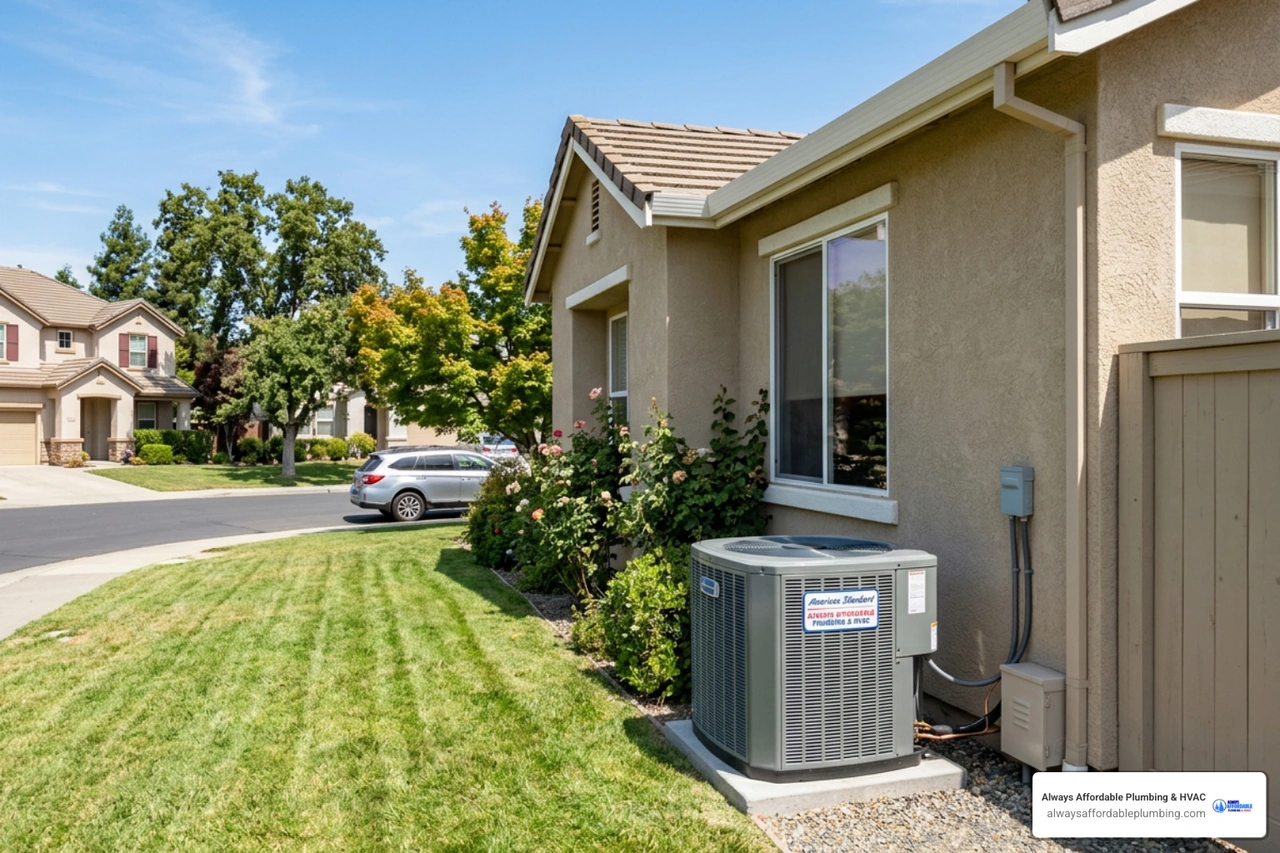
Getting the right size HVAC for the Sacramento area homes is the single biggest factor in whether your system keeps you comfortable, runs efficiently, and lasts 15 to 20 years — or drives up your energy bills and breaks down early.
Here is a quick-reference guide to HVAC sizing for Sacramento homes:
• Up to 700 — Recommended Capacity: 1.5 tons — BTUs/Hour: 18,000 BTU
• 700 - 1,400 — Recommended Capacity: 2 tons — BTUs/Hour: 24,000 BTU
• 1,400 - 1,800 — Recommended Capacity: 2.5 tons — BTUs/Hour: 30,000 BTU
• 1,800 - 2,100 — Recommended Capacity: 3 tons — BTUs/Hour: 36,000 BTU
• 2,100 - 2,400 — Recommended Capacity: 3.5 tons — BTUs/Hour: 42,000 BTU
• 2,400 - 3,000 — Recommended Capacity: 4 tons — BTUs/Hour: 48,000 BTU
• 3,000 - 3,500 — Recommended Capacity: 5 tons — BTUs/Hour: 60,000 BTU
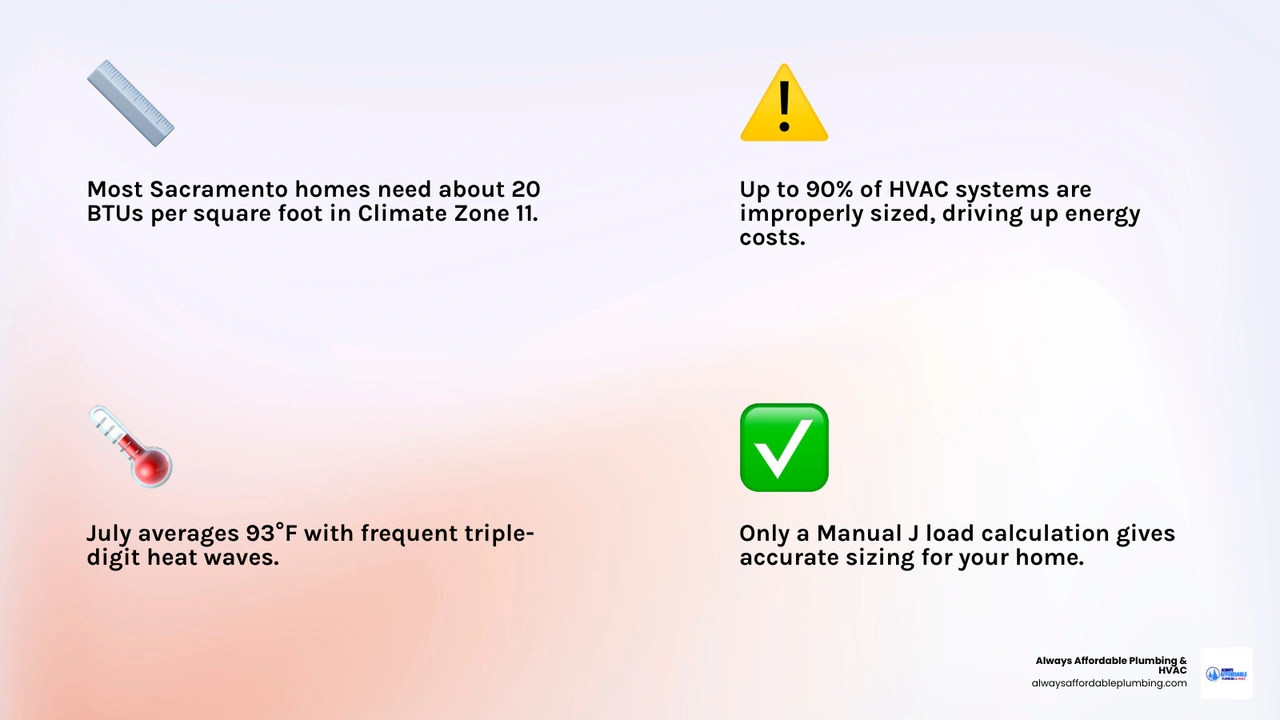
> Note: These are baseline estimates using Sacramento's Climate Zone 11 standard of approximately 20 BTUs per square foot. A professional Manual J load calculation is always required for accurate sizing — your actual needs depend on insulation, windows, ceiling height, sun exposure, and more.
Sacramento summers are no joke. July averages 93°F, and the valley regularly sees triple-digit heat waves pushing past 100°F. Standard sizing rules used in other parts of the country simply do not account for these conditions. Yet studies suggest that up to 90% of HVAC systems are improperly sized or installed — a problem that costs Sacramento homeowners real money every single summer.
Whether you are in Elk Grove, Folsom, Roseville, Rancho Cordova, or right in Sacramento, the guide below walks you through everything you need to know to make a confident, informed decision about your home's heating and cooling system.
Explore more about getting the right size hvac for the sacramento area homes:
• how hvac load calculations work
• how proper hvac sizing affects comfort and efficiency
When your old air conditioner starts blowing lukewarm air or making ominous clanking sounds, your first instinct might be to purchase the largest, most powerful replacement unit you can find. "More power means a cooler house, right?" Actually, no. In the HVAC industry, bigger is rarely better, and smaller is a recipe for a mid-August meltdown.
An improperly installed or incorrectly sized heating and cooling system is a massive financial liability. Industry data shows that up to 90% of HVAC systems are improperly sized or installed. To make matters worse, an improperly installed system can lose up to 30% of its operating efficiency before it even runs its first full season of triple-digit Sacramento heat.
Sizing isn't just about matching physical dimensions to a closet or an outdoor concrete pad; it's about matching the system's thermal capacity to the unique thermal appetite of your home. If you want to avoid premature system failure and skyrocketing utility bills, you have to know When to Upgrade Outdated AC Unit and ensure your new system is sized with scientific accuracy.
Installing an oversized heating and cooling system is one of the most common mistakes made in the Central Valley. Homeowners often assume that extra capacity acts as a safety net for those grueling 105°F afternoons in Citrus Heights or West Sacramento. In reality, an oversized system causes a host of operational issues:
• Short Cycling: A system that is too large will rapidly dump cold air into your home, satisfy the thermostat in 5 to 7 minutes, and shut off. A normal, healthy cooling cycle should last 10 to 15 minutes. Because the start of each cooling cycle uses the most electricity and places the highest stress on the compressor, frequent starting and stopping (short cycling) dramatically increases your energy bills and accelerates wear and tear.
• Poor Humidity Control: Air conditioning isn't just about lowering the temperature; it's about removing moisture from the air. To effectively dehumidify your home, air must pass over the cold evaporator coils for an extended period. Because oversized units turn off so quickly, they don't run long enough to pull humidity out of the air. This leaves your home feeling cold and clammy—which often prompts homeowners to lower the thermostat even further, wasting more energy.
• Uneven Temperatures: Because the system blasts air quickly and shuts down, the cooled air never has a chance to circulate evenly. You'll end up with freezing cold rooms near the air handler and stifling hot zones on the second floor or in rooms with west-facing windows.
• Shortened Equipment Lifespan: The constant starting and stopping of an oversized compressor is like driving a car in stop-and-go city traffic. It burns out components rapidly, turning a system designed to last 15 to 20 years into one that fails in under a decade.
On the flip side, an undersized system is equally frustrating and costly. If your system's capacity is too small for your home's heat load, you can expect:
• Continuous Running: On a typical 100°F afternoon in Roseville or Davis, an undersized system will run non-stop without ever reaching your target thermostat setting.
• Sky-High Energy Bills: Because the system never shuts off, your electricity meter will spin continuously. This constant operation can easily increase your monthly utility bills by hundreds of dollars.
• Accelerated Wear and Tear: HVAC components are designed to cycle on and off. Running a system continuously for 12 to 18 hours a day during peak summer months places extreme stress on the compressor and fan motors, leading to frequent breakdowns and premature system failure.
Historically, many contractors relied on lazy "rules of thumb" to size residential systems. You might hear a technician say, "Well, you have an 1,800-square-foot home in Rancho Cordova, so you need a 3-ton unit." While it's true that a 3-ton system (which moves 36,000 BTUs of heat out of your home every hour) is common for many 1,800-square-foot homes, relying solely on square footage is a dangerous gamble.
The only correct way to size an HVAC system is through an ACCA (Air Conditioning Contractors of America) Manual J load calculation. This is a highly detailed mathematical model that calculates your home's exact heat gain (how much heat enters the home in summer) and heat loss (how much heat escapes in winter). To learn more about this process, check out our guide on the Best HVAC Service Sizing a New AC Unit.
A true Manual J load calculation doesn't just look at the floor plan. It evaluates a complex web of structural and environmental factors:
• Insulation R-Values: A home built in the 1950s in Land Park with original fiberglass batts will have a much higher cooling load than a modern home built in Folsom with high-R-value spray foam insulation.
• Window Orientation and Type: Windows are thermal holes in your home's envelope. Large, single-pane, west-facing windows that bake in the afternoon sun will dramatically increase your cooling needs compared to double-pane, low-E windows shaded by mature valley oaks.
• Ceiling Height: Cooling is about volume, not just square footage. A living room with 12-foot vaulted ceilings contains far more air volume to cool than a standard 8-foot ceiling.
• Sun Exposure: A corner-lot home with zero shade will require a larger cooling capacity than an identical home nestled under a canopy of shade trees.
• Insulation Quality — Older Sacramento Home (Pre-1980): Poor (R-11 or lower in walls) — Modern Sacramento Home (Post-2015): Excellent (R-21+ walls, R-49+ attic)
• Window Type — Older Sacramento Home (Pre-1980): Single-pane wood/aluminum — Modern Sacramento Home (Post-2015): Double-pane, Low-E, vinyl-framed
• Ductwork Condition — Older Sacramento Home (Pre-1980): Often leaky, uninsulated, or undersized — Modern Sacramento Home (Post-2015): Sealed, insulated, and balanced
• Air Leakage — Older Sacramento Home (Pre-1980): High (drafty doors, outlets, and plates) — Modern Sacramento Home (Post-2015): Low (tightly sealed house envelope)
• Sizing Requirement — Older Sacramento Home (Pre-1980): Higher BTU capacity per square foot — Modern Sacramento Home (Post-2015): Lower BTU capacity per square foot
Sacramento sits in California's Climate Zone 11. This zone is characterized by intense, dry summer heat, wide daily temperature swings, and relatively mild winters.
Unlike coastal areas where a small 2-ton system can easily cool a large home, our inland valley geography acts as a heat trap. Our design temperature—the outdoor temperature that a system must be engineered to handle—is typically around 95°F to 98°F. However, we regularly experience extended heatwaves where temperatures hover between 100°F and 110°F.
Additionally, we benefit from the "Delta Breeze"—a cool marine air current that sweeps in from the Sacramento-San Joaquin River Delta in the late evening, dropping temperatures by up to 30 degrees. A properly sized system must be able to handle the peak daytime thermal load without short cycling during the milder, breezy evenings.
Once we establish your home's exact thermal load, the next step is selecting the right type of system and ensuring it meets local efficiency standards and environmental regulations.
One of the biggest decisions you'll make is choosing between a traditional central air system and a ductless mini-split system.
Central air systems rely on a single, powerful outdoor condenser and an indoor evaporator coil to push conditioned air through a network of ducts. Sizing these systems requires careful consideration of your ductwork's capacity. If you put a high-capacity 4-ton unit on a duct system built for 2.5 tons, it's like trying to breathe through a cocktail straw while running a marathon—the system will choke, freeze up, and fail prematurely.
Ductless mini-splits, on the other hand, use individual indoor air handlers mounted in specific zones or rooms. This allows for localized sizing. You can install a small 9,000 BTU unit in a guest bedroom and a larger 18,000 BTU unit in the main living area. This zoned approach is incredibly efficient because you only cool the rooms you are actively using. To explore the pros and cons of each setup, read our detailed comparison of Central Air vs Mini Split for the Sacramento Area Homes.
If you are planning an HVAC Replacement Sacramento CA, you must keep local regulations and utility programs in mind:
• SEER2 Efficiency Ratings: In California, all new residential split-system air conditioners must meet a minimum efficiency standard of 14.3 SEER2 (Seasonal Energy Efficiency Ratio 2). Opting for a higher rating, such as 16 or 18 SEER2, can significantly reduce your monthly energy bills, especially during our long, hot summers.
• SMUD Rebates: The Sacramento Municipal Utility District (SMUD) offers generous rebates of up to $3,000 for homeowners who transition from gas furnaces to high-efficiency electric heat pumps. However, to qualify for these rebates, the system must be sized properly and installed by a licensed contractor in the SMUD Contractor Network.
• Title 24 Compliance: California’s Title 24 Energy Code requires that any major HVAC installation or replacement include duct leakage testing (which must be verified by an independent HERS rater) and proper sizing documentation to ensure maximum energy conservation.
The most common signs of an improperly sized system include:
• Your system runs continuously on hot days but your home never reaches the set temperature (undersized).
• Your system turns on and off every few minutes, leaving the air feeling humid and clammy (oversized).
• You notice massive temperature swings between different rooms or floors in your home.
• Your utility bills are significantly higher than your neighbors' with similar-sized homes.
If you suspect your system is struggling, the first step is to schedule a professional inspection. Routine HVAC Maintenance Sacramento CA can help identify sizing and airflow bottlenecks before they lead to system failure. To keep your system running smoothly year-round, we highly recommend checking out our HVAC Service Plans, learning How Often Should You Service Your HVAC, and reviewing our Annual HVAC Maintenance Guide 2026.
A Manual J load calculation is the industry-standard method developed by the ACCA to determine the exact heating and cooling loads of a residential building. While it is not always mandatory for simple, like-for-like equipment swaps in every single municipality, California's Title 24 energy code heavily encourages it. For any major home remodel, addition, or new construction in areas like Roseville, a professional load calculation is legally required to secure a building permit. For a deeper look at local requirements, see our HVAC Installation Roseville CA Complete Guide.
Before signing any contract, look out for these red flags and best practices:
• Ask for the Math: A reputable contractor should always perform a Manual J calculation and be willing to show you the printed or digital report. If a technician simply looks at your old outdoor unit and writes down the same size on their quote, ask them to explain how they verified the size.
• Check Credentials: Ensure the company holds an active California C-20 Warm-Air Heating, Ventilating and Air-Conditioning license and employs NATE-certified technicians.
• Avoid Pressure Tactics: A trustworthy local company will focus on education and finding the right fit for your home, rather than pushing the most expensive, oversized unit on their truck. For more tips on finding a reliable service provider, read our guide on How to Choose the Best HVAC Company in Sacramento.
At the end of the day, getting the right size HVAC for the Sacramento area homes is about much more than just picking a model number out of a catalog. It is a precise science that requires a deep understanding of local microclimates, structural physics, and energy regulations.
When you invest in a system that is perfectly tailored to your home's unique footprint, you'll enjoy lower monthly utility bills, whisper-quiet operation, balanced humidity, and a system that will reliably protect your family from the intense Central Valley heat for decades to come.
At Always Affordable Plumbing & HVAC, we are proud to serve communities across Sacramento, Elk Grove, Roseville, Folsom, Rancho Cordova, Citrus Heights, and surrounding areas. Our highly trained, licensed, and NATE-certified technicians are ready to perform a precise, honest load calculation for your home. We never cut corners, and we never rely on lazy rules of thumb.
Don't leave your summer comfort to guesswork. Schedule your professional HVAC sizing consultation today and experience the peace of mind that comes with a perfectly sized home comfort system!
See what our satisfied customers have to say about their experience with Always Affordable
Plumbing & HVAC.

"Chappy was very skilled in his knowledge of my HVAC unit. I greatly appreciate the quick response and experienced tech. The whole endeavor was made less stressful by his humor and honest conversation. I find comfort in knowing I now have a shop i trust for the next time."
"Tony, James, Ronnie did an amazing job setting up our new AC! They were quick, efficient, considerate, and polite! We appreciate them scheduling us in on such short notice. Definitely recommend this company!"
"Prompt, professional service with kindness and care. They came out to address both plumbing and AC issues. I received a courtesy call before they arrived. All issues were resolved the same day with integrity and respect. Thankful for businesses like this. Absolutely recommend to those that I love."
"Excellent service! Jason came out promptly and in addition to doing my outside faucet he also put in new irrigation equipment! All done perfectly! Jason was lovely"
"Honest with the assessment; friendly and good manners. No high pressure sales. Just good to honest "tell it like you see it" Thought my kitchen disposer needed an overhaul. But Jason, there Plumber gave me an honest lesson on what was really happening. Saved me hundreds, if I went the route of replacing. Thank you!"
"Absolutely 5 stars. If you are looking for affordable ,professional and kind. Chappy was excellent and very knowledgeable . I called in the morning because my air conditioner stopped working he was here within hours and fixed my air with a smile. I highly recommend Chappy and Always Affordable plumbing and Hvac."
"Scott and James were great. They got there quickly and diagnosed the problem with my A/C.They did a very thorough job testing everything. Sent me pictures and called to keep me informed. Got it done the next day and everything is working fine. Be glad when I get home so I can enjoy my new system. Thanks guys for a great job."
"Chappy was very helpful. He knew our issue right away, cleaned our coils. He also came on the same day we called and got our AC blowing cold air again."
"After some timing ’curfuffles’ the Tech Jason arrived and not only completed a speedy install on my toilet, he was personable & professional. Because of the timing issues Jason was attentive and showed up with everything needed! No extra store runs 😊 I was very comfortable with having this Tech in my Daughter’s home. We will definitely use this Service again."


