
Why Your AC Runs Constantly: Understanding Heat Transfer Degradation and Cooling Cycles
Why is your AC running constantly? We explain heat transfer degradation. Use our local service expertise and area tips to decide when to call a pro on this.



How your HVAC affects indoor air quality is something most Sacramento homeowners never think about — until they're dealing with allergy flares, musty odors, or unexplained headaches that seem to disappear the moment they step outside.
Here's the quick answer:
Your HVAC system impacts indoor air quality in these key ways:
• Filtration — Air filters trap dust, pollen, pet dander, mold spores, and other particles every time air cycles through the system
• Ventilation — Your system can bring in fresh outdoor air and exhaust stale indoor air, diluting built-up pollutants
• Humidity control — HVAC equipment removes excess moisture in summer and can add it in winter, keeping levels in the healthy 30–50% range
• Circulation — Constantly moving air through the system means pollutants get captured rather than settling into your living spaces
• Maintenance state — A well-maintained system actively cleans your air; a neglected one can spread dust, mold, and contaminants throughout your home
According to the EPA, concentrations of some pollutants indoors are 2 to 5 times higher than outdoors — and Americans spend roughly 90% of their time indoors. That means the air your HVAC system manages every single day has a direct and measurable impact on how you feel, breathe, and sleep.
Your HVAC system is, in many ways, the lungs of your home. It cycles thousands of cubic feet of air every hour through filters, ducts, and living spaces. Whether it's removing allergens or recirculating them depends almost entirely on how the system is designed, used, and maintained.
In this guide, we'll walk through everything you need to know — from MERV ratings and humidity control to ductwork integrity and advanced IAQ upgrades — so you can make smart, evidence-based decisions for your home.
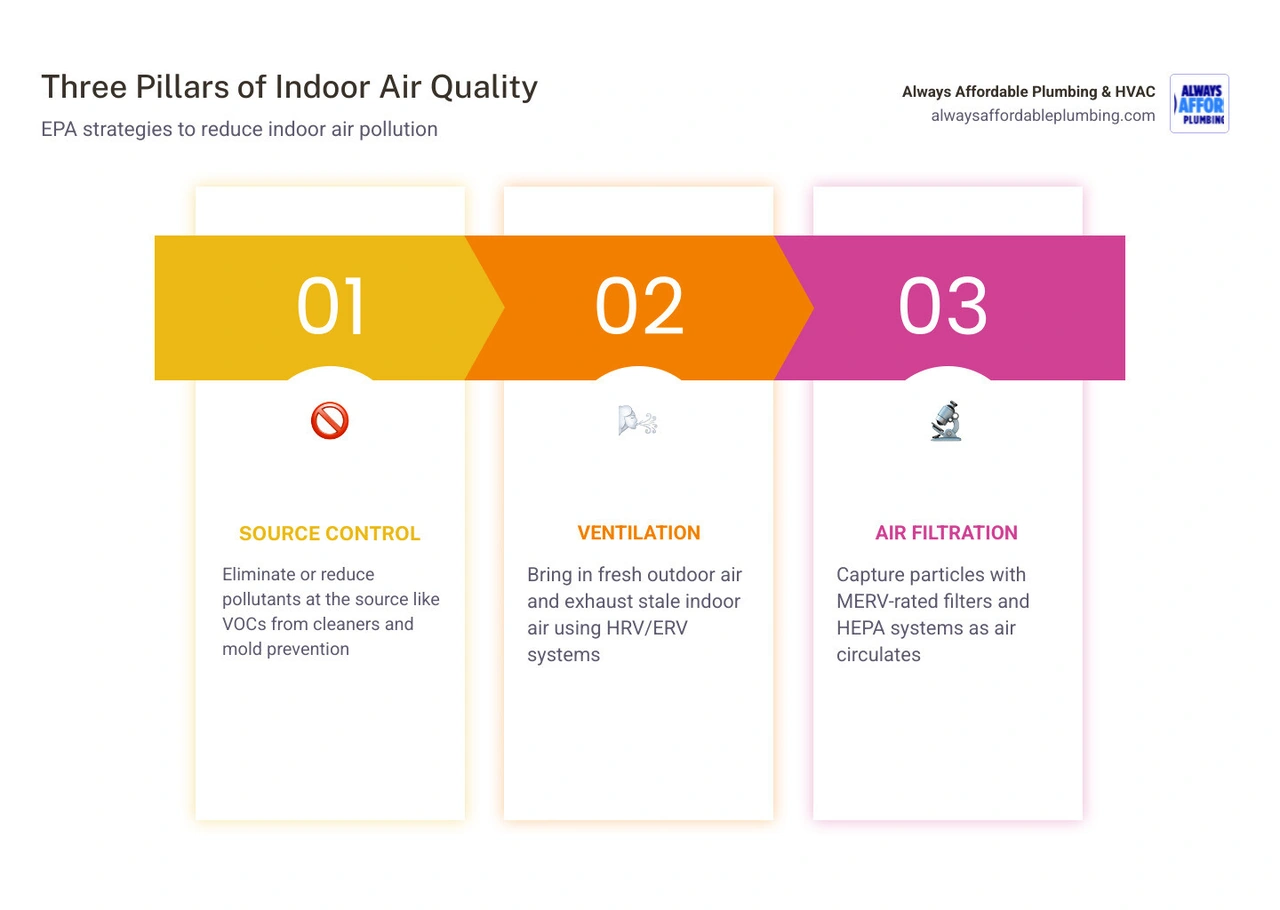
To understand how to keep your home's air clean, we have to look at the framework established by the Environmental Protection Agency (EPA). The EPA identifies three core strategies for reducing indoor air pollution: source control, improved ventilation, and air filtration.
Think of these as a three-legged stool. If you neglect any of them, your indoor air quality is bound to take a tumble.
The most effective and logical starting point for cleaner air is source control. This simply means finding what is polluting your air and removing it or sealing it off.
Common indoor air pollutants include volatile organic compounds (VOCs) from harsh household cleaners, chemical air fresheners, off-gassing carpets, and new furniture. Biological contaminants like mold spores, dust mites, and pet dander also fall into this category.
While your HVAC system works hard to filter the air, it shouldn't have to do all the heavy lifting. By switching to natural cleaning alternatives (like vinegar and baking soda), keeping your home free of indoor smoke, and storing paints or solvents in sealed containers outside, you stop pollution before it starts.
Of course, sometimes the pollution source comes from outside. In Northern California, wildfire season brings a heavy influx of smoke and fine particulate matter. When outdoor conditions deteriorate, understanding How Wildfire Smoke Affects Your Indoor Air Quality becomes critical to keeping your household safe.
The second pillar is ventilation. In the past, older homes were naturally "drafty," allowing fresh air to seep in through small gaps in windows and doors. While this was great for preventing stagnant air, it was terrible for energy efficiency. Modern homes built in the Sacramento area are tightly sealed to keep conditioned air inside. However, this airtight construction traps pollutants, carbon dioxide (CO2), and moisture inside.
This is where mechanical ventilation comes in. Most standard residential split systems do not actually bring fresh air indoors; they simply recirculate the air already inside your house. To achieve proper air exchange, homeowners should consider dedicated mechanical ventilation systems that comply with standard ASHRAE 62.2 (which outlines minimum fresh air requirements based on home size and occupancy).
Two advanced solutions for high-performance ventilation are:
• Heat Recovery Ventilators (HRVs): These systems exhaust stale indoor air while bringing in fresh outdoor air, transferring heat from the outgoing stream to the incoming stream to save energy. They are ideal for cooler, balanced climates.
• Energy Recovery Ventilators (ERVs): Similar to HRVs, ERVs transfer both heat and moisture. In hot, dry valleys or humid areas, an ERV helps keep outdoor humidity from entering your home during summer, and retains comfortable moisture levels in winter.
When outdoor conditions are clear, natural ventilation (opening windows) is fantastic. But when local air quality is compromised, mechanical ventilation with proper filtration is your best defense. You can keep an eye on regional trends by checking resources like the Folsom Air Quality guide to know when to seal your home and rely on mechanical fresh air exchange.
When pollutants are already floating around your living room, air filtration is your active shield. Every time your HVAC blower motor runs, it pulls air from your living spaces through a return duct, pushes it through a filter, and distributes it back to your rooms.
Air filters are rated using the MERV (Minimum Efficiency Reporting Value) scale, which ranges from 1 to 16 for residential systems:
• MERV 1 to 4: These are basic fiberglass filters. They are designed to protect your HVAC equipment from large dust bunnies, but they do virtually nothing to clean the air you breathe.
• MERV 8 to 11: These pleated filters are the sweet spot for most residential homes. They capture pollen, pet dander, dust mites, and mold spores.
• MERV 13: Highly recommended for allergy sufferers, asthmatics, and wildfire-prone areas. MERV 13 filters can trap bacteria, smoke, and virus-carrying droplets.
However, you cannot simply throw a MERV 13 or high-efficiency HEPA filter into any system. Denser filters restrict airflow, forcing your blower motor to work harder, which can increase utility bills and even damage your system if the static pressure is too high. Selecting the Best Air Filter for Your Home requires balancing filtration needs with your specific system's airflow capacity.
Your heating and cooling system is a powerful tool, but it is also a double-edged sword. Depending on how well it is designed, operated, and maintained, it can either be your home's ultimate air purifier or its primary source of pollution.
When operating optimally, your HVAC system does wonders for your indoor environment. First, it provides continuous air circulation. By cycling air 5 to 7 times a day, it prevents stagnant air pockets where CO2 and airborne pathogens gather.
Second, it controls relative humidity. Air conditioners naturally remove moisture from the air during the cooling process, which keeps your home dry enough to discourage mold growth and dust mite reproduction. When you combine this moisture control with high-efficiency filtration, you create an environment that supports healthy respiratory function. To keep these positive impacts working for you, utilizing professional HVAC Services ensures your system is properly sized, balanced, and running at peak performance.
On the flip side, a neglected HVAC system can actively degrade your air quality.
If you leave a filter in place for too long, it becomes clogged with dust and debris. This leads to "blow-by," a situation where air pressure forces dirty air to bypass the filter entirely, sending dust directly into your ductwork and living spaces.
Furthermore, moisture naturally condenses on your indoor evaporator coil during the cooling season. If this coil and the condensate drain pan are not cleaned regularly, they become prime breeding grounds for mold and bacteria. This can lead to "dirty sock syndrome," a musty odor caused by bacterial growth on the coils that gets blown into your home every time the system kicks on. Additionally, leaky ducts can pull in dirty air from your attic, crawlspace, or garage, distributing insulation fibers and pest droppings into your bedrooms.
Fortunately, learning How to Prevent HVAC Emergencies with Maintenance is the easiest way to avoid these nasty scenarios and keep your system working for your health, not against it.
Achieving truly healthy indoor air requires looking beyond basic air filters. We must control the invisible moisture in the air, ensure our distribution network is sealed, and consider advanced technologies that neutralize microscopic threats.
When it comes to indoor relative humidity, the EPA recommends keeping levels between 30% and 50%. If your home falls outside of this "Goldilocks Zone," you run into two distinct sets of problems:
• Too High (Above 55-60%): Excess moisture creates a paradise for mold, mildew, dust mites, and wood-boring insects. It can also cause paint to peel and hardwood floors to warp.
• Too Low (Below 30%): Dry air sucks moisture from your body, leading to dry skin, chapped lips, bloody noses, and irritated sinuses. It also allows viruses to float longer in the air and increases static electricity.
While standard air conditioners dehumidify as they cool, they may short-cycle (turn on and off too quickly) on mild, humid days, leaving your home feeling muggy. Installing a whole-house dehumidifier can solve this issue. Conversely, during dry winter months, a bypass humidifier installed on your furnace plenum can introduce gentle, controlled moisture to keep your respiratory passages comfortable.
Your ductwork is the highway system for your conditioned air. Unfortunately, the average home loses 20% to 30% of its air through leaks, loose connections, and poor seals in the ductwork.
When ducts leak, they do more than just waste energy. They create pressure imbalances that suck in unconditioned, dusty air from attics, crawlspaces, and walls. This air often contains fiberglass fibers, insulation dust, rodent droppings, and mold spores. Sealing your ducts with professional mastic or metal-backed tape keeps these contaminants out of your breathing zone.
Understanding these dynamics is especially important in hot, dry regions. Homeowners can read about the Benefits of Regular HVAC Maintenance in Hot Dry Valley areas to see how sealing ducts and maintaining system balance protects both their health and their wallets.
For homeowners who want to go above and beyond, several advanced accessories can be integrated directly into your HVAC system:
• UV-C Lights: These germicidal lamps are installed near the indoor evaporator coil. They use ultraviolet light to disrupt the DNA of biological contaminants, preventing mold from growing on the damp coils and disinfecting the passing airstream.
• Whole-House Air Purifiers: Systems like the Reme Halo use advanced oxidation technologies to neutralize viruses, bacteria, and odors in the air. When choosing any air purifier, always ensure it is certified ozone-free (certified by the California Air Resources Board) to avoid introducing harmful lung irritants into your home.
• IAQ Monitors: These smart devices continuously track PM2.5 (fine dust), CO2 levels, VOCs, and humidity. Some smart systems can even communicate with your thermostat to turn on the HVAC fan automatically when pollutant levels spike.
If you are deciding between a whole-house solution and portable air purifiers, here is how they compare:
• Coverage — Whole-House IAQ Systems: Entire home (every room connected to ductwork) — Portable Air Purifiers: Single room or localized area
• Aesthetics — Whole-House IAQ Systems: Invisible (installed inside ductwork or air handler) — Portable Air Purifiers: Takes up floor space, visible cords
• Noise — Whole-House IAQ Systems: Silent (uses existing HVAC blower) — Portable Air Purifiers: Can be noisy on high fan speeds
• Maintenance — Whole-House IAQ Systems: Low (replace filters/bulbs once or twice a year) — Portable Air Purifiers: High (frequent filter cleaning/replacements per unit)
• Overall Value — Whole-House IAQ Systems: Higher long-term value for complete home comfort — Portable Air Purifiers: Good for renters or targeting a single bedroom
You wouldn't drive your car 50,000 miles without an oil change and expect it to run perfectly. Your HVAC system is no different. Routine maintenance is the single most important factor in ensuring your heating and cooling system supports healthy air.
While major inspections should be left to licensed professionals, there are several simple tasks you can do yourself to keep your air clean:
1. Check your filters monthly: Inspect your air filter every 30 days. If it looks gray, dusty, or clogged, replace it immediately.
2. Keep vents clear: Ensure supply registers and return grilles are not blocked by furniture, rugs, or drapes. Keep at least 6 to 12 inches of clearance around them to maintain proper airflow.
3. Keep the outdoor unit clear: Trim back bushes, weeds, and debris at least two feet around your outdoor condenser to ensure proper heat transfer.
4. Clean your indoor registers: Vacuum dust off your supply and return vents to prevent it from being pulled into the ductwork.
5. Pour vinegar down the condensate drain: Every three months, pour a cup of distilled white vinegar down your AC condensate drain line to prevent algae and mold from clogging the pipe.
For a complete breakdown of seasonal steps tailored to our region, check out our comprehensive HVAC Maintenance Guide Folsom to keep your heating and cooling equipment running efficiently year-round.
Yes, but with a few trade-offs. Setting your thermostat fan to "ON" instead of "AUTO" keeps the blower motor running constantly, providing continuous air filtration and preventing stagnant air. This is incredibly helpful for allergy sufferers during peak pollen seasons.
However, running the fan continuously will increase your electricity usage, cause your air filters to load up and clog two to three times faster, and place slightly more wear and tear on your blower motor. For most homes, running the fan on "AUTO" is sufficient, but switching to "ON" during high-allergen days or cleaning sessions is a great strategy.
The EPA states that routine duct cleaning has not been proven to prevent health problems. Your ducts do not need to be cleaned every year. However, duct cleaning is highly recommended if:
• There is visible, verified mold growth inside the hard-surface ducts or on other components of your HVAC system.
• Your ducts are infested with rodents or insects.
• Your registers are releasing visible dust or debris into your rooms due to a major renovation or construction project.
Instead of routine cleaning, focusing on high-quality filters and sealing duct leaks is usually a more effective way to protect your air.
Standard fiberglass and basic pleated filters cannot capture gaseous pollutants like VOCs, nor can they trap individual virus particles, which are too small.
To remove VOCs and odors, you need a filter containing activated carbon, which chemically adsorbs gases. To capture viruses, you need a MERV 13 filter or higher, which is dense enough to trap the larger respiratory droplets that carry viruses through the air.
Your HVAC system plays a massive role in shaping the health, safety, and comfort of your home. By understanding how your HVAC affects indoor air quality, keeping up with filter replacements, and investing in preventative maintenance, you can ensure your family breathes clean, fresh air through every season.
At Always Affordable Plumbing & HVAC, we are proud to serve Sacramento, Elk Grove, Roseville, Folsom, Rancho Cordova, Citrus Heights, and the surrounding communities. We believe in providing transparent, high-quality, and affordable solutions for your home's plumbing and HVAC needs.
If you want to take the guesswork out of home maintenance, consider joining our Member's Club for exclusive discounts, priority scheduling, and regular tune-ups. Whether you need a comprehensive indoor air quality assessment, a new system installation, or an emergency repair, our team of friendly, licensed technicians is here to help.
Ready to breathe easier? Explore our professional HVAC services today and let us help you build a healthier home!
See what our satisfied customers have to say about their experience with Always Affordable
Plumbing & HVAC.

"Chappy was very skilled in his knowledge of my HVAC unit. I greatly appreciate the quick response and experienced tech. The whole endeavor was made less stressful by his humor and honest conversation. I find comfort in knowing I now have a shop i trust for the next time."
"Tony, James, Ronnie did an amazing job setting up our new AC! They were quick, efficient, considerate, and polite! We appreciate them scheduling us in on such short notice. Definitely recommend this company!"
"Prompt, professional service with kindness and care. They came out to address both plumbing and AC issues. I received a courtesy call before they arrived. All issues were resolved the same day with integrity and respect. Thankful for businesses like this. Absolutely recommend to those that I love."
"Excellent service! Jason came out promptly and in addition to doing my outside faucet he also put in new irrigation equipment! All done perfectly! Jason was lovely"
"Honest with the assessment; friendly and good manners. No high pressure sales. Just good to honest "tell it like you see it" Thought my kitchen disposer needed an overhaul. But Jason, there Plumber gave me an honest lesson on what was really happening. Saved me hundreds, if I went the route of replacing. Thank you!"
"Absolutely 5 stars. If you are looking for affordable ,professional and kind. Chappy was excellent and very knowledgeable . I called in the morning because my air conditioner stopped working he was here within hours and fixed my air with a smile. I highly recommend Chappy and Always Affordable plumbing and Hvac."
"Scott and James were great. They got there quickly and diagnosed the problem with my A/C.They did a very thorough job testing everything. Sent me pictures and called to keep me informed. Got it done the next day and everything is working fine. Be glad when I get home so I can enjoy my new system. Thanks guys for a great job."
"Chappy was very helpful. He knew our issue right away, cleaned our coils. He also came on the same day we called and got our AC blowing cold air again."
"After some timing ’curfuffles’ the Tech Jason arrived and not only completed a speedy install on my toilet, he was personable & professional. Because of the timing issues Jason was attentive and showed up with everything needed! No extra store runs 😊 I was very comfortable with having this Tech in my Daughter’s home. We will definitely use this Service again."


